
|
시장보고서
상품코드
1892752
혈당 측정기 시장 기회, 성장요인, 업계 동향 분석 및 예측(2026-2035년)Glucometer Market Opportunity, Growth Drivers, Industry Trend Analysis, and Forecast 2026 - 2035 |
||||||

세계의 혈당 측정기 시장은 2025년에 340억 달러로 평가되었고, 2035년까지 연평균 복합 성장률(CAGR) 13%로 성장하여 1,137억 달러에 이를 것으로 예측됩니다.
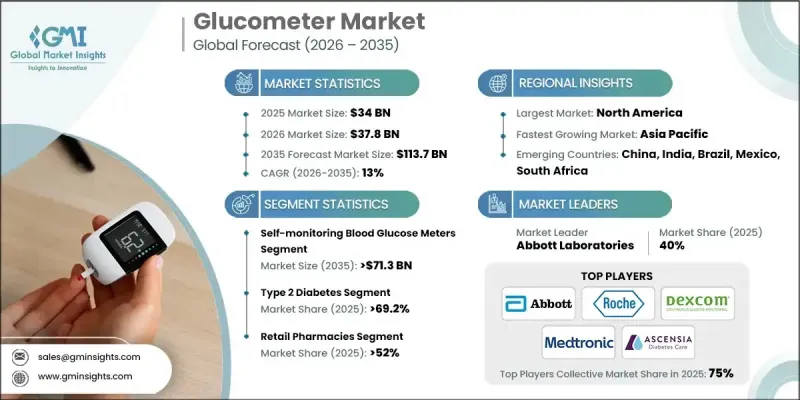
당뇨병 환자 증가와 효과적인 질병 관리에 있어 자가 혈당 측정(SMBG)의 중요성이 높아지는 것이 시장 확대 요인입니다. 전 세계 의료 시스템은 만성 질환, 고령화, 비용 효율적인 의료 서비스 제공의 필요성에 대한 압박에 직면해 있으며, 혈당 측정기는 환자 역량 강화와 임상 결과 개선에 필수적인 도구가 되고 있습니다. 현대의 혈당 측정기는 단순한 혈당 측정을 넘어 블루투스 연결, 모바일 앱 연동, 클라우드 기반 데이터 공유 등의 기능을 갖추고 있습니다. 이러한 발전은 실시간 모니터링, 원격 진료, 데이터에 기반한 의사결정을 통해 환자가 자신의 상태를 능동적으로 관리하고, 임상의가 개인화된 치료 전략을 효율적으로 수립할 수 있도록 함으로써 당뇨병 치료를 변화시키고 있습니다. 원격 의료 및 디지털 헬스 생태계와의 통합은 전 세계 환자 참여와 만성질환 관리 역량을 더욱 강화할 것입니다.
| 시장 범위 | |
|---|---|
| 개시 연도 | 2025년 |
| 예측 연도 | 2026-2035년 |
| 개시 연도 시장 규모 | 340억 달러 |
| 예측 금액 | 1,137억 달러 |
| CAGR | 13% |
자가 혈당 측정기 부문은 2025년 63.5%의 점유율을 차지했습니다. SMBG 장치는 환자의 재택 모니터링에 널리 사용되고 있으며, 잦은 병원 방문에 대한 의존도를 줄이고 더 나은 질병 관리를 위해 적시에 개입할 수 있도록 돕고 있습니다.
2형 당뇨병 부문은 2025년 69.2%의 점유율을 차지할 것으로 예상되며, 더 큰 성장이 예상됩니다. 전 세계적으로 2형 당뇨병의 부담이 계속 증가함에 따라 이 부문에서 혈당 측정기에 대한 수요가 지속적으로 증가하고 있습니다.
미국 혈당 측정기 시장은 2025년 130억 달러로 평가되었고, 이는 성숙한 기술 선진 시장을 반영합니다. 탄탄한 의료 인프라, 광범위한 보험 적용 범위, 높은 당뇨병 유병률, 원격 의료 및 원격 환자 모니터링을 포함한 디지털 건강 솔루션의 급속한 보급으로 인해 성장이 촉진되고 있습니다. 이러한 요인들로 인해 혈당 측정기가 일상적인 임상 진료와 재택 진료에 통합되는 속도가 빨라지고 있습니다.
자주 묻는 질문
목차
제1장 조사 방법과 범위
제2장 주요 요약
제3장 업계 인사이트
- 생태계 분석
- 공급업체 상황
- 밸류체인에 영향을 미치는 요인
- 업계에 대한 영향요인
- 성장 촉진요인
- 업계의 잠재적 리스크&과제
- 시장 기회
- 성장 가능성 분석
- 규제 상황
- 북미
- 유럽
- 아시아태평양
- 기술 동향
- 현재 기술 동향
- 신기술
- 향후 시장 동향
- 특허 분석
- Porter's Five Forces 분석
- PESTEL 분석
제4장 경쟁 구도
- 서론
- 기업의 시장 점유율 분석
- 세계
- 북미
- 유럽
- 기업 매트릭스 분석
- 주요 시장 기업의 경쟁 분석
- 경쟁 포지셔닝 매트릭스
- 주요 발전
- 인수합병(M&A)
- 제휴 및 협력 관계
- 신제품 발매
- 확대 계획
제5장 시장 추산 및 예측 : 제품 유형별, 2022-2035
- 주요 동향
- 자기 혈당 측정기
- 지속 혈당 모니터
제6장 시장 추산 및 예측 : 용도별, 2022-2035
- 주요 동향
- 1형 당뇨병
- 2형 당뇨병
- 임신성 당뇨
제7장 시장 추산 및 예측 : 유통 채널별, 2022-2035
- 주요 동향
- 병원 약국
- 소매 약국
- 온라인 판매
- 당뇨병 클리닉 및 센터
제8장 시장 추산 및 예측 : 지역별, 2022-2035
- 주요 동향
- 북미
- 미국
- 캐나다
- 유럽
- 독일
- 영국
- 프랑스
- 스페인
- 이탈리아
- 네덜란드
- 아시아태평양
- 중국
- 인도
- 일본
- 호주
- 한국
- 라틴아메리카
- 브라질
- 멕시코
- 아르헨티나
- 중동 및 아프리카
- 남아프리카공화국
- 사우디아라비아
- 아랍에미리트(UAE)
제9장 기업 개요
- Abbott Laboratories
- AgaMatrix
- All Medicus
- Arkray,
- Ascensia Diabetes Care Holdings
- B. Braun Melsungen
- Bionime Corporation
- DarioHealth Corporation
- Dexcom
- Essenlife Bioscience
- F. Hoffmann-La Roche
- LifeScan
- Medtronic
- Nova Biomedical
- Sinocare
The Global Glucometer Market was valued at USD 34 billion in 2025 and is estimated to grow at a CAGR of 13% to reach USD 113.7 billion by 2035.
The market is expanding due to the rising prevalence of diabetes and the increasing importance of self-monitoring of blood glucose (SMBG) for effective disease management. Healthcare systems worldwide are facing growing pressure from chronic illnesses, aging populations, and the need to deliver cost-efficient care, making glucometers a vital tool for patient empowerment and improved clinical outcomes. Modern glucometers are moving beyond simple glucose measurement, incorporating features such as Bluetooth connectivity, mobile app integration, and cloud-based data sharing. These advancements enable real-time monitoring, remote consultations, and data-driven decision-making, transforming diabetes care by allowing patients to actively manage their condition and clinicians to tailor personalized treatment strategies efficiently. Integration with telehealth and digital health ecosystems further strengthens patient engagement and chronic disease management capabilities globally.
| Market Scope | |
|---|---|
| Start Year | 2025 |
| Forecast Year | 2026-2035 |
| Start Value | $34 Billion |
| Forecast Value | $113.7 Billion |
| CAGR | 13% |
The self-monitoring blood glucose meters segment held a 63.5% share in 2025. SMBG devices remain widely used by patients for home-based monitoring, reducing dependency on frequent clinical visits and allowing timely interventions for better disease control.
The type 2 diabetes segment accounted for a 69.2% share in 2025 and is expected to grow further. The global burden of type 2 diabetes continues to increase, supporting sustained demand for glucometers in this segment.
U.S. Glucometer Market was valued at USD 13 billion in 2025, representing a mature and technologically advanced market. Growth is fueled by strong healthcare infrastructure, widespread insurance coverage, high diabetes prevalence, and rapid adoption of digital health solutions, including telehealth and remote patient monitoring. These factors accelerate the integration of glucometers into routine clinical practice and home-based care.
Key players in the Global Glucometer Market include Arkray, Bionime Corporation, Dexcom, DarioHealth Corporation, Nova Biomedical, Abbott Laboratories, All Medicus, Ascensia Diabetes Care Holdings, F. Hoffmann-La Roche, LifeScan, Medtronic, AgaMatrix, Essenlife Bioscience, B. Braun Melsungen, and Sinocare. Companies in the Global Glucometer Market are strengthening their presence through continuous innovation in device technology, such as integrating mobile connectivity, AI-driven analytics, and cloud platforms to enhance patient engagement and data accessibility. Strategic partnerships with healthcare providers and telehealth platforms help expand market reach and enable recurring usage. Firms are also investing in global distribution networks and after-sales support to improve accessibility and customer satisfaction.
Table of Contents
Chapter 1 Methodology and Scope
- 1.1 Market scope and definition
- 1.2 Research design
- 1.2.1 Research approach
- 1.2.2 Data collection methods
- 1.3 Data mining sources
- 1.3.1 Global
- 1.3.2 Regional/country
- 1.4 Base estimates and calculations
- 1.4.1 Base year calculation
- 1.4.2 Key trends for market estimation
- 1.5 Primary research and validation
- 1.5.1 Primary sources
- 1.6 Forecast model
- 1.7 Research assumptions and limitations
Chapter 2 Executive Summary
- 2.1 Industry 360° synopsis
- 2.2 Key market trends
- 2.2.1 Regional trends
- 2.2.2 Product type trends
- 2.2.3 Application trends
- 2.2.4 Distribution channel trends
- 2.3 CXO perspectives: Strategic imperatives
- 2.3.1 Key decision points for industry executives
- 2.3.2 Critical success factors for market players
- 2.4 Future outlook and strategic recommendations
Chapter 3 Industry Insights
- 3.1 Industry ecosystem analysis
- 3.1.1 Supplier landscape
- 3.1.2 Factors affecting the value chain
- 3.2 Industry impact forces
- 3.2.1 Growth drivers
- 3.2.1.1 Rising prevalence of diabetes worldwide
- 3.2.1.2 Technological advancements in glucometer
- 3.2.1.3 Rising demand for self-monitoring devices globally
- 3.2.1.4 Government initiatives for increasing awareness among people
- 3.2.2 Industry pitfalls and challenges
- 3.2.2.1 High cost of advanced devices and accessories
- 3.2.2.2 Lack of reimbursement and stringent regulations
- 3.2.3 Market opportunities
- 3.2.3.1 Integration of glucometers with digital health ecosystems
- 3.2.1 Growth drivers
- 3.3 Growth potential analysis
- 3.4 Regulatory landscape
- 3.4.1 North America
- 3.4.2 Europe
- 3.4.3 Asia Pacific
- 3.5 Technology landscape
- 3.5.1 Current technological trends
- 3.5.2 Emerging technologies
- 3.6 Future market trends
- 3.7 Patent analysis
- 3.8 Porter's analysis
- 3.9 PESTEL analysis
Chapter 4 Competitive Landscape, 2025
- 4.1 Introduction
- 4.2 Company market share analysis
- 4.2.1 Global
- 4.2.2 North America
- 4.2.3 Europe
- 4.3 Company matrix analysis
- 4.4 Competitive analysis of major market players
- 4.5 Competitive positioning matrix
- 4.6 Key developments
- 4.6.1 Merger and acquisition
- 4.6.2 Partnership and collaboration
- 4.6.3 New product launches
- 4.6.4 Expansion plans
Chapter 5 Market Estimates and Forecast, By Product Type, 2022 - 2035 ($ Mn)
- 5.1 Key trends
- 5.2 Self-monitoring blood glucose meters
- 5.3 Continuous glucose monitors
Chapter 6 Market Estimates and Forecast, By Application, 2022 - 2035 ($ Mn)
- 6.1 Key trends
- 6.2 Type 1 diabetes
- 6.3 Type 2 diabetes
- 6.4 Gestational diabetes
Chapter 7 Market Estimates and Forecast, By Distribution Channel, 2022 - 2035 ($ Mn)
- 7.1 Key trends
- 7.2 Hospital pharmacies
- 7.3 Retail pharmacies
- 7.4 Online sales
- 7.5 Diabetes clinics and centers
Chapter 8 Market Estimates and Forecast, By Region, 2022 - 2035 ($ Mn)
- 8.1 Key trends
- 8.2 North America
- 8.2.1 U.S.
- 8.2.2 Canada
- 8.3 Europe
- 8.3.1 Germany
- 8.3.2 UK
- 8.3.3 France
- 8.3.4 Spain
- 8.3.5 Italy
- 8.3.6 Netherlands
- 8.4 Asia Pacific
- 8.4.1 China
- 8.4.2 India
- 8.4.3 Japan
- 8.4.4 Australia
- 8.4.5 South Korea
- 8.5 Latin America
- 8.5.1 Brazil
- 8.5.2 Mexico
- 8.5.3 Argentina
- 8.6 Middle East and Africa
- 8.6.1 South Africa
- 8.6.2 Saudi Arabia
- 8.6.3 UAE
Chapter 9 Company Profiles
- 9.1 Abbott Laboratories
- 9.2 AgaMatrix
- 9.3 All Medicus
- 9.4 Arkray,
- 9.5 Ascensia Diabetes Care Holdings
- 9.6 B. Braun Melsungen
- 9.7 Bionime Corporation
- 9.8 DarioHealth Corporation
- 9.9 Dexcom
- 9.10 Essenlife Bioscience
- 9.11 F. Hoffmann-La Roche
- 9.12 LifeScan
- 9.13 Medtronic
- 9.14 Nova Biomedical
- 9.15 Sinocare