|
시장보고서
상품코드
1892770
심장 부정맥 모니터링 기기 시장 기회, 성장 촉진요인, 업계 동향 분석 및 예측(2026-2035년)Cardiac Arrhythmia Monitoring Devices Market Opportunity, Growth Drivers, Industry Trend Analysis, and Forecast 2026 - 2035 |
||||||

세계의 심장 부정맥 모니터링 기기 시장은 2025년 85억 달러로 평가되었으며, 2035년까지 연평균 복합 성장률(CAGR) 6.7%를 나타내 163억 달러에 이를 것으로 예측됩니다.
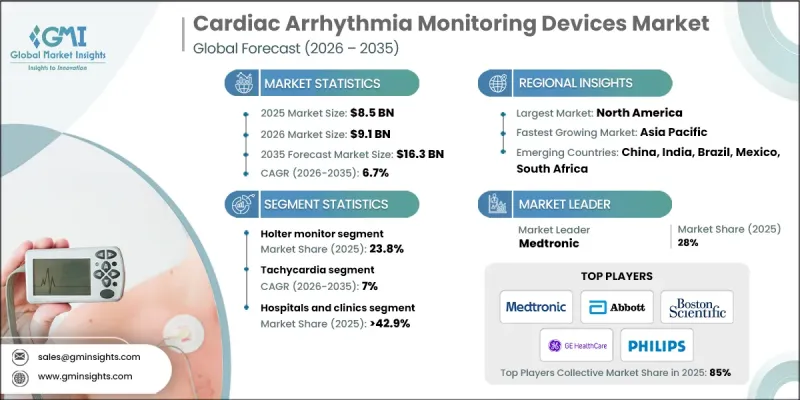
이 시장의 성장은 심혈관 질환의 유병률 상승과 조기 발견 및 지속적인 심박 리듬 모니터링에 대한 관심 증가로 인한 것입니다. 고령화 사회의 발전과 만성 심장 질환의 부담 증가에 따라 이러한 기기는 환자 결과 개선 및 입원 예방에 필수적인 도구가되었습니다. 부정맥 모니터링 솔루션은 실시간 모니터링, 적시 개입, 개인화 치료 전략을 가능하게 함으로써 심장 의료의 존재를 변화시키고 있습니다. 모바일 앱, 클라우드 플랫폼, 원격 의료 시스템과의 통합을 통해 임상의는 만성 질환을 더욱 효과적으로 관리할 수 있습니다. 이러한 기기는 특히 부정맥 위험이 높은 환자에게 중요하며, 정확한 진단을 제공하고 치료 판단을 지원함으로써 결국 심장 질환 관련 사망률을 감소시킵니다.
| 시장 범위 | |
|---|---|
| 시작 연도 | 2025년 |
| 예측 연도 | 2026-2035년 |
| 시작 가치 | 85억 달러 |
| 예측 금액 | 163억 달러 |
| CAGR | 6.7% |
홀터 모니터 부문은 2025년에 23.8%의 점유율을 차지했습니다. 홀터 모니터는 일상 활동 중 지속적인 심전도 추적에 오랫동안 사용되어 표준 심전도 검사에서 발견되지 않은 부정맥을 임상의가 발견하는 데 도움이되었습니다. 무선 연결, 컴팩트한 설계, 클라우드 기반 데이터 공유와 같은 혁신은 환자의 편의성과 접근성을 향상시켜 이 부문의 성장을 가속합니다.
빈맥 부문은 2025년부터 2035년까지 연평균 복합 성장률(CAGR) 7%를 나타낼 것으로 예측됩니다. 이 부문에는 심방 빈맥 및 심실 빈맥 모니터링 기기가 포함됩니다. 고도의 질병 모니터링 솔루션의 도입 증가가 수요를 견인하고 있으며, 특히 고령층이나 생활 습관병 관련의 리스크 요인을 가지는 개인에 있어서 심방 세동이나 심실 빈박의 증례 증가가 요인이 되고 있습니다. 지속적인 모니터링은 뇌졸중과 갑작스런 심정지와 같은 합병증 예방에 매우 중요합니다.
미국의 심장 부정맥 모니터링 기기 시장은 2025년 30억 달러로 평가되었습니다. 이 나라는 견고한 의료 인프라, 광범위한 보험 적용, 심혈관 질환 관리에 중점을 둔 노력에 힘입어 가장 진보적이고 성숙한 시장 중 하나입니다. 원격 의료, 원격 환자 모니터링, 통합 케어 모델을 포함한 디지털 건강 도입의 리더십은 임상 현장 및 재택 케어 환경에서 부정맥 모니터링 기기의 사용을 가속화하고 있습니다.
자주 묻는 질문
목차
제1장 조사 방법과 범위
제2장 주요 요약
제3장 업계 인사이트
- 생태계 분석
- 공급업체 현황
- 밸류체인에 영향을 주는 요인
- 업계에 미치는 영향요인
- 성장 촉진요인
- 세계적으로 증가하는 심혈관 질환 유병률과 심장 건강에의 지출
- 기술적 진보와 혁신적인 심전 리듬 감시 기기의 도입
- 모바일 및 텔레메트리식 심장 모니터의 채용 확대
- 고령화 인구의 확대와 비만 증가 경향
- 업계의 잠재적 위험 및 과제
- 숙련된 전문가의 부족
- 내장형 및 고급 모니터링 기기의 고비용
- 시장 기회
- 디지털 건강 생태계와의 통합
- 성장 촉진요인
- 성장 가능성 분석
- 규제 상황
- 북미
- 유럽
- 아시아태평양
- 기술 동향
- 현재 기술 동향
- 신흥 기술
- 향후 시장 동향
- 가격 분석
- 특허 분석
- Porter's Five Forces 분석
- PESTEL 분석
제4장 경쟁 구도
- 서론
- 기업의 시장 점유율 분석
- 세계
- 북미
- 유럽
- 기업 매트릭스 분석
- 주요 시장 기업의 경쟁 분석
- 경쟁 포지셔닝 매트릭스
- 주요 발전
- 인수합병
- 제휴 및 협력 관계
- 신제품 출시
- 확대 계획
제5장 시장 추계·예측 : 기기별(2021-2034년)
- 주요 동향
- 홀터 모니터
- 이벤트 레코더
- 이동형 심장 원격 측정 기기
- 이식형 심장 모니터
- 심전도(ECG) 모니터
- 기타 기기
제6장 시장 추계·예측 : 용도별(2021-2034년)
- 주요 동향
- 빈맥
- 심방빈맥
- 심실빈맥
- 서맥
- 조기수축
- 기타 용도
제7장 시장 추계·예측 : 최종 용도별(2021-2034년)
- 주요 동향
- 병원 및 진료소
- 진단센터
- 외래수술센터(ASC)
- 재택치료 환경
- 기타 최종 용도
제8장 시장 추계·예측 : 지역별(2021-2034년)
- 주요 동향
- 북미
- 미국
- 캐나다
- 유럽
- 독일
- 영국
- 프랑스
- 스페인
- 이탈리아
- 네덜란드
- 아시아태평양
- 중국
- 인도
- 일본
- 호주
- 한국
- 라틴아메리카
- 브라질
- 멕시코
- 아르헨티나
- 중동 및 아프리카
- 남아프리카
- 사우디아라비아
- 아랍에미리트(UAE)
제9장 기업 프로파일
- Abbott Laboratories
- AliveCor
- Applied Cardiac Systems
- Baxter International
- Biotronik
- Biotricity
- Boston Scientific
- FUKUDA DENSHI
- GE Healthcare
- iRhythm Technologies
- Koninklijke Philips
- Medtronic
- Mindray
- Nihon Kohden
- Spacelabs Healthcare
The Global Cardiac Arrhythmia Monitoring Devices Market was valued at USD 8.5 billion in 2025 and is estimated to grow at a CAGR of 6.7% to reach USD 16.3 billion by 2035.
The market is driven by the rising prevalence of cardiovascular disorders and a growing emphasis on early detection and continuous heart rhythm monitoring. With aging populations and the increasing burden of chronic cardiac conditions, these devices have become essential tools for improving patient outcomes and preventing hospitalizations. Cardiac arrhythmia monitoring solutions are reshaping cardiac care by enabling real-time monitoring, timely interventions, and personalized treatment strategies. Integration with mobile apps, cloud platforms, and telehealth systems allows clinicians to manage chronic conditions more effectively. These devices are especially important for patients at higher risk of arrhythmias, providing accurate diagnosis and aiding in treatment decisions, ultimately reducing mortality rates associated with cardiac disorders.
| Market Scope | |
|---|---|
| Start Year | 2025 |
| Forecast Year | 2026-2035 |
| Start Value | $8.5 Billion |
| Forecast Value | $16.3 Billion |
| CAGR | 6.7% |
The Holter monitor segment held a 23.8% share in 2025. Holter monitors have long been used for continuous ECG tracking during daily activities, helping clinicians detect arrhythmias that might not appear in standard ECG tests. Innovations such as wireless connectivity, compact designs, and cloud-based data sharing have improved patient convenience and accessibility, driving growth in this segment.
The tachycardia segment is expected to grow at a CAGR of 7% during 2025-2035. This segment includes atrial tachycardia and ventricular tachycardia monitoring devices. Rising adoption of advanced disease monitoring solutions is fueling demand, particularly due to increasing cases of atrial fibrillation and ventricular tachycardia among elderly populations and individuals with lifestyle-related risk factors. Continuous monitoring is critical for preventing complications such as stroke or sudden cardiac arrest.
U.S. Cardiac Arrhythmia Monitoring Devices Market was valued at USD 3 billion in 2025. The country remains one of the most advanced and mature markets, driven by strong healthcare infrastructure, extensive insurance coverage, and a focus on cardiovascular disease management. Leadership in digital health adoption, including telehealth, remote patient monitoring, and integrated care models, has accelerated the use of arrhythmia monitoring devices in clinical and home-care settings.
Key players in the Global Cardiac Arrhythmia Monitoring Devices Market include AliveCor, Biotricity, FUKUDA DENSHI, Boston Scientific, Medtronic, Applied Cardiac Systems, Nihon Kohden, Spacelabs Healthcare, Abbott Laboratories, GE Healthcare, Biotronik, Koninklijke Philips, Baxter International, iRhythm Technologies, and Mindray. Companies are strengthening their Cardiac Arrhythmia Monitoring Devices Market presence by investing in advanced technology integration, such as wireless connectivity, AI-assisted analytics, and cloud-based monitoring solutions. Strategic collaborations with healthcare providers and telehealth platforms expand market reach and ensure device adoption in both hospital and home settings. Continuous R&D for compact, user-friendly, and highly accurate devices enhances competitiveness. Firms are also focusing on regulatory compliance and certification to facilitate global market entry, while digital marketing and patient education campaigns help drive awareness and adoption of arrhythmia monitoring solutions worldwide.
Table of Contents
Chapter 1 Methodology and Scope
- 1.1 Market scope and definition
- 1.2 Research design
- 1.2.1 Research approach
- 1.2.2 Data collection methods
- 1.3 Data mining sources
- 1.3.1 Global
- 1.3.2 Regional/country
- 1.4 Base estimates and calculations
- 1.4.1 Base year calculation
- 1.4.2 Key trends for market estimation
- 1.5 Primary research and validation
- 1.5.1 Primary sources
- 1.6 Forecast model
- 1.7 Research assumptions and limitations
Chapter 2 Executive Summary
- 2.1 Industry 3600 synopsis
- 2.2 Key market trends
- 2.2.1 Regional trends
- 2.2.2 Device trends
- 2.2.3 Application trends
- 2.2.4 End use trends
- 2.3 CXO perspectives: Strategic imperatives
- 2.3.1 Key decision points for industry executives
- 2.3.2 Critical success factors for market players
- 2.4 Future outlook and strategic recommendations
Chapter 3 Industry Insights
- 3.1 Industry ecosystem analysis
- 3.1.1 Supplier landscape
- 3.1.2 Factors affecting the value chain
- 3.2 Industry impact forces
- 3.2.1 Growth drivers
- 3.2.1.1 Growing prevalence of cardiovascular diseases and expenditure on cardiac health globally
- 3.2.1.2 Technological advancements and introduction of innovative devices for cardiac rhythm monitoring
- 3.2.1.3 Increasing adoption of mobile and telemetry cardiac monitors
- 3.2.1.4 Expanding geriatric population base coupled with growing prevalence of obesity
- 3.2.2 Industry pitfalls and challenges
- 3.2.2.1 Lack of skilled professionals
- 3.2.2.2 High cost of implantable and advanced monitoring devices
- 3.2.3 Market opportunities
- 3.2.3.1 Integration of cardiac monitoring devices with digital health ecosystems
- 3.2.1 Growth drivers
- 3.3 Growth potential analysis
- 3.4 Regulatory landscape
- 3.4.1 North America
- 3.4.2 Europe
- 3.4.3 Asia Pacific
- 3.5 Technology landscape
- 3.5.1 Current technological trends
- 3.5.2 Emerging technologies
- 3.6 Future market trends
- 3.7 Pricing analysis
- 3.8 Patent analysis
- 3.9 Porter's analysis
- 3.10 PESTEL analysis
Chapter 4 Competitive Landscape, 2024
- 4.1 Introduction
- 4.2 Company market share analysis
- 4.2.1 Global
- 4.2.2 North America
- 4.2.3 Europe
- 4.3 Company matrix analysis
- 4.4 Competitive analysis of major market players
- 4.5 Competitive positioning matrix
- 4.6 Key developments
- 4.6.1 Merger and acquisition
- 4.6.2 Partnership and collaboration
- 4.6.3 New product launches
- 4.6.4 Expansion plans
Chapter 5 Market Estimates and Forecast, By Device Type, 2021 - 2034 ($ Mn)
- 5.1 Key trends
- 5.2 Holter monitor
- 5.3 Event recorder
- 5.4 Mobile cardiac telemetry
- 5.5 Implantable cardiac monitor
- 5.6 Electrocardiogram (ECG) monitor
- 5.7 Other devices
Chapter 6 Market Estimates and Forecast, By Application, 2021 - 2034 ($ Mn)
- 6.1 Key trends
- 6.2 Tachycardia
- 6.2.1 Atrial tachycardia
- 6.2.2 Ventricular tachycardia
- 6.3 Bradycardia
- 6.4 Premature contraction
- 6.5 Other applications
Chapter 7 Market Estimates and Forecast, By End Use, 2021 - 2034 ($ Mn)
- 7.1 Key trends
- 7.2 Hospitals and clinics
- 7.3 Diagnostic centers
- 7.4 Ambulatory surgical centers
- 7.5 Homecare settings
- 7.6 Other end use
Chapter 8 Market Estimates and Forecast, By Region, 2021 - 2034 ($ Mn)
- 8.1 Key trends
- 8.2 North America
- 8.2.1 U.S.
- 8.2.2 Canada
- 8.3 Europe
- 8.3.1 Germany
- 8.3.2 UK
- 8.3.3 France
- 8.3.4 Spain
- 8.3.5 Italy
- 8.3.6 Netherlands
- 8.4 Asia Pacific
- 8.4.1 China
- 8.4.2 India
- 8.4.3 Japan
- 8.4.4 Australia
- 8.4.5 South Korea
- 8.5 Latin America
- 8.5.1 Brazil
- 8.5.2 Mexico
- 8.5.3 Argentina
- 8.6 Middle East and Africa
- 8.6.1 South Africa
- 8.6.2 Saudi Arabia
- 8.6.3 UAE
Chapter 9 Company Profiles
- 9.1 Abbott Laboratories
- 9.2 AliveCor
- 9.3 Applied Cardiac Systems
- 9.4 Baxter International
- 9.5 Biotronik
- 9.6 Biotricity
- 9.7 Boston Scientific
- 9.8 FUKUDA DENSHI
- 9.9 GE Healthcare
- 9.10 iRhythm Technologies
- 9.11 Koninklijke Philips
- 9.12 Medtronic
- 9.13 Mindray
- 9.14 Nihon Kohden
- 9.15 Spacelabs Healthcare