

|
시장보고서
상품코드
1892779
미용 콘택트렌즈 시장 기회, 성장 촉진요인, 업계 동향 분석 및 예측(2026-2035년)Cosmetic Contact Lens Market Opportunity, Growth Drivers, Industry Trend Analysis, and Forecast 2026 - 2035 |
||||||

세계의 미용 콘택트렌즈 시장은 2025년에 15억 달러로 평가되었으며, 2035년까지 연평균 복합 성장률(CAGR) 7.1%를 나타내 29억 달러에 이를 것으로 예측됩니다.
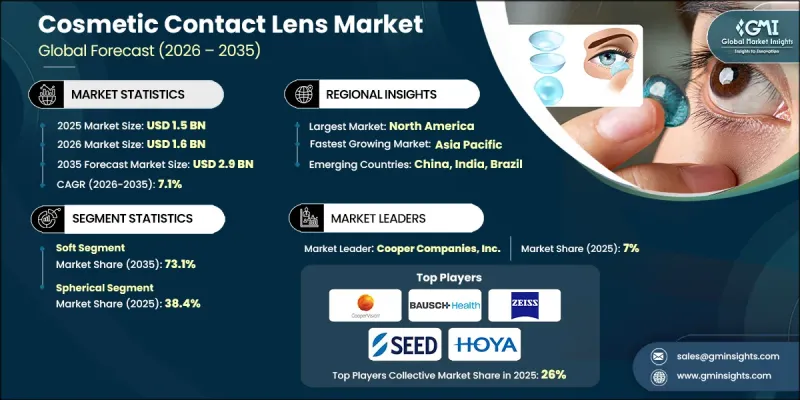
안전과 유통 관행에 대한 규제 당국의 주목도가 높아지고 있는 것이 이 시장을 크게 형성하고 있습니다. 세계 각국의 규제기관은 장식용 렌즈의 보다 안전한 사용을 보장하고 건강 위험을 최소화하기 위해 기준을 인상하고 있습니다. 소셜 미디어 플랫폼은 미용과 패션의 동향에 영향력 있는 거점이 되어, 인플루언서가 자기 표현의 툴로서 미용 렌즈를 소개했습니다. 소비자는 눈 색깔을 시험하고, 외모를 향상시키거나, 복장이나 특별한 기회에 맞추어 옷차림을 정돈하는 목적으로, 점점 렌즈를 이용하게 되어 있습니다. 영화, 뮤직 비디오, TV 프로그램에 미용 렌즈의 채용이 더욱 보급을 촉진하고, 소비자가 유명인이나 캐릭터의 외형을 재현하는 계기가 되고 있습니다. 패션 액세서리로서의 인지도 향상에 더해, 미적 및 기능적인 매력이 더해져, 시장은 계속해서 성장을 계속하고 있습니다.
| 시장 범위 | |
|---|---|
| 시작 연도 | 2025년 |
| 예측 연도 | 2026-2035년 |
| 시작 가치 | 15억 달러 |
| 예측 금액 | 29억 달러 |
| CAGR | 7.1% |
소프트 렌즈 부문은 2035년까지 7.1%라는 최고 CAGR을 나타낼 것으로 예측됩니다. 이것은 1일 일회용 렌즈에 대한 소비자의 기호의 높아짐과 미용 용도에 적합한 쾌적성에 중점을 둔 실리콘 하이드로겔 소재의 채용이 촉진요인이 되고 있습니다.
구면 렌즈 부문은 2025년에 38.4%의 점유율을 차지했으며 시장 규모는 6억 달러였습니다. 이 부문이 주류인 이유는 비교정용 미용 렌즈의 대부분이 심플한 구면 설계이며, 저도수 또는 평탄한 심미 제품에 최적이기 때문입니다.
북미의 미용 콘택트렌즈 시장은 2024년 36.9%의 점유율을 차지했으며, 5억 달러 시장 규모를 창출했습니다. 시장을 견인하고 있는 것은 가처분 소득이 높은 소비자층의 기반, 일일 일회용 유형의 조기 도입, 안과 의료 전문가를 통한 견고한 유통망입니다. 미용 렌즈가 라이프 스타일이나 패션 액세서리로 받아들여지는 경향이 강해지고 있는 것에 더해, 엄격한 규제 준수가, 이 지역에서의 프리미엄 제품의 채용을 한층 더 추진하고 있습니다.
자주 묻는 질문
목차
제1장 조사 방법과 범위
제2장 주요 요약
제3장 업계 인사이트
- 생태계 분석
- 공급업체 현황
- 이익률
- 각 단계별 부가가치
- 밸류체인에 영향을 주는 요인
- 업계에 미치는 영향요인
- 성장 촉진요인
- 처방전 판매에 관한 세계의 규제 집행
- 1일 일회용 렌즈와 실리콘 하이드로 카본 소재의 대두
- 소셜 미디어와 인플루언서 마케팅
- 업계의 잠재적 위험 및 과제
- 프리미엄 데일리/실리콘 하이드로 렌즈의 고비용
- 위조품·규제 대상외 제품에 의한 건강 리스크
- 기회
- AR/가상 시착 기술의 통합
- 교정용과 미용용을 겸한 렌즈의 발매
- 성장 촉진요인
- 성장 가능성 분석
- 향후 시장 동향
- 기술 및 혁신 현황
- 현재 기술 동향
- 신흥 기술
- 가격 동향
- 지역별
- 유형별
- 규제 상황
- 규격 및 컴플라이언스 요건
- 지역별 규제 프레임워크
- 인증기준
- Porter's Five Forces 분석
- PESTEL 분석
제4장 경쟁 구도
- 서론
- 기업의 시장 점유율 분석
- 지역별
- 기업 매트릭스 분석
- 주요 시장 기업의 경쟁 분석
- 경쟁 포지셔닝 매트릭스
- 주요 발전
- 인수합병
- 파트너십 및 협력
- 신제품 출시
- 확대 계획
제5장 시장 추계·예측 : 제품 유형별(2022-2035년)
- 주요 동향
- 컬러 렌즈
- 서클 렌즈
제6장 시장 추계·예측 : 유형별(2022-2035년)
- 주요 동향
- 경질 가스 투과성 콘택트렌즈(RGP)
- 소프트 콘택트렌즈
- 하이브리드 콘택트렌즈
제7장 시장 추계·예측 : 재료별(2022-2035년)
- 주요 동향
- 하이드로겔
- 폴리머
제8장 시장 추계·예측 : 용도별(2022-2035년)
- 주요 동향
- 일회용
- 주간용
- 월간용
- 연간용
제9장 시장 추계·예측 : 설계별
- 주요 동향
- 구면
- 난시용
- 이중초점 및 다초점
- 기타
제10장 시장 추계·예측 : 가격별
- 주요 동향
- 저가격대
- 중가격대
- 고가격대
제11장 시장 추계·예측 : 유통 채널별
- 주요 동향
- 안경점
- 온라인 스토어
- 소매점
- 독립 브랜드 쇼룸
- 기타
제12장 시장 추계·예측 : 지역별(2022-2035년)
- 주요 동향
- 북미
- 미국
- 캐나다
- 유럽
- 독일
- 영국
- 프랑스
- 이탈리아
- 스페인
- 아시아태평양
- 중국
- 일본
- 인도
- 호주
- 한국
- 라틴아메리카
- 브라질
- 멕시코
- 아르헨티나
- 중동 및 아프리카
- 남아프리카
- 사우디아라비아
- 아랍에미리트(UAE)
제13장 기업 프로파일
- Johnson &Johnson Vision Care, Inc.
- Alcon
- Cooper Companies, Inc.
- Bausch Health Companies Inc.
- Carl Zeiss AG
- Seed Co., Ltd.
- Hoya Corporation
- Menicon Co., Ltd.
- CAMAX Optical Corp.
- Clearlab Pte Ltd.
- QUALIMED SRL
- VIEWELL.INC
- X-Cel Specialty Contacts
- Metro Optics.
- Anesthesia USA
The Global Cosmetic Contact Lens Market was valued at USD 1.5 billion in 2025 and is estimated to grow at a CAGR of 7.1% to reach USD 2.9 billion by 2035.
Increasing regulatory attention on safety and distribution practices is significantly shaping this market. Regulatory bodies worldwide are raising standards to ensure safer usage of decorative lenses and minimize health risks. Social media platforms have become influential hubs for beauty and fashion trends, with influencers showcasing cosmetic lenses as tools for personal expression. Consumers are increasingly using lenses to experiment with eye color, enhance their appearance, and complement outfits or special occasions. The integration of cosmetic lenses into movies, music videos, and television productions has popularized them further, inspiring consumers to replicate celebrity or character looks. Rising awareness of these lenses as fashion accessories, combined with their aesthetic and functional appeal, continues to drive the market forward.
| Market Scope | |
|---|---|
| Start Year | 2025 |
| Forecast Year | 2026-2035 |
| Start Value | $1.5 Billion |
| Forecast Value | $2.9 Billion |
| CAGR | 7.1% |
The soft lens segment is forecasted to achieve the highest CAGR of 7.1% through 2035, propelled by growing consumer preference for daily disposable lenses and the adoption of comfort-focused Silicone Hydrogel materials, which are well-suited for cosmetic applications.
The spherical lens segment held a 38.4% share in 2025, with a market value of USD 0.6 billion. This segment dominates because most non-corrective cosmetic lenses are simple spherical designs, which are ideal for low-prescription or plano aesthetic products.
North America Cosmetic Contact Lens Market held 36.9% share, generating USD 0.5 billion in 2024. Market leadership is driven by a strong consumer base with high discretionary income, early adoption of daily disposable formats, and robust distribution through eye care professionals. Increasing acceptance of cosmetic lenses as lifestyle and fashion accessories, alongside strict regulatory compliance, further supports premium product adoption in the region.
Key players in the Global Cosmetic Contact Lens Market include Seed Co., Ltd., CAMAX Optical Corp., Carl Zeiss AG, Hoya Corporation, Alcon, Johnson & Johnson Vision Care, Inc., Metro Optics, and VIEWELL.INC, X-Cel Specialty Contacts, Clearlab (Singapore) Pte Ltd., Bausch Health Companies Inc., Cooper Companies, Inc. (CooperVision), QUALIMED SRL, Menicon Co., Ltd., and Anesthesia USA. Leading companies employ strategies such as expanding product portfolios to include diverse colors, styles, and lens materials that enhance comfort and visual appeal. Brands invest in research and development to introduce innovative daily disposable and long-wear lenses, ensuring regulatory compliance and high safety standards. Marketing campaigns leverage social media, influencers, and fashion collaborations to build brand visibility and consumer engagement. Companies also strengthen partnerships with eye care professionals and specialty retailers, utilize e-commerce platforms for wider reach, and implement loyalty programs and subscription services to retain customers while maintaining a strong market presence.
Table of Contents
Chapter 1 Methodology and Scope
- 1.1 Market scope and definition
- 1.2 Research design
- 1.2.1 Research approach
- 1.2.2 Data collection methods
- 1.3 Data mining sources
- 1.3.1 Global
- 1.3.2 Regional/Country
- 1.4 Base estimates and calculations
- 1.4.1 Base year calculation
- 1.4.2 Key trends for market estimation
- 1.5 Primary research and validation
- 1.5.1 Primary sources
- 1.6 Forecast model
- 1.7 Research assumptions and limitations
Chapter 2 Executive Summary
- 2.1 Industry 360° synopsis
- 2.2 Key market trends
- 2.2.1 Regional
- 2.2.2 Product type
- 2.2.3 Type
- 2.2.4 Material
- 2.2.5 Usage
- 2.2.6 Design
- 2.2.7 Price
- 2.2.8 Distribution channel
- 2.3 CXO perspectives: strategic imperatives
- 2.3.1 Key decision points for industry executives
- 2.3.2 Critical success factors for market players
- 2.4 Future outlook and strategic recommendations
Chapter 3 Industry Insights
- 3.1 Industry ecosystem analysis
- 3.1.1 Supplier landscape
- 3.1.2 Profit margin
- 3.1.3 Value addition at each stage
- 3.1.4 Factor affecting the value chain
- 3.2 Industry impact forces
- 3.2.1 Growth drivers
- 3.2.1.1 Global regulatory enforcement of prescription-only sales
- 3.2.1.2 Rise of daily disposable lenses & SiHy materials
- 3.2.1.3 Social media and influencer marketing
- 3.2.2 Industry pitfalls & challenges
- 3.2.2.1 High cost of premium daily/SiHy lenses
- 3.2.2.2 Health risks from counterfeit/unregulated products
- 3.2.3 Opportunities
- 3.2.3.1 Integration of AR/virtual try-on technology
- 3.2.3.2 Launch of combined corrective and cosmetic lenses
- 3.2.1 Growth drivers
- 3.3 Growth potential analysis
- 3.4 Future market trends
- 3.5 Technology and innovation landscape
- 3.5.1 Current technological trends
- 3.5.2 Emerging technologies
- 3.6 Price trends
- 3.6.1 By region
- 3.6.2 By type
- 3.7 Regulatory landscape
- 3.7.1 Standards and compliance requirements
- 3.7.2 Regional regulatory frameworks
- 3.7.3 Certification standards
- 3.8 Porter's analysis
- 3.9 PESTEL analysis
Chapter 4 Competitive Landscape, 2025
- 4.1 Introduction
- 4.2 Company market share analysis
- 4.2.1 By region
- 4.2.1.1 North America
- 4.2.1.2 Europe
- 4.2.1.3 Asia Pacific
- 4.2.1.4 Latin America
- 4.2.1.5 Middle East and Africa
- 4.2.1 By region
- 4.3 Company matrix analysis
- 4.4 Competitive analysis of major market players
- 4.5 Competitive positioning matrix
- 4.6 Key developments
- 4.6.1 Mergers & acquisitions
- 4.6.2 Partnerships & collaborations
- 4.6.3 New product launches
- 4.6.4 Expansion plans
Chapter 5 Market Estimates and Forecast, By Product Type, 2022 - 2035, (USD Billion) (Thousand Units)
- 5.1 Key trends
- 5.2 Colored
- 5.3 Circle
Chapter 6 Market Estimates and Forecast, By Type, 2022 - 2035, (USD Billion) (Thousand Units)
- 6.1 Key trends
- 6.2 Rigid gas permeable (RGP)
- 6.3 Soft
- 6.4 Hybrid
Chapter 7 Market Estimates and Forecast, By Material, 2022 - 2035, (USD Billion) (Thousand Units)
- 7.1 Key trends
- 7.2 Hydrogel
- 7.3 Polymers
Chapter 8 Market Estimates and Forecast, By Usage, 2022 - 2035, (USD Billion) (Thousand Units)
- 8.1 Key trends
- 8.2 Daily disposable
- 8.3 Weekly disposable
- 8.4 Monthly disposable
- 8.5 Yearly disposable
Chapter 9 Market Estimates & Forecast, By Design, (USD Billion) (Thousand units)
- 9.1 Key trends
- 9.2 Spherical
- 9.3 Toric
- 9.4 Bifocal and multifocal
- 9.5 Others
Chapter 10 Market Estimates & Forecast, By Price, (USD Billion) (Thousand units)
- 10.1 Key trends
- 10.2 Low
- 10.3 Medium
- 10.4 High
Chapter 11 Market Estimates & Forecast, By Distribution Channel, (USD Billion) (Thousand units)
- 11.1 Key trends
- 11.2 Optical stores
- 11.3 Online stores
- 11.4 Retail stores
- 11.5 Independent brand showrooms
- 11.6 Others
Chapter 12 Market Estimates and Forecast, By Region, 2022 - 2035 (USD Billion) (Thousand Units)
- 12.1 Key trends
- 12.2 North America
- 12.2.1 U.S.
- 12.2.2 Canada
- 12.3 Europe
- 12.3.1 Germany
- 12.3.2 UK
- 12.3.3 France
- 12.3.4 Italy
- 12.3.5 Spain
- 12.4 Asia Pacific
- 12.4.1 China
- 12.4.2 Japan
- 12.4.3 India
- 12.4.4 Australia
- 12.4.5 South Korea
- 12.5 Latin America
- 12.5.1 Brazil
- 12.5.2 Mexico
- 12.5.3 Argentina
- 12.6 Middle East and Africa
- 12.6.1 South Africa
- 12.6.2 Saudi Arabia
- 12.6.3 UAE
Chapter 13 Company Profiles
- 13.1 Johnson & Johnson Vision Care, Inc.
- 13.2 Alcon
- 13.3 Cooper Companies, Inc.
- 13.4 Bausch Health Companies Inc.
- 13.5 Carl Zeiss AG
- 13.6 Seed Co., Ltd.
- 13.7 Hoya Corporation
- 13.8 Menicon Co., Ltd.
- 13.9 CAMAX Optical Corp.
- 13.10 Clearlab Pte Ltd.
- 13.11 QUALIMED SRL
- 13.12 VIEWELL.INC
- 13.13 X-Cel Specialty Contacts
- 13.14 Metro Optics.
- 13.15 Anesthesia USA


