|
시장보고서
상품코드
1892801
어린이 안전 좌석 시장 기회, 성장요인, 업계 동향 분석 및 예측(2025-2034년)Child Safety Seat Market Opportunity, Growth Drivers, Industry Trend Analysis, and Forecast 2025 - 2034 |
||||||

세계의 어린이 안전 좌석 시장은 2024년에 46억 달러로 평가되었고, 2034년까지 연평균 복합 성장률(CAGR) 5.7%로 성장하여 80억 달러에 이를 것으로 예측됩니다.
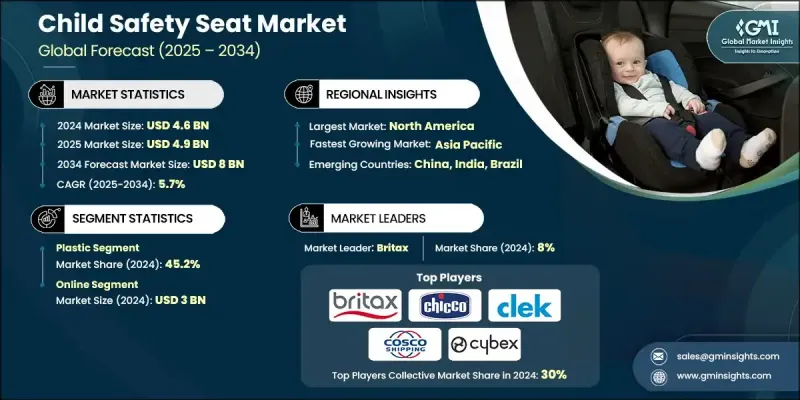
정부의 규제와 법적 의무가 이 시장의 성장을 견인하는 중요한 역할을 하고 있습니다. 세계 각국의 당국은 연령과 체중에 따른 적절한 카시트 사용을 의무화하는 엄격한 법규를 도입하고 있습니다. 이러한 규제는 이동 중 적절한 구속 시스템을 확보하여 어린 승객의 부상과 사망을 줄이는 것을 목표로 하고 있습니다. 특히 선진 지역에서는 규제 위반에 대한 집행 조치와 처벌이 보급률을 높이고 있습니다. 또한, 보호자의 자녀 안전에 대한 인식이 높아진 것도 시장 성장에 기여하고 있습니다. 간병인들은 인증된 안전 시트 사용의 중요성을 점점 더 많이 인식하고 있습니다. 어린이 안전 기준 및 규정의 지속적인 업데이트는 적합 제품에 대한 수요를 촉진합니다. 컴팩트하고 사용하기 쉬운 디자인과 편안함을 유지하면서 보호력을 높이는 혁신 기술 추구도 시장을 뒷받침하고 있습니다. 이러한 요인들이 결합되어 세계 카시트 시장은 꾸준한 상승세를 유지하고 있습니다.
| 시장 범위 | |
|---|---|
| 개시 연도 | 2024년 |
| 예측 기간 | 2025-2034년 |
| 개시 연도 시장 규모 | 46억 달러 |
| 예측 금액 | 80억 달러 |
| CAGR | 5.7% |
2024년, 온라인 판매 부문은 30억 달러의 매출을 창출했습니다. 편의성, 다양한 제품 선택, 구성 및 설치 안내, 지속적인 유지보수에 대한 제조업체의 지원으로 인해 전자상거래 채널이 선호되고 있습니다.
플라스틱 부문은 경량성, 내구성, 비용 효율성으로 인해 2024년 45.2%의 점유율을 차지할 것으로 예측됩니다. 내충격성을 향상시키면서 경량화를 위해 고급 폴리머의 활용이 증가하고 있습니다.
미국 카시트 시장은 2024년 84.5%의 점유율을 차지하며 14억 달러의 매출을 기록했습니다. 북미는 높은 물류 네트워크, 높은 소비자 기술 도입률, 캘리포니아 주 등의 스마트 통합형 카시트 시스템 도입을 촉진하는 정부의 의무화 조치로 인해 견조한 성장세를 보이고 있습니다.
자주 묻는 질문
목차
제1장 조사 방법과 범위
제2장 주요 요약
제3장 업계 인사이트
- 생태계 분석
- 공급업체 상황
- 이익률
- 각 단계별 부가가치
- 밸류체인에 영향을 미치는 요인
- 업계에 대한 영향요인
- 성장 촉진요인
- 업계의 잠재적 리스크&과제
- 기회
- 성장 가능성 분석
- 향후 시장 동향
- 기술과 혁신 동향
- 현재 기술 동향
- 신기술
- 가격 동향
- 지역별
- 유형별
- 규제 상황
- 규격 및 적합 요건
- 지역별 규제 구조
- 인증 기준
- Porter's Five Forces 분석
- PESTEL 분석
제4장 경쟁 구도
- 서론
- 기업의 시장 점유율 분석
- 지역별
- 기업 매트릭스 분석
- 주요 시장 기업의 경쟁 분석
- 경쟁 포지셔닝 매트릭스
- 주요 발전
- 인수합병(M&A)
- 제휴 및 협업
- 신제품 발매
- 확대 계획
제5장 시장 추산 및 예측 : 제품별, 2021-2034
- 주요 동향
- 컨버터블 시트
- 부스터 시트
- 콤비네이션 시트
- 올인원 시트
제6장 시장 추산 및 예측 : 유형별, 2021-2034
- 주요 동향
- 후방 장착형 카시트
- 전방 장착형 카시트
제7장 시장 추산 및 예측 : 재료별, 2021-2034
- 주요 동향
- 플라스틱
- 발포체
- 강재
- 기타(프로파일렌 등)
제8장 시장 추산 및 예측 : 연령층별, 2021-2034
- 주요 동향
- 6개월 미만
- 6-12개월
- 12-24개월
- 24개월 이상
제9장 시장 추산 및 예측 : 가격별, 2021-2034
- 주요 동향
- 저
- 중
- 고
제10장 시장 추산 및 예측 : 최종 용도별, 2021-2034
- 주요 동향
- 운송 및 여행
- 홈
- 보육시설
- 헬스케어
- 유원지
- HoReCa
- 기타(캠프 용품, 쇼핑카드 등)
제11장 시장 추산 및 예측 : 유통 채널별, 2021-2034
- 주요 동향
- 온라인
- 오프라인
제12장 시장 추산 및 예측 : 지역별, 2021-2034
- 주요 동향
- 북미
- 미국
- 캐나다
- 유럽
- 독일
- 영국
- 프랑스
- 이탈리아
- 스페인
- 아시아태평양
- 중국
- 일본
- 인도
- 호주
- 한국
- 라틴아메리카
- 브라질
- 멕시코
- 아르헨티나
- 중동 및 아프리카
- 남아프리카공화국
- 사우디아라비아
- 아랍에미리트(UAE)
제13장 기업 개요
- Baby Jogger
- Britax
- Chicco
- Clek
- Cosco
- Cybex
- Diono
- Evenflo
- Graco
- Joie
- Kidsembrace
- Maxi-Cosi
- Nuna
- Peg Perego
- Recaro
- Safety 1st
The Global Child Safety Seat Market was valued at USD 4.6 billion in 2024 and is estimated to grow at a CAGR of 5.7% to reach USD 8 billion by 2034.
Government regulations and legal mandates play a pivotal role in driving this market, as authorities worldwide have introduced stringent laws that require children to be secured in appropriate car seats based on age and weight categories. These regulations aim to reduce injuries and fatalities among young passengers by ensuring proper restraint systems during travel. Enforcement measures and penalties for non-compliance have boosted adoption rates, particularly in developed regions. Rising parental awareness regarding child safety further contributes to market growth, as caregivers increasingly recognize the importance of using certified safety seats. Continuous updates to child safety standards and regulations encourage demand for compliant products. The market is further supported by the search for compact, user-friendly designs and innovations that enhance protection without compromising comfort. These factors collectively maintain a steady upward trajectory in the global child safety seat market.
| Market Scope | |
|---|---|
| Start Year | 2024 |
| Forecast Year | 2025-2034 |
| Start Value | $4.6 Billion |
| Forecast Value | $8 Billion |
| CAGR | 5.7% |
In 2024, the online sales segment generated USD 3 billion. E-commerce channels are preferred due to the convenience, wide product selection, and manufacturer support for configurations, installation guidance, and ongoing maintenance.
Plastic segment held 45.2% share in 2024, due to its lightweight, durability, and cost efficiency. Advanced polymers are increasingly utilized to improve impact resistance while reducing weight.
U.S. Child Safety Seat Market held an 84.5% share and generated USD 1.4 billion in 2024. North America continues to show strong growth, supported by advanced logistics networks, high consumer adoption of technology, and government mandates in states such as California that promote smart and integrated child restraint systems.
Key players in the Global Child Safety Seat Market include Graco, Chicco, Clek, Diono, Britax, Nuna, Cybex, Peg Perego, Cosco, Joie, Recaro, Baby Jogger, Evenflo, Kidsembrace, Maxi-Cosi, and Safety 1st. Companies in the Child Safety Seat Market focus on product innovation, including lightweight, compact designs and advanced safety features to meet evolving regulatory standards and consumer expectations. Expanding e-commerce presence allows brands to reach a broader audience while offering personalized customer support and installation guidance. Partnerships with retailers, online marketplaces, and childcare providers enhance distribution channels and increase product visibility. Many manufacturers invest in marketing campaigns that emphasize safety certifications, durability, and ergonomic designs to strengthen brand trust. Adoption of advanced materials and smart technologies, such as sensor-integrated seats, helps differentiate offerings.
Table of Contents
Chapter 1 Methodology and Scope
- 1.1 Market scope and definition
- 1.2 Research design
- 1.2.1 Research approach
- 1.2.2 Data collection methods
- 1.3 Data mining sources
- 1.3.1 Global
- 1.3.2 Regional/Country
- 1.4 Base estimates and calculations
- 1.4.1 Base year calculation
- 1.4.2 Key trends for market estimation
- 1.5 Primary research and validation
- 1.5.1 Primary sources
- 1.6 Forecast model
- 1.7 Research assumptions and limitations
Chapter 2 Executive Summary
- 2.1 Industry 360° synopsis
- 2.2 Key market trends
- 2.2.1 Regional
- 2.2.2 Product
- 2.2.3 Type
- 2.2.4 Age group
- 2.2.5 Pricing
- 2.2.6 Material
- 2.2.7 End use
- 2.2.8 Distribution channel
- 2.3 CXO perspectives: Strategic imperatives
- 2.3.1 Key decision points for industry executives
- 2.3.2 Critical success factors for market players
- 2.4 Future outlook and strategic recommendations
Chapter 3 Industry Insights
- 3.1 Industry ecosystem analysis
- 3.1.1 Supplier landscape
- 3.1.2 Profit margin
- 3.1.3 Value addition at each stage
- 3.1.4 Factor affecting the value chain
- 3.2 Industry impact forces
- 3.2.1 Growth drivers
- 3.2.1.1 Enforcement of stringent child safety regulation
- 3.2.1.2 Increased parental awareness and focus on child safety
- 3.2.1.3 Technological integration of smart seats
- 3.2.2 Industry pitfalls & challenges
- 3.2.2.1 High initial cost and certified seat systems
- 3.2.2.2 Consumer confusion and installation gaps
- 3.2.3 Opportunities
- 3.2.3.1 Growth in emerging economies.
- 3.2.3.2 Development of lightweight and e-commerce optimized seats
- 3.2.1 Growth drivers
- 3.3 Growth potential analysis
- 3.4 Future market trends
- 3.5 Technology and innovation landscape
- 3.5.1 Current technological trends
- 3.5.2 Emerging technologies
- 3.6 Price trends
- 3.6.1 By region
- 3.6.2 By type
- 3.7 Regulatory landscape
- 3.7.1 Standards and compliance requirements
- 3.7.2 Regional regulatory frameworks
- 3.7.3 Certification standards
- 3.8 Porter's analysis
- 3.9 PESTEL analysis
Chapter 4 Competitive Landscape, 2024
- 4.1 Introduction
- 4.2 Company market share analysis
- 4.2.1 By region
- 4.2.1.1 North America
- 4.2.1.2 Europe
- 4.2.1.3 Asia Pacific
- 4.2.1.4 Latin America
- 4.2.1.5 Middle East and Africa
- 4.2.1 By region
- 4.3 Company matrix analysis
- 4.4 Competitive analysis of major market players
- 4.5 Competitive positioning matrix
- 4.6 Key developments
- 4.6.1 Mergers & acquisitions
- 4.6.2 Partnerships & collaborations
- 4.6.3 New product launches
- 4.6.4 Expansion plans
Chapter 5 Market Estimates and Forecast, By Product, 2021 - 2034 (USD Billion) (Thousand Units)
- 5.1 Key trends
- 5.2 Convertible seats
- 5.3 Booster seats
- 5.4 Combination seats
- 5.5 All-in-one seats
Chapter 6 Market Estimates and Forecast, By Type, 2021 - 2034 (USD Billion) (Thousand Units)
- 6.1 Key trends
- 6.2 Rearward facing seats
- 6.3 Forward facing seats
Chapter 7 Market Estimates and Forecast, By Material, 2021 - 2034 (USD Billion) (Thousand Units)
- 7.1 Key trends
- 7.2 Plastic
- 7.3 Foam
- 7.4 Steel
- 7.5 Others (propylene, etc.)
Chapter 8 Market Estimates and Forecast, By Age Group, 2021 - 2034 (USD Billion) (Thousand Units)
- 8.1 Key trends
- 8.2 Below 6 months
- 8.3 6-12 months
- 8.4 12-24 months
- 8.5 Above 24 months
Chapter 9 Market Estimates and Forecast, By Price, 2021 - 2034 (USD Billion) (Thousand Units)
- 9.1 Key trends
- 9.2 Low
- 9.3 Medium
- 9.4 High
Chapter 10 Market Estimates and Forecast, By End Use, 2021 - 2034 (USD Billion) (Thousand Units)
- 10.1 Key trends
- 10.2 Transport & travel
- 10.3 Home
- 10.4 Playgroup institutes
- 10.5 Healthcare
- 10.6 Amusement parks
- 10.7 HoReCa
- 10.8 Others (camping, shopping carts, etc.)
Chapter 11 Market Estimates and Forecast, By Distribution Channel, 2021 - 2034 (USD Billion) (Thousand Units)
- 11.1 Key trends
- 11.2 Online
- 11.3 Offline
Chapter 12 Market Estimates and Forecast, By Region, 2021 - 2034 (USD Billion) (Thousand Units)
- 12.1 Key trends
- 12.2 North America
- 12.2.1 U.S.
- 12.2.2 Canada
- 12.3 Europe
- 12.3.1 Germany
- 12.3.2 UK
- 12.3.3 France
- 12.3.4 Italy
- 12.3.5 Spain
- 12.4 Asia Pacific
- 12.4.1 China
- 12.4.2 Japan
- 12.4.3 India
- 12.4.4 Australia
- 12.4.5 South Korea
- 12.5 Latin America
- 12.5.1 Brazil
- 12.5.2 Mexico
- 12.5.3 Argentina
- 12.6 Middle East and Africa
- 12.6.1 South Africa
- 12.6.2 Saudi Arabia
- 12.6.3 UAE
Chapter 13 Company Profiles
- 13.1 Baby Jogger
- 13.2 Britax
- 13.3 Chicco
- 13.4 Clek
- 13.5 Cosco
- 13.6 Cybex
- 13.7 Diono
- 13.8 Evenflo
- 13.9 Graco
- 13.10 Joie
- 13.11 Kidsembrace
- 13.12 Maxi-Cosi
- 13.13 Nuna
- 13.14 Peg Perego
- 13.15 Recaro
- 13.16 Safety 1st