|
시장보고서
상품코드
1892803
전기자동차 택시 시장 기회, 성장요인, 업계 동향 분석 및 예측(2026-2035년)Electric Vehicle (EV) Taxi Market Opportunity, Growth Drivers, Industry Trend Analysis, and Forecast 2026 - 2035 |
||||||

세계의 전기자동차 택시 시장은 2025년에 257억 달러로 평가되었고, 2035년까지 연평균 복합 성장률(CAGR) 14.1%로 성장하여 900억 달러에 이를 것으로 예측됩니다.
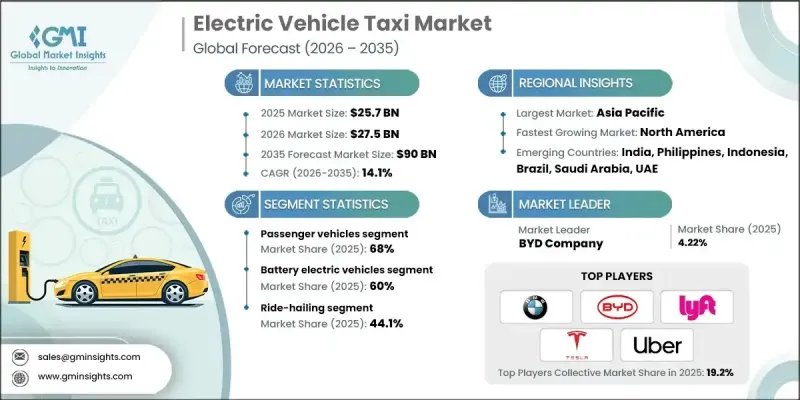
이러한 성장은 지속 가능한 교통수단으로의 전환, 지능형 차량 관리, 도시 지역의 전동화 모빌리티 시스템에 의해 촉진되고 있습니다. 현대의 EV 택시 플랫폼은 대용량 배터리, AI를 통한 차량 최적화, 실시간 차량 모니터링, 스마트 충전 네트워크를 결합하여 효율성 향상, 운영 비용 절감, 배기가스 배출 최소화, 승객 안전 향상을 실현하고 있습니다. 정부와 모빌리티 서비스 제공업체들은 규제 요건 준수, 연료 의존도 감소, 도시 전체의 교통 지속가능성 향상을 위해 전기 택시로의 전환을 가속화하고 있습니다. 이러한 혁신 기술은 사업자가 유지보수 수요를 예측하고, 연료 가격 변동 위험을 피하며, 경로 계획을 최적화하는 데에도 기여하고 있습니다. 업계 재편, 전략적 제휴, 기술 파트너십은 EV 택시 산업의 구조를 변화시키고 있으며, 제조업체, 배터리 공급업체, 소프트웨어 제공업체가 협력하여 장거리 주행 차량, 초고속 충전 솔루션, 원활한 운영 및 에너지 효율적인 경로 계획을 보장하는 통합 디지털 플랫폼을 개발하고 있습니다. 통합 디지털 플랫폼을 개발하고 있습니다.
| 시장 범위 | |
|---|---|
| 개시 연도 | 2025년 |
| 예측 연도 | 2026-2035년 |
| 개시 연도 시장 규모 | 257억 달러 |
| 예측 금액 | 900억 달러 |
| CAGR | 14.1% |
승용차 부문은 2025년 68%의 점유율을 차지할 것으로 예상되며, 2035년까지 연평균 13.6%의 성장률을 보일 것으로 전망됩니다. 소형 및 중형차는 저렴한 가격, 효율적인 에너지 소비, 일상적인 도시 경로에 대한 적합성 때문에 EV 택시 산업을 지배하고 있습니다. 이 차량들은 EV 파워트레인과 호환되기 때문에 차량 운영자는 보조금을 활용하고, 연료비를 절감하고, 배기가스 배출을 줄이면서 유지보수를 간소화할 수 있습니다.
배터리 전기자동차(BEV) 부문은 2025년 60%의 점유율을 차지할 것으로 예상되며, 2035년까지 연평균 14.4%의 성장률을 보일 것으로 예측됩니다. BEV는 무공해 운전, 낮은 운영비, 긴 항속거리, 빠른 충전, 우수한 안전 기능으로 인해 택시 사업에서 선호되고 있습니다. 정부의 인센티브와 확대되는 공공 및 민간 충전 네트워크는 도입을 더욱 촉진하고 지속적인 운영과 차량 효율성 향상을 보장하고 있습니다.
중국 전기차 택시 시장은 2024년 40억 2,000만 달러 규모로 37%의 점유율을 차지했습니다. 특히 주요 도시 지역에서는 급속한 차량 전동화, 강력한 정부 지원책, 적극적인 배출가스 저감 정책으로 인해 도입이 가속화되고 있습니다. 보조금, 면허비 감면, 우대 충전 프로그램 등을 통해 택시 사업자들은 기존 내연기관차에서 전기자동차로의 전환을 촉진하고 있습니다.
자주 묻는 질문
목차
제1장 조사 방법
- 시장 범위와 정의
- 조사 설계
- 조사 접근
- 데이터 수집 방법
- 데이터 마이닝 정보원
- 세계
- 지역별/국가별
- 기본 추정치와 계산
- 기준연도 계산
- 시장 추정 주요 동향
- 1차 조사와 검증
- 1차 정보
- 예측 모델
- 조사의 전제조건과 제한 사항
제2장 주요 요약
제3장 업계 인사이트
- 생태계 분석
- 공급업체 상황
- 이익률 분석
- 비용 구조
- 각 단계별 부가가치
- 밸류체인에 영향을 미치는 요인
- 파괴적 변화
- 업계에 대한 영향요인
- 성장 촉진요인
- 업계의 잠재적 리스크&과제
- 시장 기회
- 성장 가능성 분석
- 규제 상황
- 북미
- 미국 연방정부 우대 조치(세액공제, 보조금)에 가세해 인프라 자금(NEVI/IIJA)이 차량 전동화와 창고 충전을 지원
- 유럽
- 독일 : 전기 모빌리티법(EmoG)
- 영국 : 플러그인 택시 보조금 제도(PiTG)
- 프랑스 : 모빌리티 지향법(LOM법)
- 이탈리아 : 국가 에너지 기후 통합 계획(PNIEC)
- 아시아태평양
- 중국 : 신에너지 차(NEV) 의무화 정책
- 인도 : FAME II 스킴(전기자동차 장려책)
- 일본 : EV/FCV 도입을 위한 전략적 로드맵
- 호주 : 주 레벨 탄소 제로 자동차 의무화
- 라틴아메리카
- 브라질 : 국가 전기자동차 정책(PNME)
- 멕시코 : 도시 탄소 제로 택시 프로그램
- 아르헨티나 : 주별 EV 택시 규제(부에노스아이레스주)
- 중동 및 아프리카
- 아랍에미리트 : EV 충전 인프라 규제(ADDM/DEWA)
- 사우디아라비아 : 전기자동차 도입에 관한 규제 구조(SASO)
- 남아프리카공화국 : 그린 교통 전략
- 북미
- Porter's Five Forces 분석
- PESTEL 분석
- 기술과 혁신 동향
- 현재 기술 동향
- 신기술
- 특허 분석
- 가격 분석
- 지역별
- 추진력별
- 비용 내역 분석
- 차량 비용
- 운영 비용
- 총 소유비용(TCO)
- 충전 인프라 비용
- 설치 및 가동 비용
- 연구개발비
- 지속가능성과 환경 영향 분석
- 지속가능한 대처
- 폐기물 감축 전략
- 생산 에너지 효율
- 친환경 이니셔티브
- 탄소발자국에 관한 고려사항
- 전망과 기회
- 기술 로드맵과 진화 타임라인
- 새로운 응용 분야 기회
- 투자 요건과 자금조달 근원
- 리스크 평가와 경감책
- 시장 진출기업에의 전략적 제안
제4장 경쟁 구도
- 서론
- 기업의 시장 점유율 분석
- 주요 시장 기업의 경쟁 분석
- 경쟁 포지셔닝 매트릭스
- 전략적 전망 매트릭스
- 주요 발전
- 인수합병(M&A)
- 제휴 및 협업
- 신제품 발매
- 사업 확대 계획과 자금조달
제5장 시장 추산 및 예측 : 차량별, 2022-2035
- 주요 동향
- 승용차
- 해치백차
- 세단
- SUV
- 상용차
- 소형 상용차(LCV)
- 중형 상용차(MCV)
- 대형 상용차(HCV)
제6장 시장 추산 및 예측 : 추진력별, 2022-2035
- 주요 동향
- 배터리 전기자동차(BEV)
- 하이브리드 전기자동차(HEV)
- 플러그인 하이브리드 전기자동차(PHEV)
제7장 시장 추산 및 예측 : 서비스별, 2022-2035
- 주요 동향
- 라이드 헤일링
- 택시 서비스
- 플릿 오퍼레이터 서비스
- 로보택시 서비스
제8장 시장 추산 및 예측 : 소유 형태별, 2022-2035
- 주요 동향
- 플릿 소유
- 개인 소유(운전자 소유)
- 구독
- 협동조합 모델
- 기타
제9장 시장 추산 및 예측 : 범위별, 2022-2035
- 주요 동향
- 단거리(1회 충전당 150km 미만)
- 중거리(1회 충전당 150-250km)
- 장거리(1회 충전당 250km 이상)
제10장 시장 추산 및 예측 : 충전 인프라별, 2022-2035
- 주요 동향
- 급속 충전
- 저속 충전
- 무선 충전
제11장 시장 추산 및 예측 : 지역별, 2022-2035
- 주요 동향
- 북미
- 미국
- 캐나다
- 유럽
- 독일
- 영국
- 프랑스
- 이탈리아
- 스페인
- 러시아
- 북유럽 국가
- 아시아태평양
- 중국
- 인도
- 일본
- 호주
- 한국
- 필리핀
- 인도네시아
- 라틴아메리카
- 브라질
- 멕시코
- 아르헨티나
- 중동 및 아프리카
- 남아프리카공화국
- 사우디아라비아
- 아랍에미리트(UAE)
제12장 기업 개요
- 세계 기업
- BAIC
- BYD
- Didi Chuxing
- GoGreen Cab Services
- Green Cab
- Lyft
- Nissan Motor
- Tesla
- Uber
- Volkswagen
- Waymo(Alphabet)
- 지역 기업
- Alto
- BluSmart Mobility
- EEE-Taxi Mobility Solutions
- EV Capital
- EVERA Auto
- Grab Holdings
- Ola
- 신규 기업
- Cruise LLC(General Motors)
- Evera Cabs
- GSM Green and Smart Mobility
- Xanh SM
The Global Electric Vehicle Taxi Market was valued at USD 25.7 billion in 2025 and is estimated to grow at a CAGR of 14.1% to reach USD 90 billion by 2035.
Growth is fueled by the global shift toward sustainable transportation, intelligent fleet management, and electrified urban mobility systems. Modern EV taxi platforms combine high-capacity batteries, AI-driven fleet optimization, real-time vehicle monitoring, and smart charging networks to enhance efficiency, reduce operating costs, minimize emissions, and elevate passenger safety. Governments and mobility service providers are increasingly transitioning to electric taxis to meet regulatory mandates, reduce fuel dependency, and improve city-wide transport sustainability. These innovations also help operators anticipate maintenance needs, avoid fuel price volatility, and optimize route planning. Industry consolidation, strategic alliances, and technology partnerships are reshaping the EV taxi landscape, with manufacturers, battery suppliers, and software providers working together to develop long-range vehicles, ultra-fast charging solutions, and integrated digital platforms that ensure seamless operations and energy-efficient routing.
| Market Scope | |
|---|---|
| Start Year | 2025 |
| Forecast Year | 2026-2035 |
| Start Value | $25.7 Billion |
| Forecast Value | $90 Billion |
| CAGR | 14.1% |
The passenger vehicle segment held a 68% share in 2025 and is expected to grow at a CAGR of 13.6% through 2035. Compact and mid-sized cars dominate the EV taxi industry due to their affordability, efficient energy consumption, and suitability for daily urban routes. Their compatibility with EV powertrains allows fleet operators to leverage subsidies, reduce fuel expenses, and lower emissions while simplifying maintenance.
The battery electric vehicles segment held a 60% share in 2025 and is projected to grow at a CAGR of 14.4% by 2035. BEVs are preferred for taxi operations due to zero-emission operation, lower running costs, longer ranges, faster charging, and superior safety features. Government incentives and expanding public and private charging networks further drive adoption, ensuring continuous operations and increased fleet efficiency.
China Electric Vehicle Taxi Market held a 37% share, generating USD 4.02 billion in 2024. Rapid fleet electrification, strong government incentives, and aggressive emission-reduction policies are accelerating adoption, especially in major urban centers. Subsidies, reduced licensing fees, and preferential charging programs encourage taxi operators to transition from traditional ICE vehicles to EVs.
Prominent companies operating in the Electric Vehicle Taxi Market include Tesla, BYD Company, Uber Electric, Didi Chuxing, OLA, BMW, BAIC, EV Capital, EVERA Auto, and Lyft. Companies are strengthening their Electric Vehicle Taxi Market positions by developing long-range EV taxis and integrating solid-state or high-density battery systems to enhance vehicle performance and reliability. Strategic partnerships with charging network providers, fleet management software companies, and urban mobility platforms enable seamless operations, optimized routing, and energy-efficient trip allocation. Leading players are investing in AI-driven fleet optimization, predictive maintenance tools, and real-time telematics to reduce downtime and operating costs. Incentive programs, fleet subscription models, and flexible leasing solutions help attract taxi operators to EV adoption.
Table of Contents
Chapter 1 Methodology
- 1.1 Market scope and definition
- 1.2 Research design
- 1.2.1 Research approach
- 1.2.2 Data collection methods
- 1.3 Data mining sources
- 1.3.1 Global
- 1.3.2 Regional/Country
- 1.4 Base estimates and calculations
- 1.4.1 Base year calculation
- 1.4.2 Key trends for market estimation
- 1.5 Primary research and validation
- 1.5.1 Primary sources
- 1.6 Forecast model
- 1.7 Research assumptions and limitations
Chapter 2 Executive Summary
- 2.1 Industry 3600 synopsis, 2022 - 2035
- 2.2 Key market trends
- 2.2.1 Regional
- 2.2.2 Vehicle
- 2.2.3 Propulsion
- 2.2.4 Service
- 2.2.5 Ownership Model
- 2.2.6 Range
- 2.2.7 Charging Infrastructure
- 2.3 TAM Analysis, 2026-2035
- 2.4 CXO perspectives: Strategic imperatives
- 2.4.1 Executive decision points
- 2.4.2 Critical success factors
- 2.5 Future outlook and strategic recommendations
Chapter 3 Industry Insights
- 3.1 Industry ecosystem analysis
- 3.1.1 Supplier landscape
- 3.1.2 Profit margin analysis
- 3.1.3 Cost structure
- 3.1.4 Value addition at each stage
- 3.1.5 Factor affecting the value chain
- 3.1.6 Disruptions
- 3.2 Industry impact forces
- 3.2.1 Growth drivers
- 3.2.1.1 Government incentives and stricter emission norms
- 3.2.1.2 Rising fuel prices of gasoline-powered vehicles
- 3.2.1.3 Advancements in battery technology
- 3.2.1.4 Growing awareness about climate change and the need for sustainable transportation solutions
- 3.2.1.5 Rapid urbanization and smart city initiatives
- 3.2.2 Industry pitfalls and challenges
- 3.2.2.1 High initial costs of electric vehicles
- 3.2.2.2 Limited charging infrastructure
- 3.2.3 Market opportunities
- 3.2.3.1 Expansion of charging infrastructure
- 3.2.3.2 Integration with smart city initiatives
- 3.2.3.3 Fleet electrification programs by corporations
- 3.2.3.4 Technological advancements in batteries and EV components
- 3.2.1 Growth drivers
- 3.3 Growth potential analysis
- 3.4 Regulatory landscape
- 3.4.1 North America
- 3.4.1.1 US Federal incentives (tax credits, grants) plus infrastructure funding (NEVI/IIJA) support fleet electrification and depot charging.
- 3.4.2 Europe
- 3.4.2.1 Germany: Electric Mobility Act (EmoG)
- 3.4.2.2 UK: Plug-in Taxi Grant Scheme (PiTG)
- 3.4.2.3 France: Mobility Orientation Law (LOM Act)
- 3.4.2.4 Italy: National Integrated Plan for Energy and Climate (PNIEC)
- 3.4.3 Asia Pacific
- 3.4.3.1 China: New Energy Vehicle (NEV) Mandate
- 3.4.3.2 India: FAME II Scheme (EV Incentives)
- 3.4.3.3 Japan: Strategic Roadmap for EV/FCV Deployment
- 3.4.3.4 Australia: State-Level Zero-Emission Vehicle Mandates
- 3.4.4 Latin America
- 3.4.4.1 Brazil: National Electric Mobility Policy (PNME)
- 3.4.4.2 Mexico: Urban Zero-Emission Taxi Programs
- 3.4.4.3 Argentina: Provincial EV Taxi Regulations (Buenos Aires)
- 3.4.5 MEA
- 3.4.5.1 UAE: EV Charging Infrastructure Regulation (ADDM/DEWA)
- 3.4.5.2 Saudi Arabia: EV Deployment Regulatory Framework (SASO)
- 3.4.5.3 South Africa: Green Transport Strategy
- 3.4.1 North America
- 3.5 Porter's analysis
- 3.6 PESTEL analysis
- 3.7 Technology and Innovation landscape
- 3.7.1 Current technological trends
- 3.7.2 Emerging technologies
- 3.8 Patent analysis
- 3.9 Pricing Analysis
- 3.9.1 By region
- 3.9.2 By propulsion
- 3.10 Cost breakdown analysis
- 3.10.1 Vehicle Cost
- 3.10.2 Operational Cost
- 3.10.3 Total cost of ownership (TCO)
- 3.10.4 Charging Infrastructure Cost
- 3.10.5 Installation & activation costs
- 3.10.6 Research & development costs
- 3.11 Sustainability and environmental impact analysis
- 3.11.1 Sustainable practices
- 3.11.2 Waste reduction strategies
- 3.11.3 Energy efficiency in production
- 3.11.4 Eco-friendly initiatives
- 3.11.5 Carbon footprint considerations
- 3.12 Future outlook & opportunities
- 3.12.1 Technology roadmap & evolution timeline
- 3.12.2 Emerging application opportunities
- 3.12.3 Investment requirements & funding sources
- 3.12.4 Risk assessment & mitigation strategies
- 3.12.5 Strategic recommendations for market participants
Chapter 4 Competitive Landscape, 2025
- 4.1 Introduction
- 4.2 Company market share analysis
- 4.2.1 North America
- 4.2.2 Europe
- 4.2.3 Asia Pacific
- 4.2.4 Latin America
- 4.2.5 MEA
- 4.3 Competitive analysis of major market players
- 4.4 Competitive positioning matrix
- 4.5 Strategic outlook matrix
- 4.6 Key developments
- 4.6.1 Mergers & acquisitions
- 4.6.2 Partnerships & collaborations
- 4.6.3 New Product Launches
- 4.6.4 Expansion Plans and funding
Chapter 5 Market Estimates & Forecast, By Vehicle, 2022 - 2035 ($Bn, Units)
- 5.1 Key trends
- 5.2 Passenger vehicles
- 5.2.1 Hatchbacks
- 5.2.2 Sedans
- 5.2.3 SUV
- 5.3 Commercial vehicles
- 5.3.1 Light commercial vehicles (LCV)
- 5.3.2 Medium commercial vehicles (MCV)
- 5.3.3 Heavy commercial vehicles (HCV)
Chapter 6 Market Estimates & Forecast, By Propulsion, 2022 - 2035 ($Bn, Units)
- 6.1 Key trends
- 6.2 Battery electric vehicles (BEVs)
- 6.3 Hybrid electric vehicles (HEVs)
- 6.4 Plug-in hybrid electric vehicles (PHEVs)
Chapter 7 Market Estimates & Forecast, By Service, 2022 - 2035 ($Bn, Units)
- 7.1 Key trends
- 7.2 Ride-Hailing
- 7.3 Cab Services
- 7.4 Fleet Operator Services
- 7.5 Robotaxi Services
Chapter 8 Market Estimates & Forecast, By Ownership Model, 2022 - 2035 ($Bn, Units)
- 8.1 Key trends
- 8.2 Fleet-Owned
- 8.3 Individual Driver-Owned
- 8.4 Subscription
- 8.5 Cooperative Models
- 8.6 Others
Chapter 9 Market Estimates & Forecast, By Range, 2022 - 2035 ($Bn, Units)
- 9.1 Key trends
- 9.2 Short Range (<150 km per charge)
- 9.3 Medium Range (150-250 km per charge)
- 9.4 Long Range (250+ km per charge)
Chapter 10 Market Estimates & Forecast, By Charging infrastructure, 2022 - 2035 ($Bn, Units)
- 10.1 Key trends
- 10.2 Fast charging
- 10.3 Slow charging
- 10.4 Wireless charging
Chapter 11 Market Estimates & Forecast, By Region, 2022 - 2035 ($Bn, Units)
- 11.1 Key trends
- 11.2 North America
- 11.2.1 US
- 11.2.2 Canada
- 11.3 Europe
- 11.3.1 Germany
- 11.3.2 UK
- 11.3.3 France
- 11.3.4 Italy
- 11.3.5 Spain
- 11.3.6 Russia
- 11.3.7 Nordics
- 11.4 Asia Pacific
- 11.4.1 China
- 11.4.2 India
- 11.4.3 Japan
- 11.4.4 Australia
- 11.4.5 South Korea
- 11.4.6 Philippines
- 11.4.7 Indonesia
- 11.5 Latin America
- 11.5.1 Brazil
- 11.5.2 Mexico
- 11.5.3 Argentina
- 11.6 MEA
- 11.6.1 South Africa
- 11.6.2 Saudi Arabia
- 11.6.3 UAE
Chapter 12 Company Profiles
- 12.1 Global Players
- 12.1.1 BAIC
- 12.1.2 BYD
- 12.1.3 Didi Chuxing
- 12.1.4 GoGreen Cab Services
- 12.1.5 Green Cab
- 12.1.6 Lyft
- 12.1.7 Nissan Motor
- 12.1.8 Tesla
- 12.1.9 Uber
- 12.1.10 Volkswagen
- 12.1.11 Waymo (Alphabet)
- 12.2 Regional Players
- 12.2.1 Alto
- 12.2.2 BluSmart Mobility
- 12.2.3 EEE-Taxi Mobility Solutions
- 12.2.4 EV Capital
- 12.2.5 EVERA Auto
- 12.2.6 Grab Holdings
- 12.2.7 Ola
- 12.3 Emerging Players
- 12.3.1 Cruise LLC (General Motors)
- 12.3.2 Evera Cabs
- 12.3.3 GSM Green and Smart Mobility
- 12.3.4 Xanh SM