
|
시장보고서
상품코드
1892804
헬리콥터 시장 기회, 성장요인, 업계 동향 분석 및 예측(2026-2035년)Helicopter Market Opportunity, Growth Drivers, Industry Trend Analysis, and Forecast 2026 - 2035 |
||||||

세계의 헬리콥터 시장은 2025년에 343억 달러로 평가되었고, 2035년까지 연평균 복합 성장률(CAGR) 7%로 성장하여 665억 달러에 이를 것으로 예측됩니다.
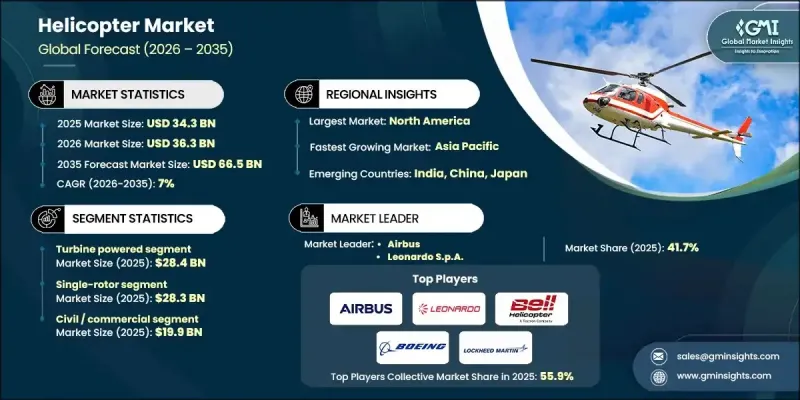
시장 확대는 군사 및 국방 예산 증가, 헬리콥터 설계 및 기술 발전, 항공 응급 서비스의 보급 확대에 의해 촉진되고 있습니다. 레저 비행과 헬리콥터 투어에 대한 수요 증가도 시장 성장에 기여하고 있습니다. 헬리콥터는 응급 의료 이송에서 중요한 역할을 하며, 신속한 환자 이송을 가능하게 함으로써 적시에 의료 서비스를 받을 수 없는 곳으로의 접근을 가능케 합니다. 전 세계적으로 긴급 대응과 시간적 제약이 있는 의료 개입에 대한 관심이 높아지면서 헬리콥터는 필수적인 존재가 되었습니다. 각 제조업체들은 상업, 군사, 의료 분야의 요구에 부응하기 위해 고성능, 고효율, 고신뢰성 헬리콥터 개발에 주력하고 있습니다. 한편, 소재 기술과 연료 효율의 혁신은 업계의 미래를 계속 형성하고 있습니다.
| 시장 범위 | |
|---|---|
| 개시 연도 | 2025년 |
| 예측 연도 | 2026-2035년 |
| 개시 연도 시장 규모 | 343억 달러 |
| 예측 금액 | 665억 달러 |
| CAGR | 7% |
터빈 구동 부문은 2024년 284억 달러의 매출을 기록할 것으로 예측됩니다. 터빈 엔진 수요는 특히 군사, 상업, 비상 작전 분야에서 신뢰성, 효율성, 고출력에 의해 주도되고 있습니다. 각 제조업체들은 비용 관리와 함께 성능 향상을 위해 터빈 엔진의 효율성, 연료 소비 최적화, 첨단 소재 활용에 집중하고 있습니다.
단일 로터 부문은 2025년 283억 달러 시장 규모를 달성했습니다. 뛰어난 연비, 유연성, 종합적인 성능이 보급을 촉진하고 있습니다. 제조업체들은 단일 로터 헬리콥터의 운영 효율성과 성능을 향상시키기 위해 첨단 소재의 통합, 최적화된 로터 설계, 비용 효율적인 솔루션을 도입하는 것을 우선순위로 삼고 있습니다.
미국 헬리콥터 시장은 2025년 120억 달러에 달할 것으로 예측됩니다. 시장 성장은 항공 분야의 기술 리더십, 에너지 분야의 오프쇼어 작업 증가, 개인용 민간 헬리콥터 도입 확대에 힘입어 성장세를 보이고 있습니다. 각 업체들은 자율비행 기술, 해양 임무를 위한 연료 효율성, 그리고 미국 수요에 부응하기 위해 성능, 안전성, 고급스러움을 강화한 맞춤형 헬리콥터 설계에 집중하고 있습니다.
자주 묻는 질문
목차
제1장 조사 방법과 범위
제2장 주요 요약
제3장 업계 인사이트
- 생태계 분석
- 공급업체 상황
- 이익률
- 비용 구조
- 각 단계별 부가가치
- 밸류체인에 영향을 미치는 요인
- 파괴적 변화
- 업계에 대한 영향요인
- 성장 촉진요인
- 업계의 잠재적 리스크&과제
- 시장 기회
- 성장 가능성 분석
- 규제 상황
- 북미
- 유럽
- 아시아태평양
- 라틴아메리카
- 중동 및 아프리카
- Porter's Five Forces 분석
- PESTEL 분석
- 기술과 혁신 동향
- 현재 기술 동향
- 신기술
- 신흥 비즈니스 모델
- 컴플라이언스 요건
- 방위 예산 분석
- 세계의 방위 지출 동향
- 지역별 방위 예산배분
- 북미
- 유럽
- 아시아태평양
- 중동 및 아프리카
- 라틴아메리카
- 주요 방위 현대화 프로그램
- 예산 예측(2025-2034)
- 산업 성장에 대한 영향
- 국가별 방위 예산
- 공급망 회복탄력성
- 지정학적 분석
- 노동력 분석
- 디지털 전환
- 인수합병(M&A) 및 전략적 제휴 동향
- 리스크 평가와 관리
- 주요 계약 수여(2021-2024)
제4장 경쟁 구도
- 서론
- 기업의 시장 점유율 분석
- 지역별
- 북미
- 유럽
- 아시아태평양
- 라틴아메리카
- 중동 및 아프리카
- 시장 집중도 분석
- 지역별
- 주요 기업의 경쟁 벤치마킹
- 재무 실적 비교
- 매출
- 이익률
- 연구개발
- 제품 포트폴리오 비교
- 제품 라인 넓이
- 기술
- 혁신
- 지역 존재감 비교
- 세계 전개 분석
- 서비스 네트워크 커버율
- 지역별 시장 침투율
- 경쟁 포지셔닝 매트릭스
- 리더 기업
- 챌린저
- 팔로워
- 니치 기업
- 전략적 전망 매트릭스
- 재무 실적 비교
- 주요 발전, 2021-2024
- 인수합병(M&A)
- 제휴 및 공동 사업
- 기술적 진보
- 확대와 투자 전략
- 지속가능성 이니셔티브
- 디지털 전환 대처
- 신흥/스타트업 경쟁 동향
제5장 시장 추산 및 예측 : 엔진 유형별, 2022-2035
- 주요 동향
- 피스톤
- 터빈
제6장 시장 추산 및 예측 : 로터 유형별, 2022-2035
- 주요 동향
- 싱글 로터
- 트윈 로터/동축 로터
- 틸트 로터
제7장 시장 추산 및 예측 : 중량별, 2022-2035
- 주요 동향
- 소형 헬리콥터(3,000kg 이하)
- 중형 헬리콥터(3,001-7,000kg)
- 대형 헬리콥터(7,000kg 이상)
제8장 시장 추산 및 예측 : 추진 방식별, 2022-2035
- 주요 동향
- 기존 연료 구동
- 하이브리드 전기/전기
제9장 시장 추산 및 예측 : 거리별, 2022-2035
- 주요 동향
- 단거리(300km 이하)
- 중거리(301-800km)
- 장거리(800km 이상)
제10장 시장 추산 및 예측 : 판매채널별, 2022-2035
- 주요 동향
- OEM
- 유지보수, 수리 및 점검(MRO)
제11장 시장 추산 및 예측 : 최종 이용 산업별, 2022-2035
- 주요 동향
- 민간/상업
- 운송/여객 서비스
- 의료 서비스/응급 의료·수색 구조(EMS/SAR)
- 해양 작업
- 관광 및 레저
- 기타
- 군 분야
- 정찰
- 해상 감시
- 공격/전투
- 운송/병원 이동
- 기타
제12장 시장 추산 및 예측 : 지역별, 2022-2035
- 주요 동향
- 북미
- 미국
- 캐나다
- 유럽
- 독일
- 영국
- 프랑스
- 스페인
- 이탈리아
- 네덜란드
- 아시아태평양
- 중국
- 인도
- 일본
- 호주
- 한국
- 라틴아메리카
- 브라질
- 멕시코
- 아르헨티나
- 중동 및 아프리카
- 사우디아라비아
- 남아프리카공화국
- 아랍에미리트(UAE)
제13장 기업 개요
- 세계의 주요 기업
- Airbus
- Boeing
- Lockheed Martin Corporation(Sikorsky brand)
- Textron, Inc.(Bell Helicopter)
- 지역별 주요 기업
- 북미
- Columbia Helicopters, LLC
- Kaman Corporation
- MD Helicopters LLC
- Robinson Helicopter Company
- 유럽
- Leonardo S.p.A.
- Enstrom Helicopter Corporation
- Helicopteres Guimbal S.A.S
- Asia-Pacific
- Hindustan Aeronautics Limited(HAL)
- Mitsubishi Heavy Industries, Ltd.
- Kawasaki Heavy Industries, Ltd.
- 북미
- 디스럽터/니치 기업
- Korea Aerospace Industries, Ltd.
- Subaru Corporation
- Alpi Aviation SRL
- DB Aerocopter Ltd.
- Schweizer
- Hiller Aircraft Corporation
- Karem Aircraft, Inc.
The Global Helicopter Market was valued at USD 34.3 billion in 2025 and is estimated to grow at a CAGR of 7% to reach USD 66.5 billion by 2035.
The expansion of the market is driven by rising military and defense budgets, advancements in helicopter design and technology, and the growing availability of air ambulance services. Increased demand for leisure flights and helicopter tours is further contributing to market growth. Helicopters play a critical role in emergency medical transport, enabling rapid patient transfer to locations where timely medical care is otherwise inaccessible. The global emphasis on emergency response and time-sensitive medical interventions has made helicopters indispensable. Manufacturers are focusing on developing high-performance, efficient, and reliable helicopters to meet the needs of commercial, military, and medical sectors, while innovations in materials and fuel efficiency continue to shape the industry's future.
| Market Scope | |
|---|---|
| Start Year | 2025 |
| Forecast Year | 2026-2035 |
| Start Value | $34.3 Billion |
| Forecast Value | $66.5 Billion |
| CAGR | 7% |
The turbine-powered segment generated USD 28.4 billion in 2024. The demand for turbine engines is fueled by their reliability, efficiency, and high power output, particularly in military, commercial, and emergency operations. Manufacturers are emphasizing turbine engine efficiency, fuel consumption optimization, and the use of advanced materials to enhance performance while managing costs.
The single-rotor segment generated USD 28.3 billion in 2025. Superior fuel efficiency, flexibility, and overall performance drive its adoption. Manufacturers are prioritizing the integration of advanced materials, optimized rotor designs, and cost-effective solutions to improve both operational efficiency and performance in single-rotor helicopters.
U.S. Helicopter Market reached USD 12 billion in 2025. Market growth is supported by technological leadership in aviation, rising offshore operations for energy sectors, and the increasing adoption of private helicopters for personal use. Companies are focusing on autonomous flight technologies, fuel efficiency for offshore missions, and designing customized helicopters with enhanced performance, safety, and luxury features to cater to U.S. demand.
Key players in the Global Helicopter Market include Karem Aircraft, Inc., Leonardo S.p.A., Alpi Aviation SRL, MD Helicopters LLC, Hindustan Aeronautics Limited (HAL), Columbia Helicopters, LLC, KOREA AEROSPACE INDUSTRIES, LTD., Textron, Inc. (Bell Helicopter), Robinson Helicopter Company, Airbus, Hiller Aircraft Corporation, Lockheed Martin Corporation (Sikorsky brand), Enstrom Helicopter Corporation, Mitsubishi Heavy Industries, Ltd., Kaman Corporation, DB Aerocopter Ltd., Schweizer, Helicopteres Guimbal S.A.S, Kawasaki Heavy Industries, Ltd., and Subaru Corporation. Companies in the Global Helicopter Market are strengthening their position through a combination of strategies focused on innovation, operational efficiency, and market expansion. Key approaches include investing heavily in research and development to enhance turbine engine performance, fuel efficiency, and safety systems. Manufacturers are exploring lightweight, high-strength materials and integrating advanced avionics and autonomous flight technologies. Strategic partnerships with military, emergency, and commercial operators help expand market reach, while tailored offerings for private and luxury helicopter segments enhance brand differentiation.
Table of Contents
Chapter 1 Methodology and scope
- 1.1 Market scope and definition
- 1.2 Research design
- 1.2.1 Research approach
- 1.2.2 Data collection methods
- 1.3 Data mining sources
- 1.3.1 Global
- 1.3.2 Regional/Country
- 1.4 Base estimates and calculations
- 1.4.1 Base year calculation
- 1.4.2 Key trends for market estimation
- 1.5 Primary research and validation
- 1.5.1 Primary sources
- 1.6 Forecast model
- 1.7 Research assumptions and limitations
Chapter 2 Executive Summary
- 2.1 Industry snapshot
- 2.2 Key market trends
- 2.2.1 Engine type trends
- 2.2.2 Rotor type trends
- 2.2.3 Weight trends
- 2.2.4 Propulsion type trends
- 2.2.5 Range trends
- 2.2.6 Sales channel trends
- 2.2.7 End use trends
- 2.2.8 Regional
- 2.3 TAM Analysis, 2025-2034 (USD Million)
- 2.4 CXO perspectives: Strategic imperatives
- 2.4.1 Executive decision points
- 2.4.2 critical success factors
- 2.5 Future outlook and strategic recommendations
Chapter 3 Industry Insights
- 3.1 Industry ecosystem analysis
- 3.1.1 Supplier landscape
- 3.1.2 Profit margin
- 3.1.3 Cost structure
- 3.1.4 Value addition at each stage
- 3.1.5 Factor affecting the value chain
- 3.1.6 Disruptions
- 3.2 Industry impact forces
- 3.2.1 Growth drivers
- 3.2.1.1 Increasing military and defense expenditures
- 3.2.1.2 Technological advancements in helicopter design and systems
- 3.2.1.3 Growing importance of emergency medical services
- 3.2.1.4 Rising urban air mobility (UAM)
- 3.2.1.5 Growing interest in helicopter tours and leisure flights
- 3.2.2 Industry pitfalls and challenges
- 3.2.2.1 High operational cost of helicopters
- 3.2.2.2 Limited short-range transportation
- 3.2.3 Market opportunities
- 3.2.3.1 Integration of autonomous technology
- 3.2.3.2 Advancements in electric helicopters
- 3.2.1 Growth drivers
- 3.3 Growth potential analysis
- 3.4 Regulatory landscape
- 3.4.1 North America
- 3.4.2 Europe
- 3.4.3 Asia Pacific
- 3.4.4 Latin America
- 3.4.5 Middle East & Africa
- 3.5 Porter's analysis
- 3.6 PESTEL analysis
- 3.7 Technology and innovation landscape
- 3.7.1 Current technological trends
- 3.7.2 Emerging technologies
- 3.8 Emerging business models
- 3.9 Compliance requirements
- 3.10 Defense Budget Analysis
- 3.11 Global Defense Spending Trends
- 3.12 Regional Defense Budget Allocation
- 3.12.1 North America
- 3.12.2 Europe
- 3.12.3 Asia Pacific
- 3.12.4 Middle East and Africa
- 3.12.5 Latin America
- 3.13 Key Defense Modernization Programs
- 3.14 Budget Forecast (2025-2034)
- 3.14.1 Impact on Industry Growth
- 3.14.2 Defense Budgets by Country
- 3.15 Supply Chain Resilience
- 3.16 Geopolitical Analysis
- 3.17 Workforce Analysis
- 3.18 Digital Transformation
- 3.19 Mergers, Acquisitions, and Strategic Partnerships Landscape
- 3.20 Risk Assessment and Management
- 3.21 Major Contract Awards (2021-2024)
Chapter 4 Competitive Landscape, 2024
- 4.1 Introduction
- 4.2 Company market share analysis
- 4.2.1 By region
- 4.2.1.1 North America
- 4.2.1.2 Europe
- 4.2.1.3 Asia Pacific
- 4.2.1.4 Latin America
- 4.2.1.5 Middle East & Africa
- 4.2.2 Market Concentration Analysis
- 4.2.1 By region
- 4.3 Competitive benchmarking of key players
- 4.3.1 Financial performance comparison
- 4.3.1.1 Revenue
- 4.3.1.2 Profit margin
- 4.3.1.3 R&D
- 4.3.2 Product portfolio comparison
- 4.3.2.1 Product range breadth
- 4.3.2.2 Technology
- 4.3.2.3 Innovation
- 4.3.3 Geographic presence comparison
- 4.3.3.1 Global footprint analysis
- 4.3.3.2 Service network coverage
- 4.3.3.3 Market penetration by region
- 4.3.4 Competitive positioning matrix
- 4.3.4.1 Leaders
- 4.3.4.2 Challengers
- 4.3.4.3 Followers
- 4.3.4.4 Niche players
- 4.3.5 Strategic outlook matrix
- 4.3.1 Financial performance comparison
- 4.4 Key developments, 2021-2024
- 4.4.1 Mergers and acquisitions
- 4.4.2 Partnerships and collaborations
- 4.4.3 Technological advancements
- 4.4.4 Expansion and investment strategies
- 4.4.5 Sustainability initiatives
- 4.4.6 Digital transformation initiatives
- 4.5 Emerging/ startup competitors landscape
Chapter 5 Market estimates and forecast, by Engine Type, 2022 - 2035 (USD Million)
- 5.1 Key trends
- 5.2 Piston-powered
- 5.3 Turbine-powered
Chapter 6 Market estimates and forecast, By Rotor Type, 2022 - 2035 (USD Million)
- 6.1 Key trends
- 6.2 Single rotor
- 6.3 Twin-rotor / coaxial
- 6.4 Tiltrotor
Chapter 7 Market estimates and forecast, By Weight, 2022 - 2035 (USD Million)
- 7.1 Key trends
- 7.2 Light helicopters (≤3,000 kg)
- 7.3 Medium helicopters (3,001-7,000 kg)
- 7.4 Heavy helicopters (>7,000 kg)
Chapter 8 Market estimates and forecast, By Propulsion Type, 2022 - 2035 (USD Million)
- 8.1 Key trends
- 8.2 Conventional fuel-powered
- 8.3 Hybrid-electric / electric
Chapter 9 Market estimates and forecast, By Range, 2022 - 2035 (USD Million)
- 9.1 Key trends
- 9.2 Short-range (≤300 km)
- 9.3 Medium-range (301-800 km)
- 9.4 Long-range (>800 km)
Chapter 10 Market estimates and forecast, By Sales Channel, 2022 - 2035 (USD Million)
- 10.1 Key trends
- 10.2 OEM (original equipment manufacturer)
- 10.3 Maintenance, repair, and overhaul (MRO)
Chapter 11 Market estimates and forecast, By End Use Industry, 2022 - 2035 (USD Million)
- 11.1 Key trends
- 11.2 Civil / commercial
- 11.2.1 Transport / passenger services
- 11.2.2 Medical services / search & rescue (EMS/SAR)
- 11.2.3 Offshore operations
- 11.2.4 Tourism & leisure
- 11.2.5 Others
- 11.3 Military
- 11.3.1 Reconnaissance
- 11.3.2 Maritime surveillance
- 11.3.3 Attack / combat
- 11.3.4 Transport / troop movement
- 11.3.5 Others
Chapter 12 Market estimates and forecast, By Region, 2022 - 2035 (USD Million)
- 12.1 Key trends
- 12.2 North America
- 12.2.1 U.S.
- 12.2.2 Canada
- 12.3 Europe
- 12.3.1 Germany
- 12.3.2 UK
- 12.3.3 France
- 12.3.4 Spain
- 12.3.5 Italy
- 12.3.6 Netherlands
- 12.4 Asia Pacific
- 12.4.1 China
- 12.4.2 India
- 12.4.3 Japan
- 12.4.4 Australia
- 12.4.5 South Korea
- 12.5 Latin America
- 12.5.1 Brazil
- 12.5.2 Mexico
- 12.5.3 Argentina
- 12.6 Middle East and Africa
- 12.6.1 Saudi Arabia
- 12.6.2 South Africa
- 12.6.3 UAE
Chapter 13 Company profiles
- 13.1 Global Key Players
- 13.1.1 Airbus
- 13.1.2 Boeing
- 13.1.3 Lockheed Martin Corporation (Sikorsky brand)
- 13.1.4 Textron, Inc. (Bell Helicopter)
- 13.2 Regional Key Players
- 13.2.1 North America
- 13.2.1.1 Columbia Helicopters, LLC
- 13.2.1.2 Kaman Corporation
- 13.2.1.3 MD Helicopters LLC
- 13.2.1.4 Robinson Helicopter Company
- 13.2.2 Europe
- 13.2.2.1 Leonardo S.p.A.
- 13.2.2.2 Enstrom Helicopter Corporation
- 13.2.2.3 Helicopteres Guimbal S.A.S
- 13.2.3 Asia-Pacific
- 13.2.3.1 Hindustan Aeronautics Limited (HAL)
- 13.2.3.2 Mitsubishi Heavy Industries, Ltd.
- 13.2.3.3 Kawasaki Heavy Industries, Ltd.
- 13.2.1 North America
- 13.3 Disruptors / Niche Players
- 13.3.1 Korea Aerospace Industries, Ltd.
- 13.3.2 Subaru Corporation
- 13.3.3 Alpi Aviation SRL
- 13.3.4 DB Aerocopter Ltd.
- 13.3.5 Schweizer
- 13.3.6 Hiller Aircraft Corporation
- 13.3.7 Karem Aircraft, Inc.