|
시장보고서
상품코드
1892816
울혈성 심부전 치료제 시장 기회, 성장요인, 업계 동향 분석 및 예측(2025-2034년)Congestive Heart Failure Drugs Market Opportunity, Growth Drivers, Industry Trend Analysis, and Forecast 2025 - 2034 |
||||||

세계의 울혈성 심부전 치료제 시장은 2024년에 180억 달러로 평가되었고, 2034년까지 연평균 복합 성장률(CAGR) 10.5%로 성장하여 539억 달러에 이를 것으로 예측됩니다.
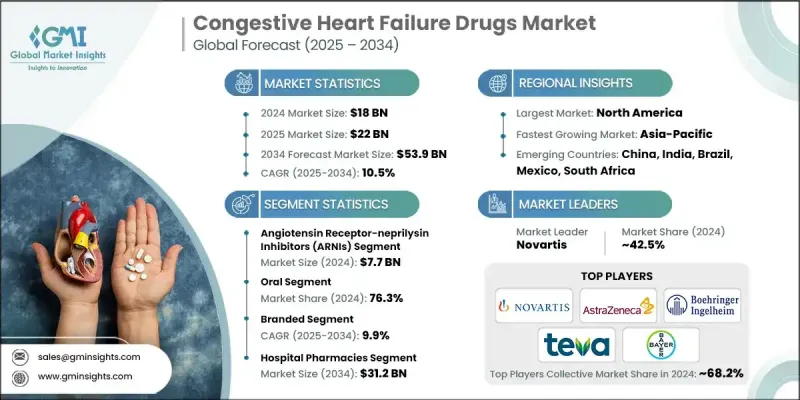
시장 성장은 심부전 유병률 증가, 의약품 개발의 발전, 가이드라인에 기반한 약물 치료의 확대에 의해 주도되고 있습니다. ACE 억제제, 베타차단제, 이뇨제 등 기존 치료제와 더불어 SGLT2 억제제, ARNIs 등 새로운 약제군의 도입 확대로 생존율이 향상되고 입원이 감소하고 있어 대상 환자군이 확대되고 있습니다. 원격 의료와 원격 모니터링의 통합이 진행됨에 따라 조기 개입, 보다 엄격한 치료 최적화, 장기적인 복약 순응도 향상, 급성기 및 만성기 치료 환경 모두에서 약물 사용을 촉진하고 있습니다. 제약사들은 또한 파이프라인 혁신, 병용요법, 광범위한 심부전 표현형에 대한 적응증 확대에 집중하고 있으며, 이는 예측 기간 동안 시장 성장을 더욱 가속화할 것입니다.
| 시장 범위 | |
|---|---|
| 개시 연도 | 2024년 |
| 예측 기간 | 2025-2034년 |
| 개시 연도 시장 규모 | 180억 달러 |
| 예측 금액 | 539억 달러 |
| CAGR | 10.5% |
울혈성 심부전 치료제 시장은 주로 투여 경로에 따라 분류되며, 2024년 경구 투여 부문이 76.3%를 차지할 것으로 예측됩니다. 경구용 치료제는 편리성, 자가 투여의 용이성, 낮은 투여 비용, 그리고 만성 심부전의 장기적인 재택 관리 적합성 때문에 선호되고 있습니다. 서방형 제제, 1일 1회 투여 제제, 고정용량 복합제는 복잡한 치료 계획을 간소화하여 여러 동반 질환을 관리하는 환자의 복약 순응도와 치료 결과를 개선합니다. 또한, ACE 억제제, 베타차단제, SGLT2 억제제 등 강력한 경구용 약물의 보급 확대는 외래 진료 및 원격의료 활용 진료 모델 모두에서 이 부문의 우위를 강화하고 있습니다.
유통 채널별로는 급성 심부전 환자의 높은 부담(집중적인 프로토콜에 기반한 치료가 필요한)을 배경으로 2024년 병원 약국 부문은 312억 달러 시장 규모를 창출할 것으로 예측됩니다. 이들 시설에서는 정맥강심제, 이뇨제, ARNIs(아르기닐리신뉴클레오티드분해효소억제제), SGLT2 억제제 등 첨단 치료제를 복합적으로 조합하여 관리함으로써 막대한 약품 소비를 견인하고, 치료 시작과 최적화를 위한 중요한 거점으로서 병원 약국의 위상을 확립하고 있습니다. 하고 있습니다.
북미 울혈성 심부전 치료제 시장은 2024년 53.9%의 점유율을 차지했습니다. 이러한 우위는 많은 진단 환자 수, 혁신적 치료법의 조기 도입, 강력한 상환 제도, 그리고 가이드라인 업데이트와 신물질 도입을 가속화하는 탄탄한 임상 연구 인프라에 의해 뒷받침되고 있습니다.
자주 묻는 질문
목차
제1장 조사 방법과 범위
제2장 주요 요약
제3장 업계 인사이트
- 생태계 분석
- 업계에 대한 영향요인
- 성장 촉진요인
- 업계의 잠재적 리스크&과제
- 업계의 잠재적 리스크&과제
- 성장 가능성 분석
- 규제 상황
- 북미
- 미국
- 캐나다
- 유럽
- 아시아태평양
- 라틴아메리카
- 중동 및 아프리카
- 북미
- 기술 환경
- 현재 기술 동향
- 신기술
- 파이프라인 분석
- 향후 시장 동향
- Porter's Five Forces 분석
- PESTEL 분석
제4장 경쟁 구도
- 서론
- 기업의 시장 점유율 분석
- 세계
- 북미
- 유럽
- 아시아태평양
- 기업 매트릭스 분석
- 주요 시장 기업의 경쟁 분석
- 경쟁 포지셔닝 매트릭스
- 주요 발전
제5장 시장 추산 및 예측 : 약제 클래스별, 2021-2034
- 주요 동향
- ACE 억제제
- 베타 차단제
- 이뇨제
- 안지오텐신 II 수용체 차단제
- 미네랄 코르티코이드 수용체 길항제(MRA)
- 안지오텐신 수용체 네프릴리신 억제제(ARNI)
- 강심제
- SGLT2 억제제
- 기타 약제 분류
제6장 시장 추산 및 예측 : 투여 경로별, 2021-2034
- 주요 동향
- 경구 투여
- 비경구
제7장 시장 추산 및 예측 : 유형별, 2021-2034
- 주요 동향
- 브랜드 제품
- 제네릭
제8장 시장 추산 및 예측 : 유통 채널별, 2021-2034
- 주요 동향
- 병원 약국
- 소매 약국
- 온라인 약국
제9장 시장 추산 및 예측 : 지역별, 2021-2034
- 주요 동향
- 북미
- 미국
- 캐나다
- 유럽
- 독일
- 영국
- 프랑스
- 이탈리아
- 스페인
- 네덜란드
- 아시아태평양
- 중국
- 일본
- 인도
- 호주
- 한국
- 라틴아메리카
- 브라질
- 멕시코
- 아르헨티나
- 중동 및 아프리카
- 남아프리카공화국
- 사우디아라비아
- 아랍에미리트(UAE)
제10장 기업 개요
- Alnylam Pharmaceuticals
- Amgen
- AstraZeneca
- Bayer
- Boehringer Ingelheim International
- Bristol-Myers Squibb Company
- Eli Lilly and Company
- GlaxoSmithKline
- Johnson &Johnson
- Merck
- Novartis
- Otsuka Pharmaceutical
- Pfizer
- Sanofi
- Teva Pharmaceutical Industries
The Global Congestive Heart Failure Drugs Market was valued at USD 18 billion in 2024 and is estimated to grow at a CAGR of 10.5% to reach USD 53.9 billion by 2034.
Market growth is driven by the rising prevalence of heart failure, advances in drug development, and the expansion of guideline-directed medical therapy. Growing adoption of novel classes such as SGLT2 inhibitors and ARNIs, alongside established therapies like ACE inhibitors, beta-blockers, and diuretics, is improving survival outcomes and reducing hospitalizations, thereby expanding the addressable patient pool. Increasing integration of telemedicine and remote monitoring is enabling earlier intervention, tighter therapy optimization, and better long-term adherence, which in turn is boosting drug utilization across acute and chronic care settings. Pharmaceutical companies are also focusing heavily on pipeline innovation, combination therapies, and label expansions into broader heart failure phenotypes, further accelerating market momentum over the forecast horizon.
| Market Scope | |
|---|---|
| Start Year | 2024 |
| Forecast Year | 2025-2034 |
| Start Value | $18 Billion |
| Forecast Value | $53.9 Billion |
| CAGR | 10.5% |
The Congestive Heart Failure Drugs Market is primarily segmented by route of administration, where the oral segment held 76.3% in 2024. Oral therapies are preferred due to their convenience, ease of self-administration, lower administration costs, and suitability for long-term, home-based management of chronic heart failure. Extended-release, once-daily, and fixed-dose combination formulations simplify complex regimens, improving adherence and outcomes for patients managing multiple comorbidities. In addition, the expanding availability of potent oral agents such as ACE inhibitors, beta-blockers, and SGLT2 inhibitors reinforces the dominance of this segment in both outpatient and telemedicine-enabled care models.
By distribution channel, the hospital pharmacies segment generated USD 31.2 billion in 2024, underpinned by the high burden of acute decompensated heart failure cases requiring intensive, protocol-driven therapy. These settings manage complex combinations of intravenous inotropes, diuretics, and advanced therapies like ARNIs and SGLT2 inhibitors, driving substantial drug consumption and positioning hospital pharmacies as a critical node in treatment initiation and optimization.
North America Congestive Heart Failure Drugs Market held a 53.9% share in 2024. This dominance is supported by a high diagnosed patient base, early adoption of innovative therapies, strong reimbursement frameworks, and robust clinical research infrastructure that accelerates guideline updates and uptake of new molecules.
Key companies operating in the Global Congestive Heart Failure Drugs Market include Novartis, AstraZeneca, Boehringer Ingelheim, Bayer, Teva Pharmaceutical, Pfizer, Sanofi, Johnson & Johnson, GlaxoSmithKline, Merck & Co., Merck KGaA, Lexicon Pharmaceuticals, Zensun Sci & Tech, Amgen, and AdvaCare Pharma, which collectively shape the competitive landscape through extensive portfolios, global commercial footprints, and active R&D strategies. In the Congestive Heart Failure Drugs Market, leading companies are adopting a mix of product innovation, lifecycle management, strategic collaborations, and geographic expansion to strengthen their market foothold. Many players are investing heavily in R&D for novel mechanisms of action, including SGLT2 inhibitors, ARNI-based combinations, vasodilators, and other advanced drug classes, while also pursuing label expansions into broader heart failure populations such as HFpEF and patients with comorbid diabetes or chronic kidney disease.
Table of Contents
Chapter 1 Methodology and Scope
- 1.1 Market scope and definition
- 1.2 Research design
- 1.2.1 Research approach
- 1.2.2 Data collection methods
- 1.3 Data mining sources
- 1.3.1 Global
- 1.3.2 Regional/Country
- 1.4 Base estimates and calculations
- 1.4.1 Base year calculation
- 1.4.2 Key trends for market estimation
- 1.5 Primary research and validation
- 1.5.1 Primary sources
- 1.6 Forecast model
- 1.7 Research assumptions and limitations
Chapter 2 Executive Summary
- 2.1 Industry 360° synopsis
- 2.2 Key market trends
- 2.2.1 Regional trends
- 2.2.2 Drug class trends
- 2.2.3 Route of administration trends
- 2.2.4 Type trends
- 2.2.5 Distribution channel trends
- 2.3 CXO perspectives: Strategic imperatives
- 2.3.1 Key decision points for industry executives
- 2.3.2 Critical success factors for market players
- 2.4 Future outlook and strategic recommendations
Chapter 3 Industry Insights
- 3.1 Industry ecosystem analysis
- 3.2 Industry impact forces
- 3.2.1 Growth drivers
- 3.2.1.1 Rising prevalence of heart failure
- 3.2.1.2 Advancements in drug development
- 3.2.1.3 Increasing awareness and screening
- 3.2.2 Industry pitfalls and challenges
- 3.2.2.1 Stringent regulatory approval
- 3.2.2.2 High cost of advanced medications
- 3.2.3 Industry pitfalls and challenges
- 3.2.3.1 Development of novel drug classes
- 3.2.3.2 Integration of telemedicine and remote monitoring for CHF management
- 3.2.1 Growth drivers
- 3.3 Growth potential analysis
- 3.4 Regulatory landscape
- 3.4.1 North America
- 3.4.1.1 U.S.
- 3.4.1.2 Canada
- 3.4.2 Europe
- 3.4.3 Asia Pacific
- 3.4.4 Latin America
- 3.4.5 Middle East and Africa
- 3.4.1 North America
- 3.5 Technology landscape
- 3.5.1 Current technological trends
- 3.5.2 Emerging technologies
- 3.6 Pipeline analysis
- 3.7 Future market trends
- 3.8 Porter's analysis
- 3.9 PESTEL analysis
Chapter 4 Competitive Landscape, 2024
- 4.1 Introduction
- 4.2 Company market share analysis
- 4.2.1 Global
- 4.2.2 North America
- 4.2.3 Europe
- 4.2.4 Asia Pacific
- 4.3 Company matrix analysis
- 4.4 Competitive analysis of major market players
- 4.5 Competitive positioning matrix
- 4.6 Key developments
Chapter 5 Market Estimates and Forecast, By Drug Class, 2021 - 2034 ($ Mn)
- 5.1 Key trends
- 5.2 ACE inhibitors
- 5.3 Beta blockers
- 5.4 Diuretics
- 5.5 Angiotensin 2 receptor blockers
- 5.6 Mineralocorticoid receptor antagonists (MRAs)
- 5.7 Angiotensin receptor-neprilysin inhibitors (ARNIs)
- 5.8 Inotropes
- 5.9 SGLT2 inhibitors
- 5.10 Other drug classes
Chapter 6 Market Estimates and Forecast, By Route of Administration, 2021 - 2034 ($ Mn)
- 6.1 Key trends
- 6.2 Oral
- 6.3 Parenteral
Chapter 7 Market Estimates and Forecast, By Type, 2021 - 2034 ($ Mn)
- 7.1 Key trends
- 7.2 Branded
- 7.3 Generic
Chapter 8 Market Estimates and Forecast, By Distribution Channel, 2021 - 2034 ($ Mn)
- 8.1 Key trends
- 8.2 Hospital pharmacies
- 8.3 Retail pharmacies
- 8.4 Online pharmacies
Chapter 9 Market Estimates and Forecast, By Region, 2021 - 2034 ($ Mn)
- 9.1 Key trends
- 9.2 North America
- 9.2.1 U.S.
- 9.2.2 Canada
- 9.3 Europe
- 9.3.1 Germany
- 9.3.2 UK
- 9.3.3 France
- 9.3.4 Italy
- 9.3.5 Spain
- 9.3.6 Netherlands
- 9.4 Asia Pacific
- 9.4.1 China
- 9.4.2 Japan
- 9.4.3 India
- 9.4.4 Australia
- 9.4.5 South Korea
- 9.5 Latin America
- 9.5.1 Brazil
- 9.5.2 Mexico
- 9.5.3 Argentina
- 9.6 Middle East and Africa
- 9.6.1 South Africa
- 9.6.2 Saudi Arabia
- 9.6.3 UAE
Chapter 10 Company Profiles
- 10.1 Alnylam Pharmaceuticals
- 10.2 Amgen
- 10.3 AstraZeneca
- 10.4 Bayer
- 10.5 Boehringer Ingelheim International
- 10.6 Bristol-Myers Squibb Company
- 10.7 Eli Lilly and Company
- 10.8 GlaxoSmithKline
- 10.9 Johnson & Johnson
- 10.10 Merck
- 10.11 Novartis
- 10.12 Otsuka Pharmaceutical
- 10.13 Pfizer
- 10.14 Sanofi
- 10.15 Teva Pharmaceutical Industries