|
시장보고서
상품코드
1892817
양면 태양광 모듈 시장 기회, 성장요인, 업계 동향 분석 및 예측(2026-2035년)Bifacial Solar Module Market Opportunity, Growth Drivers, Industry Trend Analysis, and Forecast 2026 - 2035 |
||||||

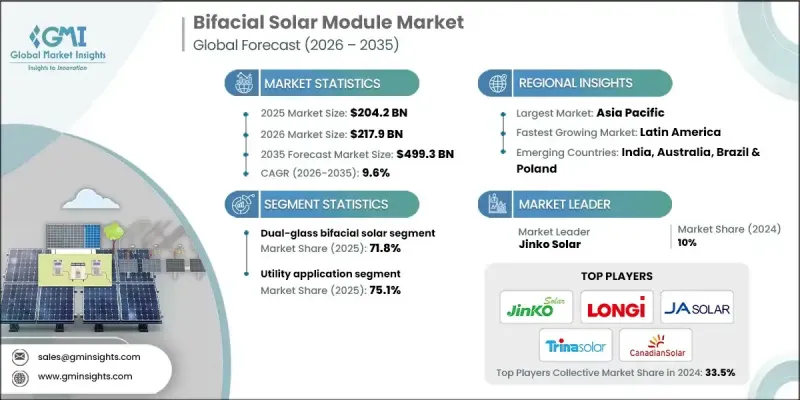
세계의 양면 태양광 모듈 시장은 2025년에 2,042억 달러로 평가되었고, 2035년까지 연평균 복합 성장률(CAGR) 9.6%로 성장하여 4,993억 달러에 이를 것으로 예측됩니다.
시장 성장의 모멘텀은 특히 대규모 재생에너지 개발에서 같은 면적에서 더 많은 전력을 생산할 수 있는 고용량 태양광 솔루션에 대한 수요 증가에 의해 뒷받침되고 있습니다. n형 PERC, TOPCon, 헤테로 접합 기술 등 첨단 셀 구조는 변환 효율 향상, 열화 억제, 장기 성능 강화로 채택이 가속화되고 있습니다. 양면 수광형 태양전지 모듈은 패널의 양면에서 태양광을 포착하도록 설계되어 전면의 직사광선과 후면의 반사광 및 확산광 모두에서 발전이 가능합니다. 이 구성은 기존의 단면 모듈에 비해 총 발전량이 증가합니다. 가혹한 환경에서의 도입이 확대됨에 따라 제조업체들은 더 긴 수명에 걸쳐 신뢰할 수 있는 성능을 제공하는 더 견고한 모듈식 설계를 개발하고 있습니다. 셀 효율과 모듈 내구성이 지속적으로 향상됨에 따라 양면 기술은 현대 태양광 발전 설비에서 에너지 수율을 극대화하는 최적의 솔루션으로서의 역할을 강화하고 있습니다.
| 시장 범위 | |
|---|---|
| 개시 연도 | 2025년 |
| 예측 연도 | 2026-2035년 |
| 개시 연도 시장 규모 | 2,042억 달러 |
| 예측 금액 | 4,993억 달러 |
| CAGR | 9.6% |
이중 유리 양면형 태양광 모듈 부문은 2025년 71.8%의 점유율을 차지하며 2035년까지 연평균 복합 성장률(CAGR) 8.4%를 보일 것으로 예측됩니다. 시장 성장은 수명이 길고 구조적 강도가 높은 모듈에 대한 수요 증가에 의해 주도되고 있습니다. 양면 유리 구조는 환경적 스트레스에 대한 내성을 향상시키고 장기적인 신뢰성을 높여 대규모 발전소 및 상업시설의 운영 비용 절감과 재무적 수익률 향상에 기여합니다.
상업 및 산업 부문은 2035년까지 연평균 10.8%의 연평균 복합 성장률(CAGR)을 보일 것으로 예측됩니다. 설치 공간이 제한된 환경에서 발전량 극대화가 필요하기 때문에 이 부문에서 채택이 증가하고 있습니다. 양면 모듈은 시스템 규모를 확대하지 않고도 고출력을 실현하여 에너지 경제성 향상에 기여하기 때문에 사업시설의 보급 확대를 촉진하고 있습니다.
미국 양면 태양전지 모듈 시장은 2025년 95.8%의 점유율을 차지하며 2035년까지 390억 달러 규모에 달할 것으로 예측됩니다. 첨단 태양광 기술에 대한 강한 수요와 함께 대규모 태양광 발전 시설의 확대와 연방 정부의 지원책이 결합되어 시장 침투를 지속적으로 촉진하고 있습니다. 개발 사업자들은 프로젝트 수익 향상과 가용한 토지 자원으로부터의 에너지 생산 최적화를 위해 양면 시스템에 대한 의존도를 높이고 있습니다.
자주 묻는 질문
목차
제1장 조사 방법과 범위
제2장 주요 요약
제3장 업계 인사이트
- 업계 에코시스템
- 원재료 가용성과 조달 분석
- 제조능력 평가
- 공급망 회복력과 리스크 요인
- 유통 네트워크 분석
- 규제 상황
- 업계에 대한 영향요인
- 성장 촉진요인
- 업계의 잠재적 리스크&과제
- 성장 가능성 분석
- 비용 구조 분석
- Porter's Five Forces 분석
- PESTEL 분석
- 새로운 기회와 동향
- 디지털화와 IoT 통합
- 신흥 시장 진출
- 투자 분석과 전망
제4장 경쟁 구도
- 서론
- 기업의 시장 점유율 분석 : 지역별
- 북미
- 유럽
- 아시아태평양
- 라틴아메리카
- 중동 및 아프리카
- 전략적 대시보드
- 전략적 이니셔티브
- 기업 벤치마킹
- 혁신과 기술 동향
제5장 시장 규모와 예측 : 두께별, 2022-2035
- 주요 동향
- 2mm 미만
- 2mm-3mm
- 3mm 이상
제6장 시장 규모와 예측 : 유형별, 2022-2035
- 주요 동향
- 양면 유리형 양면 태양광
- 유리 백시트 양면 태양광
제7장 시장 규모와 예측 : 용도별, 2022-2035
- 주요 동향
- 주택
- 상업 및 산업
- 유틸리티
제8장 시장 규모와 예측 : 기술별, 2022-2035
- 주요 동향
- Passivated Emitter Rear Contact (PERC)
- TOPCon
- Heterojunction (HJT)
제9장 시장 규모와 예측 : 프레임 유형별, 2022-2035
- 주요 동향
- 프레임
- 프레임리스
제10장 시장 규모와 예측 : 지역별, 2022-2035
- 주요 동향
- 북미
- 미국
- 캐나다
- 유럽
- 독일
- 스페인
- 네덜란드
- 폴란드
- 아시아태평양
- 중국
- 호주
- 인도
- 일본
- 중동 및 아프리카
- 아랍에미리트(UAE)
- 튀르키예
- 이집트
- 라틴아메리카
- 브라질
- 칠레
제11장 기업 개요
- 3Sun
- AE Solar
- Astronergy
- Axitec
- Bluesun Solar
- Boviet Solar
- Canadian Solar
- First Solar
- Hanwha Q CELLS
- JA Solar Technology
- Jinko Solar
- LONGi Green Energy Technology
- Primroot
- Seraphim Solar
- Sharp Corporation
- Silfab Solar
- Sunergy
- Trina Solar
- Vikram Solar
- Yingli Solar
The Global Bifacial Solar Module Market was valued at USD 204.2 billion in 2025 and is estimated to grow at a CAGR of 9.6% to reach USD 499.3 billion by 2035.
Market momentum is supported by rising demand for high-capacity solar solutions that deliver greater electricity output from the same land area, particularly in large-scale renewable energy developments. Advanced cell architectures, including n-type PERC, TOPCon, and heterojunction technologies, are accelerating adoption by improving conversion efficiency, reducing degradation, and enhancing long-term performance. Bifacial solar modules are designed to capture solar radiation from both sides of the panel, allowing energy generation from direct sunlight on the front surface and reflected or diffused light on the rear side. This configuration increases overall power output compared to conventional single-sided modules. Growing deployment in demanding environments has encouraged manufacturers to engineer more resilient module designs that deliver reliable performance over extended operating lifetimes. Continuous improvements in cell efficiency and module durability are strengthening the role of bifacial technology as a preferred solution for maximizing energy yield in modern solar installations.
| Market Scope | |
|---|---|
| Start Year | 2025 |
| Forecast Year | 2026-2035 |
| Start Value | $204.2 Billion |
| Forecast Value | $499.3 Billion |
| CAGR | 9.6% |
The dual-glass bifacial solar modules segment accounted for 71.8% share in 2025 and is forecast to grow at a CAGR of 8.4% through 2035. Market growth is driven by increasing preference for modules with extended lifespan and higher structural strength. Dual-glass construction improves resistance to environmental stressors and enhances long-term reliability, which supports lower operating expenses and stronger financial returns for both utility-scale and commercial deployments.
The commercial and industrial segment is expected to register a CAGR of 10.8% through 2035. Adoption in this segment is driven by the need to maximize electricity generation where installation space is constrained. Bifacial modules enable higher output without expanding system size, which supports improved energy economics and drives wider use across business facilities.
U.S. Bifacial Solar Module Market held 95.8% share in 2025 and is expected to reach USD 39 billion by 2035. Strong demand for advanced solar technologies, combined with expanding large-scale solar installations and supportive federal incentive structures, continues to boost market penetration. Developers increasingly rely on bifacial systems to enhance project returns and optimize energy production from available land resources.
Key companies active in the Global Bifacial Solar Module Market include Jinko Solar, Canadian Solar, LONGi Green Energy Technology, Trina Solar, JA Solar Technology, Hanwha Q CELLS, First Solar, Sharp Corporation, Vikram Solar, Silfab Solar, Astronergy, AE Solar, Axitec, Boviet Solar, Bluesun Solar, Seraphim Solar, Yingli Solar, Primroot, Sunergy, and 3Sun. Companies operating in the Global Bifacial Solar Module Market focus on multiple strategic initiatives to strengthen their competitive position. Manufacturers prioritize investments in research and development to enhance cell efficiency, reduce power loss, and extend product lifespan. Capacity expansion and vertical integration strategies are adopted to control production costs and ensure stable supply chains. Strategic partnerships with project developers and energy providers help accelerate market penetration and secure long-term contracts. Firms also emphasize geographic expansion to capture demand in high-growth regions while aligning product portfolios with local regulatory frameworks.
Table of Contents
Chapter 1 Methodology & Scope
- 1.1 Research design
- 1.1.1 Research approach
- 1.1.2 Data collection methods
- 1.2 Base estimates and calculations
- 1.2.1 Base year calculation
- 1.2.2 Market estimates & forecast parameters
- 1.3 Forecast
- 1.3.1 Key trends for market estimates
- 1.3.1.1 Quantified market impact analysis
- 1.3.2 Mathematical impact of growth parameters on forecast
- 1.3.3 Scenario analysis framework
- 1.3.1 Key trends for market estimates
- 1.4 Primary research and validation
- 1.4.1 Some of the primary sources (but not limited to)
- 1.5 Data mining sources
- 1.5.1 Paid Sources
- 1.5.2 Sources, by region
- 1.6 Research trail & scoring components
- 1.6.1 Research trail components
- 1.6.2 Scoring components
- 1.7 Research transparency addendum
- 1.7.1 Source attribution framework
- 1.7.2 Quality assurance metrics
- 1.7.3 Our commitment to trust
- 1.8 Market definitions
Chapter 2 Executive Summary
- 2.1 Industry synopsis, 2022 - 2035
- 2.2 Business trends
- 2.3 Thickness trends
- 2.4 Type trends
- 2.5 Application trends
- 2.6 Technology trends
- 2.7 Frame type trends
- 2.8 Regional trends
Chapter 3 Industry Insights
- 3.1 Industry ecosystem
- 3.1.1 Raw material availability & sourcing analysis
- 3.1.2 Manufacturing capacity assessment
- 3.1.3 Supply chain resilience & risk factors
- 3.1.4 Distribution network analysis
- 3.2 Regulatory landscape
- 3.3 Industry impact forces
- 3.3.1 Growth drivers
- 3.3.2 Industry pitfalls & challenges
- 3.4 Growth potential analysis
- 3.5 Cost structure analysis
- 3.6 Porter's analysis
- 3.6.1 Bargaining power of suppliers
- 3.6.2 Bargaining power of buyers
- 3.6.3 Threat of new entrants
- 3.6.4 Threat of substitutes
- 3.7 PESTEL analysis
- 3.7.1 Political factors
- 3.7.2 Economic factors
- 3.7.3 Social factors
- 3.7.4 Technological factors
- 3.7.5 Legal factors
- 3.7.6 Environmental factors
- 3.8 Emerging opportunities & trends
- 3.8.1 Digitalization & IoT integration
- 3.8.2 Emerging market penetration
- 3.9 Investment analysis and future outlook
Chapter 4 Competitive landscape, 2025
- 4.1 Introduction
- 4.2 Company market share analysis, by region, 2025
- 4.2.1 North America
- 4.2.2 Europe
- 4.2.3 Asia Pacific
- 4.2.4 Latin America
- 4.2.5 Middle East & Africa
- 4.3 Strategic dashboard
- 4.4 Strategic initiatives
- 4.5 Company benchmarking
- 4.6 Innovation & technology landscape
Chapter 5 Market Size and Forecast, By Thickness, 2022 - 2035 (USD Billion)
- 5.1 Key trends
- 5.2 < 2 mm
- 5.3 2 mm to 3 mm
- 5.4 > 3 mm
Chapter 6 Market Size and Forecast, By Type, 2022 - 2035 (USD Billion)
- 6.1 Key trends
- 6.2 Dual-Glass Bifacial Solar
- 6.3 Glass-Backsheet Bifacial Solar
Chapter 7 Market Size and Forecast, By Application, 2022 - 2035 (USD Billion)
- 7.1 Key trends
- 7.2 Residential
- 7.3 Commercial & Industrial
- 7.4 Utility
Chapter 8 Market Size and Forecast, By Technology, 2022 - 2035 (USD Billion)
- 8.1 Key trends
- 8.2 Passivated Emitter Rear Contact (PERC)
- 8.3 TOPCon
- 8.4 Heterojunction (HJT)
Chapter 9 Market Size and Forecast, By Frame Type, 2022 - 2035 (USD Billion)
- 9.1 Key trends
- 9.2 Framed
- 9.3 Frameless
Chapter 10 Market Size and Forecast, By Region, 2022 - 2035 (USD Billion)
- 10.1 Key trends
- 10.2 North America
- 10.2.1 U.S.
- 10.2.2 Canada
- 10.3 Europe
- 10.3.1 Germany
- 10.3.2 Spain
- 10.3.3 Netherlands
- 10.3.4 Poland
- 10.4 Asia Pacific
- 10.4.1 China
- 10.4.2 Australia
- 10.4.3 India
- 10.4.4 Japan
- 10.5 Middle East & Africa
- 10.5.1 UAE
- 10.5.2 Turkey
- 10.5.3 Egypt
- 10.6 Latin America
- 10.6.1 Brazil
- 10.6.2 Chile
Chapter 11 Company Profiles
- 11.1 3Sun
- 11.2 AE Solar
- 11.3 Astronergy
- 11.4 Axitec
- 11.5 Bluesun Solar
- 11.6 Boviet Solar
- 11.7 Canadian Solar
- 11.8 First Solar
- 11.9 Hanwha Q CELLS
- 11.10 JA Solar Technology
- 11.11 Jinko Solar
- 11.12 LONGi Green Energy Technology
- 11.13 Primroot
- 11.14 Seraphim Solar
- 11.15 Sharp Corporation
- 11.16 Silfab Solar
- 11.17 Sunergy
- 11.18 Trina Solar
- 11.19 Vikram Solar
- 11.20 Yingli Solar