

|
시장보고서
상품코드
1892851
자율주행 농업 차량 시장 기회, 성장요인, 업계 동향 분석 및 예측(2025-2034년)Autonomous Agricultural Vehicle Market Opportunity, Growth Drivers, Industry Trend Analysis, and Forecast 2025 - 2034 |
||||||

세계의 자율주행 농업 차량 시장은 2024년에 67억 달러로 평가되었고, 2034년까지 연평균 복합 성장률(CAGR) 13.4%로 성장하여 237억 달러에 이를 것으로 예측됩니다.
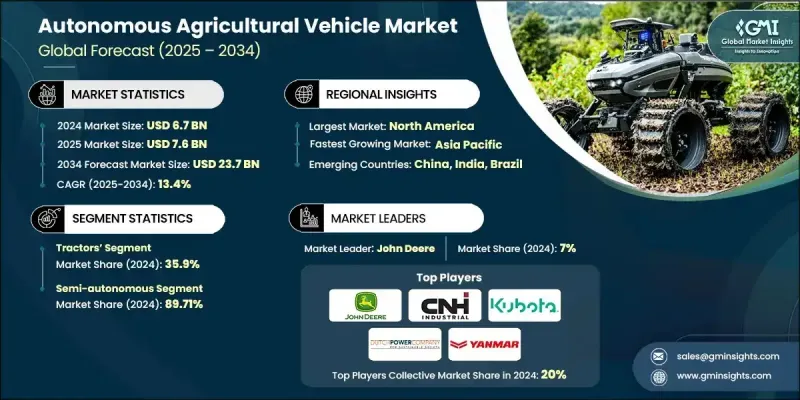
농부들이 노동력에 대한 의존도를 줄이면서 생산성을 높이려는 움직임이 강화되면서 시장은 계속 확대되고 있습니다. 농업 작업 전반에 걸쳐 자동화와 스마트 기술의 통합이 진행되면서 자율주행 트랙터, 수확기, 작물 재배 및 작물 모니터링, 수확을 지원하는 특수 로봇에 대한 수요가 증가하고 있습니다. 인건비 상승과 수확량 극대화에 대한 요구가 농가의 자율 시스템 도입을 촉진하고 있습니다. 또한, 세계 인구 증가와 식량 수요 증가로 인해 보다 효율적인 농법의 필요성이 대두되고 있습니다. 전기 및 하이브리드 농기계의 혁신, 첨단 센서 융합 기술, 농장 관리 소프트웨어와의 원활한 연계를 통해 차량의 효율성, 정확성, 신뢰성을 향상시키고 있습니다. 이러한 기술 발전으로 자율주행 농업용 차량은 현대 농업에서 없어서는 안 될 필수적인 도구로 자리매김하고 있습니다.
| 시장 범위 | |
|---|---|
| 개시 연도 | 2024년 |
| 예측 연도 | 2025-2034년 |
| 개시 연도 시장 규모 | 67억 달러 |
| 예측 금액 | 237억 달러 |
| CAGR | 13.4% |
2024년 트랙터 부문은 35.9%의 점유율을 차지했습니다. 트랙터는 경작, 파종, 재배, 수확, 농산물 운송 등의 작업을 담당하며 현대 농업의 근간을 이루고 있습니다. 단일 기계로 여러 농작업을 수행할 수 있는 다재다능함으로 인해 자율주행의 이상적인 후보로 떠오르고 있습니다.
2024년 반자율형 부문은 89.71%의 점유율을 차지했습니다. GPS 유도 조향, 자동 구획 살포기 제어, 기본 작업기 관리 등을 포함한 반자율형 솔루션은 인간 작업자의 능력을 완전히 대체하는 것이 아니라 강화하는 것입니다. 이러한 광범위한 채택은 농업 분야에서 보조 자동화의 현재 성숙도와 선호도를 잘 보여주고 있습니다.
북미 자율주행 농업용 차량 시장은 2024년 44.1%의 점유율을 차지하며 가장 빠르게 성장하는 지역입니다. 이 지역의 농가는 선진 기술을 일찍 도입한 농가들이며, 대규모 농장의 보급으로 자율 주행 차량의 단위당 투자비용이 낮아져 규모의 경제 효과를 누릴 수 있기 때문입니다.
자주 묻는 질문
목차
제1장 조사 방법과 범위
제2장 주요 요약
제3장 업계 인사이트
- 생태계 분석
- 공급업체 상황
- 이익률
- 각 단계별 부가가치
- 밸류체인에 영향을 미치는 요인
- 업계에 대한 영향요인
- 성장 촉진요인
- 업계의 잠재적 리스크&과제
- 기회
- 성장 가능성 분석
- 향후 시장 동향
- 기술과 혁신 동향
- 현재 기술 동향
- 신기술
- 가격 동향
- 지역별
- 유형별
- 규제 상황
- 규격 및 컴플라이언스 요건
- 지역별 규제 구조
- 인증 기준
- Porter's Five Forces 분석
- PESTEL 분석
제4장 경쟁 구도
- 서론
- 기업의 시장 점유율 분석
- 지역별
- 기업 매트릭스 분석
- 주요 시장 기업의 경쟁 분석
- 경쟁 포지셔닝 매트릭스
- 주요 발전
- 인수합병(M&A)
- 제휴 및 협업
- 신제품 발매
- 확대 계획
제5장 시장 추산 및 예측 : 제품별, 2021-2034
- 주요 동향
- 트랙터
- 20마력 미만
- 21-45마력
- 46-60마력
- 61-75마력
- 75마력 이상
- 수확기
- 자주식 콤바인
- 기존 콤바인
- 로터리 콤바인
- 제어 콤바인
- 자주식 콤바인
- 파종기
- 살포식 파종기
- 드롭식 파종기
- 공기식 파종기
- 정밀 파종기
- 기타(FINGER 배정기 등)
- 분무기
- 핸드헬드 분무기
- 백팩 분무기
- 에어리스 분무기
- 압축 분무기
- 미스트 분무기
제6장 시장 추산·예측, 자동화, 2021-2034
- 주요 동향
- 완전자율형
- 준자율형
제7장 시장 추산 및 예측 : 용도별, 2021-2034
- 주요 동향
- 경작
- 쟁기질
- 시비
- 수확
- 재배
- 기타
제8장 시장 추산 및 예측 : 지역별, 2021-2034
- 주요 동향
- 북미
- 미국
- 캐나다
- 유럽
- 독일
- 영국
- 프랑스
- 이탈리아
- 스페인
- 아시아태평양
- 중국
- 일본
- 인도
- 호주
- 한국
- 라틴아메리카
- 브라질
- 멕시코
- 아르헨티나
- 중동 및 아프리카
- 남아프리카공화국
- 사우디아라비아
- 아랍에미리트(UAE)
제9장 기업 개요
- ABB
- Assa Abloy
- Berger Stromversorgungen
- Camtec Power Supplies
- Delta Electronics
- Emerson
- Gebruder Frei
- Mean Well
- Murata Manufacturing
- Murrelektronik
- Schneider Electric
- Siemens
- TDK Corporation
- Weidmueller Interface
- XP Power
The Global Autonomous Agricultural Vehicle Market was valued at USD 6.7 billion in 2024 and is estimated to grow at a CAGR of 13.4% to reach USD 23.7 billion by 2034.
The market is expanding as farms increasingly seek to boost productivity while reducing reliance on labor. The integration of automation and smart technologies across agricultural operations is driving demand for self-driving tractors, harvesters, and specialized robots that assist in planting, monitoring crops, and harvesting. Rising labor costs and the need to maximize crop yields are pushing farmers to adopt these autonomous systems. Additionally, the growing global population and increasing demand for food are fueling the need for more efficient farming practices. Innovations in electric and hybrid agricultural machinery, advanced sensor fusion, and seamless connectivity with farm management software are enhancing vehicle efficiency, precision, and reliability. These technological improvements are positioning autonomous agricultural vehicles as indispensable tools in modern agriculture.
| Market Scope | |
|---|---|
| Start Year | 2024 |
| Forecast Year | 2025-2034 |
| Start Value | $6.7 Billion |
| Forecast Value | $23.7 Billion |
| CAGR | 13.4% |
In 2024, the tractors segment held a 35.9% share. Tractors remain the backbone of modern farming, performing tasks such as plowing, planting, cultivating, harvesting, and transporting produce. Their versatility makes them ideal candidates for autonomous operations, as a single machine can carry out multiple field activities.
The semi-autonomous segment held a 89.71% share in 2024. Semi-autonomous solutions, including GPS-guided steering, auto-section sprayer control, and basic implement management, enhance human operator capabilities rather than fully replacing them. This widespread adoption highlights the current maturity and preference for assisted automation in agriculture.
North America Autonomous Agricultural Vehicle Market accounted for 44.1% share in 2024 and is the fastest-growing region. Farmers in this region are early adopters of advanced technologies, and the prevalence of large-scale farms reduces the per-unit investment cost for autonomous vehicles, allowing them to benefit from economies of scale.
Major players operating in the Autonomous Agricultural Vehicle Market include AGCO, John Deere, CNH Industrial, Kubota Corporation, Dutch Power Company, Yanmar Co. Ltd, Zimeno Inc., AutoNxt Automation, Argo Tractors, Monarch Tractors, Case IH, and New Holland. Companies in the Autonomous Agricultural Vehicle Market focus on continuous innovation in robotics, electrification, and sensor integration to enhance vehicle efficiency and performance. Firms invest heavily in research and development to develop versatile machines capable of multiple tasks and operating in diverse agricultural conditions. Strategic partnerships with technology providers, software developers, and farm management platforms help companies integrate precision farming solutions. Expanding global distribution networks and after-sales service infrastructure ensures market reach and customer support. Companies also offer training programs and demonstration initiatives to educate farmers on autonomous technology benefits. Customizing vehicles for regional crops, terrains, and farm sizes strengthens market penetration.
Table of Contents
Chapter 1 Methodology and Scope
- 1.1 Market scope and definition
- 1.2 Research design
- 1.2.1 Research approach
- 1.2.2 Data collection methods
- 1.3 Data mining sources
- 1.3.1 Global
- 1.3.2 Regional/Country
- 1.4 Base estimates and calculations
- 1.4.1 Base year calculation
- 1.4.2 Key trends for market estimation
- 1.5 Primary research and validation
- 1.5.1 Primary sources
- 1.6 Forecast model
- 1.7 Research assumptions and limitations
Chapter 2 Executive Summary
- 2.1 Industry 360° synopsis
- 2.2 Key market trends
- 2.2.1 Regional
- 2.2.2 Product
- 2.2.3 Automation
- 2.2.4 Application
- 2.3 CXO perspectives: Strategic imperatives
- 2.3.1 Key decision points for industry executives
- 2.3.2 Critical success factors for market players
- 2.4 Future outlook and strategic recommendations
Chapter 3 Industry Insights
- 3.1 Industry ecosystem analysis
- 3.1.1 Supplier landscape
- 3.1.2 Profit margin
- 3.1.3 Value addition at each stage
- 3.1.4 Factor affecting the value chain
- 3.2 Industry impact forces
- 3.2.1 Growth drivers
- 3.2.1.1 Big Labor Shortages
- 3.2.1.2 Tech Getting Cheaper & Better
- 3.2.1.3 Global Push for Precision Farming
- 3.2.2 Industry pitfalls & challenges
- 3.2.2.1 Stricter Government Regulations (Safety & Efficiency)
- 3.2.2.2 Shift from "Autonomous" to "AI-Enhanced"
- 3.2.3 Opportunities
- 3.2.3.1 Modular, Small Robot Fleets
- 3.2.3.2 Data-as-a-Service (DaaS) Integration
- 3.2.1 Growth drivers
- 3.3 Growth potential analysis
- 3.4 Future market trends
- 3.5 Technology and innovation landscape
- 3.5.1 Current technological trends
- 3.5.2 Emerging technologies
- 3.6 Price trends
- 3.6.1 By region
- 3.6.2 By type
- 3.7 Regulatory landscape
- 3.7.1 Standards and compliance requirements
- 3.7.2 Regional regulatory frameworks
- 3.7.3 Certification standards
- 3.8 Porter's analysis
- 3.9 PESTEL analysis
Chapter 4 Competitive Landscape, 2024
- 4.1 Introduction
- 4.2 Company market share analysis
- 4.2.1 By region
- 4.2.1.1 North America
- 4.2.1.2 Europe
- 4.2.1.3 Asia Pacific
- 4.2.1.4 Latin America
- 4.2.1.5 Middle East and Africa
- 4.2.1 By region
- 4.3 Company matrix analysis
- 4.4 Competitive analysis of major market players
- 4.5 Competitive positioning matrix
- 4.6 Key developments
- 4.6.1 Mergers & acquisitions
- 4.6.2 Partnerships & collaborations
- 4.6.3 New product launches
- 4.6.4 Expansion plans
Chapter 5 Market Estimates and Forecast, By Product, 2021 - 2034 (USD Billion) (Thousand Units)
- 5.1 Key trends
- 5.2 Tractor
- 5.2.1 Below 20 HP
- 5.2.2 21-45 HP
- 5.2.3 46-60 HP
- 5.2.4 61-75 HP
- 5.2.5 Above 75 HP
- 5.3 Harvester
- 5.3.1 Self-propelled Combine Harvesters
- 5.3.1.1 Conventional combines
- 5.3.1.2 Rotary combines
- 5.3.2 Control Combine Harvester
- 5.3.1 Self-propelled Combine Harvesters
- 5.4 Seeders
- 5.4.1 Broadcast seeder
- 5.4.2 Drop seeder
- 5.4.3 Pneumatic seeder
- 5.4.4 Precision seeder
- 5.4.5 Others (Finger seeder, etc.)
- 5.5 Sprayers
- 5.5.1 Handheld sprayers
- 5.5.2 Backpack sprayers
- 5.5.3 Airless sprayers
- 5.5.4 Compression sprayers
- 5.5.5 Mist sprayers
Chapter 6 Market Estimates and Forecast, Automation, 2021 - 2034 (USD Billion) (Thousand Units)
- 6.1 Key trends
- 6.2 Fully autonomous
- 6.3 Semi-autonomous
Chapter 7 Market Estimates and Forecast, By Application, 2021 - 2034 (USD Billion) (Thousand Units)
- 7.1 Key trends
- 7.2 Cultivating
- 7.3 Plowing
- 7.4 Fertilizing
- 7.5 Harvesting
- 7.6 Planting
- 7.7 Others
Chapter 8 Market Estimates and Forecast, By Region, 2021 - 2034 (USD Billion) (Thousand Units)
- 8.1 Key trends
- 8.2 North America
- 8.2.1 U.S.
- 8.2.2 Canada
- 8.3 Europe
- 8.3.1 Germany
- 8.3.2 UK
- 8.3.3 France
- 8.3.4 Italy
- 8.3.5 Spain
- 8.4 Asia Pacific
- 8.4.1 China
- 8.4.2 Japan
- 8.4.3 India
- 8.4.4 Australia
- 8.4.5 South Korea
- 8.5 Latin America
- 8.5.1 Brazil
- 8.5.2 Mexico
- 8.5.3 Argentina
- 8.6 Middle East and Africa
- 8.6.1 South Africa
- 8.6.2 Saudi Arabia
- 8.6.3 UAE
Chapter 9 Company Profiles
- 9.1 ABB
- 9.2 Assa Abloy
- 9.3 Berger Stromversorgungen
- 9.4 Camtec Power Supplies
- 9.5 Delta Electronics
- 9.6 Emerson
- 9.7 Gebruder Frei
- 9.8 Mean Well
- 9.9 Murata Manufacturing
- 9.10 Murrelektronik
- 9.11 Schneider Electric
- 9.12 Siemens
- 9.13 TDK Corporation
- 9.14 Weidmueller Interface
- 9.15 XP Power


