

|
시장보고서
상품코드
1892904
오토바이용 에어백 재킷 시장 기회, 성장 촉진요인, 업계 동향 분석 및 예측(2026-2035년)Motorcycle Airbag Jacket Market Opportunity, Growth Drivers, Industry Trend Analysis, and Forecast 2026 - 2035 |
||||||

세계의 오토바이용 에어백 재킷 시장은 2025년에 7억 6,530만 달러로 평가되었으며, 2035년까지 연평균 복합 성장률(CAGR) 6.8%를 나타내 15억 달러에 이를 것으로 예측됩니다.
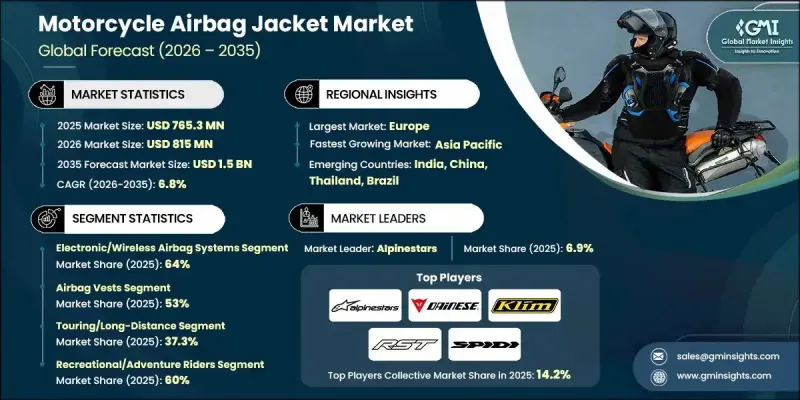
성장의 배경은 특히 유럽과 아시아태평양에서 오토바이 보급률의 상승과 안전 규제의 강화를 포함합니다. 이러한 지역은 오토바이 이용이 널리 보급되고 있는 것 외에 보호구에 관한 엄격한 법률이 시행되고 있기 때문에 시장을 견인하는 지역이 되고 있습니다. 에어백 재킷은 의무화된 보호구 프로그램에 통합되는 케이스가 증가하고 있으며, 아시아태평양이 세계 오토바이 시장에서 차지하는 큰 점유율이 수요를 더욱 밀어 올리고 있습니다. 실시간 감시 및 경보 기능 등 연결형 안전 시스템의 기술 혁신은 라이더의 안전성과 제품의 신뢰성을 높이고 있습니다. 충격 흡수 성능과 전개 신뢰성에 대한 표준화된 시험 방법도 소비자의 신뢰를 강화하고 있습니다. 충돌 보호에 대한 의식이 높아지고 세계 안전 의식이 높은 라이더 커뮤니티의 지지를 받아 프리미엄 부문와 통근 부문 모두에서 채용이 진행되고 있습니다.
| 시장 범위 | |
|---|---|
| 시작 연도 | 2025년 |
| 예측 연도 | 2026-2035년 |
| 시작 가치 | 7억 6,530만 달러 |
| 예측 금액 | 15억 달러 |
| CAGR | 6.8% |
전자 및 무선 에어백 시스템 부문은 2025년에 64%의 점유율을 차지했으며 2035년까지 연평균 복합 성장률(CAGR) 7.8%를 나타낼 것으로 예측됩니다. 전자식 시스템은 밀리 세컨드 단위로의 신속한 작동과 복수의 센서를 이용한 정밀도 향상을 실현해, 고도의 보호를 요구하는 라이더로부터 높은 지지를 얻고 있습니다.
에어백 베스트 부문은 2025년에 53%의 점유율을 차지했으며, 2026년부터 2035년까지 연평균 복합 성장률(CAGR) 7.4%를 나타낼 것으로 추정됩니다. 베스트는 라이더가 표준 재킷을 착용하면서 추가 보호 레이어를 추가할 수 있기 때문에 인기가 있습니다. 2024년에는 저렴하고 안전한 솔루션을 채택한 통근자와 교육 프로그램에 힘입어 전 세계 230만 대 이상이 판매되었습니다.
미국의 오토바이용 에어백 재킷 시장은 2025년 86.2%의 점유율을 차지하며 1억 7,480만 달러의 매출을 창출했습니다. 충돌 보호에 대한 의식이 높아지고 장거리 주행 증가, 어드벤처 및 투어링 라이더층에서의 채용 확대가 시장 성장을 견인하고 있습니다. 프로 레이서와 스턴트 라이더도 레이스 단체가 정하는 안전 기준을 배경으로 전자식 에어백 시스템의 이용을 증가시키고 있습니다. 국내 모터스포츠 이벤트도 프리미엄 제품의 보급을 더욱 뒷받침하고 있습니다.
자주 묻는 질문
목차
제1장 조사 방법
제2장 주요 요약
제3장 업계 인사이트
- 생태계 분석
- 공급업체 현황
- 이익률 분석
- 비용 구조
- 각 단계별 부가가치
- 밸류체인에 영향을 주는 요인
- 파괴적 혁신
- 업계에 미치는 영향요인
- 성장 촉진요인
- 증가하는 오토바이 사고율
- 프리미엄 안전 장비에 대한 수요 증가
- 이륜차에 의한 도시 통근 확대
- 센싱 및 인플레이션 시스템의 기술 업그레이드
- 업계의 잠재적 위험 및 과제
- 제품 가격의 높이와 한정된 저렴한
- 개발 도상 지역의 소비자 인지도의 낮음
- 시장 기회
- 전자식 에어백 시스템과 커넥티드 플랫폼의 통합이 진전하고 있습니다.
- 오토바이 관광 및 어드벤처 스포츠 성장
- 라이더 훈련 프로그램의 확충
- 성장 가능성 분석
- 규제 상황
- 북미
- 유럽
- 아시아태평양
- 라틴아메리카
- 중동 및 아프리카
- Porter's Five Forces 분석
- PESTEL 분석
- 기술 및 혁신 현황
- 현재 기술 동향
- 신흥 기술
- 가격 동향
- 국가별
- 제품별
- 생산 통계
- 생산 거점
- 소비 거점
- 수출입
- 코스트 내역 분석
- 원재료 비용
- 지역별 직접 노무비
- 공장 간접비 및 광열비
- 설비 및 기계의 감가상각
- 품질관리 및 시험비용
- 특허·지적재산 상황
- 주요 특허 보유자
- 기술 라이선싱 모델
- 특허출원 동향(2022-2025년)
- 지리적 특허 분포
- 신흥 지적재산권의 기회
- 지속가능성과 환경면
- 지속가능한 실천
- 폐기물 감축 전략
- 생산에 있어서 에너지 효율
- 환경에 배려한 대처
- 탄소발자국에 관한 고려 사항
- R&D 투자 분석
- 업계의 연구개발 지출 동향
- 기업별 연구개발 중점분야
- 대학 및 연구기관과의 제휴
- 정부 자금에 의한 조사 프로그램
- 최종 사용자 행동 분석
- 구매 결정 요인
- 프로페셔널 라이더의 행동
- 레크리에이션/어드벤처 라이더의 행동
- 일상적인 통근자의 행동
제4장 경쟁 구도
- 서론
- 기업의 시장 점유율 분석
- 북미
- 유럽
- 아시아태평양
- 라틴아메리카
- 중동 및 아프리카
- 주요 시장 기업의 경쟁 분석
- 경쟁 포지셔닝 매트릭스
- 전략적 전망 매트릭스
- 주요 발전
- 인수합병
- 파트너십 및 협력
- 신제품 출시
- 사업 확대 계획과 자금 조달
제5장 시장 추계·예측 : 기술별(2022-2035년)
- 전자식/무선 에어백 시스템
- 기계식/유선 에어백 시스템
제6장 시장 추계·예측 : 제품별(2022-2035년)
- 에어백 재킷
- 에어백 조끼
- 에어백 슈트
제7장 시장 추계·예측 : 용도별(2022-2035년)
- 도로 주행/스트리트 라이딩
- 오프로드/어드벤처 라이딩
- 레이싱/트랙 사용
- 투어링/장거리 주행
제8장 시장 추계·예측 : 최종 용도별(2022-2035년)
- 프로 모터사이클리스트
- 레크리에이션/어드벤처 라이더
- 일상 통근자
제9장 시장 추계·예측 : 유통 채널별(2022-2035년)
- 오프라인
- 온라인
제10장 시장 추계·예측 : 지역별(2022-2035년)
- 북미
- 미국
- 캐나다
- 유럽
- 독일
- 영국
- 프랑스
- 이탈리아
- 스페인
- 러시아
- 북유럽 국가
- 네덜란드
- 스웨덴
- 아시아태평양
- 중국
- 인도
- 일본
- 호주
- 한국
- 싱가포르
- 태국
- 인도네시아
- 베트남
- 라틴아메리카
- 브라질
- 멕시코
- 아르헨티나
- 중동 및 아프리카
- 남아프리카
- 사우디아라비아
- 아랍에미리트(UAE)
- 튀르키예
제11장 기업 프로파일
- 세계 기업
- Alpinestars
- Autoliv
- Dainese
- Helite
- Honda Motor
- Klim
- Mugen Denko
- Rev'It!
- 지역 기업
- Bering Moto
- BMW Motorrad
- Clover IT
- Furygan
- Held
- Ixon
- RST
- Spidi
- Tucano Urbano
- Motoairbag
- 신흥 기업/디스 랩터
- Forcefield
- GIMOTO SRL
- Icon
- In&motion
- Macna
- Point Two Air Vests
The Global Motorcycle Airbag Jacket Market was valued at USD 765.3 million in 2025 and is estimated to grow at a CAGR of 6.8% to reach USD 1.5 billion by 2035.
Growth is driven by rising motorcycle adoption and stricter safety regulations, particularly in Europe and the Asia Pacific, which are leading regions due to their extensive motorcycle usage and stringent protective gear laws. Airbag jackets are increasingly integrated into mandatory protective gear programs, while the Asia Pacific's significant share of the global motorcycle market further boosts demand. Technological innovations in connected safety systems, such as real-time monitoring and alerts, are enhancing rider safety and product credibility. Standardized testing methods for impact absorption and deployment reliability are also strengthening consumer confidence. The market is witnessing adoption across both premium and commuter segments, supported by growing awareness of crash protection and safety-conscious riding communities worldwide.
| Market Scope | |
|---|---|
| Start Year | 2025 |
| Forecast Year | 2026-2035 |
| Start Value | $765.3 Million |
| Forecast Value | $1.5 Billion |
| CAGR | 6.8% |
The electronic and wireless airbag systems segment held a 64% share in 2025, expected to grow at a CAGR of 7.8% through 2035. Electronic systems offer rapid activation within milliseconds and improved accuracy using multiple sensors, making them highly preferred among riders seeking enhanced protection.
The airbag vests segment held a 53% share in 2025 and is growing at a CAGR of 7.4% from 2026 to 2035. Vests are popular as they allow riders to wear standard jackets while adding an extra layer of protection. In 2024, over 2.3 million units were sold globally, supported by commuters and training programs adopting affordable safety solutions.
U.S. Motorcycle Airbag Jacket Market held 86.2% share, generating USD 174.8 million in 2025. Rising awareness of crash protection, increased long-distance riding, and adoption among adventure and touring motorcyclists are driving market growth. Professional racers and stunt riders are also increasingly using electronic airbag systems, encouraged by safety standards enforced by racing organizations. National motorsport events further support premium product penetration.
Key players operating in the Motorcycle Airbag Jacket Market include Alpinestars, Dainese, Furygan, Held, Helite, Ixon, Klim, Mugen Denko, RST, and Spidi. To strengthen their presence, companies are focusing on continuous innovation in electronic airbag systems to enhance activation speed, reliability, and sensor accuracy. Expanding distribution through online and offline channels improves accessibility, while collaborations with OEMs and motorcycle clubs increase adoption rates. Investment in R&D ensures compliance with evolving safety regulations and standards, while marketing campaigns target both commuter and premium segments. Brands are also emphasizing sustainable materials, customization options, and affordable product lines to attract a wider consumer base and build long-term loyalty.
Table of Contents
Chapter 1 Methodology
- 1.1 Market scope and definition
- 1.2 Research design
- 1.2.1 Research approach
- 1.2.2 Data collection methods
- 1.3 Data mining sources
- 1.3.1 Global
- 1.3.2 Regional/Country
- 1.4 Base estimates and calculations
- 1.4.1 Base year calculation
- 1.4.2 Key trends for market estimation
- 1.5 Primary research and validation
- 1.5.1 Primary sources
- 1.6 Forecast model
- 1.7 Research assumptions and limitations
Chapter 2 Executive Summary
- 2.1 Industry 360° synopsis, 2022 - 2035
- 2.2 Key market trends
- 2.2.1 Regional
- 2.2.2 Technology
- 2.2.3 Product
- 2.2.4 Application
- 2.2.5 End Use
- 2.2.6 Distribution Channel
- 2.3 TAM Analysis, 2026-2035
- 2.4 CXO perspectives: Strategic imperatives
- 2.4.1 Executive decision points
- 2.4.2 Critical success factors
- 2.5 Future outlook and strategic recommendations
Chapter 3 Industry Insights
- 3.1 Industry ecosystem analysis
- 3.1.1 Supplier landscape
- 3.1.2 Profit margin analysis
- 3.1.3 Cost structure
- 3.1.4 Value addition at each stage
- 3.1.5 Factor affecting the value chain
- 3.1.6 Disruptions
- 3.2 Industry impact forces
- 3.2.1.1 Growth drivers
- 3.2.1.2 Rising motorcycle accident rates
- 3.2.1.3 Growing demand for premium safety gear
- 3.2.1.4 Expansion of urban commuting on two wheelers
- 3.2.1.5 Technology upgrades in sensing and inflation systems
- 3.2.2 Industry pitfalls and challenges
- 3.2.2.1 High product cost and limited affordability
- 3.2.2.2 Low consumer awareness in developing regions
- 3.2.3 Market opportunities
- 3.2.3.1 Rising integration of electronic airbag systems with connected platforms
- 3.2.3.2 Growth of motorcycle tourism and adventure sports
- 3.2.3.3 Expansion of rider training programs
- 3.3 Growth potential analysis
- 3.4 Regulatory landscape
- 3.4.1 North America
- 3.4.2 Europe
- 3.4.3 Asia Pacific
- 3.4.4 Latin America
- 3.4.5 Middle East & Africa
- 3.5 Porter's analysis
- 3.6 PESTEL analysis
- 3.7 Technology and innovation landscape
- 3.7.1 Current technological trends
- 3.7.2 Emerging technologies
- 3.8 Price trends
- 3.8.1 By Country
- 3.8.2 By Product
- 3.9 Production statistics
- 3.9.1 Production hubs
- 3.9.2 Consumption hubs
- 3.9.3 Export and import
- 3.10 Cost breakdown analysis
- 3.10.1 Raw material costs
- 3.10.2 Direct labor costs by region
- 3.10.3 Factory overhead & utilities
- 3.10.4 Equipment & machinery depreciation
- 3.10.5 Quality control & testing costs
- 3.11 Patent & IP landscape
- 3.11.1 Key patent holders
- 3.11.2 Technology licensing models
- 3.11.3 Patent filing trends (2022-2025)
- 3.11.4 Geographic patent distribution
- 3.11.5 Emerging IP opportunities
- 3.12 Sustainability and environmental aspects
- 3.12.1 Sustainable practices
- 3.12.2 Waste reduction strategies
- 3.12.3 Energy efficiency in production
- 3.12.4 Eco-friendly Initiatives
- 3.12.5 Carbon footprint considerations
- 3.13 R&D Investment Analysis
- 3.13.1 Industry R&D Spending Trends
- 3.13.2 Company-Specific R&D Focus Areas
- 3.13.3 University & Research Institution Partnerships
- 3.13.4 Government-Funded Research Programs
- 3.14 End use behavior analysis
- 3.14.1 Purchase decision factors
- 3.14.2 Professional motorcyclist behavior
- 3.14.3 Recreational/adventure rider behavior
- 3.14.4 Daily commuter behavior
Chapter 4 Competitive Landscape, 2025
- 4.1 Introduction
- 4.2 Company market share analysis
- 4.2.1 North America
- 4.2.2 Europe
- 4.2.3 Asia Pacific
- 4.2.4 LATAM
- 4.2.5 MEA
- 4.3 Competitive analysis of major market players
- 4.4 Competitive positioning matrix
- 4.5 Strategic outlook matrix
- 4.6 Key developments
- 4.6.1 Mergers & acquisitions
- 4.6.2 Partnerships & collaborations
- 4.6.3 New Product Launches
- 4.6.4 Expansion Plans and funding
Chapter 5 Market Estimates & Forecast, By Technology, 2022 2035 (USD Mn, Units)
- 5.1 Key trends
- 5.2 Electronic/Wireless Airbag Systems
- 5.3 Mechanical/Tethered Airbag Systems
Chapter 6 Market Estimates & Forecast, By Product, 2022 - 2035 (USD Mn, Units)
- 6.1 Key trends
- 6.2 Airbag Jackets
- 6.3 Airbag Vests
- 6.4 Airbag Suits
Chapter 7 Market Estimates & Forecast, By Application, 2022 - 2035 (USD Mn, Units)
- 7.1 Key trends
- 7.2 On-Road/Street Riding
- 7.3 Off-Road/Adventure Riding
- 7.4 Racing/Track Use
- 7.5 Touring/Long-Distance
Chapter 8 Market Estimates & Forecast, By End Use, 2022 - 2035 (USD Mn, Units)
- 8.1 Key trends
- 8.2 Professional Motorcyclists
- 8.3 Recreational/Adventure Riders
- 8.4 Daily Commuters
Chapter 9 Market Estimates & Forecast, By Distribution Channel, 2022 - 2035 (USD Mn, Units)
- 9.1 Key trends
- 9.2 Offline
- 9.3 Online
Chapter 10 Market Estimates & Forecast, By Region, 2022 - 2035 (USD Mn, Units)
- 10.1 Key trends
- 10.2 North America
- 10.2.1 US
- 10.2.2 Canada
- 10.3 Europe
- 10.3.1 Germany
- 10.3.2 UK
- 10.3.3 France
- 10.3.4 Italy
- 10.3.5 Spain
- 10.3.6 Russia
- 10.3.7 Nordics
- 10.3.8 Netherlands
- 10.3.9 Sweden
- 10.4 Asia Pacific
- 10.4.1 China
- 10.4.2 India
- 10.4.3 Japan
- 10.4.4 Australia
- 10.4.5 South Korea
- 10.4.6 Singapore
- 10.4.7 Thailand
- 10.4.8 Indonesia
- 10.4.9 Vietnam
- 10.5 Latin America
- 10.5.1 Brazil
- 10.5.2 Mexico
- 10.5.3 Argentina
- 10.6 MEA
- 10.6.1 South Africa
- 10.6.2 Saudi Arabia
- 10.6.3 UAE
- 10.6.4 Turkey
Chapter 11 Company Profiles
- 11.1 Global Players
- 11.1.1 Alpinestars
- 11.1.2 Autoliv
- 11.1.3 Dainese
- 11.1.4 Helite
- 11.1.5 Honda Motor
- 11.1.6 Klim
- 11.1.7 Mugen Denko
- 11.1.8 Rev'It!
- 11.2 Regional Players
- 11.2.1 Bering Moto
- 11.2.2 BMW Motorrad
- 11.2.3 Clover IT
- 11.2.4 Furygan
- 11.2.5 Held
- 11.2.6 Ixon
- 11.2.7 RST
- 11.2.8 Spidi
- 11.2.9 Tucano Urbano
- 11.2.10 Motoairbag
- 11.3 Emerging Players/Disruptors
- 11.3.1 Forcefield
- 11.3.2 GIMOTO SRL
- 11.3.3 Icon
- 11.3.4 In&motion
- 11.3.5 Macna
- 11.3.6 Point Two Air Vests


