|
시장보고서
상품코드
1892915
HVAC용 에어 핸들링 유닛 시장 기회, 성장 촉진요인, 업계 동향 분석 및 예측(2026-2035년)HVAC Air Handling Units Market Opportunity, Growth Drivers, Industry Trend Analysis, and Forecast 2026 - 2035 |
||||||

세계의 HVAC용 에어 핸들링 유닛 시장은 2025년에 705억 달러로 평가되었으며, 2035년까지 CAGR 11.4%로 성장하여 2,066억 달러에 달할 것으로 예측됩니다.
에어 핸들링 유닛 부문은 상업, 주거, 산업 시설에서 기류를 관리하고 실내 환경 조건을 유지하는 시스템으로 광범위한 HVAC 프레임워크에서 가장 중요한 구성요소 중 하나입니다. 각 유닛은 일반적으로 팬, 여과 시스템, 코일, 댐퍼를 결합하여 습도, 온도, 환기, 공기 청정도를 조절합니다. 도시가 계속 확장되고 건축 인프라가 고도화됨에 따라 신뢰할 수 있고 에너지 효율이 높은 공기 처리 솔루션에 대한 수요가 증가하고 있습니다. 실내 공기질에 대한 인식이 높아지고 에너지 성능에 대한 규제가 강화되면서 시장 확대에 크게 기여하고 있습니다. 현대 건축물은 최적화된 기류 관리가 필요하기 때문에 첨단 AHU의 필요성이 지속적으로 증가하고 있으며, 이는 전 세계적으로 꾸준한 성장을 뒷받침하고 있습니다.
| 시장 범위 | |
|---|---|
| 시작 연도 | 2025년 |
| 예측 연도 | 2026-2035 |
| 시작 가치 | 705억 달러 |
| 예측 금액 | 2,066억 달러 |
| CAGR | 11.4% |
필터 부문은 2035년까지 CAGR 12.1%로 성장할 것으로 예상됩니다. 실내 공기질에 대한 관심이 높아지면서 고효율 여과 기술의 필요성이 가속화되고 있으며, 이에 따라 다양한 HVAC 애플리케이션에 사용되는 교체용 필터에 대한 수요가 지속적으로 발생하고 있습니다.
5000 CFM 미만 부문은 2025년 42.4%의 점유율을 차지했으며, 앞으로도 주도적인 위치를 유지할 것으로 전망됩니다. 이 유닛은 크기 조정의 용이성, 모듈식 설계, 비용 효율적인 설치로 인해 경공업, 상업 및 소매 시설에서 지속적으로 우선적으로 선택되고 있습니다.
북미 HVAC용 에어 핸들링 유닛 시장은 2025년 36.5%의 점유율을 차지하며 257억 달러 규모에 달할 것으로 예상됩니다. 이 지역의 우위는 풍부한 상업용 건물 재고, 진화하는 에너지 효율 요구 사항, 공기질 개선 및 운영 비용 절감을 위한 통합 AHU 시스템의 적극적인 도입으로 뒷받침되고 있습니다.
자주 묻는 질문
목차
제1장 조사 방법과 범위
제2장 주요 요약
제3장 업계 인사이트
- 생태계 분석
- 공급업체 상황
- 이익률
- 각 단계의 부가가치
- 밸류체인에 영향을 미치는 요인
- 업계에 대한 영향요인
- 성장 촉진요인
- 엄격한 에너지 효율 규제
- 실내 공기질(IAQ)에 대한 관심 상승
- 아시아태평양의 급속한 도시화와 건설 붐
- 업계의 잠재적 리스크와 과제
- 첨단 공조 유닛(AHU)의 높은 초기 비용과 복잡성
- 공급망 변동성과 재료 가격 변동
- 기회
- 데이터센터의 수요 급증
- IoT 및 스마트 빌딩 기술과의 통합
- 성장 촉진요인
- 성장 가능성 분석
- 향후 시장 동향
- 기술과 혁신 동향
- 현재 기술 동향
- 신기술
- 가격 동향
- 지역별
- 유형별
- 규제 상황
- 규격 및 컴플라이언스 요건
- 지역별 규제 프레임워크
- 인증 기준
- Porters 분석
- PESTEL 분석
제4장 경쟁 구도
- 소개
- 기업의 시장 점유율 분석
- 지역별
- 기업 매트릭스 분석
- 주요 시장 기업 경쟁 분석
- 경쟁 포지셔닝 매트릭스
- 주요 발전
- 인수합병
- 제휴·협업
- 신제품 발매
- 확대 계획
제5장 시장 추정 및 예측 : 구성요소별, 2022-2035
- 가열 또는 냉각 코일
- 필터
- 댐퍼
- 팬
- 에어 핸들러
- 블로어
- 기타(가습기 또는 제습기, 아이솔레이터 등)
제6장 시장 추정 및 예측 : 용량별, 2022-2035
- 5,000 CFM 미만
- 5,000 CFM-10,000 CFM
- 10,000 CFM 이상
제7장 시장 추정 및 예측 : 용도별, 2022-2035
- 주거용
- 상업용
- 산업용
제8장 시장 추정 및 예측 : 유통 채널별, 2022-2035
- 직접 판매
- 간접 판매
제9장 시장 추정 및 예측 : 지역별, 2022-2035
- 북미
- 미국
- 캐나다
- 유럽
- 독일
- 영국
- 프랑스
- 이탈리아
- 스페인
- 아시아태평양
- 중국
- 일본
- 인도
- 호주
- 한국
- 라틴아메리카
- 브라질
- 멕시코
- 아르헨티나
- 중동 및 아프리카
- 남아프리카공화국
- 사우디아라비아
- 아랍에미리트
제10장 기업 개요
- Airedale International Air Conditioning Ltd.
- Carrier Global Corporation
- Daikin Industries Ltd.
- GEA Group AG
- Johnson Controls International plc
- Lennox International Inc.
- LG Electronics Inc.
- Mitsubishi Electric Corporation
- Munters Group AB
- Rheem Manufacturing Company
- Systemair AB
- Titus HVAC
- Toshiba Corporation
- Trane Technologies plc
- York International Corporation
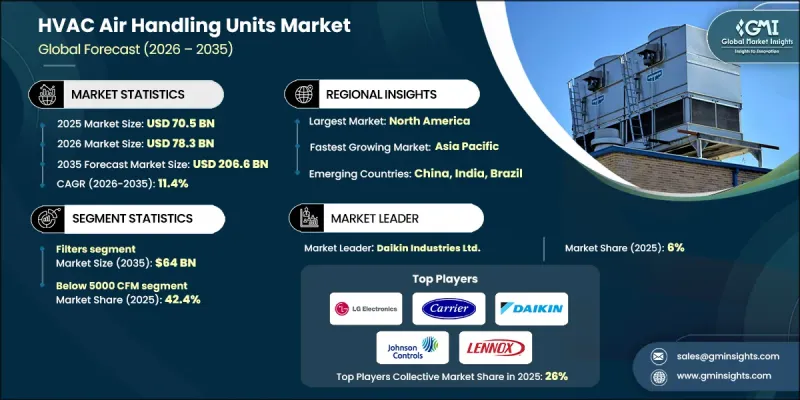
The Global HVAC Air Handling Units Market was valued at USD 70.5 billion in 2025 and is estimated to grow at a CAGR of 11.4% to reach USD 206.6 billion by 2035.
The air handling units segment represents one of the most essential components of the broader HVAC framework, as these systems manage airflow and maintain indoor environmental conditions across commercial, residential, and industrial spaces. Each unit typically combines fans, filtration systems, coils, and dampers to regulate humidity, temperature, ventilation, and air purity. As cities continue to expand and building infrastructure becomes more sophisticated, demand for reliable, energy-efficient air handling solutions increases. Heightened awareness of indoor air quality and growing regulatory emphasis on energy performance contribute substantially to market expansion. With modern buildings requiring optimized airflow management, the need for advanced AHUs continues to rise, supporting steady global growth.
| Market Scope | |
|---|---|
| Start Year | 2025 |
| Forecast Year | 2026-2035 |
| Start Value | $70.5 Billion |
| Forecast Value | $206.6 Billion |
| CAGR | 11.4% |
The filters segment is projected to grow at a CAGR of 12.1% through 2035. The growing focus on indoor air quality is accelerating the need for high-efficiency filtration technologies, resulting in consistent demand for replacement filters used across various HVAC applications.
The below 5000 CFM segment held 42.4% share in 2025 and is expected to sustain its leading position. These units remain the preferred choice for light industrial facilities, commercial spaces, and retail properties due to their adaptable sizing, modular design, and cost-effective installation.
North America HVAC Air Handling Units Market held 36.5% share and generated USD 25.7 billion in 2025. The region's dominance is supported by its extensive stock of commercial buildings, evolving energy efficiency requirements, and strong adoption of integrated AHU systems designed to enhance air quality and lower operational costs.
Key companies in the HVAC Air Handling Units Market include York International Corporation, Lennox International Inc., Trane Technologies plc, Airedale International Air Conditioning Ltd., Carrier Global Corporation, Systemair AB, Mitsubishi Electric Corporation, LG Electronics Inc., Daikin Industries Ltd., GEA Group AG, Munters Group AB, Titus HVAC, Rheem Manufacturing Company, Johnson Controls International plc, and Toshiba Corporation. Companies competing in the HVAC Air Handling Units Market strengthen their position by expanding product portfolios with energy-efficient designs, variable-speed technologies, and advanced filtration options that support rising IAQ expectations. Many manufacturers invest in R&D to develop smart controls, IoT-enabled monitoring capabilities, and modular platforms that simplify installation and maintenance. Geographic expansion through distributor networks, localized assembly, and strategic partnerships helps accelerate market reach.
Table of Contents
Chapter 1 Methodology and Scope
- 1.1 Market scope and definition
- 1.2 Research design
- 1.2.1 Research approach
- 1.2.2 Data collection methods
- 1.3 Data mining sources
- 1.3.1 Global
- 1.3.2 Regional/Country
- 1.4 Base estimates and calculations
- 1.4.1 Base year calculation
- 1.4.2 Key trends for market estimation
- 1.5 Primary research and validation
- 1.5.1 Primary sources
- 1.6 Forecast model
- 1.7 Research assumptions and limitations
Chapter 2 Executive Summary
- 2.1 Industry 3600 synopsis
- 2.2 Key market trends
- 2.2.1 Regional
- 2.2.2 Product
- 2.2.3 Capacity
- 2.2.4 Application
- 2.2.5 Distribution channel
- 2.3 CXO perspectives: strategic imperatives
- 2.3.1 Key decision points for industry executives
- 2.3.2 Critical success factors for market players
- 2.4 Future outlook and strategic recommendations
Chapter 3 Industry Insights
- 3.1 Industry ecosystem analysis
- 3.1.1 Supplier landscape
- 3.1.2 Profit margin
- 3.1.3 Value addition at each stage
- 3.1.4 Factor affecting the value chain
- 3.2 Industry impact forces
- 3.2.1 Growth drivers
- 3.2.1.1 Strict energy efficiency regulations
- 3.2.1.2 Growing focus on indoor air quality (IAQ)
- 3.2.1.3 Rapid urbanization and construction boom in APAC
- 3.2.2 Industry pitfalls & challenges
- 3.2.2.1 High upfront cost and complexity of advanced AHUs
- 3.2.2.2 Supply chain volatility and material price fluctuations
- 3.2.3 Opportunities
- 3.2.3.1 Exploding demand from data centers
- 3.2.3.2 Integration with IoT and smart building technologies
- 3.2.1 Growth drivers
- 3.3 Growth potential analysis
- 3.4 Future market trends
- 3.5 Technology and innovation landscape
- 3.5.1 Current technological trends
- 3.5.2 Emerging technologies
- 3.6 Price trends
- 3.6.1 By region
- 3.6.2 By type
- 3.7 Regulatory landscape
- 3.7.1 Standards and compliance requirements
- 3.7.2 Regional regulatory frameworks
- 3.7.3 Certification standards
- 3.8 Porter's analysis
- 3.9 PESTEL analysis
Chapter 4 Competitive Landscape, 2025
- 4.1 Introduction
- 4.2 Company market share analysis
- 4.2.1 By region
- 4.2.1.1 North America
- 4.2.1.2 Europe
- 4.2.1.3 Asia Pacific
- 4.2.1.4 Latin America
- 4.2.1.5 Middle East and Africa
- 4.2.1 By region
- 4.3 Company matrix analysis
- 4.4 Competitive analysis of major market players
- 4.5 Competitive positioning matrix
- 4.6 Key developments
- 4.6.1 Mergers & acquisitions
- 4.6.2 Partnerships & collaborations
- 4.6.3 New product launches
- 4.6.4 Expansion plans
Chapter 5 Market Estimates and Forecast, By Component Type, 2022 - 2035, (USD Billion) (Thousand Units)
- 5.1 Key trends
- 5.2 Heating or cooling coils
- 5.3 Filters
- 5.4 Dampers
- 5.5 Fans
- 5.6 Air handlers
- 5.7 Blowers
- 5.8 Others (humidifiers or dehumidifiers, isolators, etc.)
Chapter 6 Market Estimates and Forecast, By Capacity, 2022 - 2035, (USD Billion) (Thousand Units)
- 6.1 Key trends
- 6.2 Below 5,000 CFM
- 6.3 5,000 CFM - 10,000 CFM
- 6.4 Above 10,000 CFM
Chapter 7 Market Estimates and Forecast, By Application, 2022 - 2035, (USD Billion) (Thousand Units)
- 7.1 Key trends
- 7.2 Residential
- 7.3 Commercial
- 7.4 Industrial
Chapter 8 Market Estimates and Forecast, By Distribution Channel, 2022 - 2035, (USD Billion) (Thousand Units)
- 8.1 Key trends
- 8.2 Direct
- 8.3 Indirect
Chapter 9 Market Estimates and Forecast, By Region, 2022 - 2035 (USD Billion) (Thousand Units)
- 9.1 Key trends
- 9.2 North America
- 9.2.1 U.S.
- 9.2.2 Canada
- 9.3 Europe
- 9.3.1 Germany
- 9.3.2 UK
- 9.3.3 France
- 9.3.4 Italy
- 9.3.5 Spain
- 9.4 Asia Pacific
- 9.4.1 China
- 9.4.2 Japan
- 9.4.3 India
- 9.4.4 Australia
- 9.4.5 South Korea
- 9.5 Latin America
- 9.5.1 Brazil
- 9.5.2 Mexico
- 9.5.3 Argentina
- 9.6 Middle East and Africa
- 9.6.1 South Africa
- 9.6.2 Saudi Arabia
- 9.6.3 UAE
Chapter 10 Company Profiles
- 10.1 Airedale International Air Conditioning Ltd.
- 10.2 Carrier Global Corporation
- 10.3 Daikin Industries Ltd.
- 10.4 GEA Group AG
- 10.5 Johnson Controls International plc
- 10.6 Lennox International Inc.
- 10.7 LG Electronics Inc.
- 10.8 Mitsubishi Electric Corporation
- 10.9 Munters Group AB
- 10.10 Rheem Manufacturing Company
- 10.11 Systemair AB
- 10.12 Titus HVAC
- 10.13 Toshiba Corporation
- 10.14 Trane Technologies plc
- 10.15 York International Corporation