



|
시장보고서
상품코드
1892916
웨어러블 생체 전자 피부 패치 시장 기회, 성장 촉진요인, 업계 동향 분석 및 예측(2025-2034년)Wearable Bioelectronic Skin Patches Market Opportunity, Growth Drivers, Industry Trend Analysis, and Forecast 2025 - 2034 |
||||||

세계의 웨어러블 생체 전자 피부 패치 시장은 2024년에 125억 달러로 평가되었고, 2034년까지 연평균 복합 성장률(CAGR) 14.7%를 나타내 485억 달러에 달할 것으로 예측되고 있습니다.
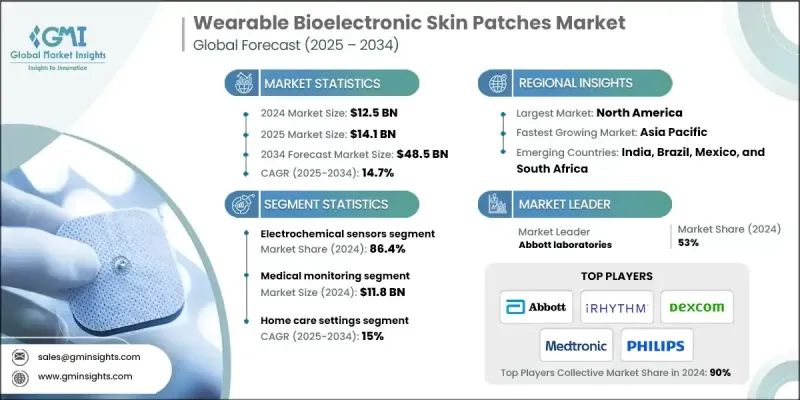
시장 성장은 실시간 건강 모니터링의 보급 확대, 만성 질환 증가 경향, 유연한 바이오센싱 기술의 급속한 진보에 의해 견인되고 있습니다. 이러한 차세대 패치는 멀티센서 시스템, 무선 연결성, AI를 활용한 분석 기능을 통합하여 심혈관·대사·생리학적 파라미터에 대한 지속적인 인사이트를 제공합니다. 의료 시스템이 예방 의료·원격 케어 모델로 이행하는 중, 웨어러블 생체 전자 패치는 장기 모니터링, 조기 진단, 맞춤형 치료 관리에 필수적인 존재가 되고 있습니다. 세계의 원격 의료에 대한 관심 증가와 비침습적 솔루션을 선호하는 환자의 추세가 함께 시장의 보급을 더욱 가속화하고 있습니다. 신축성 전자 및 생체적합성 재료의 연구 개발이 확대되고 있는 가운데, 이러한 패치는 디지털 헬스 에코시스템과 원활하게 통합하는 첨단 플랫폼으로 진화하여 임상 성과 향상과 환자 부담 경감에 기여하고 있습니다.
| 시장 범위 | |
|---|---|
| 시작 연도 | 2024년 |
| 예측 기간 | 2025-2034년 |
| 시작 가치 | 125억 달러 |
| 예측 금액 | 485억 달러 |
| CAGR | 14.7% |
본 시장은 주로 유형별로 구분되어 있으며, 2024년에는 전기화학 센서 부문이 86.4%의 점유율을 차지해 세계 시장에서 가장 높은 수익 부문이 되었습니다. 전기화학 센서는 생화학적 모니터링, 특히 혈당 추적, 전해질 평가, 락트산 분석에서 정확도가 높기 때문에 우위를 보여줍니다. 높은 감도, 비용 효율성, 유연한 기판과의 호환성으로 웨어러블 패치에 통합이 가능하며, 당뇨병 관리에서 스포츠 성능까지 폭넓은 용도를 지원합니다. 이 센서는 화학 반응을 전기 신호로 변환하여 땀과 조직 간 액체를 통한 정확하고 지속적인 모니터링을 제공합니다.
용도별로는 의료 모니터링 분야가 2024년에 1,180만 달러 시장 규모를 기록해, 세계적으로 주요한 응용 분야가 되었습니다. 부정맥, 당뇨병, 고혈압, 수술 후 회복기 등 만성 질환의 끊김없는 모니터링 수요가이 분야를 견인하고 있습니다. 의료 모니터링 패치는 임상 환경 밖에서도 지속적이고 고품질의 데이터를 제공하여 재입원률 감소 및 합병증의 조기 발견을 가능하게 합니다. 의료 제공업체가 원격 환자 모니터링 플랫폼과 하이브리드 케어 모델을 적극적으로 도입함에 따라, 그 이용은 급속히 확대되고 있습니다. 병원과 임상의가 정밀 진단, 비용 절감, 환자 결과 개선을 선호하는 가운데, 바이오일렉트로닉스 피부 패치는 현대화된 의료 제공의 핵심이 되고 있습니다.
북미의 웨어러블 생체 전자 피부 패치 시장은 2024년 44.4%의 점유율을 차지했습니다. 강력한 의료 인프라, 디지털 건강 도구의 보급, 원격 모니터링 시스템의 광범위한 사용이 성장의 주요 성장 촉진요인이 되었습니다. 이 지역은 바이오센서 기술을 임상 워크플로우에 신속하게 통합하고, 만성 질환 부담을 증가시키고, 원격 모니터링 장치의 상환 범위를 확대하는 이점을 누리고 있습니다. 또한 애봇, 덱스콤, 아이리즘 등 북미에 본사를 두고 있는 주요 기업들은 연구개발, 제품혁신, 대규모 상업화에 계속 투자하고 있습니다. 원격 의료 플랫폼의 강력한 존재감과 지속적인 건강 추적에 대한 소비자의 의식이 높아짐에 따라 북미는 웨어러블 생체 전자 피부 패치 분야에서 장기적인 리더로서의 지위를 확립하고 있습니다.
자주 묻는 질문
목차
제1장 조사 방법과 범위
제2장 주요 요약
제3장 업계 인사이트
- 생태계 분석
- 업계에 미치는 영향요인
- 성장 촉진요인
- 비침습적이고 실시간 건강 모니터링 솔루션에 대한 수요 증가
- 플렉서블 및 스트레치 가능한 일렉트로닉스의 기술적 진보
- 만성 질환 증가 경향
- 건강 의식과 피트니스 의식 증가
- 업계의 잠재적 위험 및 과제
- 높은 개발·제조 비용
- 데이터 프라이버시와 보안에 대한 우려
- 시장 기회
- 원격 건강 모니터링
- AI 및 IoT와의 통합에 의한 맞춤형 의료
- 성장 촉진요인
- 성장 가능성 분석
- 규제 상황
- 북미
- 아시아태평양
- 유럽
- 기술 동향
- 현재 기술 동향
- 신흥 기술
- 향후 시장 동향
- 갭 분석
- Porter's Five Forces 분석
- PESTEL 분석
제4장 경쟁 구도
- 서론
- 기업의 시장 점유율 분석
- 기업 매트릭스 분석
- 주요 시장 기업의 경쟁 분석
- 경쟁 포지셔닝 매트릭스
- 전략 대시보드
- 주요 발전
- 인수합병
- 제휴 및 공동 사업
- 신제품 출시
- 확대 계획
제5장 시장 추계·예측 : 제품별(2021-2034년)
- 전기화학 센서
- ECG 센서
- 온도 센서
- EMG 센서
- 기타 유형
제6장 시장 추계·예측 : 용도별(2021-2034년)
- 피트니스 및 웰니스
- 의료 모니터링
- 기타 용도
제7장 시장 추계·예측 : 최종 용도별(2021-2034년)
- 병원 및 진료소
- 재택치료 환경
- 기타 최종 용도
제8장 시장 추계·예측 : 지역별(2021-2034년)
- 북미
- 미국
- 캐나다
- 유럽
- 독일
- 영국
- 프랑스
- 스페인
- 이탈리아
- 네덜란드
- 아시아태평양
- 중국
- 일본
- 인도
- 호주
- 한국
- 라틴아메리카
- 브라질
- 멕시코
- 아르헨티나
- 중동 및 아프리카
- 남아프리카
- 사우디아라비아
- 아랍에미리트(UAE)
제9장 기업 프로파일
- 2M Engineering
- Abbott Laboratories
- Biolinq
- Baxter International
- Boston Scientific
- Dexcom
- Epicore Biosystems, Inc.
- GE Healthcare Technologies Inc.
- GENTAG, Inc.
- Insulet Corporation
- iRhythm Technologies, Inc.
- Koninklijke Philips NV
- LifeSignals, Inc.
- Medtronic plc
- Sinocare
- SmartCardia Inc.
- VitalConnect
- VivaLNK, Inc.
The Global Wearable Bioelectronic Skin Patches Market was valued at USD 12.5 billion in 2024 and is estimated to grow at a CAGR of 14.7% to reach USD 48.5 billion by 2034.
Market growth is driven by rising adoption of real-time health monitoring, increasing prevalence of chronic diseases, and rapid advancements in flexible biosensing technologies. These next-generation patches integrate multi-sensor systems, wireless connectivity, and AI-enabled analytics, offering continuous insights into cardiovascular, metabolic, and physiological parameters. As healthcare systems shift toward preventive and remote care models, wearable bioelectronic patches are becoming indispensable for long-term monitoring, early diagnosis, and personalized therapy management. The growing global focus on telehealth, combined with patient preference for non-invasive solutions, further accelerates market uptake. With expanding R&D in stretchable electronics and biocompatible materials, these patches are evolving into advanced platforms that seamlessly integrate with digital health ecosystems, enhancing clinical outcomes and reducing patient burden.
| Market Scope | |
|---|---|
| Start Year | 2024 |
| Forecast Year | 2025-2034 |
| Start Value | $12.5 Billion |
| Forecast Value | $48.5 billion |
| CAGR | 14.7% |
The market is primarily segmented by type, with the electrochemical sensors segment holding 86.4% share in 2024, making it the highest revenue segment in the global market. Electrochemical sensors dominate due to their precision in biochemical monitoring, especially in glucose tracking, electrolyte assessment, and lactate analysis. Their integration within wearable patches supports a wide range of applications from diabetes management to sports performance, owing to high sensitivity, cost-effectiveness, and compatibility with flexible substrates. These sensors transform chemical reactions into electrical signals, enabling accurate and continuous monitoring through sweat and interstitial fluids.
In terms of application, the medical monitoring segment generated USD 11.8 million in 2024, making it the dominant application segment globally. This segment is driven by the need for uninterrupted monitoring of chronic conditions such as arrhythmia, diabetes, hypertension, and post-surgical recovery. Medical monitoring patches provide continuous, high-quality data outside clinical environments, reducing hospital readmissions and enabling early detection of complications. Their use is expanding rapidly as healthcare providers increasingly adopt remote patient monitoring platforms and hybrid care models. As hospitals and clinicians prioritize precision diagnostics, cost reduction, and improved patient outcomes, bioelectronic skin patches are becoming central to modernized care delivery.
North America Wearable Bioelectronic Skin Patches Market held 44.4% share in 2024. Strong healthcare infrastructure, high adoption of digital health tools, and widespread use of remote monitoring systems are key growth drivers. The region benefits from rapid integration of biosensor technologies into clinical workflows, rising chronic disease burden, and expanding reimbursement for remote monitoring devices. Additionally, major industry players headquartered in North America, such as Abbott, Dexcom, and iRhythm, continue to invest in R&D, product innovation, and large-scale commercialization. The strong presence of telehealth platforms, combined with increasing consumer awareness of continuous health tracking, positions North America as a long-term leader in wearable bioelectronic skin patches.
Key players in the Global Wearable Bioelectronic Skin Patches Market include 2M Engineering, Abbott Laboratories, Baxter International, Biolinq, Boston Scientific, Dexcom, Epicore Biosystems, GE Healthcare Technologies, GENTAG, Insulet Corporation, iRhythm Technologies, Koninklijke Philips, LifeSignals, Medtronic, Sinocare, SmartCardia, VitalConnect, and VivaLNK Companies. The wearable bioelectronic skin patches market is focusing on multi-layered strategies to strengthen its market foothold. Leading players are investing heavily in R&D to develop flexible, biocompatible materials, advanced electrochemical and ECG sensor platforms, and AI-driven analytics that enhance clinical accuracy and user comfort. Strategic partnerships with hospitals, digital health platforms, and research institutions are accelerating the integration of patches into remote patient monitoring and telehealth ecosystems.
Table of Contents
Chapter 1 Methodology and Scope
- 1.1 Market scope and definitions
- 1.2 Research design
- 1.2.1 Research approach
- 1.2.2 Data collection methods
- 1.3 Data mining sources
- 1.3.1 Global
- 1.3.2 Regional/Country
- 1.4 Base estimates and calculations
- 1.4.1 Base year calculation
- 1.4.2 Key trends for market estimation
- 1.5 Primary research and validation
- 1.5.1 Primary sources
- 1.6 Forecast model
- 1.7 Research assumptions and limitations
Chapter 2 Executive Summary
- 2.1 Industry 3600 synopsis
- 2.2 Key market trends
- 2.2.1 Regional trends
- 2.2.2 Production trends
- 2.2.3 Application trends
- 2.2.4 End use trends
- 2.3 CXO perspectives: Strategic imperatives
- 2.3.1 Key decision points for industry executives
- 2.3.2 Critical success factors for market players
- 2.4 Future outlook and strategic recommendations
Chapter 3 Industry Insights
- 3.1 Industry ecosystem analysis
- 3.2 Industry impact forces
- 3.2.1 Growth drivers
- 3.2.1.1 Rising demand for non-invasive and real-time health monitoring solutions
- 3.2.1.2 Technological advancements in flexible and stretchable electronics
- 3.2.1.3 Growing prevalence of chronic diseases
- 3.2.1.4 Increasing health awareness and fitness consciousness
- 3.2.2 Industry pitfalls and challenges
- 3.2.2.1 High development and manufacturing costs
- 3.2.2.2 Concerns regarding data privacy and the security
- 3.2.3 Market opportunities
- 3.2.4 Remote health monitoring
- 3.2.5 Integration with AI and IoT for personalized healthcare
- 3.2.1 Growth drivers
- 3.3 Growth potential analysis
- 3.4 Regulatory landscape
- 3.4.1 North America
- 3.4.2 Asia Pacific
- 3.4.3 Europe
- 3.5 Technology landscape
- 3.5.1 Current technological trends
- 3.5.2 Emerging technologies
- 3.6 Future market trends
- 3.7 Gap analysis
- 3.8 Porter's analysis
- 3.9 PESTEL analysis
Chapter 4 Competitive Landscape, 2024
- 4.1 Introduction
- 4.2 Company market share analysis
- 4.3 Company matrix analysis
- 4.4 Competitive analysis of major market players
- 4.5 Competitive positioning matrix
- 4.6 Strategy dashboard
- 4.7 Key developments
- 4.7.1 Mergers and acquisitions
- 4.7.2 Partnerships and collaborations
- 4.7.3 New product launches
- 4.7.4 Expansion plans
Chapter 5 Market Estimates and Forecast, By Product, 2021 - 2034 ($ Mn)
- 5.1 Key trends
- 5.2 Electrochemical sensors
- 5.3 ECG sensors
- 5.4 Temperature sensors
- 5.5 EMG sensors
- 5.6 Other types
Chapter 6 Market Estimates and Forecast, By Application, 2021 - 2034 ($ Mn)
- 6.1 Key trends
- 6.2 Fitness and wellness
- 6.3 Medical monitoring
- 6.4 Other applications
Chapter 7 Market Estimates and Forecast, By End Use, 2021 - 2034 ($ Mn)
- 7.1 Key trends
- 7.2 Hospitals and clinics
- 7.3 Home care settings
- 7.4 Other end use
Chapter 8 Market Estimates and Forecast, By Region, 2021 - 2034 ($ Mn)
- 8.1 Key trends
- 8.2 North America
- 8.2.1 U.S.
- 8.2.2 Canada
- 8.3 Europe
- 8.3.3 Germany
- 8.3.4 UK
- 8.3.5 France
- 8.3.6 Spain
- 8.3.7 Italy
- 8.3.8 Netherlands
- 8.4 Asia Pacific
- 8.4.1 China
- 8.4.2 Japan
- 8.4.3 India
- 8.4.4 Australia
- 8.4.5 South Korea
- 8.5 Latin America
- 8.5.1 Brazil
- 8.5.2 Mexico
- 8.5.3 Argentina
- 8.6 Middle East and Africa
- 8.6.1 South Africa
- 8.6.2 Saudi Arabia
- 8.6.3 UAE
Chapter 9 Company Profiles
- 9.1 2M Engineering
- 9.2 Abbott Laboratories
- 9.3 Biolinq
- 9.4 Baxter International
- 9.5 Boston Scientific
- 9.6 Dexcom
- 9.7 Epicore Biosystems, Inc.
- 9.8 GE Healthcare Technologies Inc.
- 9.9 GENTAG, Inc.
- 9.10 Insulet Corporation
- 9.11 iRhythm Technologies, Inc.
- 9.12 Koninklijke Philips N.V.
- 9.13 LifeSignals, Inc.
- 9.14 Medtronic plc
- 9.15 Sinocare
- 9.16 SmartCardia Inc.
- 9.17 VitalConnect
- 9.18 VivaLNK, Inc.


