|
시장보고서
상품코드
1892918
자동차용 센서 시장 기회, 성장 촉진요인, 업계 동향 분석 및 예측(2026-2035년)Automotive Sensor Market Opportunity, Growth Drivers, Industry Trend Analysis, and Forecast 2026 - 2035 |
||||||

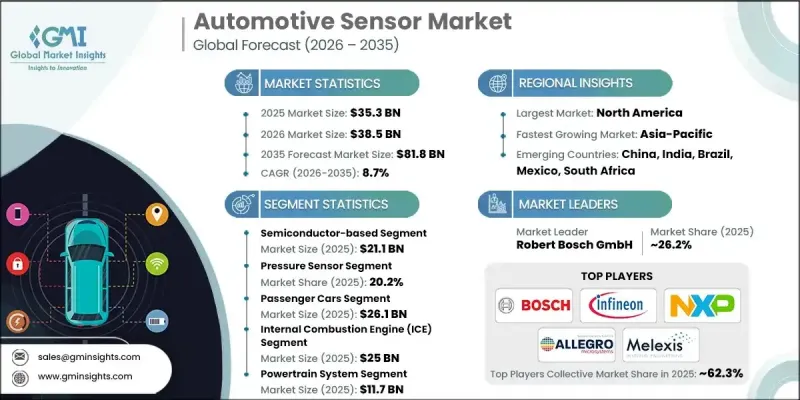
세계의 자동차용 센서 시장은 2025년 353억 달러로 평가되었으며, 2035년까지 연평균 복합 성장률(CAGR) 8.7%를 나타내 818억 달러에 이를 것으로 예측됩니다.
시장의 성장은 ADAS(첨단 운전자 보조 시스템)의 보급 확대, 커넥티드카 및 자율주행차의 인기 상승 및 안전성, 효율성, 차량 성능 전반을 향상시키는 스마트 센서의 도입에 의해 견인되고 있습니다. 어댑티브 크루즈 컨트롤, 차선 일탈 경보, 자동 브레이크, 사각 감시 등의 기능은 레이더, 라이더, 카메라, 초음파 센서의 통합을 촉진하여 실시간 상황 인식을 가능하게 하고 있습니다. 또한 전기자동차로의 전환은 배터리 성능 관리, 열 조절, 모터 제어 및 에너지 효율을 관리하는 센서 수요를 지원합니다. 안전, 배출가스 절감, 연비효율을 증진시키는 정부 규정은 모든 차량 부문에서 센서 도입을 더욱 가속화하고 있습니다. 전기차 생산 증가와 깨끗한 운송 수단에 대한 인센티브도 세계 시장 성장에 기여하고 있습니다.
| 시장 범위 | |
|---|---|
| 시작 연도 | 2025년 |
| 예측 연도 | 2026-2035년 |
| 시작 가치 | 353억 달러 |
| 예측 금액 | 818억 달러 |
| CAGR | 8.7% |
반도체 기반 센서 부문은 2024년 211억 달러에 달했습니다. 이 센서는 정확하고 신뢰할 수 있으며 단일 칩에 여러 기능을 통합할 수 있습니다. 컴팩트한 설계, 저소비 전력, 비용 효율성 및 선진적인 자동차용 전자기기와의 호환성으로 전기차, 자율주행차, 커넥티드카에 있어서 필수적인 존재가 되고 있습니다. ADAS(첨단 운전자 보조 시스템), 파워트레인, 배터리 관리, 인포테인먼트, 안전시스템 등 폭넓은 분야에서 이용되어 세계 시장에서 견조한 수요를 유지하고 있습니다.
압력 센서 부문은 2025년 71억 달러로 평가되었습니다. 그 보급은 엔진 관리, 트랜스미션 시스템, 타이어 공압 감시, 브레이크 시스템, 전기자동차 배터리 관리 등에의 응용이 배경에 있습니다. 차량 안전, 규제 준수, 배출 가스 제어 및 연비 효율에 대한 중시 증가가 세계 승용차 및 상용차에서 이러한 센서 수요를 계속 견인하고 있습니다.
북미의 자동차용 센서 시장은 2025년 37.1%의 점유율을 차지했습니다. 이 지역의 우위성은 강력한 자동차 제조거점, 선진 차량 기술의 조기 도입, 안전·연비 효율·배출 가스 규제 적합 차량에 대한 수요 증가에 기인합니다. 전동화, 커넥티드카, 자율주행 솔루션에 대한 관심 증가가 ADAS(첨단 운전자 보조 시스템) 및 파워트레인 시스템에 있어서 센서 도입을 촉진하고 있습니다. 또한, 엄격한 정부 규제와 혁신적인 자동차 기술에 대한 소비자의 선호도는 북미 세계 시장의 주도적 지위를 지원합니다.
자주 묻는 질문
목차
제1장 조사 방법과 범위
제2장 주요 요약
제3장 업계 인사이트
- 생태계 분석
- 공급업체 현황
- 이익률
- 비용 구조
- 각 단계별 부가가치
- 밸류체인에 영향을 주는 요인
- 파괴적 혁신
- 업계에 미치는 영향요인
- 성장 촉진요인
- 전기자동차 및 자율주행차의 보급
- 엄격한 안전기준 및 배출가스 규제
- 차재 체험의 향상에 대한 소비자 수요
- 기술적 진보와 비용 절감
- ADAS(첨단 운전자 보조 시스템) 수요 증가
- 업계의 잠재적 위험 및 과제
- 높은 개발·생산 비용
- 통합 복잡성과 호환성 문제
- 시장 기회
- 전기자동차(EV)의 확대
- ADAS(첨단 운전자 보조 시스템) 및 자동 운전 차량
- 성장 촉진요인
- 성장 가능성 분석
- 규제 상황
- 북미
- 유럽
- 아시아태평양
- 라틴아메리카
- 중동 및 아프리카
- Porter's Five Forces 분석
- PESTEL 분석
- 기술 및 혁신 동향
- 현재 기술 동향
- 신흥 기술
- 가격 동향
- 지역별
- 제품별
- 가격 전략
- 신흥 비즈니스 모델
- 컴플라이언스 요건
- 지속가능성 대책
- 소비자 심리 분석
- 특허 및 지적재산 분석
- 지정학적·무역 동향
제4장 경쟁 구도
- 서론 기업의 시장 점유율 분석
- 기업의 시장 점유율 분석
- 지역별
- 북미
- 유럽
- 아시아태평양
- 시장 집중도 분석
- 주요 기업의 경쟁 벤치마킹
- 재무실적 비교
- 수익
- 이익률
- 연구개발
- 제품 포트폴리오 비교
- 제품 라인의 폭
- 기술
- 파괴적 혁신
- 지역별 사업 전개 비교
- 세계전개분석
- 서비스 네트워크 커버리지
- 지역별 시장 침투율
- 경쟁 포지셔닝 매트릭스
- 리더기업
- 과제자
- 팔로워
- 틈새 기업
- 전략적 전망 매트릭스
- 재무실적 비교
- 주요 발전(2022-2025년)
- 인수합병
- 제휴 및 협력 관계
- 기술적 진보
- 확대 및 투자 전략
- 지속가능성에 대한 노력
- 디지털 전환의 대처
- 신흥/스타트업 경쟁의 동향
제5장 시장 추계·예측 : 센서 유형별(2022-2035년)
- 압력 센서
- 연료 레일 압력 센서
- 매니폴드 절대 압력(MAP) 센서
- 차압 센서(GPF/DPF)
- 타이어 공기압 모니터링 센서
- 브레이크 압력 센서
- 기타
- 가스 센서
- 미립자 물질(PM) 센서
- NOx(질소 산화물) 센서
- 산소(람다) 센서
- 이산화탄소(CO2) 센서
- 탄화수소(HC) 센서
- 기타
- 온도 센서
- 배기 가스 온도(EGT) 센서
- 엔진 냉각수 온도 센서
- 배터리 온도 센서(전기자동차용)
- 주변 온도 센서
- 오일 온도 센서
- 기타
- 전류 및 전압 센서
- 배터리 전류 센서(전기자동차용)
- 배터리 전압 센서(전기자동차용)
- 고전압 인터록 루프(HVIL) 센서
- 충전 전류 센서
- 기타
- 위치 및 속도 센서
- 캠축 위치 센서
- 크랭크축 위치 센서
- 휠 속도 센서
- 스티어링 각도 센서
- 스로틀 위치 센서
- 기타
- 광학 센서
- 카메라/이미지 센서
- LiDAR 센서
- 적외선 센서
- 비/광 센서
- 기타
- 레이더 센서
- 24GHz 레이더 센서
- 77GHz 레이더 센서
- 79GHz 레이더 센서
- 기타
- 초음파 센서
- 주차 보조 센서
- 탑승자 감지 센서
- 기타
- 관성 센서
- 가속도계
- 자이로스코프
- 관성 측정 장치(IMU)
- 기타
- 기타
제6장 시장 추계·예측 : 기술별(2022-2035년)
- 반도체 기반 센서
- 실리콘 기반 센서
- 세라믹 기반 센서
- MEMS(미소 전기기계 시스템)
- 자기 센서
- 홀 효과 센서
- 자기 저항 센서
- 광학 센서
- 전기 화학 센서
제7장 시장 추계·예측 : 차종별(2022-2035년)
- 승용차
- 소형차
- 중형차
- 고급차
- SUV
- 소형 상용차
- 대형 상용차
- 중형 트럭
- 대형 트럭
- 버스
제8장 시장 추계·예측 : 추진 방식별(2022-2035년)
- 내연기관(ICE)
- 가솔린
- 디젤
- 대체 연료(CNG, LPG)
- 전기화 차량
- 하이브리드 전기자동차(HEV)
- 플러그인 하이브리드 전기자동차(PHEV)
- 배터리 전기자동차(BEV)
- 연료전지 전기자동차(FCEV)
제9장 시장 추계·예측 : 용도별(2022-2035년)
- 파워트레인 시스템
- 엔진 관리 시스템
- 변속기 제어 시스템
- 연료 공급 시스템
- 배기 후처리 시스템
- 전기화 시스템
- 배터리 관리 시스템
- 전동 모터 제어 시스템
- 충전 시스템
- 열 관리 시스템(전기자동차용)
- 고전압 안전 시스템
- 안전 및 ADAS 시스템
- 충돌 회피 시스템
- 차선 유지 보조 시스템
- 적응형 크루즈 컨트롤 시스템
- 주차 보조 시스템
- 사각지대 감지 시스템
- 차체 및 섀시 시스템
- 스조향 시스템
- 서스펜션 시스템
- 제동 시스템
- 공조 시스템
- 조명 시스템
- 편의 시스템
- 인포테인먼트 시스템
- 시트 제어 시스템
- 출입 제어 시스템
- 기타
제10장 시장 추계·예측 : 판매 채널별(2022-2035년)
- OEM
- 애프터마켓
제11장 시장 추계·예측 : 지역별(2022-2035년)
- 북미
- 미국
- 캐나다
- 유럽
- 독일
- 영국
- 프랑스
- 이탈리아
- 스페인
- 네덜란드
- 아시아태평양
- 중국
- 인도
- 일본
- 한국
- 호주
- 라틴아메리카
- 브라질
- 멕시코
- 아르헨티나
- 중동 및 아프리카
- 아랍에미리트(UAE)
- 사우디아라비아
- 남아프리카
제12장 기업 프로파일
- Allegro MicroSystems LLC
- Analog Devices Inc.
- Aptiv PLC
- BorgWarner Inc.
- Continental AG
- Denso Corporation
- First Sensor AG
- Hitachi Astemo Americas Inc.
- Honeywell International Inc.
- Infineon Technologies AG
- Melexis NV
- Microchip Technology Inc.
- NXP Semiconductors
- OMNIVISION Technologies Inc.
- ON Semiconductor
- Panasonic Corporation
- Renesas Electronics Corporation
- Robert Bosch GmbH
- Sensata Technologies Inc.
- STMicroelectronics NV
- TE Connectivity Ltd.
- Valeo SA
The Global Automotive Sensor Market was valued at USD 35.3 billion in 2025 and is estimated to grow at a CAGR of 8.7% to reach USD 81.8 billion by 2035.
The market's growth is fueled by the rising adoption of advanced driver assistance systems (ADAS), the increasing popularity of connected and autonomous vehicles, and the deployment of smart sensors that enhance safety, efficiency, and overall vehicle performance. Features such as adaptive cruise control, lane departure warning, automatic braking, and blind-spot monitoring are driving the integration of radar, lidar, camera, and ultrasonic sensors, enabling real-time situational awareness. Additionally, the transition to electric vehicles is supporting demand for sensors that manage battery performance, thermal regulation, motor control, and energy efficiency. Government mandates promoting safety, emission reduction, and fuel efficiency further accelerate sensor adoption across all vehicle segments. Rising production of EVs and incentives for cleaner transportation are also contributing to market growth globally.
| Market Scope | |
|---|---|
| Start Year | 2025 |
| Forecast Year | 2026-2035 |
| Start Value | $35.3 Billion |
| Forecast Value | $81.8 Billion |
| CAGR | 8.7% |
The semiconductor-based sensors segment reached USD 21.1 billion in 2024. These sensors are highly accurate, reliable, and capable of integrating multiple functions on a single chip. Their compact design, low power requirements, cost-effectiveness, and compatibility with advanced automotive electronics make them indispensable in electric, autonomous, and connected vehicles. They are widely utilized across ADAS, powertrain, battery management, infotainment, and safety systems, sustaining strong demand across global markets.
The pressure sensor segment was valued at USD 7.1 billion in 2025. Their widespread adoption stems from applications in engine management, transmission systems, tire pressure monitoring, braking systems, and electric vehicle battery management. Rising emphasis on vehicle safety, regulatory compliance, emission control, and fuel efficiency continues to drive demand for these sensors across passenger and commercial vehicles worldwide.
North America Automotive Sensor Market held a 37.1% share in 2025. The region's dominance is attributed to its strong automotive manufacturing base, early adoption of advanced vehicle technologies, and increasing demand for safety, fuel efficiency, and emission-compliant vehicles. Growing focus on electrification, connected vehicles, and autonomous driving solutions has driven sensor deployment in ADAS and powertrain systems. Additionally, stringent government regulations and consumer preference for innovative automotive technologies support North America's leadership in the global market.
Key players operating in Global Automotive Sensor Market include Infineon Technologies AG, Denso Corporation, Panasonic Corporation, Melexis NV, Analog Devices Inc., Microchip Technology Inc., TE Connectivity Ltd., NXP Semiconductors, Honeywell International Inc., Allegro MicroSystems LLC, Renesas Electronics Corporation, Robert Bosch GmbH, BorgWarner Inc., ON Semiconductor, Aptiv PLC, Hitachi Astemo Americas Inc., Continental AG, Sensata Technologies Inc., First Sensor AG, Valeo SA, STMicroelectronics NV, and OMNIVISION Technologies Inc. Companies in the Global Automotive Sensor Market are employing diverse strategies to strengthen their presence and expand their market foothold. They are investing heavily in research and development to deliver innovative, high-precision sensors for ADAS, autonomous, and electric vehicles. Strategic partnerships, mergers, and acquisitions are being pursued to expand technological capabilities, geographic reach, and production capacity. Firms are also focusing on product differentiation through miniaturization, multi-function integration, and energy-efficient designs. Additionally, companies are enhancing customer support, providing software-enabled solutions, and targeting emerging markets to capture growth opportunities, strengthen distribution networks, and maintain a competitive edge in the rapidly evolving automotive sensor landscape.
Table of Contents
Chapter 1 Methodology and Scope
- 1.1 Market scope and definition
- 1.2 Research design
- 1.2.1 Research approach
- 1.2.2 Data collection methods
- 1.3 Data mining sources
- 1.3.1 Global
- 1.3.2 Regional/Country
- 1.4 Base estimates and calculations
- 1.4.1 Base year calculation
- 1.4.2 Key trends for market estimation
- 1.5 Primary research and validation
- 1.5.1 Primary sources
- 1.6 Forecast model
- 1.7 Research assumptions and limitations
Chapter 2 Executive Summary
- 2.1 Industry 3600 synopsis
- 2.2 Key market trends
- 2.2.1 Business trends
- 2.2.2 Sensor type trends
- 2.2.3 Technology type trends
- 2.2.4 Vehicle type trends
- 2.2.5 Propulsion type trends
- 2.2.6 Application trends
- 2.2.7 Sales channel trends
- 2.2.8 Regional trends
- 2.3 TAM Analysis, 2026-2035 (USD Million)
- 2.4 CXO Perspectives: Strategic imperatives
- 2.5 Executive decision points
- 2.6 Critical Success Factors
- 2.7 Future Outlook and Strategic Recommendations
Chapter 3 Industry Insights
- 3.1 Industry ecosystem analysis
- 3.1.1 Supplier Landscape
- 3.1.2 Profit Margin
- 3.1.3 Cost structure
- 3.1.4 Value addition at each stage
- 3.1.5 Factor affecting the value chain
- 3.1.6 Disruptions
- 3.2 Industry impact forces
- 3.2.1 Growth drivers
- 3.2.1.1 Proliferation of electric and autonomous vehicles
- 3.2.1.2 Stringent safety and emission regulations
- 3.2.1.3 Consumer demand for enhanced in-vehicle experience
- 3.2.1.4 Technological advancements and cost reduction
- 3.2.1.5 Increasing Demand for Advanced Driver Assistance Systems (ADAS)
- 3.2.2 Industry pitfalls and challenges
- 3.2.2.1 High development and production costs
- 3.2.2.2 Complexity of integration and compatibility issues
- 3.2.3 Market Opportunities
- 3.2.3.1 Expansion of Electric Vehicles (EVs)
- 3.2.3.2 Advanced Driver Assistance Systems (ADAS) and Autonomous Vehicles
- 3.2.1 Growth drivers
- 3.3 Growth potential analysis
- 3.4 Regulatory landscape
- 3.4.1 North America
- 3.4.2 Europe
- 3.4.3 Asia Pacific
- 3.4.4 Latin America
- 3.4.5 Middle East & Africa
- 3.5 Porter's analysis
- 3.6 PESTEL analysis
- 3.7 Technological and Innovation landscape
- 3.7.1 Current technological trends
- 3.7.2 Emerging technologies
- 3.8 Price Trends
- 3.8.1 By region
- 3.8.2 By product
- 3.9 Pricing strategies
- 3.10 Emerging business models
- 3.11 Compliance requirements
- 3.12 Sustainability measures
- 3.13 Consumer sentiment analysis
- 3.14 Patent and IP analysis
- 3.15 Geopolitical and trade dynamics
Chapter 4 Competitive Landscape, 2025
- 4.1 Introduction Company market share analysis
- 4.2 Company market share analysis
- 4.2.1 By region
- 4.2.1. North America
- 4.2.2. Europe
- 4.2.3. Asia Pacific
- 4.2.2 Market concentration analysis
- 4.3 Competitive Benchmarking of key Players
- 4.3.1 Financial Performance Comparison
- 4.3.1.1. Revenue
- 4.3.1.2. Profit Margin
- 4.3.1.3. R&D
- 4.3.2 Product Portfolio Comparison
- 4.3.2.1. Product Range Breadth
- 4.3.2.2. Technology
- 4.3.2.3. Innovation
- 4.3.3 Geographic Presence Comparison
- 4.3.3.1. Global Footprint Analysis
- 4.3.3.2. Service Network Coverage
- 4.3.3.3. Market Penetration by Region
- 4.3.4 Competitive Positioning Matrix
- 4.3.4.1. Leaders
- 4.3.4.2. Challengers
- 4.3.4.3. Followers
- 4.3.4.4. Niche Players
- 4.3.5 Strategic outlook matrix
- 4.3.1 Financial Performance Comparison
- 4.4 Key developments, 2022-2025
- 4.4.1 Mergers and Acquisitions
- 4.4.2 Partnerships and Collaborations
- 4.4.3 Technological Advancements
- 4.4.4 Expansion and Investment Strategies
- 4.4.5 Sustainability Initiatives
- 4.4.6 Digital Transformation Initiatives
- 4.5 Emerging/ Startup Competitors Landscape
Chapter 5 Market Estimates & Forecast, By Sensor Type, 2022 - 2035 (USD Million & Units)
- 5.1 Key trends
- 5.2 Pressure Sensors
- 5.2.1 Fuel Rail Pressure Sensors
- 5.2.2 Manifold Absolute Pressure (MAP) Sensors
- 5.2.3 Differential Pressure Sensors (GPF/DPF)
- 5.2.4 Tire Pressure Monitoring Sensors
- 5.2.5 Brake Pressure Sensors
- 5.2.6 Others
- 5.3 Gas Sensors
- 5.3.1 Particulate Matter (PM) Sensors
- 5.3.2 NOx (Nitrogen Oxide) Sensors
- 5.3.3 Oxygen (Lambda) Sensors
- 5.3.4 CO2 Sensors
- 5.3.5 Hydrocarbon (HC) Sensors
- 5.3.6 Others
- 5.4 Temperature Sensors
- 5.4.1 Exhaust Gas Temperature (EGT) Sensors
- 5.4.2 Engine Coolant Temperature Sensors
- 5.4.3 Battery Temperature Sensors (EV)
- 5.4.4 Ambient Temperature Sensors
- 5.4.5 Oil Temperature Sensors
- 5.4.6 Others
- 5.5 Current & Voltage Sensors
- 5.5.1 Battery Current Sensors (EV)
- 5.5.2 Battery Voltage Sensors (EV)
- 5.5.3 High Voltage Interlock Loop (HVIL) Sensors
- 5.5.4 Charging Current Sensors
- 5.5.5 Others
- 5.6 Position & Speed Sensors
- 5.6.1 Camshaft Position Sensors
- 5.6.2 Crankshaft Position Sensors
- 5.6.3 Wheel Speed Sensors
- 5.6.4 Steering Angle Sensors
- 5.6.5 Throttle Position Sensors
- 5.6.6 Others
- 5.7 Optical Sensors
- 5.7.1 Camera/Image Sensors
- 5.7.2 LiDAR Sensors
- 5.7.3 Infrared Sensors
- 5.7.4 Rain/Light Sensors
- 5.7.5 Others
- 5.8 Radar Sensors
- 5.8.1 24 GHz Radar Sensors
- 5.8.2 77 GHz Radar Sensors
- 5.8.3 79 GHz Radar Sensors
- 5.8.4 Others
- 5.9 Ultrasonic Sensors
- 5.9.1 Parking Assistance Sensors
- 5.9.2 Occupancy Detection Sensors
- 5.9.3 Others
- 5.10 Inertial Sensors
- 5.10.1 Accelerometers
- 5.10.2 Gyroscopes
- 5.10.3 Inertial Measurement Units (IMU)
- 5.10.4 Others
- 5.11 Others
Chapter 6 Market estimates & forecast, By Technology, 2022 - 2035 (USD Million & Units)
- 6.1 Key trends
- 6.2 Semiconductor-based Sensors
- 6.2.1 Silicon-based Sensors
- 6.2.2 Ceramic-based Sensors
- 6.3 MEMS (Micro-Electro-Mechanical Systems)
- 6.4 Magnetic Sensors
- 6.4.1 Hall-Effect Sensors
- 6.4.2 Magneto-Resistive Sensors
- 6.5 Optical Sensors
- 6.6 Electrochemical Sensors
Chapter 7 Market estimates & forecast, By Vehicle Type, 2022 - 2035 (USD Million & Units)
- 7.1 Key trends
- 7.2 Passenger Cars
- 7.2.1 Compact Cars
- 7.2.2 Mid-size Cars
- 7.2.3 Luxury Cars
- 7.2.4 SUVs
- 7.3 Light Commercial Vehicles
- 7.4 Heavy Commercial Vehicles
- 7.4.1 Medium-duty Trucks
- 7.4.2 Heavy-duty Trucks
- 7.4.3 Buses
Chapter 8 Market estimates & forecast, By Propulsion Type, 2022-2035 (USD Million & Units)
- 8.1 Key trends
- 8.2 Internal Combustion Engine (ICE)
- 8.1.1 Gasoline
- 8.1.2 Diesel
- 8.3 Alternative Fuels (CNG, LPG)
- 8.1.3 Electrified Vehicles
- 8.1.4 Hybrid Electric Vehicle (HEV)
- 8.1.5 Plug-in Hybrid Electric Vehicle (PHEV)
- 8.1.6 Battery Electric Vehicle (BEV)
- 8.1.7 Fuel Cell Electric Vehicle (FCEV)
Chapter 9 Market estimates & forecast, By Application, 2022-2035 (USD Million & Units)
- 9.1 Key trends
- 9.2 Powertrain Systems
- 9.2.1 Engine Management Systems
- 9.2.2 Transmission Control Systems
- 9.2.3 Fuel Delivery Systems
- 9.2.4 Emissions After-treatment Systems
- 9.3 Electrification Systems
- 9.3.1 Battery Management Systems
- 9.3.2 Electric Motor Control Systems
- 9.3.3 Charging Systems
- 9.3.4 Thermal Management Systems (EV)
- 9.3.5 High Voltage Safety Systems
- 9.4 Safety & ADAS Systems
- 9.4.1 Collision Avoidance Systems
- 9.4.2 Lane Keeping Assistance Systems
- 9.4.3 Adaptive Cruise Control Systems
- 9.4.4 Parking Assistance Systems
- 9.4.5 Blind Spot Detection Systems
- 9.5 Body & Chassis Systems
- 9.5.1 Steering Systems
- 9.5.2 Suspension Systems
- 9.5.3 Braking Systems
- 9.5.4 Climate Control Systems
- 9.5.5 Lighting Systems
- 9.6 Comfort & Convenience Systems
- 9.6.1 Infotainment Systems
- 9.6.2 Seat Control Systems
- 9.6.3 Access Control Systems
- 9.6.4 Others
Chapter 10 Market estimates & forecast, By Sales channel, 2022-2035 (USD Million & Units)
- 10.1 Key trends
- 10.2 Original Equipment Manufacturer (OEM)
- 10.3 Aftermarket
Chapter 11 Market Estimates and Forecast, By Region, 2022 - 2035 (USD Million & Units)
- 11.1 Key trends
- 11.2 North America
- 11.2.1 U.S.
- 11.2.2 Canada
- 11.3 Europe
- 11.3.1 Germany
- 11.3.2 U.K.
- 11.3.3 France
- 11.3.4 Italy
- 11.3.5 Spain
- 11.3.6 Netherlands
- 11.4 Asia Pacific
- 11.4.1 China
- 11.4.2 India
- 11.4.3 Japan
- 11.4.4 South Korea
- 11.4.5 Australia
- 11.5 Latin America
- 11.5.1 Brazil
- 11.5.2 Mexico
- 11.5.3 Argentina
- 11.6 Middle East & Africa
- 11.6.1 UAE
- 11.6.2 Saudi Arabia
- 11.6.3 South Africa
Chapter 12 Company Profile
- 12.1 Allegro MicroSystems LLC
- 12.2 Analog Devices Inc.
- 12.3 Aptiv PLC
- 12.4 BorgWarner Inc.
- 12.5 Continental AG
- 12.6 Denso Corporation
- 12.7 First Sensor AG
- 12.8 Hitachi Astemo Americas Inc.
- 12.9 Honeywell International Inc.
- 12.10 Infineon Technologies AG
- 12.11 Melexis NV
- 12.12 Microchip Technology Inc.
- 12.13 NXP Semiconductors
- 12.14 OMNIVISION Technologies Inc.
- 12.15 ON Semiconductor
- 12.16 Panasonic Corporation
- 12.17 Renesas Electronics Corporation
- 12.18 Robert Bosch GmbH
- 12.19 Sensata Technologies Inc.
- 12.20 STMicroelectronics NV
- 12.21 TE Connectivity Ltd.
- 12.22 Valeo SA