|
시장보고서
상품코드
1913335
국토안보 시장 : 시장 기회, 성장 요인, 산업 동향 분석 및 예측(2026-2035년)Homeland Security Market Opportunity, Growth Drivers, Industry Trend Analysis, and Forecast 2026 - 2035 |
||||||

세계의 국토안보 시장은 2025년 6,201억 달러로 평가되었고, 2035년까지 연평균 복합 성장률(CAGR) 6.1%로 성장할 전망이며, 1조 1,100억 달러에 이를 것으로 예측됩니다.
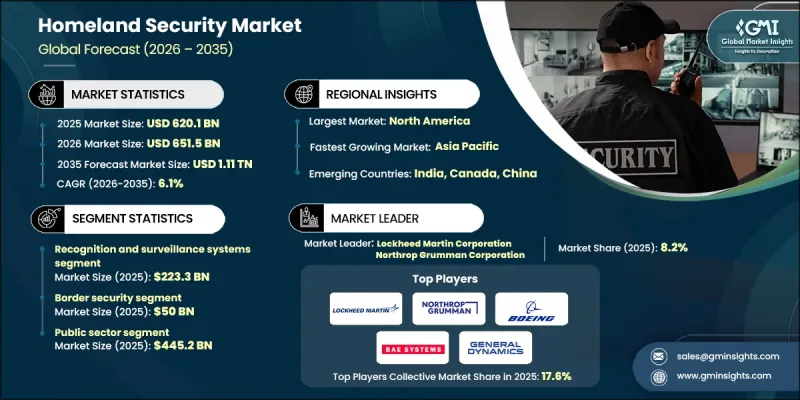
시장의 성장은 국경을 넘은 분쟁으로부터 국민을 보호하기 위한 정부 투자 증가, 세계의 밀수 및 인신거래 활동 확대, 자연재해의 빈도와 다양성의 증대에 의해 견인되고 있습니다. 사이버 위협에 대한 우려 증가와 국경 관리 및 이민 관리의 강화 요구가 함께 수요를 더욱 밀어 올리고 있습니다. 각국 정부는 리스크 경감을 위해, 고도의 긴급 사태 관리 시스템, 조기 경계 기술, 내재해성 인프라에 대한 자금 투입을 진행하고 있습니다. 이로 인해 재해 대책 솔루션, 위험 감소 기술 및 복구 시스템에 대한 강한 수요가 탄생했습니다. 국토안보 분야에서는 감시 및 대응을 위한 드론 기술의 도입이 진행되어, 생체 인증, 센서, 얼굴 인식 기술을 통합한 스마트 국경 경비 솔루션도 보급을 가속하고 있습니다. 클라우드 기반의 여행자 인증 시스템은 국경 절차를 효율화하고 대기 시간 단축 및 처리 효율 향상을 실현하고 있습니다.
| 시장 범위 | |
|---|---|
| 시작 연도 | 2025년 |
| 예측 연도 | 2026-2035년 |
| 시작 시 가치 | 6,201억 달러 |
| 예측 금액 | 1조 1,100억 달러 |
| CAGR | 6.1% |
인식 및 감시 시스템 분야는 2025년에 2,232억 달러를 차지했으며, 최대 시장으로서 대두했습니다. 세계 안보 우려가 커지고 AI 기술의 진보 및 드론 보급이 도입을 촉진하고 있습니다. 기업은 진화하는 세계의 위협에 대처하기 위해 생체인증 도구, AI를 활용한 분석 기술, 고급 드론 기반 감시 시스템의 개발에 주력하고 있습니다.
국경 경비 부문은 2025년 500억 달러에 달했습니다. 이민 단속 강화, 월경 범죄 증가, 기술 혁신이 국경 경비 솔루션에 대한 수요를 형성하고 있습니다. 기업은 지능형 모니터링 시스템, 현대화된 국경 인프라, AI를 활용한 위협 감지, 통합된 국제 보안 관리 플랫폼에 대한 투자를 추진하고 있습니다.
미국의 국토안보 시장은 2025년 2,009억 달러를 창출했습니다. 국경보호 강화, 이민제도 개혁, 연방 사이버보안 시책 등 국가적 우선 사항이 시장 성장을 견인하고 있습니다. 기업은 고도의 AI 감시 시스템, 연방 기준에 준거한 사이버 보안 솔루션, 테러 대책 및 과격주의 대책에 있어서 법 집행 기관을 지원하는 기기의 개발을 진행하고 있습니다.
자주 묻는 질문
목차
제1장 조사 방법 및 범위
제2장 주요 요약
제3장 업계 인사이트
- 생태계 분석
- 공급자의 상황
- 이익률
- 비용 구조
- 각 단계에서의 부가가치
- 밸류체인에 영향을 주는 요인
- 혁신
- 생태계 분석
- 업계에 미치는 영향요인
- 성장 촉진요인
- 국경을 넘은 분쟁으로부터 국가를 지키기 위한 정부 투자
- 세계적으로 증가하는 밀수 및 인신거래 사례
- 자연재해 발생
- 국경 및 이민 관리에 대한 중점화
- 사이버 위협 증가 경향
- 과제 및 어려움
- 급속한 기술 진보
- 조달 및 유지 관리의 높은 비용
- 시장 기회
- AI 및 머신러닝 기술의 채용
- 사이버 보안 인프라 확충
- 성장 촉진요인
- 성장 가능성 분석
- 규제 상황
- 북미
- 유럽
- 아시아태평양
- 라틴아메리카
- 중동 및 아프리카
- Porter's Five Forces 분석
- PESTEL 분석
- 기술 및 혁신 동향
- 현재 기술 동향
- 신흥 기술
- 신흥 비즈니스 모델
- 컴플라이언스 요건
- 지속가능성 대책
- 소비자 심리 분석
- 특허 및 지적재산 분석
- 지정학적 및 무역 동향
제4장 경쟁 구도
- 서문
- 기업의 시장 점유율 분석
- 지역별
- 북미
- 유럽
- 아시아태평양
- 라틴아메리카
- 중동 및 아프리카
- 시장 집중도 분석
- 지역별
- 주요 기업의 경쟁 벤치마킹
- 재무실적 비교
- 수익
- 이익률
- 연구개발
- 제품 포트폴리오 비교
- 제품 라인의 넓이
- 기술
- 혁신
- 지리적 존재 비교
- 세계 전개 분석
- 서비스 네트워크의 커버율
- 지역별 시장 침투율
- 경쟁 포지셔닝 매트릭스
- 리더 기업
- 챌린저
- 팔로워
- 틈새 기업
- 전략적 전망 매트릭스
- 재무실적 비교
- 주요 발전(2021-2024년)
- 합병 및 인수
- 제휴 및 협력 관계
- 기술적 진보
- 확대 및 투자 전략
- 지속가능성에 대한 노력
- 디지털 전환의 대처
- 신흥 및 스타트업 경쟁의 동향
제5장 시장 추계 및 예측 : 보안 유형별(2022-2035년)
- 국경 경비
- 항공 보안
- 해상 보안
- 중요 인프라 보안
- 사이버 보안
- 대량 수송 보안
- 법 집행 기관
- CBRN(화학, 생물, 방사선, 핵) 보안
- 기타
제6장 시장 추계 및 예측 : 기술별(2022-2035년)
- 인식 및 감시 시스템
- AI 기반 솔루션
- 보안 플랫폼
- 기타
제7장 시장 추계 및 예측 : 최종 용도별(2022-2035년)
- 공공 부문
- 민간 부문
제8장 시장 추계 및 예측 : 지역별(2022-2035년)
- 북미
- 미국
- 캐나다
- 유럽
- 독일
- 영국
- 프랑스
- 스페인
- 이탈리아
- 네덜란드
- 아시아태평양
- 중국
- 인도
- 일본
- 호주
- 한국
- 라틴아메리카
- 브라질
- 멕시코
- 아르헨티나
- 중동 및 아프리카
- 사우디아라비아
- 남아프리카
- 아랍에미리트(UAE)
제9장 기업 프로파일
- 세계 주요 기업
- Lockheed Martin
- Raytheon Technologies
- BAE Systems
- Boeing
- 지역별 주요 기업
- 북미
- General Dynamics
- Northrop Grumman
- Leidos
- 유럽
- Thales Group
- Rohde & Schwarz
- 아시아태평양
- Bharat Electronics Limited(BEL)
- Israel Aerospace Industries(IAI)
- 북미
- 디스럽터 및 틈새 기업
- CRFS
- IDEMIA
- SITA
- OPSWAT Inc.
- Amadeus IT Group SA
- Securitas Technology
- Elbit Systems Ltd.
- Exiger
The Global Homeland Security Market was valued at USD 620.1 billion in 2025 and is estimated to grow at a CAGR of 6.1% to reach USD 1.11 trillion by 2035.
The market's growth is driven by rising government investments aimed at safeguarding populations from cross-border conflicts, increasing global smuggling and trafficking activities, and the growing frequency and variety of natural disasters. Heightened concerns about cyber threats, coupled with the need for enhanced border and immigration controls, are further boosting demand. Governments are channeling funds into advanced emergency management systems, early warning technologies, and resilient infrastructure to mitigate risks. This has created strong demand for disaster preparedness solutions, risk reduction technologies, and recovery systems. The homeland security sector is also embracing drone technologies for surveillance and response, while smart border security solutions integrating biometrics, sensors, and facial recognition are becoming increasingly prevalent. Cloud-based traveler verification systems have streamlined border processes, reducing wait times and improving efficiency.
| Market Scope | |
|---|---|
| Start Year | 2025 |
| Forecast Year | 2026-2035 |
| Start Value | $620.1 Billion |
| Forecast Value | $1.11 Trillion |
| CAGR | 6.1% |
The recognition and surveillance systems segment accounted for USD 223.2 billion in 2025, emerging as the largest market. Rising global security concerns, advancements in AI, and the proliferation of drones are driving adoption. Companies are focusing on developing biometric recognition tools, AI-powered analytics, and sophisticated drone-based surveillance systems to address evolving global threats.
The border security segment reached USD 50 billion in 2025. Increasing immigration enforcement, rising transnational crime, and technological innovations are shaping demand for border security solutions. Firms are investing in intelligent surveillance systems, modernized border infrastructure, AI-enabled threat detection, and integrated international security management platforms.
U.S. Homeland Security Market generated USD 200.9 billion in 2025. National priorities, including enhanced border protection, immigration reform, and federal cybersecurity initiatives, are driving market growth. Companies are developing advanced AI surveillance systems, cybersecurity solutions aligned with federal standards, and devices that assist law enforcement in counterterrorism and anti-extremism operations.
Key players in the Global Homeland Security Market include Lockheed Martin, BAE Systems, Leidos, Northrop Grumman, Boeing, Raytheon Technologies, IDEMIA, Elbit Systems Ltd., General Dynamics, Exiger, Rohde & Schwarz, OPSWAT Inc., Israel Aerospace Industries (IAI), CRFS, Amadeus IT Group SA, Bharat Electronics Limited (BEL), Securitas Technology, and SITA. To strengthen their presence, the Global Homeland Security Market focuses on strategic R&D investments to introduce innovative technologies such as AI-driven analytics, drone-based surveillance, and integrated cybersecurity solutions. They expand their geographic footprint through regional offices and partnerships to cater to government contracts worldwide. Mergers and acquisitions are leveraged to gain access to complementary technologies and increase market share. Firms also prioritize compliance with global regulatory frameworks, ensuring their solutions meet international security standards. Collaborations with defense agencies, border authorities, and technology providers enhance credibility, while ongoing innovation in biometrics, IoT-enabled monitoring, and predictive risk management positions them competitively for long-term growth.
Table of Contents
Chapter 1 Methodology and scope
- 1.1 Market scope and definition
- 1.2 Research design
- 1.2.1 Research approach
- 1.2.2 Data collection methods
- 1.3 Data mining sources
- 1.3.1 Global
- 1.3.2 Regional/Country
- 1.4 Base estimates and calculations
- 1.4.1 Base year calculation
- 1.4.2 Key trends for market estimation
- 1.5 Primary research and validation
- 1.5.1 Primary sources
- 1.6 Forecast model
- 1.7 Research assumptions and limitations
Chapter 2 Executive summary
- 2.1 Industry 3600 synopsis
- 2.2 Key market trends
- 2.2.1 Security Type trend
- 2.2.2 Technology trends
- 2.2.3 End use trends
- 2.2.4 Regional trends
- 2.3 TAM Analysis, 2026-2035 (USD Billion)
- 2.4 CXO perspectives: Strategic imperatives
- 2.4.1 Executive decision points
- 2.4.2 critical success factors
- 2.5 Future outlook and strategic recommendations
Chapter 3 Industry insights
- 3.1 Industry ecosystem analysis
- 3.1.1 Supplier landscape
- 3.1.2 Profit margin
- 3.1.3 Cost structure
- 3.1.4 Value addition at each stage
- 3.1.5 Factor affecting the value chain
- 3.1.6 Disruptions
- 3.2 Industry ecosystem analysis
- 3.3 Industry impact forces
- 3.3.1 Growth drivers
- 3.3.1.1 Government investments in protecting countries from cross-border disputes
- 3.3.1.2 Rising cases of smuggling and trafficking globally
- 3.3.1.3 Occurrence of natural disasters
- 3.3.1.4 Focus on border & immigration control
- 3.3.1.5 Rising prevalence of cyber threats
- 3.3.2 Pitfalls and challenges
- 3.3.2.1 Rapid technological advancements
- 3.3.2.2 High procurement and maintenance costs
- 3.3.3 Market opportunities
- 3.3.3.1 Adoption of AI and machine learning technologies
- 3.3.3.2 Expansion of cybersecurity infrastructure
- 3.3.1 Growth drivers
- 3.4 Growth potential analysis
- 3.5 Regulatory landscape
- 3.5.1 North America
- 3.5.2 Europe
- 3.5.3 Asia Pacific
- 3.5.4 Latin America
- 3.5.5 Middle East & Africa
- 3.6 Porter's analysis
- 3.7 PESTEL analysis
- 3.8 Technology and Innovation landscape
- 3.8.1 Current technological trends
- 3.8.2 Emerging technologies
- 3.9 Emerging Business Models
- 3.10 Compliance Requirements
- 3.11 Sustainability Measures
- 3.12 Consumer Sentiment Analysis
- 3.13 Patent and IP analysis
- 3.14 Geopolitical and trade dynamics
Chapter 4 Competitive landscape, 2025
- 4.1 Introduction
- 4.2 Company market share analysis
- 4.2.1 By region
- 4.2.1.1 North America
- 4.2.1.2 Europe
- 4.2.1.3 Asia Pacific
- 4.2.1.4 Latin America
- 4.2.1.5 Middle East & Africa
- 4.2.2 Market concentration analysis
- 4.2.1 By region
- 4.3 Competitive benchmarking of key players
- 4.3.1 Financial performance comparison
- 4.3.1.1 Revenue
- 4.3.1.2 Profit margin
- 4.3.1.3 R&D
- 4.3.2 Product portfolio comparison
- 4.3.2.1 Product range breadth
- 4.3.2.2 Technology
- 4.3.2.3 Innovation
- 4.3.3 Geographic presence comparison
- 4.3.3.1 Global footprint analysis
- 4.3.3.2 Service network coverage
- 4.3.3.3 Market penetration by region
- 4.3.4 Competitive positioning matrix
- 4.3.4.1 Leaders
- 4.3.4.2 Challengers
- 4.3.4.3 Followers
- 4.3.4.4 Niche players
- 4.3.5 Strategic outlook matrix
- 4.3.1 Financial performance comparison
- 4.4 Key developments, 2021-2024
- 4.4.1 Mergers and acquisitions
- 4.4.2 Partnerships and collaborations
- 4.4.3 Technological advancements
- 4.4.4 Expansion and investment strategies
- 4.4.5 Sustainability initiatives
- 4.4.6 Digital transformation initiatives
- 4.5 Emerging/ startup competitors landscape
Chapter 5 Market estimates and forecast, by Security Type, 2022 - 2035 (USD Billion)
- 5.1 Key trends
- 5.2 Border security
- 5.3 Aviation security
- 5.4 Maritime security
- 5.5 Critical infrastructure security
- 5.6 Cyber security
- 5.7 Mass transport security
- 5.8 Law enforcement
- 5.9 CBRN (chemical, biological, radiological and nuclear) security
- 5.10 Others
Chapter 6 Market estimates and forecast, by Technology, 2022 - 2035 (USD Billion)
- 6.1 Key trends
- 6.2 Recognition and surveillance systems
- 6.3 AI-based solutions
- 6.4 Security platforms
- 6.5 Others
Chapter 7 Market estimates and forecast, by End Use, 2022 - 2035 (USD Billion)
- 7.1 Key trends
- 7.2 Public sector
- 7.3 Private sector
Chapter 8 Market estimates and forecast, by Region, 2022 - 2035 (USD Billion)
- 8.1 Key trends
- 8.2 North America
- 8.2.1 U.S.
- 8.2.2 Canada
- 8.3 Europe
- 8.3.1 Germany
- 8.3.2 UK
- 8.3.3 France
- 8.3.4 Spain
- 8.3.5 Italy
- 8.3.6 Netherlands
- 8.4 Asia Pacific
- 8.4.1 China
- 8.4.2 India
- 8.4.3 Japan
- 8.4.4 Australia
- 8.4.5 South Korea
- 8.5 Latin America
- 8.5.1 Brazil
- 8.5.2 Mexico
- 8.5.3 Argentina
- 8.6 Middle East and Africa
- 8.6.1 Saudi Arabia
- 8.6.2 South Africa
- 8.6.3 UAE
Chapter 9 Company profiles
- 9.1 Global Key Players
- 9.1.1 Lockheed Martin
- 9.1.2 Raytheon Technologies
- 9.1.3 BAE Systems
- 9.1.4 Boeing
- 9.2 Regional Key Players
- 9.2.1 North America
- 9.2.1.1 General Dynamics
- 9.2.1.2 Northrop Grumman
- 9.2.1.3 Leidos
- 9.2.2 Europe
- 9.2.2.1 Thales Group
- 9.2.2.2 Rohde & Schwarz
- 9.2.3 Asia-Pacific
- 9.2.3.1 Bharat Electronics Limited (BEL)
- 9.2.3.2 Israel Aerospace Industries (IAI)
- 9.2.1 North America
- 9.3 Disruptors / Niche Players
- 9.3.1 CRFS
- 9.3.2 IDEMIA
- 9.3.3 SITA
- 9.3.4 OPSWAT Inc.
- 9.3.5 Amadeus IT Group SA
- 9.3.6 Securitas Technology
- 9.3.7 Elbit Systems Ltd.
- 9.3.8 Exiger