|
시장보고서
상품코드
1913339
셀프 서비스 기술 시장 : 시장 기회, 성장 요인, 산업 동향 분석 및 예측(2026-2035년)Self-service Technology Market Opportunity, Growth Drivers, Industry Trend Analysis, and Forecast 2026 - 2035 |
||||||

세계의 셀프 서비스 기술 시장은 2025년 41억 달러로 평가되었고, 2035년까지 연평균 복합 성장률(CAGR) 11.2%로 성장할 전망이며, 116억 달러에 이를 것으로 예측됩니다.

성장의 주요 요인은 소매, 은행 및 접객 산업에서 비접촉적이고 편리하며 시간 효율적인 서비스 솔루션에 대한 소비자 수요 증가입니다. AI, IoT, 클라우드 컴퓨팅 등의 첨단 기술을 채택함으로써 셀프 서비스 플랫폼의 효율성, 지능화 및 개인화가 향상되었습니다. 소비자들은 점점 더 빠르고 원활한 거래를 추구하고 있으며, 기업은 대기 시간을 단축하면서 전반적인 사용자 경험을 향상시키는 자동 키오스크, 모바일 애플리케이션 및 대화형 단말기에 대한 투자를 촉진하고 있습니다. 예측 분석, 자동 지원 및 연결 시스템의 통합을 통해 기업은 적응성이 있는 개인화된 서비스를 제공할 수 있습니다. 게다가 디지털 결제, 모바일 월렛, 비접촉형 거래 등의 대두로 소매, 운수, 은행업계에서 셀프서비스 키오스크 및 단말기 도입이 가속화되어 보다 스마트하고 효율적인 서비스 제공 기회가 탄생하고 있습니다.
| 시장 범위 | |
|---|---|
| 시작 연도 | 2025년 |
| 예측 연도 | 2026-2035년 |
| 시작 시 가치 | 41억 달러 |
| 예측 금액 | 116억 달러 |
| CAGR | 11.2% |
ATM 부문은 2025년에 48.5%의 점유율을 차지했습니다. 현금 자동 예금기(ATM)는 기존의 현금 지급 기능에서 예금, 자금 이동, 공공 요금 지불, 선불 카드 구매 등의 서비스를 제공하는 다기능 은행 키오스크로 진화하고 있습니다. 이러한 변화는 다양하고 편리한 셀프서비스 솔루션을 요구하는 소비자의 요구에 부응하며, ATM의 역할을 기본 은행 업무를 넘어 확대하고 있습니다.
하드웨어 부문은 2025년에 17억 달러의 수익을 창출했습니다. 이 부문의 성장은 의료, 소매, 은행, 접객 산업에서 키오스크 단말기, ATM, 자동 판매기, 대화형 단말기 등 내구성이 뛰어난 고급 장치의 광범위한 설치로 추진되고 있습니다. 강화된 사용자 인터페이스, 터치 스크린, 센서, 안전한 결제 모듈에 대한 수요와 하드웨어 설계 및 신뢰성에 대한 지속적인 혁신이 결합되어 이 부문은 셀프 서비스 기술 산업의 주요 수익원으로 자리잡고 있습니다.
북미의 셀프 서비스 기술 시장은 2025년 28.1%의 점유율을 차지했습니다. 이 지역의 확대는 비접촉형 자동화 서비스에 대한 선호가 높아지고 디지털 결제 시스템 보급, AI 탑재 키오스크 및 클라우드 기반 플랫폼의 도입 증가에 의해 추진되고 있습니다. 기업은 소매, 의료, 금융 서비스, 접객 등 다양한 분야에서 업무 효율화, 인건비 절감, 변화하는 고객 기대에 대응하기 위해 셀프 서비스 기술을 활용하고 있습니다.
자주 묻는 질문
목차
제1장 조사 방법 및 범위
제2장 주요 요약
제3장 업계 인사이트
- 생태계 분석
- 공급자의 상황
- 이익률
- 비용 구조
- 각 단계에서의 부가가치
- 밸류체인에 영향을 주는 요인
- 혁신
- 업계에 미치는 영향요인
- 성장 촉진요인
- 기술적 진보
- 기업의 비용 절감
- 세계화 및 시장 확대
- 높아지는 소비자 기술 리터러시
- 비접촉 솔루션에 대한 관심 증가
- 업계의 잠재적 위험 및 과제
- 기술적인 결함 및 신뢰성의 문제
- 사용자의 저항 및 도입에 있어서의 과제
- 시장 기회
- 신흥 시장에서의 사업 확대
- 첨단 기술의 통합
- 성장 촉진요인
- 성장 가능성 분석
- 규제 상황
- 북미
- 유럽
- 아시아태평양
- 라틴아메리카
- 중동 및 아프리카
- Porter's Five Forces 분석
- PESTEL 분석
- 기술 및 혁신 동향
- 현재 기술 동향
- 신흥 기술
- 가격 동향
- 과거 가격 분석(2022-2024년)
- 가격 동향의 요인
- 지역별 가격 변동
- 가격 예측(2026-2035년)
- 가격 전략
- 신흥 비즈니스 모델
- 컴플라이언스 요건
- 지속가능성 대책
- 지속 가능한 재료의 평가
- 탄소발자국 분석
- 순환형 경제의 도입
- 지속가능성 인증 및 기준
- 지속가능성 ROI 분석
- 세계 소비자 심리 분석
- 특허 분석
제4장 경쟁 구도
- 서문
- 기업의 시장 점유율 분석
- 지역별
- 북미
- 유럽
- 아시아태평양
- 라틴아메리카
- 중동 및 아프리카
- 시장 집중도 분석
- 지역별
- 주요 기업의 경쟁 벤치마킹
- 재무 실적 비교
- 수익
- 이익률
- 연구개발
- 제품 포트폴리오 비교
- 제품 라인의 넓이
- 기술
- 혁신
- 지리적 존재 비교
- 세계 전개 분석
- 서비스 네트워크의 커버율
- 지역별 시장 침투율
- 경쟁 포지셔닝 매트릭스
- 리더 기업
- 챌린저
- 팔로워
- 틈새 기업
- 전략적 전망 매트릭스
- 재무 실적 비교
- 주요 발전(2022-2025년)
- 합병 및 인수
- 제휴 및 공동 사업
- 기술적 진보
- 확대 및 투자 전략
- 지속가능성에 대한 노력
- 디지털 전환의 대처
- 신흥 및 스타트업 경쟁의 동향
제5장 셀프 서비스 기술 시장 추계 및 예측 : 컴포넌트별(2022-2035년)
- : 컴포넌트별
- 하드웨어
- 소프트웨어
- 서비스
제6장 셀프 서비스 기술 시장 추계 및 예측 : 유형별(2022-2035년)
- : 유형별
- ATM
- 자동판매기
- 키오스크 단말
- 기타
제7장 셀프 서비스 기술 시장 추계 및 예측 : 최종 사용자별(2022-2035년)
- : 용도별
- 소매
- 퀵 서비스 레스토랑
- 접객
- 헬스케어
- 기업 오피스
- 교통기관
- BFSI
- 기타
제8장 셀프 서비스 기술 시장 추계 및 예측 : 지역별(2022-2035년)
- : 지역별
- 북미
- 미국
- 캐나다
- 유럽
- 영국
- 독일
- 프랑스
- 이탈리아
- 스페인
- 러시아
- 기타 유럽
- 아시아태평양
- 중국
- 인도
- 일본
- 한국
- ANZ
- 기타 아시아태평양
- 라틴아메리카
- 브라질
- 멕시코
- 기타 라틴아메리카
- 중동 및 아프리카
- 사우디아라비아
- 남아프리카
- 아랍에미리트(UAE)
- 기타 중동 및 아프리카
제9장 기업 프로파일
- Avanti Markets
- Diebold Nixdorf
- Elo Touch Solutions
- Embross
- Emergency Management
- Facility Management System
- GRG Banking
- Ingenico Group
- KIOSK Information Systems
- Meridian Kiosks
- NCR Corporation
- Olea Kiosks
- Phoenix Kiosk
- RedyRef Interactive Kiosks
- SlabbKiosks
- Source Technologies
- Toshiba Global Commerce Solutions
- Ugenie.io
- Verifone
- Wincor Nixdorf(Now part of Diebold Nixdorf)
- XIPHIAS Software Technologies
- Zebra Technologies
The Global Self-service Technology Market was The Global Self-service Technology Market was valued at USD 4.1 billion in 2025 and is estimated to grow at a CAGR of 11.2% to reach USD 11.6 billion by 2035.
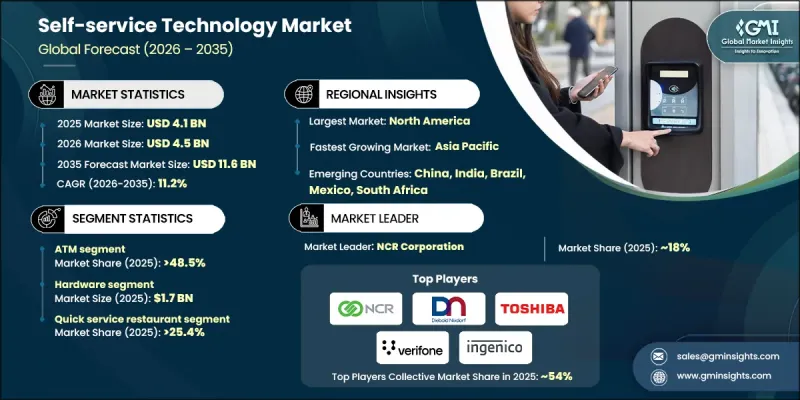
Growth is primarily driven by increasing consumer demand for contactless, convenient, and time-efficient service solutions across retail, banking, and hospitality industries. The adoption of advanced technologies such as AI, IoT, and cloud computing is enhancing the efficiency, intelligence, and personalization of self-service platforms. Consumers are increasingly seeking quick, seamless transactions, prompting businesses to invest in automated kiosks, mobile applications, and interactive terminals that reduce waiting times while improving overall user experience. The integration of predictive analytics, automated support, and connected systems allows businesses to deliver adaptive, personalized services. Furthermore, the rise of digital payments, mobile wallets, and contactless transactions has accelerated the deployment of self-service kiosks and terminals in retail, transportation, and banking, creating opportunities for smarter, more efficient service delivery.
| Market Scope | |
|---|---|
| Start Year | 2025 |
| Forecast Year | 2026-2035 |
| Start Value | $4.1 Billion |
| Forecast Value | $11.6 Billion |
| CAGR | 11.2% |
The ATM segment held a 48.5% share in 2025. Automated Teller Machines are evolving from traditional cash-dispensing roles to multifunctional banking kiosks, offering services such as deposits, fund transfers, bill payments, and prepaid card purchases. This transformation addresses consumer demand for versatile and convenient self-service solutions, expanding the scope of ATMs beyond basic banking operations.
The hardware segment generated USD 1.7 billion in 2025. Growth in this segment is fueled by the widespread installation of durable, advanced devices such as kiosks, ATMs, vending machines, and interactive terminals across healthcare, retail, banking, and hospitality. Demand for enhanced user interfaces, touchscreens, sensors, and secure payment modules, coupled with continuous innovations in hardware design and reliability, positions this segment as the primary revenue driver in the self-service technology industry.
North America Self-service Technology Market held a 28.1% share in 2025. Expansion in the region is propelled by the growing preference for contactless and automated services, adoption of digital payment systems, and increasing implementation of AI-driven kiosks and cloud-based platforms. Businesses leverage self-service technologies to streamline operations, reduce labor costs, and meet evolving customer expectations across multiple sectors, including retail, healthcare, financial services, and hospitality.
Key players in the Global Self-service Technology Market include GRG Banking, Ingenico Group, Olea Kiosks, Zebra Technologies, Elo Touch Solutions, RedyRef Interactive Kiosks, Diebold Nixdorf, Ugenie.io, KIOSK Information Systems, Phoenix Kiosk, NCR Corporation, Avanti Markets, SlabbKiosks, Meridian Kiosks, Toshiba Global Commerce Solutions, XIPHIAS Software Technologies, Verifone, Emergency Management, Embross, and Facility Management System. Companies in the Global Self-service Technology Market adopt multiple strategies to strengthen their market position and expand global presence. Investments in R&D and technological innovation enhance product capabilities, including AI-driven analytics, IoT integration, and cloud-based management. Strategic collaborations with banks, retailers, and hospitality providers help expand market reach and increase adoption of self-service solutions. Companies are also focusing on introducing multifunctional, secure, and user-friendly devices to meet evolving consumer expectations. Expanding production capacity, entering emerging markets, and optimizing supply chains improve responsiveness to regional demand valued at USD 4.1 billion in 2025 and is estimated to grow at a CAGR of 11.2% to reach USD 11.6 billion by 2035.
Table of Contents
Chapter 1 Methodology and Scope
- 1.1 Market scope and definition
- 1.2 Research design
- 1.2.1 Research approach
- 1.2.2 Data collection methods
- 1.3 Data mining sources
- 1.3.1 Global
- 1.3.2 Regional/Country
- 1.4 Base estimates and calculations
- 1.4.1 Base year calculation
- 1.4.2 Key trends for market estimation
- 1.5 Primary research and validation
- 1.5.1 Primary sources
- 1.6 Forecast model
- 1.7 Research assumptions and limitations
Chapter 2 Executive Summary
- 2.1 Industry snapshot
- 2.2 Key market trends
- 2.2.1 Type trends
- 2.2.2 Component trends
- 2.2.3 End Use trends
- 2.2.4 Regional
- 2.3 TAM Analysis, 2025-2034 (USD Million)
- 2.4 CXO perspectives: Strategic imperatives
- 2.4.1 Executive decision points
- 2.4.2 critical success factors
- 2.5 Future outlook and strategic recommendations
Chapter 3 Industry Insights
- 3.1 Industry ecosystem analysis
- 3.1.1 Supplier Landscape
- 3.1.2 Profit Margin
- 3.1.3 Cost structure
- 3.1.4 Value addition at each stage
- 3.1.5 Factor affecting the value chain
- 3.1.6 Disruptions
- 3.2 Industry impact forces
- 3.2.1 Growth drivers
- 3.2.1.1 Technological advancements
- 3.2.1.2 Cost savings for businesses
- 3.2.1.3 Globalization and market expansion
- 3.2.1.4 Growing consumer tech literacy
- 3.2.1.5 Increasing emphasis on contactless solutions
- 3.2.2 Industry pitfalls and challenges
- 3.2.2.1 Technical glitches and reliability issues
- 3.2.2.2 User resistance and adoption challenges
- 3.2.3 Market opportunities
- 3.2.4 Expansion in Emerging Markets
- 3.2.5 Integration of Advanced Technologies
- 3.2.1 Growth drivers
- 3.3 Growth potential analysis
- 3.4 Regulatory landscape
- 3.4.1 North America
- 3.4.2 Europe
- 3.4.3 Asia Pacific
- 3.4.4 Latin America
- 3.4.5 Middle East & Africa
- 3.5 Porter's analysis
- 3.6 PESTEL analysis
- 3.7 Technology and innovation landscape
- 3.7.1 Current technological trends
- 3.7.2 Emerging technologies
- 3.8 Price trends
- 3.8.1 Historical price analysis (2022-2024)
- 3.8.2 Price trend drivers
- 3.8.3 Regional price variations
- 3.8.4 Price forecast (2026-2035)
- 3.9 Pricing strategies
- 3.10 Emerging business models
- 3.11 Compliance requirements
- 3.12 Sustainability measures
- 3.12.1 Sustainable materials assessment
- 3.12.2 Carbon footprint analysis
- 3.12.3 Circular economy implementation
- 3.12.4 Sustainability certifications and standards
- 3.12.5 Sustainability roi analysis
- 3.13 Global consumer sentiment analysis
- 3.14 Patent analysis
Chapter 4 Competitive Landscape, 2025
- 4.1 Introduction
- 4.2 Company market share analysis
- 4.2.1 By region
- 4.2.1.1 North America
- 4.2.1.2 Europe
- 4.2.1.3 Asia Pacific
- 4.2.1.4 Latin America
- 4.2.1.5 Middle East & Africa
- 4.2.2 Market Concentration Analysis
- 4.2.1 By region
- 4.3 Competitive benchmarking of key players
- 4.3.1 Financial performance comparison
- 4.3.1.1 Revenue
- 4.3.1.2 Profit margin
- 4.3.1.3 R&D
- 4.3.2 Product portfolio comparison
- 4.3.2.1 Product range breadth
- 4.3.2.2 Technology
- 4.3.2.3 Innovation
- 4.3.3 Geographic presence comparison
- 4.3.3.1 Global footprint analysis
- 4.3.3.2 Service network coverage
- 4.3.3.3 Market penetration by region
- 4.3.4 Competitive positioning matrix
- 4.3.4.1 Leaders
- 4.3.4.2 Challengers
- 4.3.4.3 Followers
- 4.3.4.4 Niche players
- 4.3.5 Strategic outlook matrix
- 4.3.1 Financial performance comparison
- 4.4 Key developments, 2022-2025
- 4.4.1 Mergers and acquisitions
- 4.4.2 Partnerships and collaborations
- 4.4.3 Technological advancements
- 4.4.4 Expansion and investment strategies
- 4.4.5 Sustainability initiatives
- 4.4.6 Digital transformation initiatives
- 4.5 Emerging/ startup competitors landscape
Chapter 5 Self-service Technology Market Estimates & Forecast, By Component, 2022 - 2035 (USD Million)
- 5.1 Key trends, by component
- 5.2 Hardware
- 5.3 Software
- 5.4 Services
Chapter 6 Self-service Technology Market Estimates & Forecast, By Type, 2022 - 2035 (USD Million)
- 6.1 Key trends, by type
- 6.2 ATM
- 6.3 Vending Machine
- 6.4 Kiosks
- 6.5 Others
Chapter 7 Self-service Technology Market Estimates & Forecast, By End-Use, 2022 - 2035 (USD Million)
- 7.1 Key trends, by end-use
- 7.2 Retail
- 7.3 Quick Service Restaurant
- 7.4 Hospitality
- 7.5 Healthcare
- 7.6 Corporate Offices
- 7.7 Transportation
- 7.8 BFSI
- 7.9 Others
Chapter 8 Self-service Technology Market Estimates & Forecast, By Region, 2022 - 2035 (USD Million)
- 8.1 Key trends, by region
- 8.2 North America
- 8.2.1 U.S.
- 8.2.2 Canada
- 8.3 Europe
- 8.3.1 UK
- 8.3.2 Germany
- 8.3.3 France
- 8.3.4 Italy
- 8.3.5 Spain
- 8.3.6 Russia
- 8.3.7 Rest of Europe
- 8.4 Asia-Pacific
- 8.4.1 China
- 8.4.2 India
- 8.4.3 Japan
- 8.4.4 South Korea
- 8.4.5 ANZ
- 8.4.6 Rest of Asia-Pacific
- 8.5 Latin America
- 8.5.1 Brazil
- 8.5.2 Mexico
- 8.5.3 Rest of Latin America
- 8.6 MEA
- 8.6.1 Saudi Arabia
- 8.6.2 South Africa
- 8.6.3 UAE
- 8.6.4 Rest of MEA
Chapter 9 Company Profiles
- 1.1 Avanti Markets
- 1.2 Diebold Nixdorf
- 1.3 Elo Touch Solutions
- 1.4 Embross
- 1.5 Emergency Management
- 1.6 Facility Management System
- 1.7 GRG Banking
- 1.8 Ingenico Group
- 1.9 KIOSK Information Systems
- 1.10 Meridian Kiosks
- 1.11 NCR Corporation
- 1.12 Olea Kiosks
- 1.13 Phoenix Kiosk
- 1.14 RedyRef Interactive Kiosks
- 1.15 SlabbKiosks
- 1.16 Source Technologies
- 1.17 Toshiba Global Commerce Solutions
- 1.18 Ugenie.io
- 1.19 Verifone
- 1.20 Wincor Nixdorf (Now part of Diebold Nixdorf)
- 1.21 XIPHIAS Software Technologies
- 1.22 Zebra Technologies