|
시장보고서
상품코드
1913351
가스 터빈 시장 : 시장 기회, 성장 요인, 산업 동향 분석 및 예측(2026-2035년)Gas Turbine Market Opportunity, Growth Drivers, Industry Trend Analysis, and Forecast 2026 - 2035 |
||||||

세계의 가스 터빈 시장은 2025년 226억 달러로 평가되었고, 2035년까지 연평균 복합 성장률(CAGR) 11.2%로 성장할 전망이며, 648억 달러에 이를 것으로 예측됩니다.

이 시장 성장은 발전소의 현대화 가속화, 청정 에너지 시스템에 대한 수요 증가, 유연하고 고효율 발전 기술로의 세계 전환으로 추진되고 있습니다. 가스 터빈은 간헐적인 재생에너지를 보완하는 능력과 신속한 기동 및 저배출 성능을 실현하는 특성으로 선진국 및 신흥국을 불문하고 중요성을 계속 늘리고 있습니다. 터빈 재료, 냉각 기술, 디지털 예측 보전의 진보로 장시간 운전과 우수한 열효율에 최적화된 차세대 유닛의 도입이 더욱 강화되고 있습니다.
| 시장 범위 | |
|---|---|
| 시작 연도 | 2025년 |
| 예측 연도 | 2026-2035년 |
| 시작 시 가치 | 226억 달러 |
| 예측 금액 | 648억 달러 |
| CAGR | 11.2% |
전력 회사에 대한 탄소강도 감소 압력 증가는 하이브리드 및 수소 대응 가스 터빈에 대한 투자를 촉진하여 수명주기 배출량을 대폭 줄이고 시스템 안정성을 향상시킵니다. 이러한 혁신 기술은 전력 회사와 산업 운영자가 기존의 석탄 화력 발전 장치에서 전환을 지원합니다. 기존 터빈 설비의 업그레이드 및 개조도 시장 성장에 크게 기여하고 있습니다. 이는 설비 수명의 연장, 연료 유연성 향상, 복합 사이클 효율의 개선을 요구하는 사업자의 요구에 의한 것입니다. 제조업, 데이터센터, 중공업 분야에서 세계 전력 수요가 급증함에 따라 가스 터빈은 신뢰성 높은 베이스로드 및 피크 부하 발전의 기반 기술로서의 역할을 계속하고 있습니다.
50kW 가스 터빈 시장은 2025년 14억 달러 규모에 이르렀으며, 분산형 및 지역 밀착형 발전 솔루션에 대한 수요 증가가 주요 원동력이 되었습니다. 이러한 콤팩트 터빈은 지속적인 신뢰성, 고효율성, 운영 유연성이 최우선으로 되는 산업 시설, 원격지, 오프 그리드 지역, 마이크로그리드 등의 특수 에너지 환경에서 점점 활용되고 있습니다. 최소한의 설치 면적에서 안정적인 출력을 공급할 수 있는 특성은 끊임없는 에너지 공급이 필요한 분야에 이상적입니다. 게다가 낮은 배출량, 연료의 범용성, 신재생 에너지원과의 통합 가능성이 평가되고 있으며, 보다 깨끗하고 강인한 에너지 인프라를 요구하는 세계의 동향을 따릅니다.
복합 사이클 부문은 기존의 단순 사이클 시스템과 비교하여 같은 양의 연료 투입으로 더 많은 전력을 생산할 수 있는 뛰어난 효율성을 지원하며, 2035년까지 480억 달러 규모에 이를 것으로 예측됩니다. 복합 사이클 발전소는 낮은 배출량, 운영 유연성, 베이스 로드 및 피크 전력 수요를 모두 수용할 수 있는 능력으로 인해 대규모 유틸리티 프로젝트에서 점점 더 선호되고 있습니다. 세계 정부 및 유틸리티 사업자들은 배출 감축 목표에 따라 증가하는 전력 수요를 충족하기 위해 고효율 천연 가스 기술을 우선시하고 복합 사이클 가스 터빈 수요를 강화하고 있습니다.
아시아태평양의 가스 터빈 시장은 2025년 연간 수익으로 35%의 점유율을 차지했으며, 다른 모든 지역을 크게 상회했습니다. 이 지역의 이점은 급속한 산업화, 대규모 도시 성장 및 가스 화력 발전 인프라에 대한 대규모 투자로 인한 것입니다. 중국, 인도, 인도네시아, 동남아시아 각국 정부는 보다 깨끗한 연소 특성과 낮은 운용 비용을 배경으로 석유 및 석탄 기반 발전에서 천연가스로의 전환을 가속화하고 있습니다.
자주 묻는 질문
목차
제1장 조사 방법 및 범위
제2장 주요 요약
제3장 업계 인사이트
- 생태계 분석
- 원재료 가용성 및 조달 분석
- 제조 능력 평가
- 공급망의 탄력성 및 위험 요인
- 유통 네트워크 분석
- 규제 상황
- 업계에 미치는 영향요인
- 성장 촉진요인
- 업계의 잠재적 위험 및 과제
- 성장 가능성 분석
- Porter's Five Forces 분석
- PESTEL 분석
- 가스 터빈의 비용 구조 분석
- 가격 동향 분석(달러/MW)
- 지역별
- 용량별
- 시장 역학 및 신흥 동향
- 스마트 기술 및 인더스트리 4.0 도입
- 그린 이니셔티브 및 ESG 전략
- 가스 수송 인프라에 대한 정성 분석
- 천연가스에 의한 발전 동향
- 발전 분야에 있어서 대체 에너지원의 업계 개황
- 석탄에서 가스로의 전환에서 천연 가스의 역할에 대한 상세한 분석
- 세계의 가스 이용 상황의 개요
제4장 경쟁 구도
- 서문
- 기업의 시장 점유율 분석 : 지역별
- 북미
- 유럽
- 아시아태평양
- 중동 및 아프리카
- 라틴아메리카
- 전략적 대시보드
- 전략적 노력
- 주요 제휴 및 협력 관계
- 주요 M&A 활동
- 제품 혁신 및 신제품 출시
- 시장 확대 전략
- 경쟁 벤치마킹
- 혁신 및 지속가능성의 정세
제5장 시장 규모 및 예측 : 용량별(2022-2035년)
- 50kW 이하
- 50kW 초과-500kW
- 500kW 초과-1MW
- 1MW 이상-30MW
- 30MW 이상-70MW
- 70MW 이상-200MW
- 200MW 이상
제6장 시장 규모 및 예측 : 제품별(2022-2035년)
- 항공기 파생형
- 대형 상용차용
제7장 시장 규모 및 예측 : 기술별(2022-2035년)
- 오픈 사이클
- 복합 사이클
제8장 시장 규모 및 예측 : 용도별(2022-2035년)
- 발전소
- 석유 및 가스
- 프로세스 플랜트
- 항공 분야
- 선박
- 기타
제9장 시장 규모 및 예측 : 지역별(2022-2035년)
- 북미
- 미국
- 캐나다
- 멕시코
- 유럽
- 영국
- 프랑스
- 독일
- 러시아
- 이탈리아
- 네덜란드
- 핀란드
- 그리스
- 덴마크
- 루마니아
- 폴란드
- 스웨덴
- 아시아태평양
- 중국
- 호주
- 일본
- 인도
- 한국
- 인도네시아
- 태국
- 말레이시아
- 방글라데시
- 중동 및 아프리카
- 사우디아라비아
- 아랍에미리트(UAE)
- 카타르
- 쿠웨이트
- 오만
- 이집트
- 튀르키예
- 바레인
- 이라크
- 요르단
- 레바논
- 남아프리카
- 나이지리아
- 알제리
- 케냐
- 가나
- 라틴아메리카
- 브라질
- 아르헨티나
- 페루
- 칠레
제10장 기업 프로파일
- Ansaldo Energia
- Baker Hughes
- Bharat Heavy Electricals Limited
- Capstone Green Energy
- Destinus Energy
- Doosan Enerbility
- FlexEnergy Solutions
- GE Vernova
- Harbin Electric Corporation
- IHI Corporation
- Kawasaki Heavy Industries
- MAN Energy Solutions
- Mitsubishi Heavy Industries
- Nanjing Steam Turbine Motor(Group)
- Rolls-Royce
- Shanghai Electric
- Siemens Energy
- Solar Turbines
- Vericor
- Wartsila
The Global Gas Turbine Market was valued at USD 22.6 billion in 2025 and is estimated to grow at a CAGR of 11.2% to reach USD 64.8 billion by 2035.
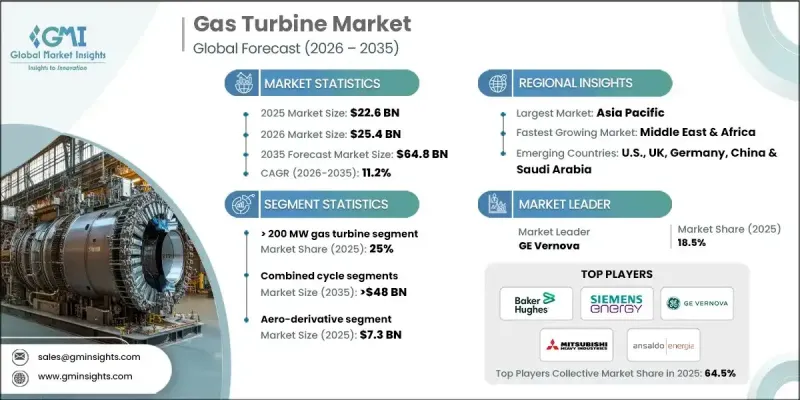
The market growth is driven by accelerated power plant modernization, rising demand for cleaner energy systems, and the global shift toward flexible, high-efficiency generation technologies. Gas turbines continue to gain prominence across both developed and emerging economies due to their capability to balance intermittent renewable energy and deliver fast-start, low-emission performance. Advancements in turbine materials, cooling technologies, and digital predictive maintenance have further strengthened the adoption of next-generation units optimized for long-duration operation and superior thermal efficiency.
| Market Scope | |
|---|---|
| Start Year | 2025 |
| Forecast Year | 2026-2035 |
| Start Value | $22.6 Billion |
| Forecast Value | $64.8 Billion |
| CAGR | 11.2% |
The increasing pressure on utilities to reduce carbon intensity has boosted investment in hybrid and hydrogen-ready gas turbines, enabling significant reductions in lifecycle emissions while enhancing grid stability. These innovations support utilities and industrial operators in transitioning from conventional coal-fired units. Upgrades and retrofits for existing turbine fleets also contribute substantially to market growth, as operators seek to extend equipment life, improve fuel flexibility, and enhance combined-cycle efficiency. With global electricity demand surging across manufacturing, data centers, and heavy industries, gas turbines continue to serve as a cornerstone technology for reliable baseload and peak-load power generation.
The 50 kW gas turbine market was valued at USD 1.4 billion in 2025, driven primarily by the growing demand for decentralized and localized power generation solutions. These compact turbines are increasingly utilized in industrial facilities, remote or off-grid locations, and specialized energy setups such as microgrids, where continuous reliability, high efficiency, and operational flexibility are paramount. Their ability to deliver consistent power output with minimal footprint makes them ideal for sectors requiring uninterrupted energy supply. Additionally, these turbines are favored for their low emissions, fuel versatility, and potential integration with renewable energy sources, which aligns with global trends toward cleaner and more resilient energy infrastructure.
The combined cycle segment is expected to reach USD 48 billion by 2035, driven by its superior efficiency and ability to generate more electricity using the same fuel input compared to conventional simple-cycle systems. Combined cycle power plants are increasingly preferred for large-scale utility projects due to their lower emissions profile, operational flexibility, and ability to support baseload as well as peak power requirements. Governments and utilities worldwide are prioritizing high-efficiency natural gas technologies to meet rising electricity demand while aligning with emission reduction goals, strengthening the demand for combined cycle gas turbines.
Asia Pacific Gas Turbine Market held 35% share in 2025 significantly outpacing all other regions in annual revenue. The region's dominance is attributed to rapid industrialization, extensive urban growth, and massive investments in gas-fired power generation infrastructure. Governments in China, India, Indonesia, and Southeast Asia are accelerating the shift from oil- and coal-based power generation to natural gas, driven by cleaner combustion characteristics and lower operating costs.
Major companies shaping the Global Gas Turbine Market include General Electric, Siemens Energy, Mitsubishi Power, Ansaldo Energia, Rolls-Royce, Solar Turbines, Doosan Enerbility, Harbin Electric, BHEL, and OPRA Turbines. These players focus on high-efficiency turbine development, hydrogen integration, service modernization, and OEM-utility partnerships to strengthen their market presence. Leading companies in the Gas Turbine Market are adopting several strategic initiatives to reinforce their global presence. A major focus is on developing hydrogen-capable and low-NOx turbines, enabling operators to transition toward cleaner fuels while future-proofing long-term asset investments. Firms are also expanding aftermarket service portfolios, offering digital monitoring, predictive maintenance, and full lifecycle management to secure recurring revenue streams. Collaborative R&D partnerships with utilities, governments, and material science companies accelerate innovation in high-temperature alloys and cooling technologies.
Table of Contents
Chapter 1 Methodology & Scope
- 1.1 Research design
- 1.1.1 Research approach
- 1.1.2 Data collection methods
- 1.2 Base estimates and calculations
- 1.2.1 Base year calculation
- 1.2.2 Market estimates & forecast parameters
- 1.3 Forecast
- 1.3.1 Key trends for market estimates
- 1.3.2 Quantified market impact analysis
- 1.3.2.1 Mathematical impact of growth parameters on forecast
- 1.3.3 Scenario analysis framework
- 1.4 Primary research and validation
- 1.4.1 Some of the primary sources (but not limited to)
- 1.5 Data mining sources
- 1.5.1 Paid Sources
- 1.5.2 Sources, by region
- 1.6 Research trail & scoring components
- 1.6.1 Research trail components
- 1.6.2 Scoring components
- 1.7 Research transparency addendum
- 1.7.1 Source attribution framework
- 1.7.2 Quality assurance metrics
- 1.7.3 Our commitment to trust
- 1.8 Market definitions
Chapter 2 Executive Summary
- 2.1 Industry synopsis, 2022 - 2035
- 2.1.1 Business trends
- 2.1.2 Capacity trends
- 2.1.3 Product trends
- 2.1.4 Technology trends
- 2.1.5 Application trends
- 2.1.6 Regional trends
Chapter 3 Industry Insights
- 3.1 Industry ecosystem analysis
- 3.1.1 Raw material availability & sourcing analysis
- 3.1.2 Manufacturing capacity assessment
- 3.1.3 Supply chain resilience & risk factors
- 3.1.4 Distribution network analysis
- 3.2 Regulatory landscape
- 3.3 Industry impact forces
- 3.3.1 Growth drivers
- 3.3.2 Industry pitfalls & challenges
- 3.4 Growth potential analysis
- 3.5 Porter's analysis
- 3.5.1 Bargaining power of suppliers
- 3.5.2 Bargaining power of buyers
- 3.5.3 Threat of new entrants
- 3.5.4 Threat of substitutes
- 3.6 PESTEL analysis
- 3.6.1 Political factors
- 3.6.2 Economic factors
- 3.6.3 Social factors
- 3.6.4 Technological factors
- 3.6.5 Legal factors
- 3.6.6 Environmental factors
- 3.7 Cost structure analysis of gas turbines
- 3.8 Price trend analysis (USD/MW)
- 3.8.1 By region
- 3.8.2 By capacity
- 3.9 Market dynamics & emerging trends
- 3.10 Smart technologies & industry 4.0 adoption
- 3.11 Green initiatives & ESG strategies
- 3.12 Qualitative analysis on gas transportation infrastructure
- 3.13 Electricity generation trends from natural gas
- 3.14 Industry overview on alternative energy sources in power generation
- 3.15 Detailed analysis on role of natural gas in coal-to-gas transition
- 3.16 Global gas utilization overview
Chapter 4 Competitive Landscape, 2025
- 4.1 Introduction
- 4.2 Company market share analysis, by region, 2025
- 4.2.1 North America
- 4.2.2 Europe
- 4.2.3 Asia Pacific
- 4.2.4 Middle East & Africa
- 4.2.5 Latin America
- 4.3 Strategic dashboard
- 4.4 Strategic initiatives
- 4.4.1 Key partnerships & collaborations
- 4.4.2 Major M&A activities
- 4.4.3 Product innovations & launches
- 4.4.4 Market expansion strategies
- 4.5 Competitive benchmarking
- 4.6 Innovation & sustainability landscape
Chapter 5 Market Size and Forecast, By Capacity, 2022 - 2035 (USD Million & MW)
- 5.1 Key trends
- 5.2 ≤ 50 kW
- 5.3 > 50 kW to 500 kW
- 5.4 > 500 kW to 1 MW
- 5.5 > 1 MW to 30 MW
- 5.6 > 30 MW to 70 MW
- 5.7 > 70 MW to 200 MW
- 5.8 > 200 MW
Chapter 6 Market Size and Forecast, By Product, 2022 - 2035 (USD Million & MW)
- 6.1 Key trends
- 6.2 Aero-derivative
- 6.3 Heavy duty
Chapter 7 Market Size and Forecast, By Technology, 2022 - 2035 (USD Million & MW)
- 7.1 Key trends
- 7.2 Open cycle
- 7.3 Combined cycle
Chapter 8 Market Size and Forecast, By Application, 2022 - 2035 (USD Million & MW)
- 8.1 Key trends
- 8.2 Power plants
- 8.3 Oil & gas
- 8.4 Process plants
- 8.5 Aviation
- 8.6 Marine
- 8.7 Others
Chapter 9 Market Size and Forecast, By Region, 2022 - 2035 (USD Million & MW)
- 9.1 Key trends
- 9.2 North America
- 9.2.1 U.S.
- 9.2.2 Canada
- 9.2.3 Mexico
- 9.3 Europe
- 9.3.1 UK
- 9.3.2 France
- 9.3.3 Germany
- 9.3.4 Russia
- 9.3.5 Italy
- 9.3.6 Netherlands
- 9.3.7 Finland
- 9.3.8 Greece
- 9.3.9 Denmark
- 9.3.10 Romania
- 9.3.11 Poland
- 9.3.12 Sweden
- 9.4 Asia Pacific
- 9.4.1 China
- 9.4.2 Australia
- 9.4.3 Japan
- 9.4.4 India
- 9.4.5 South Korea
- 9.4.6 Indonesia
- 9.4.7 Thailand
- 9.4.8 Malaysia
- 9.4.9 Bangladesh
- 9.5 Middle East & Africa
- 9.5.1 Saudi Arabia
- 9.5.2 UAE
- 9.5.3 Qatar
- 9.5.4 Kuwait
- 9.5.5 Oman
- 9.5.6 Egypt
- 9.5.7 Turkey
- 9.5.8 Bahrain
- 9.5.9 Iraq
- 9.5.10 Jordan
- 9.5.11 Lebanon
- 9.5.12 South Africa
- 9.5.13 Nigeria
- 9.5.14 Algeria
- 9.5.15 Kenya
- 9.5.16 Ghana
- 9.6 Latin America
- 9.6.1 Brazil
- 9.6.2 Argentina
- 9.6.3 Peru
- 9.6.4 Chile
Chapter 10 Company Profiles
- 10.1 Ansaldo Energia
- 10.2 Baker Hughes
- 10.3 Bharat Heavy Electricals Limited
- 10.4 Capstone Green Energy
- 10.5 Destinus Energy
- 10.6 Doosan Enerbility
- 10.7 FlexEnergy Solutions
- 10.8 GE Vernova
- 10.9 Harbin Electric Corporation
- 10.10 IHI Corporation
- 10.11 Kawasaki Heavy Industries
- 10.12 MAN Energy Solutions
- 10.13 Mitsubishi Heavy Industries
- 10.14 Nanjing Steam Turbine Motor (Group)
- 10.15 Rolls-Royce
- 10.16 Shanghai Electric
- 10.17 Siemens Energy
- 10.18 Solar Turbines
- 10.19 Vericor
- 10.20 Wartsila