

|
시장보고서
상품코드
1913375
카복시메틸셀룰로오스(CMC) 시장 : 시장 기회, 성장 촉진요인, 산업 동향 분석, 예측(2026-2035년)Carboxymethyl Cellulose Market Opportunity, Growth Drivers, Industry Trend Analysis, and Forecast 2026 - 2035 |
||||||

세계의 카복시메틸셀룰로오스 시장은 2025년에 18억 7,000만 달러로 평가되었고, 2035년까지 연평균 복합 성장률(CAGR) 4.8%로 성장할 전망이며, 29억 5,000만 달러에 이를 것으로 예측되고 있습니다.
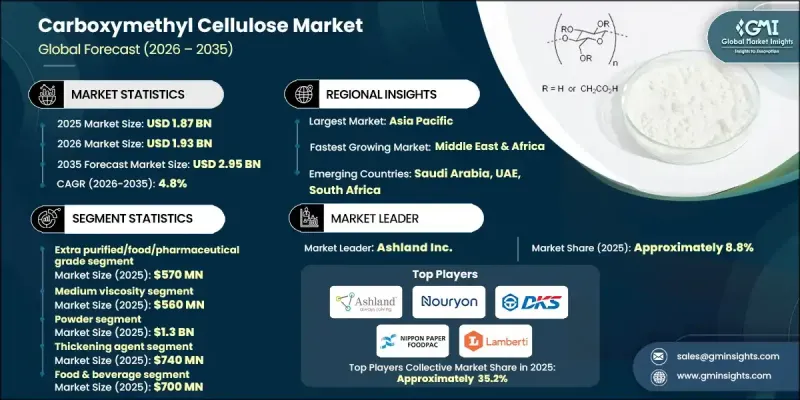
시장 성장은 다기능 성능 특성으로 인해 여러 최종 이용 산업에서 카복시메틸셀룰로오스의 채택 확대를 반영합니다. 특히 식품가공 분야에서는 편의성을 중시한 소비 패턴이 채용을 가속화하고 있으며, 제조업체가 점도 제어, 안정화, 결합 기능으로 인해 CMC에 대한 의존도를 높일수록 수요는 계속 증가하고 있습니다. 위생, 건강, 제품 품질에 대한 의식의 고조, 특히 개발 도상 지역에서의 성장은 더욱 발전하고 있습니다. 의약품 제조 분야에서 CMC는 제품의 유연성 및 균일성, 안정성 및 보존 기간을 향상시키는 능력으로 필수적인 재료가 되었습니다. 고품질 의약품에 대한 세계 수요가 지속적으로 높아지는 가운데, CMC가 의약품의 성능 및 신뢰성을 향상시키는 역할은 점점 더 중요해지고 있습니다. 또한 특수급 혁신 및 산업 용도 확대도 시장을 뒷받침하고 있으며, CMC는 성능 효율, 규제 준수, 장기적인 제품 안정성을 요구하는 제조업체에게 중요한 성분으로서의 지위를 확립하고 있습니다.
| 시장 범위 | |
|---|---|
| 시작 연도 | 2025년 |
| 예측 기간 | 2026-2035년 |
| 당초 시장 규모 | 18억 7,000만 달러 |
| 시장 규모 예측 | 29억 5,000만 달러 |
| CAGR | 4.8% |
초고순도, 식품 및 의약품 등급 부문은 2025년에 5억 7,000만 달러의 매출을 창출하였으며, 2026-2035년 CAGR 5.1%로 성장할 것으로 예측됩니다. 이러한 고순도 등급은 엄격한 품질 관리 및 성능 정확도가 요구되는 용도에 선호됩니다. 배터리 등급의 CMC도 주목을 받고 있으며, 에너지 저장 및 전동모빌리티의 동향에 따른 시장 전개가 전망됩니다.
분말 형태 부문은 2025년에 13억 달러에 이르렀고, 2035년까지 연평균 복합 성장률(CAGR) 4.5%로 성장할 것으로 예측됩니다. 취급 용이성, 보관 효율, 광범위한 산업 용도 분야에 따른 수요 증가가 성장을 이끌고 있습니다.
북미의 카복시메틸셀룰로오스 시장은 2025년 4억 9,000만 달러를 차지하며 꾸준한 성장이 예상됩니다. 식품 제조, 의약품, 퍼스널케어, 제지 가공, 에너지 관련 용도에 있어서 수요 증가가 확대를 지지하고 있습니다.
자주 묻는 질문
목차
제1장 분석 방법 및 범위
제2장 주요 요약
제3장 업계 인사이트
- 생태계 분석
- 공급자의 상황
- 이익률
- 각 단계에서의 부가가치
- 밸류체인에 영향을 주는 요인
- 혁신
- 업계에 미치는 영향요인
- 성장 촉진요인
- 업계의 잠재적 위험 및 과제
- 시장 기회
- 성장 가능성 분석
- 규제 상황
- 북미
- 유럽
- 아시아태평양
- 라틴아메리카
- 중동 및 아프리카
- Porter's Five Forces 분석
- PESTEL 분석
- 가격 동향
- 지역별
- 제품별
- 장래 시장 동향
- 기술 및 혁신 동향
- 현재 기술 동향
- 신흥 기술
- 특허 상황
- 무역 통계(주 : 무역 통계는 주요 국가에서만 제공됨)
- 주요 수입국
- 주요 수출국
- 지속가능성 및 환경면
- 지속가능한 실천
- 폐기물 감축 전략
- 생산에서 에너지 효율
- 환경에 배려한 대처
- 탄소발자국에 관한 고려 사항
제4장 경쟁 구도
- 서문
- 기업별 시장 점유율 분석
- 지역별
- 북미
- 유럽
- 아시아태평양
- 라틴아메리카
- 중동 및 아프리카
- 지역별
- 기업 매트릭스 분석
- 주요 기업의 경쟁 분석
- 경쟁 포지셔닝 매트릭스
- 주요 동향
- 합병 및 인수
- 제휴 및 협업
- 신제품 발매
- 사업 확대 계획
제5장 시장의 추정 및 예측 : 등급별(2022-2035년)
- 산업용 등급
- 반 정제 등급
- 정제 등급
- 초정제, 식품 및 의약품 등급
- 배터리 등급
제6장 시장의 추정 및 예측 : 점도 등급별(2022-2035년)
- 초저점도
- 저점도
- 중점도
- 고점도
- 초고점도
- 초초고점도
제7장 시장의 추정 및 예측 : 형태별(2022-2035년)
- 분말
- 입상
- 액체 및 용액
- 플레이크
제8장 시장의 추정 및 예측 : 기능별(2022-2035년)
- 증점제
- 안정제
- 바인더
- 피막 형성제
- 보수제
- 현탁제
제9장 시장의 추정 및 예측 : 최종 용도별(2022-2035년)
- 식품 및 음료
- 의약품
- 퍼스널케어 및 화장품
- 석유 및 가스
- 펄프 및 제지
- 세제 및 세탁 용품
- 배터리 및 에너지 저장
- 섬유
- 3D 프린팅 및 바이오메디컬
- 광업 및 광물
- 기타(건설, 도료, 접착제, 세라믹)
제10장 시장의 추정 및 예측 : 유통 채널별(2022-2035년)
- 직접 판매(B2B 및 산업용)
- 간접 판매(도매업체 및 소매업체)
제11장 시장의 추정 및 예측 : 지역별(2022-2035년)
- 북미
- 미국
- 캐나다
- 유럽
- 독일
- 영국
- 프랑스
- 이탈리아
- 스페인
- 기타 유럽
- 아시아태평양
- 중국
- 인도
- 일본
- 호주
- 한국
- 기타 아시아태평양
- 라틴아메리카
- 브라질
- 멕시코
- 아르헨티나
- 기타 라틴아메리카
- 중동 및 아프리카
- 사우디아라비아
- 남아프리카
- 아랍에미리트(UAE)
- 기타 중동 및 아프리카
제12장 기업 프로파일
- Zibo Hailan Chemical Co. Ltd
- Ashland Global Holdings
- Chongqing Lihong Fine Chemicals
- Daicel Corporation
- DKS Co. Ltd
- PAC &CMC Manufacturing Co.,Ltd.
- Nouryon
- Lamberti SpA
- Nippon Paper Industries
- Patel Industries
- Pioma Chemicals
- Qingdao Tianya Chemical
- Mare Austria GmbH
- AKKIM
The Global Carboxymethyl Cellulose Market was valued at USD 1.87 billion in 2025 and is estimated to grow at a CAGR of 4.8% to reach USD 2.95 billion by 2035.
Market growth reflects the expanding adoption of carboxymethyl cellulose across multiple end-use industries due to its multifunctional performance characteristics. Demand continues to rise as manufacturers increasingly rely on CMC for viscosity control, stabilization, and binding functions, particularly in food processing, where convenience-oriented consumption patterns are accelerating adoption. Growth is further supported by rising awareness of hygiene, wellness, and product quality, especially across developing regions. In pharmaceutical manufacturing, CMC has become an essential material due to its formulation flexibility and ability to enhance product consistency, stability, and shelf life. As global demand for high-quality medicines continues to rise, the role of CMC in improving drug performance and reliability is becoming more prominent. The market is also benefiting from innovation in specialty grades and expanding industrial applications, positioning CMC as a critical ingredient for manufacturers seeking performance efficiency, regulatory compliance, and long-term product stability.
| Market Scope | |
|---|---|
| Start Year | 2025 |
| Forecast Year | 2026-2035 |
| Start Value | $1.87 Billion |
| Forecast Value | $2.95 Billion |
| CAGR | 4.8% |
The extra-purified, food, and pharmaceutical grade segment generated USD 570 million in 2025 and is projected to grow at a CAGR of 5.1% from 2026 to 2035. These high-purity grades are preferred for applications requiring strict quality control and performance precision. Battery-grade CMC is also gaining traction, aligning the market with energy storage and electric mobility trends.
The powder form segment reached USD 1.3 billion in 2025 and is forecast to grow at a CAGR of 4.5% through 2035. Strong demand is driven by ease of handling, storage efficiency, and broad industrial usability.
North America Carboxymethyl Cellulose Market accounted for USD 490 million in 2025 and is expected to witness steady growth. Expansion is supported by rising demand across food manufacturing, pharmaceuticals, personal care, paper processing, and energy-related applications.
Key companies operating in the Global Carboxymethyl Cellulose Market include Nouryon, Ashland Global Holdings, Nippon Paper Industries, Lamberti S.p.A., DKS Co. Ltd, and other established producers. Companies in the Global Carboxymethyl Cellulose Market are strengthening their competitive position through capacity expansion, grade innovation, and targeted application development. Manufacturers are investing in research to enhance purity levels, performance consistency, and functional efficiency. Strategic partnerships with end-use industries support customized product development and long-term supply agreements. Geographic expansion into high-growth regions is improving market penetration and revenue stability. Companies are also focusing on sustainable sourcing, efficient production processes, and regulatory compliance to meet evolving industry standards. Strengthening distribution networks and technical support capabilities further enhances customer engagement and brand reliability.
Table of Contents
Chapter 1 Methodology
- 1.1 Market scope and definition
- 1.2 Research design
- 1.2.1 Research approach
- 1.2.2 Data collection methods
- 1.3 Data mining sources
- 1.3.1 Global
- 1.3.2 Regional/Country
- 1.4 Base estimates and calculations
- 1.4.1 Base year calculation
- 1.4.2 Key trends for market estimation
- 1.5 Primary research and validation
- 1.5.1 Primary sources
- 1.6 Forecast model
- 1.7 Research assumptions and limitations
Chapter 2 Executive Summary
- 2.1 Industry 360° synopsis
- 2.2 Key market trends
- 2.2.1 Regional
- 2.2.2 Grade
- 2.2.3 Viscosity Grade
- 2.2.4 Form
- 2.2.5 Function
- 2.2.6 End Use
- 2.2.7 Distribution Channel
- 2.3 TAM Analysis, 2026-2035
- 2.4 CXO perspectives: Strategic imperatives
- 2.4.1 Executive decision points
- 2.4.2 Critical success factors
- 2.5 Future Outlook and Strategic Recommendations
Chapter 3 Industry Insights
- 3.1 Industry ecosystem analysis
- 3.1.1 Supplier Landscape
- 3.1.2 Profit Margin
- 3.1.3 Value addition at each stage
- 3.1.4 Factor affecting the value chain
- 3.1.5 Disruptions
- 3.2 Industry impact forces
- 3.2.1 Growth drivers
- 3.2.2 Industry pitfalls and challenges
- 3.2.3 Market opportunities
- 3.3 Growth potential analysis
- 3.4 Regulatory landscape
- 3.4.1 North America
- 3.4.2 Europe
- 3.4.3 Asia Pacific
- 3.4.4 Latin America
- 3.4.5 Middle East & Africa
- 3.5 Porter's analysis
- 3.6 PESTEL analysis
- 3.7 Price trends
- 3.7.1 By region
- 3.7.2 By product
- 3.8 Future market trends
- 3.9 Technology and Innovation landscape
- 3.9.1 Current technological trends
- 3.9.2 Emerging technologies
- 3.10 Patent Landscape
- 3.11 Trade statistics (Note: the trade statistics will be provided for key countries only)
- 3.11.1 Major importing countries
- 3.11.2 Major exporting countries
- 3.12 Sustainability and Environmental Aspects
- 3.12.1 Sustainable Practices
- 3.12.2 Waste Reduction Strategies
- 3.12.3 Energy Efficiency in Production
- 3.12.4 Eco-friendly Initiatives
- 3.13 Carbon Footprint Considerations
Chapter 4 Competitive Landscape, 2025
- 4.1 Introduction
- 4.2 Company market share analysis
- 4.2.1 By region
- 4.2.1.1 North America
- 4.2.1.2 Europe
- 4.2.1.3 Asia Pacific
- 4.2.1.4 LATAM
- 4.2.1.5 MEA
- 4.2.1 By region
- 4.3 Company matrix analysis
- 4.4 Competitive analysis of major market players
- 4.5 Competitive positioning matrix
- 4.6 Key developments
- 4.6.1 Mergers & acquisitions
- 4.6.2 Partnerships & collaborations
- 4.6.3 New Product Launches
- 4.6.4 Expansion Plans
Chapter 5 Market Estimates and Forecast, By Grade, 2022- 2035 (USD Billion, Kilo Tons)
- 5.1 Key trends
- 5.2 Technical/industrial grade
- 5.3 Semi-purified grade
- 5.4 Purified grade
- 5.5 Extra purified/food/pharmaceutical grade
- 5.6 Battery grade
Chapter 6 Market Estimates and Forecast, By Viscosity Grade, 2022- 2035 (USD Billion, Kilo Tons)
- 6.1 Key trends
- 6.2 Extra low viscosity
- 6.3 Low viscosity
- 6.4 Medium viscosity
- 6.5 High viscosity
- 6.6 Extra high viscosity
- 6.7 Super high viscosity
Chapter 7 Market Estimates and Forecast, By Form, 2022 - 2035 (USD Billion, Kilo Tons)
- 7.1 Key trends
- 7.2 Powder
- 7.3 Granular
- 7.4 Liquid/solution
- 7.5 Flake
Chapter 8 Market Estimates and Forecast, By Function, 2022 - 2035 (USD Billion, Kilo Tons)
- 8.1 Key trends
- 8.2 Thickening agent
- 8.3 Stabilizer
- 8.4 Binder
- 8.5 Film-former
- 8.6 Water retention agent
- 8.7 Suspending agent
Chapter 9 Market Estimates and Forecast, By End Use, 2022 - 2035 (USD Billion, Kilo Tons)
- 9.1 Key trends
- 9.2 Food & beverage
- 9.3 Pharmaceuticals
- 9.4 Personal care & cosmetics
- 9.5 Oil & gas
- 9.6 Pulp & paper
- 9.7 Detergents & laundry
- 9.8 Battery/energy storage
- 9.9 Textile
- 9.10 3d printing & biomedical
- 9.11 Mining & minerals
- 9.12 Others (construction, paints, adhesives, ceramics)
Chapter 10 Market Estimates and Forecast, By Distribution Channel, 2022 - 2035 (USD Billion, Kilo Tons)
- 10.1 Key trends
- 10.2 Direct sales (B2B industrial)
- 10.3 Indirect sales (distributor/retail)
Chapter 11 Market Estimates and Forecast, By Region, 2022 - 2035 (USD Billion, Kilo Tons)
- 11.1 Key trends
- 11.2 North America
- 11.2.1 U.S.
- 11.2.2 Canada
- 11.3 Europe
- 11.3.1 Germany
- 11.3.2 UK
- 11.3.3 France
- 11.3.4 Italy
- 11.3.5 Spain
- 11.3.6 Rest of Europe
- 11.4 Asia Pacific
- 11.4.1 China
- 11.4.2 India
- 11.4.3 Japan
- 11.4.4 Australia
- 11.4.5 South Korea
- 11.4.6 Rest of Asia Pacific
- 11.5 Latin America
- 11.5.1 Brazil
- 11.5.2 Mexico
- 11.5.3 Argentina
- 11.5.4 Rest of Latin America
- 11.6 Middle East & Africa
- 11.6.1 Saudi Arabia
- 11.6.2 South Africa
- 11.6.3 UAE
- 11.6.4 Rest of Middle East & Africa
Chapter 12 Company Profiles
- 12.1 Zibo Hailan Chemical Co. Ltd
- 12.2 Ashland Global Holdings
- 12.3 Chongqing Lihong Fine Chemicals
- 12.4 Daicel Corporation
- 12.5 DKS Co. Ltd
- 12.6 PAC & CMC Manufacturing Co.,Ltd.
- 12.7 Nouryon
- 12.8 Lamberti S.p.A.
- 12.9 Nippon Paper Industries
- 12.10 Patel Industries
- 12.11 Pioma Chemicals
- 12.12 Qingdao Tianya Chemical
- 12.13 Mare Austria GmbH
- 12.14 AKKIM


