|
시장보고서
상품코드
1913480
의료용 흡입 기기 시장 예측 : 기회, 성장 요인, 업계 동향 분석(2026-2035년)Medical Suction Devices Market Opportunity, Growth Drivers, Industry Trend Analysis, and Forecast 2026 - 2035 |
||||||

세계의 의료용 흡입 기기 시장은 2025년에 11억 8,000만 달러로 평가되었고, 2035년까지 연평균 복합 성장률(CAGR) 5.8%로 성장해 20억 7,000만 달러에 이를 것으로 예측되고 있습니다.
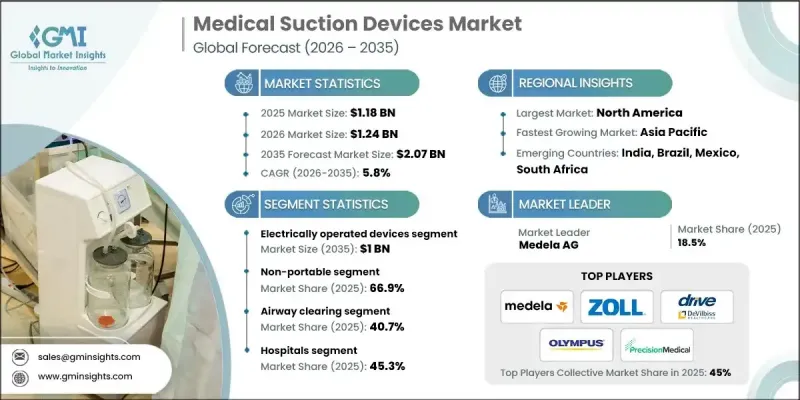
이러한 상승 동향은 장기적인 호흡기 질환 부담 증가, 흡입 기술에 의존하는 의료 절차의 확대, 재택치료 솔루션의 수용 확대에 의해 지원됩니다. 호흡기 질환이 더 흔해짐에 따라 합병증을 줄이고 환자의 회복을 돕기 위해서는 효과적인기도 클리어런스가 필수적입니다. 의료 흡입 시스템은 다양한 임상 현장에서 체액과 분비물을 제거하여 의료 치료 중 시인성과 청결을 유지하기 위해 널리 활용되고 있습니다. 세계적으로 증가하는 수술 및 진단 절차의 수는 이러한 장비에 대한 수요를 더욱 강화하고 있습니다. 또한 저침습 의료 기술로의 전환은 정밀하고 제어된 체액 관리의 필요성을 높이고 정확성, 안전성 및 일관된 임상 결과를 지원하는 고급 흡입 솔루션의 도입을 촉진하고 있습니다.
| 시장 범위 | |
|---|---|
| 시작 연도 | 2025년 |
| 예측 연도 | 2026-2035년 |
| 시작 금액 | 11억 8,000만 달러 |
| 예측 금액 | 20억 7,000만 달러 |
| CAGR | 5.8% |
전기식 의료용 흡입 기기 부문은 2025년 5억 7,360만 달러 시장 규모를 창출했습니다. 이러한 장치는 신뢰할 수 있는 성능, 조정 가능한 흡입 제어, 연속 운전을 지원하는 능력에서 높은 평가를 받았습니다. 이 디자인은 일관된 기능, 휴대성 옵션, 자동화된 안전 기능을 제공하며 의료 환경 전반에 걸쳐 널리 사용됩니다.
비 휴대용 흡입 시스템 부문은 2025년에 66.9%의 점유율을 차지했습니다. 이 거치형 유닛은 주로 대용량의 흡입이 필요한 병원 및 고급 의료시설에서 주로 사용됩니다. 견고한 설계로 안정적이고 지속적인 성능을 제공하며 중요한 의료 절차와 장기적인 환자 관리를 지원합니다.
미국 의료용 흡입 기기 시장은 2025년 4억 4,330만 달러를 기록했습니다. 만성 호흡기 질환의 발생률이 증가함에 따라 응급, 급성 및 장기 치료 환경 전반에 걸쳐 기도 관리 솔루션에 대한 수요가 계속 증가하고 있습니다.
자주 묻는 질문
목차
제1장 조사 방법과 범위
제2장 주요 요약
제3장 업계 인사이트
- 생태계 분석
- 업계에 미치는 영향요인
- 성장 촉진요인
- 만성 호흡기 질환 증가 경향
- 흡입 장치를 필요로 하는 처치 건수 증가
- 재택치료 선호도 증가
- 신흥 경제국에서의 휴대용 의료용 흡입 기기의 인식 증가
- 업계의 잠재적 위험 및 과제
- 숙련된 전문가의 부족
- 흡입 기기에 대한 상환액의 제한
- 시장 기회
- 지속적인 기술 개량
- 공적 의료 인프라 확충
- 성장 촉진요인
- 성장 가능성 분석
- 규제 상황
- 기술적 진보
- 현재의 기술 동향
- 신규기술
- 공급망 분석
- 가격 분석, 2024
- 장래 시장 동향
- Porter's Five Forces 분석
- PESTEL 분석
제4장 경쟁 구도
- 소개
- 기업의 시장 점유율 분석
- 기업 매트릭스 분석
- 주요 시장 기업의 경쟁 분석
- 경쟁 포지셔닝 매트릭스
- 주요 발전
- 합병 및 인수
- 제휴 및 공동 사업
- 신제품 발매
- 확대 계획
제5장 시장 추정 및 예측 : 유형별, 2022-2035
- 전동식 장치
- 수동식 장치
- 벤츄리
제6장 시장추정 및 예측 : 휴대성별, 2022-2035
- 비휴대용
- 휴대용
제7장 시장 추정 및 예측 : 용도별, 2022-2035
- 기도 확보
- 수술용
- 위
- 기타
제8장 시장 추정 및 예측 : 최종 용도별, 2022-2035
- 병원
- 진료소
- 기타
제9장 시장추정 및 예측 : 지역별, 2022-2035
- 북미
- 미국
- 캐나다
- 유럽
- 독일
- 영국
- 프랑스
- 스페인
- 이탈리아
- 네덜란드
- 아시아태평양
- 중국
- 인도
- 일본
- 호주
- 한국
- 라틴아메리카
- 브라질
- 멕시코
- 아르헨티나
- 중동 및 아프리카
- 사우디아라비아
- 남아프리카
- 아랍에미리트(UAE)
제10장 기업 프로파일
- Allied Healthcare Products, Inc.
- Precision Medical, Inc.
- Drive Medical
- Integra Biosciences AG
- Medicop, Inc.
- ATMOS MedizinTechnik GmbH &Co. KG
- ZOLL Medical Corporation
- Welch Vacuum
- Laerdal Medical
- Amsino International, Inc.
- Olympus Corporation
- Medtronic
The Global Medical Suction Devices Market was valued at USD 1.18 billion in 2025 and is estimated to grow at a CAGR of 5.8% to reach USD 2.07 billion by 2035.
The upward trend is supported by the rising burden of long-term respiratory conditions, the expanding volume of medical interventions that rely on suction technology, and the growing acceptance of home-based healthcare solutions. As respiratory disorders become more common, effective airway clearance has become essential to reduce complications and support patient recovery. Medical suction systems are also widely relied upon to maintain visibility and cleanliness during medical procedures by removing fluids and secretions across diverse clinical settings. The increasing global volume of surgical and diagnostic procedures continues to reinforce demand for these devices. In addition, the shift toward less invasive medical techniques has increased the need for precise and controlled fluid management, driving the adoption of advanced suction solutions that support accuracy, safety, and consistent clinical outcomes.
| Market Scope | |
|---|---|
| Start Year | 2025 |
| Forecast Year | 2026-2035 |
| Start Value | $1.18 Billion |
| Forecast Value | $2.07 Billion |
| CAGR | 5.8% |
The electrically powered medical suction devices segment generated USD 573.6 million in 2025. These devices are favored for their dependable performance, adjustable suction control, and ability to support continuous operation. Their design enables consistent functionality, portability options, and automated safety features, making them widely used across healthcare environments.
The non-portable suction systems segment accounted for 66.9% share in 2025. These stationary units are primarily used in hospitals and advanced care facilities where high-capacity and uninterrupted suction is required. Their robust design supports critical medical procedures and long-term patient management by delivering reliable and sustained performance.
U.S. Medical Suction Devices Market recorded USD 443.3 million in 2025. The rising incidence of chronic respiratory conditions continues to drive demand for airway management solutions across emergency, acute, and extended care settings.
Key companies operating in the Global Medical Suction Devices Market include Medtronic, Laerdal Medical, Allied Healthcare Products, Inc., Olympus Corporation, Drive DeVilbiss Healthcare, ATMOS MedizinTechnik GmbH & Co. KG, ZOLL Medical Corporation, Precision Medical, Inc., Amsino International, Inc., Integra Biosciences AG, Medicop, Inc., and Welch Vacuum. Companies in the Global Medical Suction Devices Market are strengthening their market position through innovation, product diversification, and strategic expansion. Many manufacturers are investing in advanced device designs that improve reliability, ease of use, and patient safety. Emphasis is being placed on developing compact, energy-efficient, and user-friendly systems suited for both clinical and home-care environments. Firms are also expanding their geographic footprint through partnerships and distribution agreements to improve market access.
Table of Contents
Chapter 1 Methodology and Scope
- 1.1 Market scope and definition
- 1.2 Research design
- 1.2.1 Research approach
- 1.2.2 Data collection methods
- 1.3 Data mining sources
- 1.3.1 Global
- 1.3.2 Regional/Country
- 1.4 Base estimates and calculations
- 1.4.1 Base year calculation
- 1.4.2 Key trends for market estimation
- 1.5 Primary research and validation
- 1.5.1 Primary sources
- 1.6 Forecast model
- 1.7 Research assumptions and limitations
Chapter 2 Executive Summary
- 2.1 Industry 3600 synopsis
- 2.2 Key market trends
- 2.2.1 Regional trends
- 2.2.2 Type trends
- 2.2.3 Portability trends
- 2.2.4 Application trends
- 2.2.5 End use trends
- 2.3 CXO perspectives: Strategic imperatives
- 2.3.1 Key decision points for industry executives
- 2.3.2 Critical success factors for market players
- 2.4 Future outlook and strategic recommendations
Chapter 3 Industry Insights
- 3.1 Industry ecosystem analysis
- 3.2 Industry impact forces
- 3.2.1 Growth drivers
- 3.2.1.1 Growing prevalence of chronic respiratory disorders
- 3.2.1.2 Rising number of procedures that require suction devices.
- 3.2.1.3 Increasing preference for home healthcare
- 3.2.1.4 Increase in awareness regarding portable medical suction devices in emerging economies.
- 3.2.2 Industry pitfalls and challenges
- 3.2.2.1 Dearth of skilled professionals
- 3.2.2.2 Limited reimbursement for suction devices
- 3.2.3 Market opportunities
- 3.2.3.1 Ongoing technology improvements
- 3.2.3.2 Expansion of public healthcare infrastructure
- 3.2.1 Growth drivers
- 3.3 Growth potential analysis
- 3.4 Regulatory landscape
- 3.5 Technological advancements
- 3.5.1 Current technological trends
- 3.5.2 Emerging technologies
- 3.6 Supply chain analysis
- 3.7 Pricing analysis, 2024
- 3.8 Future market trends
- 3.9 Porter's analysis
- 3.10 PESTEL analysis
Chapter 4 Competitive Landscape, 2024
- 4.1 Introduction
- 4.2 Company market share analysis
- 4.3 Company matrix analysis
- 4.4 Competitive analysis of major market players
- 4.5 Competitive positioning matrix
- 4.6 Key developments
- 4.6.1 Mergers and acquisitions
- 4.6.2 Partnerships and collaborations
- 4.6.3 New product launches
- 4.6.4 Expansion plans
Chapter 5 Market Estimates and Forecast, By Type, 2022 - 2035 ($ Mn)
- 5.1 Key trends
- 5.2 Electrically operated devices
- 5.3 Manually operated devices
- 5.4 Venturi
Chapter 6 Market Estimates and Forecast, By Portability, 2022 - 2035 ($ Mn)
- 6.1 Key trends
- 6.2 Non portable
- 6.3 Portable
Chapter 7 Market Estimates and Forecast, By Application, 2022 - 2035 ($ Mn)
- 7.1 Key trends
- 7.2 Airway clearing
- 7.3 Surgical
- 7.4 Gastric
- 7.5 Others
Chapter 8 Market Estimates and Forecast, By End Use, 2022 - 2035 ($ Mn)
- 8.1 Key trends
- 8.2 Hospitals
- 8.3 clinics
- 8.4 Others
Chapter 9 Market Estimates and Forecast, By Region, 2022 - 2035 ($ Mn)
- 9.1 Key trends
- 9.2 North America
- 9.2.1 U.S.
- 9.2.2 Canada
- 9.3 Europe
- 9.3.1 Germany
- 9.3.2 UK
- 9.3.3 France
- 9.3.4 Spain
- 9.3.5 Italy
- 9.3.6 Netherlands
- 9.4 Asia Pacific
- 9.4.1 China
- 9.4.2 India
- 9.4.3 Japan
- 9.4.4 Australia
- 9.4.5 South Korea
- 9.5 Latin America
- 9.5.1 Brazil
- 9.5.2 Mexico
- 9.5.3 Argentina
- 9.6 Middle East and Africa
- 9.6.1 Saudi Arabia
- 9.6.2 South Africa
- 9.6.3 UAE
Chapter 10 Company Profiles
- 10.1 Allied Healthcare Products, Inc.
- 10.2 Precision Medical, Inc.
- 10.3 Drive Medical
- 10.4 Integra Biosciences AG
- 10.5 Medicop, Inc.
- 10.6 ATMOS MedizinTechnik GmbH & Co. KG
- 10.7 ZOLL Medical Corporation
- 10.8 Welch Vacuum
- 10.9 Laerdal Medical
- 10.10 Amsino International, Inc.
- 10.11 Olympus Corporation
- 10.12 Medtronic