
|
시장보고서
상품코드
1928891
섬유 폐기물 재활용 기계 시장 기회, 성장 촉진요인, 업계 동향 분석 및 예측(2026-2035년)Textile Waste Recycling Machine Market Opportunity, Growth Drivers, Industry Trend Analysis, and Forecast 2026 - 2035 |
||||||

세계의 섬유 폐기물 재활용 기계 시장은 2025년에 42억 달러로 평가되었으며, 2035년까지 CAGR 4.6%로 성장하여 65억 달러에 달할 것으로 예측됩니다.
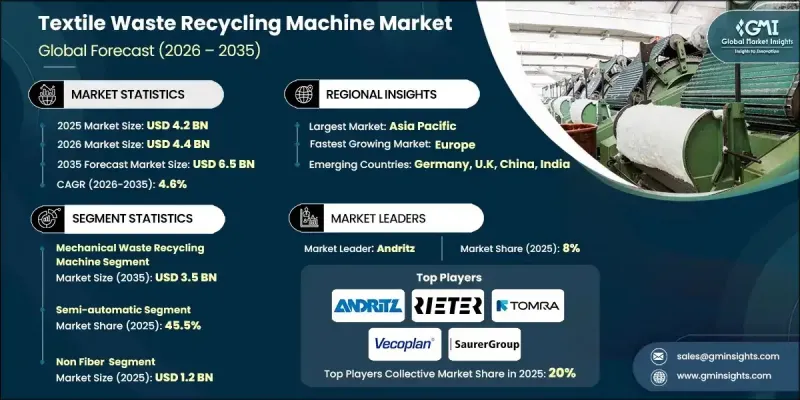
이러한 성장은 섬유 제품의 소비 및 폐기물에 대한 환경 인식이 높아지고 지속가능한 제조 관행에 대한 규제적 지원이 강화되면서 성장세를 견인하고 있습니다. 산업계는 폐기물을 최소화하고 재료 회수율을 높이는 데 집중하는 경향이 강화되고 있으며, 폐기된 섬유 제품을 재사용 가능한 섬유 형태로 변환하는 기계에 대한 수요가 가속화되고 있습니다. 매립지 의존도를 낮추고 자원 효율성을 높이기 위한 민관 부문의 노력도 시장 확대에 힘을 보태고 있습니다. 제조업체들은 이에 대응하여 처리 능력 향상, 환경 부하 감소, 순환 경제의 목표에 부합하는 재활용 기술 발전에 노력하고 있습니다. 또한, 섬유 생산자들이 소비 후 및 소비 전 폐기물을 책임감 있게 관리해야 한다는 압력이 높아지는 것도 업계에는 호재로 작용하고 있습니다. 의류 및 산업용 섬유 부문 전반에 걸쳐 지속가능성이 핵심 운영 요건으로 떠오르면서 첨단 재활용 기계에 대한 투자가 지속적으로 증가하고 있으며, 선진국과 신흥국 모두에서 장기적인 시장 안정성과 꾸준한 보급을 뒷받침하고 있습니다.
| 시장 범위 | |
|---|---|
| 시작 연도 | 2025년 |
| 예측 연도 | 2026-2035 |
| 개시시 가치 | 42억 달러 |
| 예측 금액 | 65억 달러 |
| CAGR | 4.6% |
기계식 재활용 기계 부문은 2025년에 23억 달러의 시장 규모를 창출하고 2035년까지 35억 달러에 달할 것으로 예상됩니다. 이 부문은 비용 효율성과 낮은 에너지 요구 사항으로 인해 섬유 폐기물 재활용 기계 시장의 중추적인 역할을 하고 있습니다. 기계식 시스템은 광범위한 섬유 폐기물 스트림을 처리할 수 있기 때문에 실용적이고 확장 가능한 재활용 솔루션을 원하는 제조업체에게 선호되는 선택입니다.
반자동 기계 부문은 2025년 45.5%의 점유율을 차지했습니다. 이 부문은 합리적인 가격과 조작성의 균형이 잘 잡혀 있어 시장을 선도하고 있습니다. 반자동 시스템에서는 작업자가 주요 재활용 공정을 관리하면서 반복적인 기능을 자동화할 수 있어 완전 자동화 설비에 대한 고가의 투자 없이도 노동 강도를 줄일 수 있습니다.
미국 섬유 폐기물 재활용 기계 시장은 2025년 90.5%의 점유율을 차지했습니다. 이 지역의 성장은 섬유 폐기물 감소에 대한 정부의 집중적인 노력, 국가 재활용 전략 수립, 재활용 인프라 개선을 촉진하는 새로운 입법 조치에 의해 뒷받침되고 있습니다. 이러한 노력이 대규모 섬유 재활용 기계에 대한 투자 확대를 견인하고 있습니다.
자주 묻는 질문
목차
제1장 조사 방법과 범위
제2장 주요 요약
제3장 업계 인사이트
- 생태계 분석
- 공급업체 상황
- 이익률
- 각 단계의 부가가치
- 밸류체인에 영향을 미치는 요인
- 업계에 대한 영향요인
- 성장 촉진요인
- 지속가능하고 친환경적인 소재에 대한 수요 상승
- 재활용 기술의 진보
- 섬유 폐기물에 관한 정부 규제와 정책
- 업계의 잠재적 리스크와 과제
- 초기 투자액 및 기계 비용 높음
- 높은 보수 비용과 운영 비용
- 기회
- 지속가능성 정책과 순환경제 추진
- IoT와 예지보전 솔루션의 통합
- 성장 촉진요인
- 성장 가능성 분석
- 향후 시장 동향
- 기술과 혁신 동향
- 현재 기술 동향
- 신기술
- 가격 동향
- 기종별
- 지역별
- 규제 상황
- 규격 및 컴플라이언스 요건
- 지역별 규제 프레임워크
- 인증 기준
- 무역 통계(HS 코드 8445)
- 주요 수입국
- 주요 수출국
- 격차 분석
- 리스크 평가와 경감책
- Porters 분석
- PESTEL 분석
제4장 경쟁 구도
- 소개
- 기업의 시장 점유율 분석
- 지역별
- 기업 매트릭스 분석
- 주요 시장 기업 경쟁 분석
- 경쟁 포지셔닝 매트릭스
- 주요 발전
- 인수합병
- 제휴·협업
- 신제품 발매
- 확대 계획
제5장 시장 추정 및 예측 : 기종별, 2022-2035
- 기계식 재활용 장비
- 화학적 재활용 기계
- 열 재활용 기계
제6장 시장 추정 및 예측 : 소재 유형별, 2022-2035
- 면
- 폴리에스테르
- 나일론
- 울
- 기타
제7장 시장 추정 및 예측 : 사업별, 2022-2035
- 수동
- 반자동식
- 자동
제8장 시장 추정 및 예측 : 용량별, 2022-2035
- 1,000kg/h까지
- 2,000kg/h까지
- 3000kg/h까지
- 3000kg/h 이상
제9장 시장 추정 및 예측 : 용도별, 2022-2035
- 섬유간 재활용
- 비섬유 용도
- 의류 제조
- 홈텍스타일
- 테크니컬 텍스타일
제10장 시장 추정 및 예측 : 조달 방법별, 2022-2035
- 소비 전 폐기물
- 사용 후 폐기물
제11장 시장 추정 및 예측 : 유통 채널별, 2022-2035
- 직접 판매
- 간접
제12장 시장 추정 및 예측 : 지역별, 2022-2035
- 북미
- 미국
- 캐나다
- 유럽
- 독일
- 프랑스
- 영국
- 이탈리아
- 스페인
- 아시아태평양
- 중국
- 인도
- 일본
- 한국
- 호주
- 라틴아메리카
- 브라질
- 멕시코
- 아르헨티나
- 중동 및 아프리카
- 남아프리카공화국
- 사우디아라비아
- 아랍에미리트
제13장 기업 개요
- Andritz
- Autefa Solutions
- Balkan Textile Machinery
- Dell'Orco &Villani
- HSN Machinery
- Loptex
- Margasa Projects and Textile Engineering
- Masias Machinery
- Multipro
- Rieter
- SN Surgicare and Healthcare Science
- Starlinger
- Saurer Group
- TOMRA Systems
- Vecoplan
The Global Textile Waste Recycling Machine Market was valued at USD 4.2 billion in 2025 and is estimated to grow at a CAGR of 4.6% to reach USD 6.5 billion by 2035.
Growth is driven by rising environmental awareness surrounding textile consumption and disposal, as well as stronger regulatory support for sustainable manufacturing practices. Industries are increasingly focused on minimizing waste and improving material recovery, which has accelerated demand for machinery capable of converting discarded textiles back into usable fiber forms. Public and private sector initiatives aimed at reducing landfill dependency and improving resource efficiency further support market expansion. Manufacturers are responding by advancing recycling technologies that improve throughput, reduce environmental impact, and align with circular economy goals. The industry also benefits from increasing pressure on textile producers to manage post-consumer and pre-consumer waste responsibly. As sustainability becomes a core operational requirement across apparel and industrial textile sectors, investment in advanced recycling machinery continues to rise, supporting long-term market stability and consistent adoption across developed and emerging economies.
| Market Scope | |
|---|---|
| Start Year | 2025 |
| Forecast Year | 2026-2035 |
| Start Value | $4.2 Billion |
| Forecast Value | $6.5 Billion |
| CAGR | 4.6% |
The mechanical recycling machines segment generated USD 2.3 billion in 2025 and is projected to reach USD 3.5 billion by 2035. This segment remains the backbone of the textile waste recycling machine market due to its cost efficiency and lower energy requirements. Mechanical systems can process a wide range of textile waste streams, making them a preferred choice for manufacturers seeking practical and scalable recycling solutions.
The semi-automatic machines segment accounted for 45.5% share in 2025. This segment leads the market due to its balance of affordability and operational control. Semi-automatic systems allow operators to manage key recycling stages while automating repetitive functions, reducing labor intensity without the high investment associated with fully automated equipment.
United States Textile Waste Recycling Machine Market represented 90.5% share in 2025. Regional growth is supported by increased government focus on textile waste reduction, the development of national recycling strategies, and new legislative measures that encourage improved recycling infrastructure. These efforts are driving higher investment in large-scale textile recycling machinery.
Key companies operating in the Global Textile Waste Recycling Machine Market include Rieter, Andritz, Starlinger, TOMRA Systems, Saurer Group, Vecoplan, Autefa Solutions, Masias Machinery, Loptex, Balkan Textile Machinery, Dell'Orco & Villani, Margasa Projects, Textile Engineering, Multipro, HSN Machinery, and SN Surgicare and Healthcare Science. Companies in the Global Textile Waste Recycling Machine Market focus on strengthening their market position through continuous technology upgrades and sustainability-driven innovation. Manufacturers invest heavily in research and development to enhance machine efficiency, energy performance, and material recovery rates. Strategic collaborations with textile producers and waste management firms help expand customer reach and ensure long-term equipment demand. Firms also prioritize modular machine designs that allow scalability and customization based on processing needs.
Table of Contents
Chapter 1 Methodology & Scope
- 1.1 Market scope and definition
- 1.2 Research design
- 1.2.1 Research approach
- 1.2.2 Data collection methods
- 1.3 Data mining sources
- 1.3.1 Global
- 1.3.2 Regional/Country
- 1.4 Base estimates and calculations
- 1.4.1 Base year calculation
- 1.4.2 Key trends for market estimation
- 1.5 Primary research and validation
- 1.5.1 Primary sources
- 1.6 Forecast model
- 1.7 Research assumptions and limitations
Chapter 2 Executive Summary
- 2.1 Industry 360° synopsis
- 2.2 Key market trends
- 2.2.1 Regional
- 2.2.2 Machine Type
- 2.2.3 Fabric Type
- 2.2.4 Operation
- 2.2.5 Capacity
- 2.2.6 Application
- 2.2.7 Sourcing Type
- 2.2.8 Distribution channel
- 2.3 CXO perspectives: Strategic imperatives
- 2.3.1 Key decision points for industry executives
- 2.3.2 Critical success factors for market players
- 2.4 Future outlook and strategic recommendations
Chapter 3 Industry Insights
- 3.1 Industry ecosystem analysis
- 3.1.1 Supplier landscape
- 3.1.2 Profit margin
- 3.1.3 Value addition at each stage
- 3.1.4 Factor affecting the value chain
- 3.2 Industry impact forces
- 3.2.1 Growth drivers
- 3.2.1.1 Rising demand for sustainable and eco-friendly materials
- 3.2.1.2 Advancements in recycling technologies
- 3.2.1.3 Government regulations and policies on textile waste
- 3.2.2 Industry pitfalls & challenges
- 3.2.2.1 High initial investment and machine cost
- 3.2.2.2 High maintenance and operational costs
- 3.2.3 Opportunities
- 3.2.3.1 Sustainability policies & circular economy push
- 3.2.3.2 Integration of IoT & predictive maintenance solutions
- 3.2.1 Growth drivers
- 3.3 Growth potential analysis
- 3.4 Future market trends
- 3.5 Technology and innovation landscape
- 3.5.1 Current technological trends
- 3.5.2 Emerging technologies
- 3.6 Price trends
- 3.6.1 By machine type
- 3.6.2 By region
- 3.7 Regulatory landscape
- 3.7.1 Standards and compliance requirements
- 3.7.2 Regional regulatory frameworks
- 3.7.3 Certification standards
- 3.8 Trade statistics (HS code 8445)
- 3.8.1 Major importing countries
- 3.8.2 Major exporting countries
- 3.9 Gap analysis
- 3.10 Risk assessment and mitigation
- 3.11 Porter';s analysis
- 3.12 PESTEL analysis
Chapter 4 Competitive Landscape, 2025
- 4.1 Introduction
- 4.2 Company market share analysis
- 4.2.1 By region
- 4.2.1.1 North America
- 4.2.1.2 Europe
- 4.2.1.3 Asia Pacific
- 4.2.1.4 Latin America
- 4.2.1.5 Middle East and Africa
- 4.2.1 By region
- 4.3 Company matrix analysis
- 4.4 Competitive analysis of major market players
- 4.5 Competitive positioning matrix
- 4.6 Key developments
- 4.6.1 Mergers & acquisitions
- 4.6.2 Partnerships & collaborations
- 4.6.3 New product launches
- 4.6.4 Expansion plans
Chapter 5 Market Estimates & Forecast, By Machine Type, 2022-2035 (USD Billion) (Thousand Units)
- 5.1 Key trends
- 5.2 Mechanical Recycling Machines
- 5.3 Chemical Recycling Machines
- 5.4 Thermal Recycling Machines
Chapter 6 Market Estimates & Forecast, By Fabric Type, 2022-2035 (USD Billion) (Thousand Units)
- 6.1 Key trends
- 6.2 Cotton
- 6.3 Polyester
- 6.4 Nylon
- 6.5 Wool
- 6.6 Others
Chapter 7 Market Estimates & Forecast, By Operation, 2022-2035 (USD Billion) (Thousand Units)
- 7.1 Key trends
- 7.2 Manual
- 7.3 Semi-automatic
- 7.4 Automatic
Chapter 8 Market Estimates & Forecast, By Capacity, 2022-2035 (USD Billion) (Thousand Units)
- 8.1 Key trends
- 8.2 Up to 1,000 kg/h
- 8.3 Up to 2,000 kg/h
- 8.4 Up to 3000 kg/h
- 8.5 Above 3000 kg/h
Chapter 9 Market Estimates & Forecast, By Application, 2022-2035 (USD Billion) (Thousand Units)
- 9.1 Key trends
- 9.2 Fiber-to-fibre Recycling
- 9.3 Non-fibre Applications
- 9.4 Apparel Manufacturing
- 9.5 Home Textiles
- 9.6 Technical Textiles
Chapter 10 Market Estimates & Forecast, By Sourcing Type, 2022-2035 (USD Billion) (Thousand Units)
- 10.1 Key trends
- 10.2 Pre-consumer Waste
- 10.3 Post-consumer Waste
Chapter 11 Market Estimates & Forecast, By Distribution Channel, 2022-2035 (USD Billion) (Thousand Units)
- 11.1 Key trends
- 11.2 Direct
- 11.3 Indirect
Chapter 12 Market Estimates & Forecast, By Region, 2022-2035 (USD Billion) (Thousand Units)
- 12.1 Key trends
- 12.2 North America
- 12.2.1 U.S.
- 12.2.2 Canada
- 12.3 Europe
- 12.3.1 Germany
- 12.3.2 France
- 12.3.3 UK
- 12.3.4 Italy
- 12.3.5 Spain
- 12.4 Asia Pacific
- 12.4.1 China
- 12.4.2 India
- 12.4.3 Japan
- 12.4.4 South Korea
- 12.4.5 Australia
- 12.5 Latin America
- 12.5.1 Brazil
- 12.5.2 Mexico
- 12.5.3 Argentina
- 12.6 MEA
- 12.6.1 South Africa
- 12.6.2 Saudi Arabia
- 12.6.3 UAE
Chapter 13 Company Profiles
- 13.1 Andritz
- 13.2 Autefa Solutions
- 13.3 Balkan Textile Machinery
- 13.4 Dell'Orco & Villani
- 13.5 HSN Machinery
- 13.6 Loptex
- 13.7 Margasa Projects and Textile Engineering
- 13.8 Masias Machinery
- 13.9 Multipro
- 13.10 Rieter
- 13.11 SN Surgicare and Healthcare Science
- 13.12 Starlinger
- 13.13 Saurer Group
- 13.14 TOMRA Systems
- 13.15 Vecoplan