
|
시장보고서
상품코드
1928894
신체 착용형 방충제 시장 기회, 성장 동인, 업계 동향 분석 및 예측(2026-2035년)Body Worn Insect Repellent Market Opportunity, Growth Drivers, Industry Trend Analysis, and Forecast 2026 - 2035 |
||||||

세계의 신체 착용형 방충제 시장은 2025년에 7억 9,190만 달러로 평가되었고, 2035년까지 연평균 복합 성장률(CAGR) 7.8%로 성장하여 16억 3,000만 달러에 달할 것으로 예측됩니다.

하이킹, 캠핑, 어드벤처 스포츠와 같은 야외 활동의 인기 상승과 세계 관광 산업의 급속한 성장은 개인용 방충 솔루션에 대한 수요를 촉진하고 있습니다. 소비자들은 해충으로부터 확실한 보호를 받으면서도 라이프스타일과 개인의 미적 감각에 부합하는 제품을 점점 더 많이 찾고 있습니다. 특히 열대 및 아열대 지역의 곤충 매개 질병에 대한 인식이 높아지면서 착용형 기피제에 대한 관심이 더욱 증폭되고 있습니다. 말라리아, 뎅기열, 지카, 라임병 등 매개체 질환이 확산을 주도하고 있으며, 특히 발병률이 높은 아시아태평양과 아프리카에서 두드러지게 나타나고 있습니다. 예방책을 홍보하는 공중보건 캠페인이 시장 확대를 뒷받침하는 한편, 편의성, 기능성, 라이프스타일과 결합하여 관광객, 모험 애호가, 고위험 환경의 전문가들이 일상적으로 사용하는 것을 촉진하고 있습니다.
| 시장 범위 | |
|---|---|
| 개시 연도 | 2025년 |
| 예측 연도 | 2026-2035년 |
| 개시 연도 시장 규모 | 7억 9,190만 달러 |
| 예측 금액 | 16억 3,000만 달러 |
| CAGR | 7.8% |
의류 기반 방충제 부문은 2025년 2억 5,230만 달러로 2035년까지 연평균 7.6% 성장할 것으로 예측됩니다. 반복적으로 바르지 않고도 오랜 시간 동안 보호할 수 있어 여전히 인기 있는 치료 의류는 여전히 인기가 있습니다. 실용적인 보호와 편의성을 겸비한 이 제품은 아웃도어 애호가, 여행자 및 고위험 지역에서 일하는 개인을 끌어들이고 있습니다. 또한, 방충 가공 의류의 패션성을 강조한 포지셔닝과 질병 발생 위험이 높은 지역에서의 채택은 시장에서의 매력을 더욱 높이고 있습니다.
화학 방충제 부문은 2025년 57.4%의 점유율을 차지할 것으로 예상되며, 2026년부터 2035년까지 연평균 7.6%의 성장률을 보일 것으로 예측됩니다. DEET, 피카리딘, IR3535 등의 유효성분을 함유한 이들 제품은 다양한 곤충에 대한 검증된 효과와 지속적인 보호 성능으로 선호되고 있습니다. 매개체 질환의 감염률이 높은 지역에서는 보건 당국에서 권장하는 경우가 많고, 소비자의 신뢰도도 두터워 유행지역을 여행하는 사람이나 전문가들의 첫 번째 선택이 되고 있습니다.
미국의 신체 부착형 방충제 시장은 2025년에 1억 9,830만 달러에 달할 것으로 예상되며, 2035년까지 연평균 8.1%의 연평균 복합 성장률(CAGR)을 보일 것으로 예측됩니다. 소비자의 높은 의식, 가처분 소득, 활동적인 아웃도어 라이프 스타일이 안정적인 수요를 뒷받침하고 있습니다. 소매 유통망의 확대와 전자상거래의 편리함이 시장 침투를 더욱 촉진하고 있습니다. 웨스트 나일 바이러스 등 모기 매개 질환에 대한 우려도 전국적인 바디웨어형 방충제 보급에 힘을 보태고 있습니다.
자주 묻는 질문
목차
제1장 조사 방법과 범위
제2장 주요 요약
제3장 업계 인사이트
제4장 경쟁 구도
제5장 시장 추산 및 예측 : 제품 유형별, 2022-2035년
제6장 시장 추산 및 예측 : 원료별, 2022-2035년
제7장 시장 추산 및 예측 : 가격별, 2022-2035년
제8장 시장 추산 및 예측 : 최종사용자별, 2022-2035년
제9장 시장 추산 및 예측 : 용도별, 2022-2035년
제10장 시장 추산 및 예측 : 유통 채널별, 2022-2035년
제11장 시장 추산 및 예측 : 지역별, 2022-2035년
제12장 기업 개요
LSH 26.02.27The Global Body Worn Insect Repellent Market was valued at USD 791.9 million in 2025 and is estimated to grow at a CAGR of 7.8% to reach USD 1.63 billion by 2035.
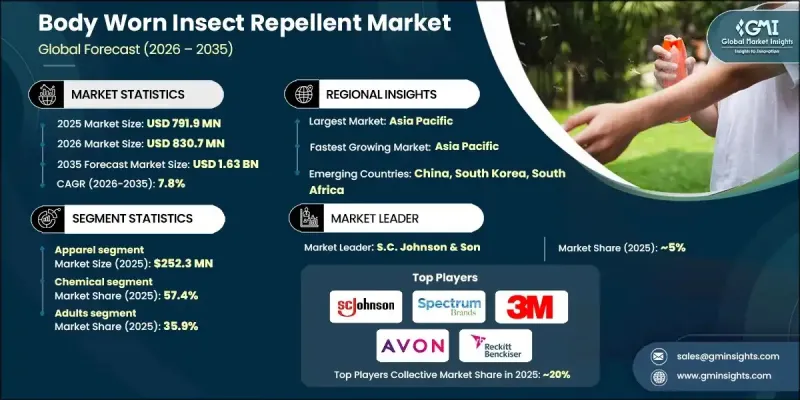
The rising popularity of outdoor activities such as hiking, camping, and adventure sports, combined with rapid growth in global tourism, has fueled demand for personal insect protection solutions. Consumers increasingly seek products that provide reliable protection against harmful insects while complementing their lifestyle and personal aesthetics. The growing awareness of insect-borne illnesses, particularly in tropical and subtropical regions, has further amplified interest in body-worn repellents. Vector-borne diseases like malaria, dengue, Zika, and Lyme disease are driving adoption, especially in regions of Asia-Pacific and Africa where prevalence is high. Public health campaigns promoting preventive measures are supporting market expansion, while the combination of convenience, functionality, and lifestyle integration is encouraging regular usage among tourists, adventure enthusiasts, and professionals in high-risk environments.
| Market Scope | |
|---|---|
| Start Year | 2025 |
| Forecast Year | 2026-2035 |
| Start Value | $791.9 Million |
| Forecast Value | $1.63 Billion |
| CAGR | 7.8% |
The apparel-based insect repellents segment accounted for USD 252.3 million in 2025 and is expected to grow at a CAGR of 7.6% through 2035. Treated clothing remains popular because it offers extended protection without repeated applications. This segment attracts outdoor enthusiasts, travelers, and individuals working in high-risk areas, as it merges practical protection with convenience. The fashion-forward positioning of treated apparel and adoption in disease-prone regions strengthen its market appeal.
The chemical repellents segment held a 57.4% share in 2025 and is projected to grow at a CAGR of 7.6% from 2026 to 2035. These products, containing active ingredients such as DEET, picaridin, and IR3535, are preferred due to their proven effectiveness and durable protection against diverse insects. They are often recommended by health authorities and trusted by consumers in regions with high vector-borne disease transmission, making them the primary choice for travelers and professionals in endemic zones.
United States Body Worn Insect Repellent Market reached USD 198.3 million in 2025 and is expected to grow at a CAGR of 8.1% through 2035. High consumer awareness, disposable income, and a strong outdoor lifestyle contribute to consistent demand. Widespread retail distribution and e-commerce accessibility further enhance market penetration. Concerns about mosquito-borne illnesses such as the West Nile virus also reinforce the adoption of body-worn insect repellents across the country.
Leading companies in the Global Body Worn Insect Repellent Market include Burt's Bees, S.C. Johnson & Son, Coleman, ThermaCELL, 3M Company, Insect Shield, Avon Products Inc., Ecolab, Sawyer Products, Mosquito Squad, Para'Kito, Cascadia Essentials, ExOfficio, Spectrum Brands, and Reckitt Benckiser. Market leaders are strengthening their foothold by investing in innovative, long-lasting, and safe formulations that appeal to both casual consumers and professionals. Companies focus on expanding their apparel-based and chemical repellent offerings to address different lifestyle needs and climatic conditions. Collaborations with tourism and outdoor activity brands, combined with targeted marketing campaigns, increase visibility and adoption. Additionally, firms emphasize compliance with regulatory standards, sustainability initiatives, and product certifications to boost consumer trust.
Table of Contents
Chapter 1 Methodology & Scope
- 1.1 Market scope & definitions
- 1.2 Research design
- 1.2.1 Research approach
- 1.2.2 Data collection methods
- 1.3 Base estimates and calculations
- 1.3.1 Base year calculation
- 1.3.2 Market estimates & forecasts parameters
- 1.4 Forecast Model
- 1.4.1 Key trends for market estimates
- 1.4.2 Quantified market impact analysis
- 1.4.2.1 Mathematical impact of growth parameters on forecast
- 1.4.3 Scenario analysis framework
- 1.5 Primary research and validation
- 1.5.1 Some of the primary sources (but not limited to)
- 1.6 Data mining sources
- 1.6.1 Paid Sources
- 1.7 Primary research and validation
- 1.7.1 Primary sources
- 1.8 Research Trail & confidence scoring
- 1.8.1 Research trail components
- 1.8.2 Scoring components
- 1.9 Research transparency addendum
- 1.9.1 Source attribution framework
- 1.9.2 Quality assurance metrics
- 1.9.3 Our commitment to trust
- 1.10 Market Definitions
Chapter 2 Executive Summary
- 2.1 Industry 360° synopsis
- 2.2 Key market trends
- 2.2.1 Regional
- 2.2.2 Product type
- 2.2.3 Ingredient
- 2.2.4 Price Range
- 2.2.5 Application
- 2.2.6 End User
- 2.2.7 Distribution channels
- 2.3 CXO perspectives: Strategic imperatives
- 2.3.1 Key decision points for industry executives
- 2.3.2 Critical success factors for market players
- 2.4 Future outlook and strategic recommendations
Chapter 3 Industry Insights
- 3.1 Industry ecosystem analysis
- 3.1.1 Supplier landscape
- 3.1.2 Profit margin
- 3.1.3 Value addition at each stage
- 3.1.4 Factor affecting the value chain
- 3.2 Industry impact forces
- 3.2.1 Growth drivers
- 3.2.1.1 Outdoor lifestyle & travel boom
- 3.2.1.2 Rising incidence of vector-borne diseases
- 3.2.1.3 Preference for eco-friendly & natural products
- 3.2.2 Pitfalls & Challenges
- 3.2.2.1 Regulatory compliance & safety concerns
- 3.2.2.2 Price sensitivity
- 3.2.3 Opportunities
- 3.2.3.1 Smart wearable integration
- 3.2.3.2 Expansion in high-risk regions
- 3.2.1 Growth drivers
- 3.3 Growth potential analysis
- 3.4 Future market trends
- 3.5 Technology and innovation landscape
- 3.5.1 Current technological trends
- 3.5.2 Emerging technologies
- 3.6 Price trends
- 3.6.1 By region
- 3.6.2 By product
- 3.7 Regulatory landscape
- 3.7.1 North America
- 3.7.1.1 US: Consumer Product Safety Commission (CPSC) 16 Code of Federal Regulations (CFR) part 1512
- 3.7.1.2 Canada: International Organization for Standardization (ISO) 4210
- 3.7.2 Europe
- 3.7.2.1 Germany: Deutsches Institut fur Normung (DIN) European Norm (EN) ISO 4210
- 3.7.2.2 UK: European Norm (EN) ISO 4210 / United Kingdom Conformity Assessed (UKCA)
- 3.7.2.3 France: European Norm (EN) ISO 4210
- 3.7.3 Asia Pacific
- 3.7.3.1 China: Guobiao (GB) 3565
- 3.7.3.2 India: Indian Standard (IS) 10613
- 3.7.3.3 Japan: Japanese Industrial Standard (JIS) D 9110
- 3.7.4 Latin America
- 3.7.4.1 Brazil: Associacao Brasileira de Normas Tecnicas (ABNT) Norma Brasileira (NBR) ISO 4210
- 3.7.4.2 Mexico: International Organization for Standardization (ISO) 4210
- 3.7.5 Middle East & Africa
- 3.7.5.1 South Africa: South African National Standard (SANS) 311
- 3.7.5.2 Saudi Arabia: Saudi Standards, Metrology and Quality Organization (SASO) Gulf Standardization Organization (GSO) ISO 4210
- 3.7.1 North America
- 3.8 Trade statistics (HS Code - 3307.20)
- 3.8.1 Major importing countries
- 3.8.2 Major exporting countries
- 3.9 Porter';s analysis
- 3.10 PESTEL analysis
Chapter 4 Competitive Landscape, 2025
- 4.1 Introduction
- 4.2 Company market share analysis
- 4.2.1 By Region
- 4.2.1.1 North America
- 4.2.1.2 Europe
- 4.2.1.3 Asia Pacific
- 4.2.1.4 Latin America
- 4.2.1.5 Middle East & Africa
- 4.2.1 By Region
- 4.3 Company matrix analysis
- 4.4 Competitive analysis of major market players
- 4.5 Competitive positioning matrix
- 4.6 Key developments
- 4.6.1 Mergers & acquisitions
- 4.6.2 Partnerships & collaborations
- 4.6.3 New product launches
- 4.6.4 Expansion plans
Chapter 5 Market Estimates & Forecast, By Product Type, 2022 - 2035, (USD Million) (Thousand Units)
- 5.1 Key trends
- 5.2 Apparel
- 5.3 Sprays
- 5.4 Oils & creams
- 5.5 Stickers & patches
- 5.6 Roll ons
- 5.7 Wipes & towelettes
- 5.8 Wearable devices
- 5.9 Others
Chapter 6 Market Estimates & Forecast, By Ingredient, 2022 - 2035, (USD Million) (Thousand Units)
- 6.1 Key trends
- 6.2 Natural
- 6.3 Chemical
Chapter 7 Market Estimates & Forecast, By Price Range, 2022 - 2035, (USD Million) (Thousand Units)
- 7.1 Key trends
- 7.2 Low
- 7.3 Medium
- 7.4 High
Chapter 8 Market Estimates & Forecast, By End User, 2022 - 2035, (USD Million) (Thousand Units)
- 8.1 Key trends
- 8.2 Adults
- 8.3 Children
- 8.4 Travelers
- 8.5 Military personnel
- 8.6 Healthcare/industrial users
Chapter 9 Market Estimates & Forecast, By Application, 2022 - 2035, (USD Million) (Thousand Units)
- 9.1 Key trends
- 9.2 Mosquitoes
- 9.3 Ticks
- 9.4 Fleas
- 9.5 Outdoor activities (camping, hiking, sports)
- 9.6 Travel & tourism
- 9.7 Home use
- 9.8 Commercial/industrial
Chapter 10 Market Estimates & Forecast, By Distribution Channel, 2022 - 2035, (USD Million) (Thousand Units)
- 10.1 Key trends
- 10.2 Online
- 10.2.1 E-commerce
- 10.2.2 Company websites
- 10.3 Offline
- 10.3.1 Supermarkets/hypermarkets
- 10.3.2 Specialty stores
- 10.3.3 Others (pharmacies, etc.)
Chapter 11 Market Estimates & Forecast, By Region, 2022 - 2035, (USD Million) (Thousand Units)
- 11.1 Key trends
- 11.2 North America
- 11.2.1 U.S.
- 11.2.2 Canada
- 11.3 Europe
- 11.3.1 Germany
- 11.3.2 UK
- 11.3.3 France
- 11.3.4 Italy
- 11.3.5 Spain
- 11.4 Asia Pacific
- 11.4.1 China
- 11.4.2 India
- 11.4.3 Japan
- 11.4.4 South Korea
- 11.4.5 Australia
- 11.5 Latin America
- 11.5.1 Brazil
- 11.5.2 Mexico
- 11.5.3 Argentina
- 11.6 MEA
- 11.6.1 Saudi Arabia
- 11.6.2 UAE
- 11.6.3 South Africa
Chapter 12 Company Profiles
- 12.1 3M Company
- 12.2 Avon Products Inc.
- 12.3 Burt’s Bees
- 12.4 Cascadia Essentials
- 12.5 Coleman
- 12.6 Ecolab
- 12.7 ExOfficio
- 12.8 Insect Shield
- 12.9 Mosquito Squad
- 12.10 Para'Kito
- 12.11 Reckitt Benckiser
- 12.12 S.C. Johnson & Son
- 12.13 Sawyer Products
- 12.14 Spectrum Brands
- 12.15 ThermaCELL