
|
시장보고서
상품코드
1928897
클래스 8 트럭 시장 성장 기회, 성장요인, 업계 동향 분석 및 예측(2026-2035년)Class 8 Trucks Market Opportunity, Growth Drivers, Industry Trend Analysis, and Forecast 2026 - 2035 |
||||||

세계의 클래스 8 트럭 시장은 2025년에 2,694억 달러로 평가되었고, 2035년까지 연평균 복합 성장률(CAGR) 4.7%로 성장하여 4,112억 달러에 이를 것으로 예측됩니다.
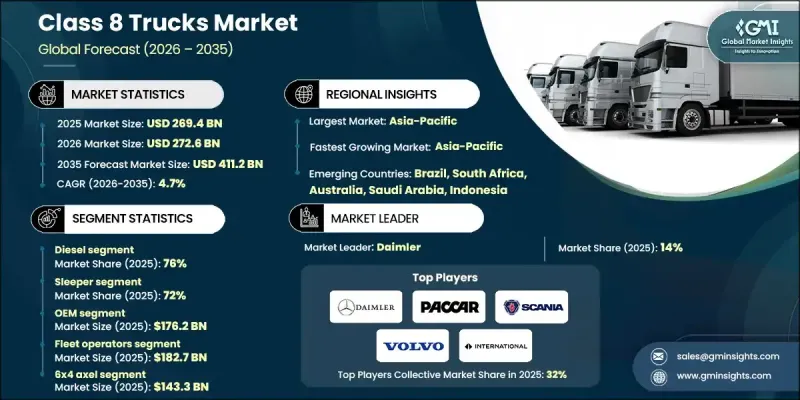
이러한 성장은 지역 협력 강화와 정책 조정의 진전에 따라 대형 트럭의 운행 범위가 확대되고 있는 것에 힘입은 것입니다. 세계 무역 활동의 지속적인 증가는 공급망의 상호 연결성 증가와 국경 간 비즈니스 활동의 확대에 따라 효율적인 장거리 화물 운송에 대한 수요를 강화하고 있습니다. 인프라 구축과 물류 회랑의 확장은 지역 간 연결성을 향상시키고, 대량 화물 운송에 있어 클래스 8 트럭의 추가 도입을 촉진하고 있습니다. 운송 기준과 국경 간 규제의 조화로 네트워크 호환성이 향상되어 화물 운송을 원활하게 하고 차량 투자 증가를 촉진하고 있습니다. 이러한 발전은 화물의 신속한 이동을 가능하게 하고, 세계 물류에서 대형 트럭의 역할을 강화하여 경제 성장을 뒷받침하고 있습니다. 무역량이 증가하고 공급망이 복잡해짐에 따라 신뢰할 수 있는 대용량 트럭 운송 솔루션에 대한 수요가 지속적으로 증가하고 있으며, 클래스 8 트럭 시장은 전 세계적으로 지속적인 성장이 예상됩니다.
| 시장 범위 | |
|---|---|
| 개시 연도 | 2025년 |
| 예측 연도 | 2026-2035년 |
| 개시 연도 가치 | 2,694억 달러 |
| 예측 금액 | 4,112억 달러 |
| CAGR | 4.7% |
디젤 엔진 탑재 트럭 부문은 2025년 76%의 점유율을 차지할 것으로 예상되며, 2026년부터 2035년까지 연평균 3.5%의 성장률을 보일 것으로 예측됩니다. 이 차량은 높은 토크 출력, 내구성, 장거리 화물 운송에 적합한 특성으로 인해 중량물 운송에 여전히 필수적입니다. 디젤 트럭은 가혹한 부하 조건에서도 안정적인 성능이 요구되는 산업을 지속적으로 지원하고 있습니다.
OEM 판매 채널 부문은 2025년 1,762억 달러의 매출을 기록할 것으로 예측됩니다. 이 부문에는 공식 딜러 네트워크를 통해 판매되는 신규 트럭 및 차량 사업자가 직접 주문한 차량이 포함됩니다. 표준화 된 사양, 제조업체 보증, 경쟁력있는 금융 옵션, 확실한 잔존 가치 지원으로 인해 대규모 차량에서 OEM 구매는 여전히 주류입니다.
중국 8등급 트럭 시장은 2025년 1,028억 4,000만 달러 규모를 기록할 것으로 예측됩니다. 강력한 산업 기반과 확장하는 전자상거래 부문으로 인해 세계 화물 운송 및 물류에서 중심적인 역할을 하고 있습니다. FAW, 동풍자동차, 중국 중기, BYD 등 국내 제조업체들은 비용 효율적인 디젤 및 대체 에너지 대형 트럭을 제공함으로써 확고한 시장 지위를 확보하고 있습니다. 고도로 통합된 공급망은 자재 조달, 부품 생산, 차량 조립의 효율적인 운영을 지원합니다.
자주 묻는 질문
목차
제1장 조사 방법과 범위
제2장 주요 요약
제3장 업계 인사이트
- 생태계 분석
- 공급업체 상황
- 원재료 공급업체
- 부품 공급업체
- 제조업체
- 서비스 제공업체
- 유통 채널
- 최종 용도
- 비용 구조
- 이익률
- 각 단계 부가가치
- 수직통합 동향
- 디스럽터
- 공급업체 상황
- 영향요인
- 성장 촉진요인
- 화물 운송 양 증가와 전자상거래 물류 확대
- 플릿 갱신 및 노후화 차량 관리
- 배출 가스 규제와 효율성 규제
- 인프라 및 산업 투자
- 업계의 잠재적 리스크&과제
- 초기 구입 비용 높이
- 경기순환성과 화물 운송 침체기
- 시장 기회
- 대체 파워트레인에의 이동
- 첨단운전자보조시스템(ADAS) 및 안전 시스템
- 커넥티비티, 텔레매틱스 및 예지보전
- 모듈러 플랫폼과 경량화
- 성장 촉진요인
- 기술 동향과 혁신·에코시스템
- 현행 기술
- 신기술
- 성장 가능성 분석
- 규제 상황
- 북미
- 미국 연방 자동차 안전기준(FMVSS)
- 미국 환경보호국(EPA)에 의한 대형 트럭용 배출 가스·온실가스 규제
- 캐나다 자동차 안전 규제(MVSR)
- 유럽
- 유엔 유럽 경제 위원회(UNECE) 규제
- 유로 6 배출 가스 규제
- EU차량 형 식 인증 및 저배출 가스 구역 대응
- 아시아태평양
- 중국 GB규격
- 인도 자동차 산업 기준(AIS)
- 국토 교통성(MLIT)에 의한 대형 차량 안전·배출 가스 규제
- 상용 트럭용 ASEAN 조화 차량 규제
- 라틴아메리카
- 브라질 교통안전 국(Contran) 및 국가 계량 기술 연구소(INMETRO) 기준
- 아르헨티나 INTI/IRAM 규격
- 멕시코 NOM 규격
- 중동 및 아프리카
- 사우디아라비아 SASO 규격
- 남아프리카공화국 SANS/NRCS 규제
- 아랍에미리트(UAE) ESMA/GSO 규제
- 북미
- Porter의 Five Forces 분석
- PESTEL 분석
- 가격 동향
- 지역별
- 제품별
- 비용 내역 분석
- 특허 분석
- 생산 통계
- 생산 거점
- 소비 거점
- 수출과 수입
- 지속가능성과 환경면
- 카 내비게이션 시스템 탄소발자국
- 순환형 경제 전략
- 지속가능내비게이션 기능
- 기업 지속가능성에 관한 대처
- 기후 변화가 항행에 미치는 영향
- 클래스 8 트럭용 파워트레인·플릿 운영 TCO 프레임워크
- 설비 투자/취득 비용
- 연료/에너지 비용
- 유지보수·서비스 비용
- 잔존 가치/재판 가치
- 기술 통합 영향
- 클래스 8 트럭용 파워트레인 이동 로드맵
- 디젤로부터 가스에의 이동 동향
- 배터리 전기자동차와 수소 연료전지 차 트레이드 오프
- 대체 파워트레인 지역별 실현 가능성
- 인프라 정비 상황과 기술 리스크 평가
- 플릿 구입 결정과 경제성 프레임워크
- OEM 플랫폼 전략과 모듈러 아키텍처 동향
제4장 경쟁 구도
- 서론
- 기업의 시장 점유율 분석
- 북미
- 유럽
- 아시아태평양
- 라틴아메리카
- 중동 및 아프리카
- 경쟁 포지셔닝 매트릭스
- 전략적 전망 매트릭스
- 주요 발전
- 인수합병(M&A)
- 제휴 및 협업
- 신제품 발매
- 사업 확대 계획과 자금조달
제5장 시장 추산·예측 : 연료별, 2022-2035
- 디젤
- 천연가스
- 하이브리드 전기자동차
- 기타
제6장 시장 추산·예측 : 택시별, 2022-2035
- 일
- 쓰리 파
제7장 시장 추산·예측 : 차축별, 2022-2035
- 4x2
- 6x4
- 6x2
제8장 시장 추산·예측 : 마력별, 2022-2035
- 300 마력 미만
- 300 마력-400 마력
- 400 마력-500 마력
- 500 마력 이상
제9장 시장 추산·예측 : 용도별, 2022-2035
- 화물 배송
- 유틸리티 서비스
- 건설 및 광업
- 기타
제10장 시장 추산·예측 : 소유 형태별, 2022-2035
- 플릿 오퍼레이터
- 독립 사업자
제11장 시장 추산·예측 : 판매채널별, 2022-2035
- OEM
- 독립계 판매점
제12장 시장 추산·예측 : 지역별, 2022-2035
- 북미
- 미국
- 캐나다
- 유럽
- 영국
- 독일
- 프랑스
- 이탈리아
- 스페인
- 벨기에
- 네덜란드
- 스웨덴
- 러시아
- 아시아태평양
- 중국
- 인도
- 일본
- 호주
- 싱가포르
- 한국
- 베트남
- 인도네시아
- 라틴아메리카
- 브라질
- 멕시코
- 아르헨티나
- 중동 및 아프리카
- 남아프리카공화국
- 사우디아라비아
- 아랍에미리트(UAE)
제13장 기업 개요
- 세계 기업
- DAF Trucks
- Daimler/Freightliner
- Iveco
- Kenworth
- Mack Trucks
- MAN
- PACCAR
- Peterbilt
- Scania
- Volvo
- Region players
- Dongfeng
- Eicher
- FAW Jiefang
- Ford
- GMC
- Hino
- International Truck/Navistar
- Isuzu
- Mitsubishi Fuso
- UD Trucks
- 신흥 제조업체
- BYD
- Tesla
- Nikola
- Hyzon Motors
- Sinotruk
The Global Class 8 Trucks Market was valued at USD 269.4 billion in 2025 and is estimated to grow at a CAGR of 4.7% to reach USD 411.2 billion by 2035.
Growth is supported by increasing regional cooperation and policy alignment that are expanding the operational reach of heavy-duty trucks. The continuous rise in global trade activity has strengthened demand for efficient long-distance freight transportation, as supply chains become more interconnected and business activity expands across borders. Infrastructure development and logistics corridor enhancements are improving connectivity between regions, encouraging greater deployment of class 8 trucks for large-volume cargo movement. Harmonization of transport standards and cross-border regulations has enhanced network compatibility, facilitating smoother freight operations and driving increased fleet investments. These developments support economic growth by enabling faster movement of goods while reinforcing the role of heavy-duty trucks in global logistics. As trade volumes rise and supply chains become more complex, demand for reliable and high-capacity trucking solutions continues to increase, positioning the class 8 trucks market for sustained growth worldwide.
| Market Scope | |
|---|---|
| Start Year | 2025 |
| Forecast Year | 2026-2035 |
| Start Value | $269.4 Billion |
| Forecast Value | $411.2 Billion |
| CAGR | 4.7% |
The diesel-powered trucks segment accounted for 76% share in 2025 and is expected to grow at a CAGR of 3.5% from 2026 to 2035. These vehicles remain essential for heavy-duty hauling due to their high torque output, durability, and suitability for long-distance freight operations. Diesel trucks continue to support industries that require consistent performance under demanding load conditions.
The OEM sales channel segment generated USD 176.2 billion in 2025. This segment includes newly manufactured trucks sold through authorized dealer networks and direct orders placed by fleet operators. OEM purchasing remains dominant among large fleets due to standardized specifications, manufacturer-backed warranties, competitive financing options, and assured residual value support.
China Class 8 Trucks Market generated USD 102.84 billion in 2025. The country plays a central role in global freight and logistics due to its strong industrial base and expanding e-commerce sector. Domestic manufacturers such as FAW, Dongfeng, Sinotruk, and BYD hold a strong market position by offering cost-effective diesel and alternative-energy heavy-duty trucks. A well-integrated supply chain supports efficient sourcing of materials, component production, and vehicle assembly.
Key companies operating in the Global Class 8 Trucks Market include Volvo Trucks, Daimler, Scania, Freightliner, MAN, Kenworth, Peterbilt, Mack Trucks, Isuzu Motors, and International Motors. Companies in the Global Class 8 Trucks Market focus on strengthening their market position through product innovation, fleet optimization solutions, and geographic expansion. Manufacturers invest in improving fuel efficiency, powertrain reliability, and vehicle durability to meet evolving freight demands. Strategic partnerships with logistics providers and fleet operators help secure long-term supply contracts. Companies also expand financing, leasing, and after-sales service programs to improve customer retention. Investments in manufacturing efficiency and supply chain integration allow firms to control costs and maintain competitive pricing.
Table of Contents
Chapter 1 Methodology & Scope
- 1.1 Market scope and definition
- 1.2 Research design
- 1.2.1 Research approach
- 1.2.2 Data collection methods
- 1.3 Data mining sources
- 1.3.1 Global
- 1.3.2 Regional/Country
- 1.4 Base estimates and calculations
- 1.4.1 Base year calculation
- 1.4.2 Key trends for market estimation
- 1.5 Primary research and validation
- 1.5.1 Primary sources
- 1.6 Forecast model
- 1.7 Research assumptions and limitations
Chapter 2 Executive Summary
- 2.1 Industry 360° synopsis
- 2.2 Key market trends
- 2.2.1 Regional
- 2.2.2 Fuel
- 2.2.3 Cab
- 2.2.4 Axle
- 2.2.5 Horsepower
- 2.2.6 Ownership
- 2.2.7 Application
- 2.2.8 Sales Channel
- 2.3 TAM Analysis, 2026-2035
- 2.4 CXO perspectives: Strategic imperatives
- 2.4.1 Key decision points for industry executives
- 2.4.2 Critical success factors for market players
- 2.5 Future outlook and strategic recommendations
Chapter 3 Industry Insights
- 3.1 Industry ecosystem analysis
- 3.1.1 Supplier landscape
- 3.1.1.1 Raw material suppliers
- 3.1.1.2 Component suppliers
- 3.1.1.3 Manufacturers
- 3.1.1.4 Service providers
- 3.1.1.5 Distribution channel
- 3.1.1.6 End Use
- 3.1.2 Cost structure
- 3.1.3 Profit margin
- 3.1.4 Value addition at each stage
- 3.1.5 Vertical integration trends
- 3.1.6 Disruptors
- 3.1.1 Supplier landscape
- 3.2 Impact on forces
- 3.2.1 Growth drivers
- 3.2.1.1 Freight growth & e-commerce logistics expansion
- 3.2.1.2 Fleet replacement & aging vehicle parcels
- 3.2.1.3 Emissions & efficiency regulations
- 3.2.1.4 Infrastructure & industrial investment
- 3.2.2 Industry pitfalls & challenges
- 3.2.2.1 High upfront purchase costs
- 3.2.2.2 Economic cyclicality & freight downturns
- 3.2.3 Market opportunities
- 3.2.3.1 Shift toward alternative powertrains
- 3.2.3.2 Advanced driver assistance & safety systems
- 3.2.3.3 Connectivity, telematics & predictive maintenance
- 3.2.3.4 Modular platforms & lightweight
- 3.2.1 Growth drivers
- 3.3 Technology trends & innovation ecosystem
- 3.3.1 Current technologies
- 3.3.2 Emerging technologies
- 3.4 Growth potential analysis
- 3.5 Regulatory landscape
- 3.5.1 North America
- 3.5.1.1 U.S. Federal Motor Vehicle Safety Standards (FMVSS)
- 3.5.1.2 U.S. EPA Emissions & Greenhouse Gas Standards for Heavy-Duty Trucks
- 3.5.1.3 Canada Motor Vehicle Safety Regulations (MVSR)
- 3.5.2 Europe
- 3.5.2.1 UNECE Regulations
- 3.5.2.2 Euro VI Emission Standards
- 3.5.2.3 EU Vehicle Type Approval & Low-Emission Zone Compliance
- 3.5.3 Asia-Pacific
- 3.5.3.1 China GB standards
- 3.5.3.2 India Automotive Industry Standards (AIS)
- 3.5.3.3 Japan MLIT Heavy Vehicle Safety and Emission Regulations
- 3.5.3.4 ASEAN Harmonized Vehicle Regulations for commercial trucks
- 3.5.4 Latin America
- 3.5.4.1 Brazil Contran & INMETRO standards
- 3.5.4.2 Argentina INTI / IRAM standards
- 3.5.4.3 Mexico NOM standards
- 3.5.5 Middle East & Africa
- 3.5.5.1 Saudi Arabia SASO standards
- 3.5.5.2 South Africa SANS / NRCS regulations
- 3.5.5.3 UAE ESMA / GSO regulations
- 3.5.1 North America
- 3.6 Porter';s analysis
- 3.7 PESTEL analysis
- 3.8 Price trends
- 3.8.1 By region
- 3.8.2 By product
- 3.9 Cost breakdown analysis
- 3.10 Patent analysis
- 3.11 Production statistics
- 3.11.1 Production hubs
- 3.11.2 Consumption hubs
- 3.11.3 Export and import
- 3.12 Sustainability and environmental aspects
- 3.12.1 Carbon footprint of navigation systems
- 3.12.2 Circular economic strategies
- 3.12.3 Sustainable navigation features
- 3.12.4 Corporate sustainability initiatives
- 3.12.5 Climate change impact on navigation
- 3.13 Powertrain & Fleet Operations TCO Framework for class 8 Trucks
- 3.13.1 CapEx / Acquisition Costs
- 3.13.2 Fuel / Energy Costs
- 3.13.3 Maintenance & Service Costs
- 3.13.4 Residual / Resale Value
- 3.13.5 Technology Integration Impact
- 3.14 Powertrain transition roadmap for class 8 trucks
- 3.14.1 Diesel-to-gas transition dynamics
- 3.14.2 Battery-electric vs hydrogen fuel cell trade-offs
- 3.14.3 Regional feasibility of alternative powertrains
- 3.14.4 Infrastructure readiness and technology risk assessment
- 3.15 Fleet purchase decision and economics framework
- 3.16 OEM platform strategy and modular architecture trends
Chapter 4 Competitive Landscape, 2025
- 4.1 Introduction
- 4.2 Company market share analysis
- 4.2.1 North America
- 4.2.2 Europe
- 4.2.3 Asia-Pacific
- 4.2.4 Latin America
- 4.2.5 Middle East & Africa
- 4.3 Competitive positioning matrix
- 4.4 Strategic outlook matrix
- 4.5 Key developments
- 4.5.1 Mergers & acquisitions
- 4.5.2 Partnerships & collaborations
- 4.5.3 New product launches
- 4.5.4 Expansion plans and funding
Chapter 5 Market Estimates & Forecast, By Fuel, 2022 - 2035 ($Bn, Units)
- 5.1 Key trends
- 5.2 Diesel
- 5.3 Natural gas
- 5.4 Hybrid electric
- 5.5 Others
Chapter 6 Market Estimates & Forecast, By Cab, 2022 - 2035 ($Bn, units)
- 6.1 Key trends
- 6.2 Day
- 6.3 Sleeper
Chapter 7 Market Estimates & Forecast, By Axle, 2022 - 2035 ($Bn, Units)
- 7.1 Key trends
- 7.2 4x2
- 7.3 6x4
- 7.4 6x2
Chapter 8 Market Estimates & Forecast, By Horsepower, 2022 - 2035 ($Bn, Units)
- 8.1 Key trends
- 8.2 Below 300HP
- 8.3 300HP - 400HP
- 8.4 400HP - 500HP
- 8.5 500HP & Above
Chapter 9 Market Estimates & Forecast, By Application, 2022 - 2035 ($Bn, Units)
- 9.1 Key trends
- 9.2 Freight delivery
- 9.3 Utility services
- 9.4 Construction & mining
- 9.5 Others
Chapter 10 Market Estimates & Forecast, By Ownership, 2022 - 2035 ($Bn, Units)
- 10.1 Key trends
- 10.2 Fleet operator
- 10.3 Independent operator
Chapter 11 Market Estimates & Forecast, By Sales Channel, 2022 - 2035 ($Bn, Units)
- 11.1 Key trends
- 11.2 OEM
- 11.3 Independent dealer
Chapter 12 Market Estimates & Forecast, By Region, 2022 - 2035 ($Bn, Units)
- 12.1 North America
- 12.1.1 US
- 12.1.2 Canada
- 12.2 Europe
- 12.2.1 UK
- 12.2.2 Germany
- 12.2.3 France
- 12.2.4 Italy
- 12.2.5 Spain
- 12.2.6 Belgium
- 12.2.7 Netherlands
- 12.2.8 Sweden
- 12.2.9 Russia
- 12.3 Asia Pacific
- 12.3.1 China
- 12.3.2 India
- 12.3.3 Japan
- 12.3.4 Australia
- 12.3.5 Singapore
- 12.3.6 South Korea
- 12.3.7 Vietnam
- 12.3.8 Indonesia
- 12.4 Latin America
- 12.4.1 Brazil
- 12.4.2 Mexico
- 12.4.3 Argentina
- 12.5 MEA
- 12.5.1 South Africa
- 12.5.2 Saudi Arabia
- 12.5.3 UAE
Chapter 13 Company Profiles
- 13.1 Global players
- 13.1.1 DAF Trucks
- 13.1.2 Daimler / Freightliner
- 13.1.3 Iveco
- 13.1.4 Kenworth
- 13.1.5 Mack Trucks
- 13.1.6 MAN
- 13.1.7 PACCAR
- 13.1.8 Peterbilt
- 13.1.9 Scania
- 13.1.10 Volvo
- 13.2 Region players
- 13.2.1 Dongfeng
- 13.2.2 Eicher
- 13.2.3 FAW Jiefang
- 13.2.4 Ford
- 13.2.5 GMC
- 13.2.6 Hino
- 13.2.7 International Truck / Navistar
- 13.2.8 Isuzu
- 13.2.9 Mitsubishi Fuso
- 13.2.10 UD Trucks
- 13.3 Emerging players
- 13.3.1 BYD
- 13.3.2 Tesla
- 13.3.3 Nikola
- 13.3.4 Hyzon Motors
- 13.3.5 Sinotruk