

|
시장보고서
상품코드
1928907
디지털 조선소 시장 기회, 성장요인, 업계 동향 분석 및 예측(2026-2035년)Digital Shipyard Market Opportunity, Growth Drivers, Industry Trend Analysis, and Forecast 2026 - 2035 |
||||||

세계의 디지털 조선소 시장은 2025년에 25억 달러로 평가되었고, 2035년까지 연평균 복합 성장률(CAGR) 16.2%로 성장하여 110억 달러에 이를 것으로 예측됩니다.
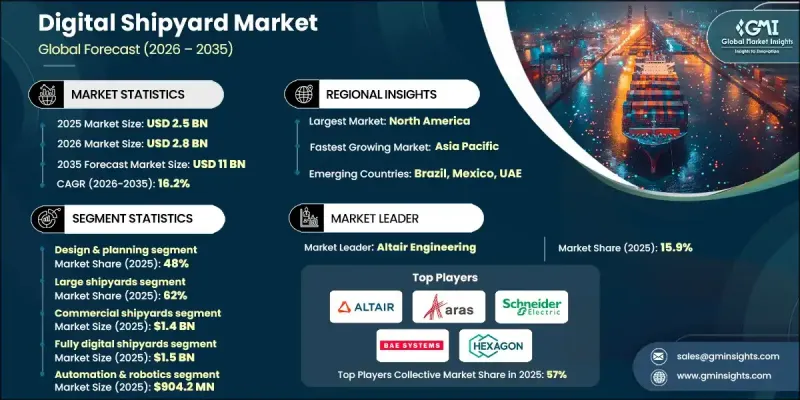
시장 성장의 배경에는 효율적인 조선 및 유지보수 프로세스에 대한 수요 증가, 커넥티드 및 지능형 시스템에 대한 의존도 증가, 규제 및 환경 규제 준수 요건 강화 등이 있습니다. 조선사, 해군 조직, 상업 운항 사업자는 비용 절감, 건조 정확도 향상, 프로젝트 기간 단축에 초점을 맞추고 있으며, 이는 디지털 조선소 플랫폼의 도입을 가속화하고 있습니다. 데이터에 기반한 의사결정은 조선소 운영의 핵심이 되고 있으며, 생산성 향상, 안전 기준 개선, 자산 수명주기 관리의 최적화를 실현하고 있습니다. 조선 산업이 현대화됨에 따라 디지털 조선소 솔루션은 조선 및 수리 생태계 전반에 걸쳐 실시간 가시성, 예측 능력, 협업 워크플로우를 지원하는 핵심 기반 기술로 부상하고 있습니다.
| 시장 범위 | |
|---|---|
| 개시 연도 | 2025년 |
| 예측 연도 | 2026-2035년 |
| 개시 연도 가치 | 25억 달러 |
| 예측 금액 | 110억 달러 |
| CAGR | 16.2% |
인공지능, 머신러닝, 커넥티드 센서, 가상 모델링의 발전으로 수작업 공정이 지능형 자동화 시스템으로 대체되면서 조선소 운영이 재편되고 있습니다. 통합 디지털 플랫폼을 통해 설계, 시공, 유지보수 활동 전반에 걸쳐 지속적인 모니터링, 성능 분석, 시뮬레이션 기반 계획이 가능합니다. 이러한 기능을 통해 손이 많이 가는 것을 줄이고, 컴플라이언스를 향상시키며, 예방적 유지보수 전략을 실현할 수 있습니다. 분석, 자동화, 커넥티드 인프라가 일상 업무에 통합되면서 디지털 조선 환경은 계속 성숙해져 확장성과 장기적인 생산 계획을 지원하고 있습니다.
설계 및 계획 분야는 2025년 48%의 점유율을 차지하며 2035년까지 연평균 복합 성장률(CAGR) 16.8%를 나타낼 것으로 예측됩니다. 이 분야가 선도적인 위치에 있는 이유는 정확한 모델링, 조정된 워크플로우, 예측적 스케줄링의 중요성 때문입니다. 디지털 계획 도구는 복잡한 조선 프로그램 전반에 걸쳐 협업을 지원하고, 설계 오류를 줄이며, 납기를 개선합니다.
대형 조선소 부문은 2025년 62%의 점유율을 차지할 것으로 예상되며, 2026년부터 2035년까지 연평균 복합 성장률(CAGR) 16.7%를 나타낼 것으로 예측됩니다. 이러한 선도적 위치는 더 큰 재정적 능력, 첨단 인프라, 대규모 사업 전반에 걸쳐 종합적인 디지털 솔루션을 배포할 수 있는 능력에 의해 뒷받침됩니다. 고도의 자동화 및 시스템 통합을 통해 대형 시설은 엔드 투 엔드 디지털 조선소 기술의 주요 도입자로 자리매김하고 있습니다.
미국 디지털 조선소 시장은 2025년 78%의 점유율을 차지하며 7억 5,470만 달러 규모에 달할 것으로 예측됩니다. 이러한 지역적 우위는 고도의 산업 역량, 강력한 기술 도입, 그리고 운영 효율성과 안전성을 향상시키는 커넥티드 및 지능형 조선소 플랫폼의 조기 도입에 의해 뒷받침되고 있습니다.
자주 묻는 질문
목차
제1장 조사 방법과 범위
제2장 주요 요약
제3장 업계 인사이트
- 생태계 분석
- 공급업체 상황
- 이익률
- 비용 구조
- 각 단계 부가가치
- 밸류체인에 영향을 미치는 요인
- 파괴적 변화
- 업계에 대한 영향요인
- 성장 촉진요인
- 첨단 디지털 기술 보급 확대
- 업무 효율화와 비용 절감 필요성
- 방위·민간 부문으로부터 수요 증가
- 규제 준수와 환경기준
- 업계의 잠재적 리스크&과제
- 높은 도입·유지 비용
- 레거시 시스템과의 복잡한 통합
- 시장 기회
- 예지보전과 수명주기 최적화
- 중소규모 조선소 도입 상황
- 클라우드 기반 한편 통합 플랫폼 도입
- 디지털 트윈 및 예지보전 솔루션 확대
- 성장 촉진요인
- 성장 가능성 분석
- 규제 상황
- 북미
- 미국 : OSHA 및 미국 연안경비대 가이드라인
- 캐나다 : 운송 성 및 노동 안전 위생 가이드라인
- 유럽
- 독일 : BMVI(연방 교통·디지털화 성) 및 DGUV(독일 노동자 재해보상 보험) 규제
- 프랑스 : DGME 및 CNES 가이드라인
- 영국 : 해사 해병성(MCA) 및 건강 안전 집행국(HSE) 규제
- 이탈리아 : ENAC 및 INAIL 가이드라인
- 아시아태평양
- 중국 : CCS(중국 선급 협회) 및 해상 안전 규제
- 일본 : JCAB 및 국토 교통성 가이드라인
- 한국 : 국토 교통성(MOLIT) 및 안전 가이드라인
- 인도 : 해운총국 및 도크 안전 규칙
- 라틴아메리카
- 브라질 : ANTAQ(국가 해운국) 및 인프라성 가이드라인
- 멕시코 : SEMAR 및 DGPM 규제
- 중동 및 아프리카
- 아랍에미리트 : 에너지·인프라성 규제
- 사우디아라비아 : 사우디 항만청 가이드라인
- 북미
- Porter의 Five Forces 분석
- PESTEL 분석
- 기술과 혁신 동향
- 현재 기술 동향
- 신기술
- 가격 동향
- 지역별
- 제품별
- 비용 내역 분석
- 특허 분석
- 지속가능성과 환경면
- 지속가능한 실천
- 폐기물 감축 전략
- 생산 에너지 효율
- 친환경 이니셔티브
- 탄소발자국에 관한 고려사항
- 이용 사례 시나리오
- 디지털 조선소 아키텍처 프레임워크
- 엔드 투 엔드 디지털 조선소 레퍼런스 아키텍처
- IT-OT융합 레이어
- 데이터 상호운용성 및 통합 기준
- 조선 사이버물리 시스템
- 디지털 성숙도·준비도 지수
- 조선소 디지털 성숙도 레벨
- 능력 벤치마크 : 기존 조선소와 스마트 조선소 비교
- 지역별 성숙도 비교
- 조선소 규모별 준비 상황 갭
- 구입자 및 이해관계자 분석
제4장 경쟁 구도
- 서론
- 기업의 시장 점유율 분석
- 북미
- 유럽
- 아시아태평양
- 라틴아메리카
- 중동 및 아프리카
- 주요 시장 기업의 경쟁 분석
- 경쟁 포지셔닝 매트릭스
- 전략적 전망 매트릭스
- 주요 발전
- 인수합병(M&A)
- 제휴 및 협업
- 신제품 발매
- 사업 확대 계획과 자금조달
제5장 시장 추산·예측 : 유형별, 2022-2035
- 상업 조선소
- 군용 조선소
제6장 시장 추산·예측 : 제조 공정별, 2022-2035
- 설계·계획
- 건설
- 유지보수·수리
제7장 시장 추산·예측 : 용량별, 2022-2035
- 대형 조선소
- 중규모 조선소
- 소규모 조선소
제8장 시장 추산·예측 : 디지털화 레벨별, 2022-2035
- 완전 디지털화 조선소
- 반 디지털화 조선소
제9장 시장 추산·예측 : 기술별, 2022-2035
- 자동화 및 로보틱스
- 사물인터넷(IoT)
- 데이터 분석과 빅데이터
- 디지털 트윈 기술
- 기타
제10장 시장 추산·예측 : 최종 용도별, 2022-2035
- 조선사 및 조선소
- 방위 및 군
- 선박소유자 및 운항 회사
제11장 시장 추산·예측 : 지역별, 2022-2035
- 북미
- 미국
- 캐나다
- 유럽
- 영국
- 독일
- 프랑스
- 이탈리아
- 스페인
- 벨기에
- 네덜란드
- 스웨덴
- 아시아태평양
- 중국
- 인도
- 일본
- 호주
- 싱가포르
- 한국
- 베트남
- 인도네시아
- 라틴아메리카
- 브라질
- 멕시코
- 아르헨티나
- 중동 및 아프리카
- 아랍에미리트
- 남아프리카공화국
- 사우디아라비아
제12장 기업 개요
- Global Player
- ABB
- Altair Engineering
- Aras
- BAE Systems
- Dassault Systemes
- Hexagon
- iBase-t
- Mitsubishi Heavy Industries
- Schneider Electric(AVEVA)
- Siemens
- Regional Player
- Austal
- China State Shipbuilding Corporation(CSSC)
- Daewoo Shipbuilding &Marine Engineering
- Fincantieri
- Honeywell International
- Hyundai Heavy Industries
- Kongsberg Gruppen
- Larsen &Toubro(L&T) Shipbuilding
- Mitsui E&S
- Navantia
- 신규 기업
- DNV Digital Solutions
- Marine Technologies
- MarineCFO
- Navis Marine Solutions
- ShipConstructor
The Global Digital Shipyard Market was valued at USD 2.5 billion in 2025 and is estimated to grow at a CAGR of 16.2% to reach USD 11 billion by 2035.
The market growth is driven by the rising need for efficient shipbuilding and maintenance processes, increased reliance on connected and intelligent systems, and stricter regulatory and environmental compliance requirements. Shipbuilders, naval organizations, and commercial operators are increasingly focused on reducing costs, improving build accuracy, and shortening project timelines, which is accelerating the adoption of digital shipyard platforms. Data-driven decision-making is becoming central to shipyard operations, enabling higher productivity, improved safety standards, and optimized asset lifecycle management. As the industry modernizes, digital shipyard solutions are emerging as critical enablers that support real-time visibility, predictive capabilities, and coordinated workflows across the entire shipbuilding and repair ecosystem.
| Market Scope | |
|---|---|
| Start Year | 2025 |
| Forecast Year | 2026-2035 |
| Start Value | $2.5 Billion |
| Forecast Value | $11 Billion |
| CAGR | 16.2% |
Advancements in artificial intelligence, machine learning, connected sensors, and virtual modeling are reshaping shipyard operations by replacing manual processes with intelligent, automated systems. Integrated digital platforms allow continuous monitoring, performance analysis, and simulation-based planning across design, construction, and maintenance activities. These capabilities reduce rework, improve compliance, and enable proactive maintenance strategies. The digital shipyard environment continues to mature as analytics, automation, and connected infrastructure become embedded into daily operations, supporting scalable and long-term production planning.
The design and planning segment held a 48% share in 2025 and is projected to grow at a CAGR of 16.8% through 2035. This segment leads due to its importance in enabling accurate modeling, coordinated workflows, and predictive scheduling. Digital planning tools support collaboration, reduce design errors, and improve delivery timelines across complex shipbuilding programs.
The large shipyards segment held 62% share in 2025 and is expected to grow at a CAGR of 16.7% between 2026 and 2035. Their leadership is supported by greater financial capacity, advanced infrastructure, and the ability to deploy comprehensive digital solutions across large-scale operations. High levels of automation and system integration position large facilities as primary adopters of end-to-end digital shipyard technologies.
U.S. Digital Shipyard Market accounted for 78% share in 2025, generating USD 754.7 million. Regional leadership is supported by advanced industrial capabilities, strong technology adoption, and early implementation of connected and intelligent shipyard platforms that enhance operational efficiency and safety.
Key companies active in the Global Digital Shipyard Market include Siemens, ABB, Dassault Systemes, Schneider Electric (AVEVA), Honeywell International, Hexagon, BAE Systems, Altair Engineering, Aras, and iBase-t. Companies operating in the Global Digital Shipyard Market are strengthening their competitive positions through continuous technology innovation and strategic collaboration. Providers are investing heavily in AI-driven design tools, real-time analytics, and integrated digital platforms to deliver end-to-end visibility across shipyard operations. Partnerships with shipbuilders, defense organizations, and technology firms are being used to accelerate the deployment and customization of solutions. Many players are expanding cloud-based offerings to support scalability and remote collaboration. Emphasis is also being placed on cybersecurity, compliance support, and predictive maintenance capabilities.
Table of Contents
Chapter 1 Methodology & Scope
- 1.1 Market scope and definition
- 1.2 Research design
- 1.2.1 Research approach
- 1.2.2 Data collection methods
- 1.3 Data mining sources
- 1.3.1 Global
- 1.3.2 Regional/Country
- 1.4 Base estimates and calculations
- 1.4.1 Base year calculation
- 1.4.2 Key trends for market estimation
- 1.5 Primary research and validation
- 1.5.1 Primary sources
- 1.6 Forecast
- 1.7 Research assumptions and limitations
Chapter 2 Executive Summary
- 2.1 Industry 360° synopsis, 2022 - 2035
- 2.2 Key market trends
- 2.2.1 Regional
- 2.2.2 Type
- 2.2.3 Process
- 2.2.4 Capacity
- 2.2.5 Digitalization Level
- 2.2.6 Technology
- 2.2.7 End Use
- 2.3 TAM Analysis, 2026-2035
- 2.4 CXO perspectives: Strategic imperatives
- 2.4.1 Executive decision points
- 2.4.2 Critical success factors
- 2.5 Future outlook and strategic recommendations
Chapter 3 Industry Insights
- 3.1 Industry ecosystem analysis
- 3.1.1 Supplier Landscape
- 3.1.2 Profit Margin
- 3.1.3 Cost structure
- 3.1.4 Value addition at each stage
- 3.1.5 Factor affecting the value chain
- 3.1.6 Disruptions
- 3.2 Industry impact forces
- 3.2.1 Growth drivers
- 3.2.1.1 Rising Adoption of Advanced Digital Technologies
- 3.2.1.2 Need for Operational Efficiency and Cost Reduction
- 3.2.1.3 Growing Demand from Defense and Commercial Sectors
- 3.2.1.4 Regulatory Compliance and Environmental Standards
- 3.2.2 Industry pitfalls and challenges
- 3.2.2.1 High Implementation and Maintenance Costs
- 3.2.2.2 Complex Integration with Legacy Systems
- 3.2.3 Market opportunities
- 3.2.3.1 Predictive Maintenance and Lifecycle Optimization
- 3.2.3.2 Adoption by Medium and Small Shipyards
- 3.2.3.3 Cloud-Based and Integrated Platform Deployments
- 3.2.3.4 Expansion of Digital Twin and Predictive Maintenance Solutions
- 3.2.1 Growth drivers
- 3.3 Growth potential analysis
- 3.4 Regulatory landscape
- 3.4.1 North America
- 3.4.1.1 U.S.: OSHA & US Coast Guard Guidelines
- 3.4.1.2 Canada: Transport & WorkSafe Guidelines
- 3.4.2 Europe
- 3.4.2.1 Germany: BMVI & DGUV Regulations
- 3.4.2.2 France: DGME & CNES Guidelines
- 3.4.2.3 UK: MCA & HSE Regulations
- 3.4.2.4 Italy: ENAC & INAIL Guidelines
- 3.4.3 Asia Pacific
- 3.4.3.1 China: CCS & Maritime Safety Regulations
- 3.4.3.2 Japan: JCAB & MLIT Guidelines
- 3.4.3.3 South Korea: MOLIT & Safety Guidelines
- 3.4.3.4 India: DG Shipping & Dock Safety Rules
- 3.4.4 Latin America
- 3.4.4.1 Brazil: ANTAQ & Ministry of Infrastructure Guidelines
- 3.4.4.2 Mexico: SEMAR & DGPM Regulations
- 3.4.5 Middle East and Africa
- 3.4.5.1 UAE: Ministry of Energy & Infrastructure Regulations
- 3.4.5.2 Saudi Arabia: Saudi Ports Authority Guidelines
- 3.4.1 North America
- 3.5 Porter';s analysis
- 3.6 PESTEL analysis
- 3.7 Technology and Innovation Landscape
- 3.7.1 Current technological trends
- 3.7.2 Emerging technologies
- 3.8 Price trends
- 3.8.1 By region
- 3.8.2 By product
- 3.9 Cost breakdown analysis
- 3.10 Patent analysis
- 3.11 Sustainability and Environmental Aspects
- 3.11.1 Sustainable practices
- 3.11.2 Waste reduction strategies
- 3.11.3 Energy efficiency in production
- 3.11.4 Eco-friendly initiatives
- 3.11.5 Carbon footprint considerations
- 3.12 Use case scenarios
- 3.13 Digital Shipyard Architecture Framework
- 3.13.1 End-to-end digital shipyard reference architecture
- 3.13.2 IT-OT convergence layers
- 3.13.3 Data interoperability & integration standards
- 3.13.4 Cyber-physical systems in shipbuilding
- 3.14 Digital Maturity & Readiness Index
- 3.14.1 Shipyard digital maturity levels
- 3.14.2 Capability benchmarking: legacy vs smart shipyards
- 3.14.3 Regional maturity comparison
- 3.14.4 Readiness gaps by shipyard size
- 3.15 Buyer & Stakeholder Analysis
Chapter 4 Competitive Landscape, 2025
- 4.1 Introduction
- 4.2 Company market share analysis
- 4.2.1 North America
- 4.2.2 Europe
- 4.2.3 Asia Pacific
- 4.2.4 Latin America
- 4.2.5 Middle East & Africa
- 4.3 Competitive analysis of major market players
- 4.4 Competitive positioning matrix
- 4.5 Strategic outlook matrix
- 4.6 Key developments
- 4.6.1 Mergers & acquisitions
- 4.6.2 Partnerships & collaborations
- 4.6.3 New product launches
- 4.6.4 Expansion plans and funding
Chapter 5 Market Estimates & Forecast, By Type, 2022 - 2035 ($ Bn)
- 5.1 Key trends
- 5.2 Commercial shipyards
- 5.3 Military shipyards
Chapter 6 Market Estimates & Forecast, By Process, 2022 - 2035 ($ Bn)
- 6.1 Key trends
- 6.2 Design & planning
- 6.3 Construction
- 6.4 Maintenance & repair
Chapter 7 Market Estimates & Forecast, By Capacity, 2022 - 2035 ($ Bn)
- 7.1 Key trends
- 7.2 Large shipyards
- 7.3 Medium shipyards
- 7.4 Small shipyards
Chapter 8 Market Estimates & Forecast, By Digitalization Level, 2022 - 2035 ($ Bn)
- 8.1 Key trends
- 8.2 Fully digital shipyard
- 8.3 Semi-digital shipyard
Chapter 9 Market Estimates & Forecast, By Technology, 2022 - 2035 ($ Bn)
- 9.1 Key trends
- 9.2 Automation & robotics
- 9.3 Internet of Things (IoT)
- 9.4 Data analytics & big data
- 9.5 Digital twin technology
- 9.6 Others
Chapter 10 Market Estimates & Forecast, By End Use, 2022 - 2035 ($ Bn)
- 10.1 Key trends
- 10.2 Shipbuilders & shipyards
- 10.3 Defense & military
- 10.4 Ship Owners & Operators
Chapter 11 Market Estimates & Forecast, By Region, 2022 - 2035 ($ Bn)
- 11.1 Key trends
- 11.2 North America
- 11.2.1 US
- 11.2.2 Canada
- 11.3 Europe
- 11.3.1 UK
- 11.3.2 Germany
- 11.3.3 France
- 11.3.4 Italy
- 11.3.5 Spain
- 11.3.6 Belgium
- 11.3.7 Netherlands
- 11.3.8 Sweden
- 11.4 Asia Pacific
- 11.4.1 China
- 11.4.2 India
- 11.4.3 Japan
- 11.4.4 Australia
- 11.4.5 Singapore
- 11.4.6 South Korea
- 11.4.7 Vietnam
- 11.4.8 Indonesia
- 11.5 Latin America
- 11.5.1 Brazil
- 11.5.2 Mexico
- 11.5.3 Argentina
- 11.6 MEA
- 11.6.1 UAE
- 11.6.2 South Africa
- 11.6.3 Saudi Arabia
Chapter 12 Company Profiles
- 12.1 Global Player
- 12.1.1 ABB
- 12.1.2 Altair Engineering
- 12.1.3 Aras
- 12.1.4 BAE Systems
- 12.1.5 Dassault Systemes
- 12.1.6 Hexagon
- 12.1.7 iBase-t
- 12.1.8 Mitsubishi Heavy Industries
- 12.1.9 Schneider Electric (AVEVA)
- 12.1.10 Siemens
- 12.2 Regional Player
- 12.2.1 Austal
- 12.2.2 China State Shipbuilding Corporation (CSSC)
- 12.2.3 Daewoo Shipbuilding & Marine Engineering
- 12.2.4 Fincantieri
- 12.2.5 Honeywell International
- 12.2.6 Hyundai Heavy Industries
- 12.2.7 Kongsberg Gruppen
- 12.2.8 Larsen & Toubro (L&T) Shipbuilding
- 12.2.9 Mitsui E&S
- 12.2.10 Navantia
- 12.3 Emerging Players
- 12.3.1 DNV Digital Solutions
- 12.3.2 Marine Technologies
- 12.3.3 MarineCFO
- 12.3.4 Navis Marine Solutions
- 12.3.5 ShipConstructor


