|
시장보고서
상품코드
1928934
소각로 시장 기회, 성장요인, 업계 동향 분석 및 예측(2026-2035년)Incinerator Market Opportunity, Growth Drivers, Industry Trend Analysis, and Forecast 2026 - 2035 |
||||||

세계의 소각로 시장은 2025년에 186억 달러로 평가되었고, 2035년까지 연평균 복합 성장률(CAGR) 2.2%로 성장하여 233억 달러에 이를 것으로 예측됩니다.
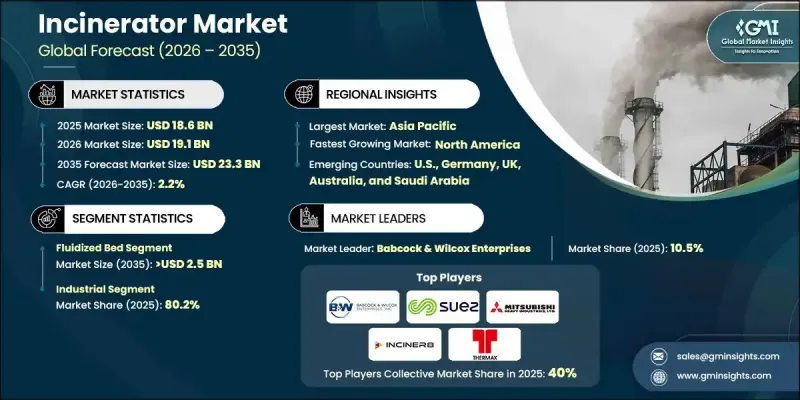
시장의 발전은 전 세계적으로 증가하는 도시 폐기물의 양과 매립지 가용성에 대한 압력이 증가함에 따라 형성되고 있습니다. 공공 및 민간 폐기물 처리 사업자는 장기적인 폐기물 관리 요구를 지원하기 위해 폐기물 양 감소, 위생적 처리, 신뢰할 수 있는 처리 능력을 우선순위에 두고 있습니다. 소각 시스템은 에너지 회수 인프라와 통합되어 엄격한 배출 규제를 유지하면서 폐기물을 사용 가능한 열과 전력으로 변환할 수 있게 되었습니다. 현대식 시설은 더 높은 처리 능력, 개선된 열 효율, 지역 열 공급 네트워크와의 호환성으로 설계되었습니다. 처분 수수료, 발전, 열공급 계약, 자원회수 등을 통한 수익원 다변화로 수익의 안정성이 향상되고 있습니다. 계약 모델은 원재료의 변동성과 운영 성과를 더 잘 관리할 수 있도록 진화하고 있습니다. 동시에 환경 목표가 플랜트 설계에 영향을 미치고, 수명주기 배출량 감소, 연료 대체, 첨단 탄소 관리 솔루션에 대한 대응 준비가 더욱 강조되고 있습니다. 이러한 복합적인 요인들이 꾸준한 성장을 뒷받침하고 통합 폐기물 관리 프레임워크에서 소각의 역할을 강화하고 있습니다.
| 시장 범위 | |
|---|---|
| 개시 연도 | 2025년 |
| 예측 연도 | 2026-2035년 |
| 개시 연도 가치 | 186억 달러 |
| 예측 금액 | 233억 달러 |
| CAGR | 2.2% |
유동층 소각로 부문은 2035년까지 25억 달러에 달할 것으로 예측됩니다. 이 기술은 안정적인 연소 효율과 균일한 열 분배를 실현할 수 있어 수요가 증가하고 있습니다. 이러한 시스템은 열 성능 향상과 배출량 감소로 평가되어 다양한 폐기물 처리 분야에서 채택이 진행되고 있습니다.
산업 응용 분야는 2025년 80.2%의 점유율을 차지할 것으로 예상되며, 2035년까지 180억 달러에 달할 것으로 예측됩니다. 성장은 산업 활동의 확대와 유해 폐기물 및 비재생 폐기물 증가량에 의해 주도되고 있습니다. 산업체들은 제품별 안전한 취급을 보장하는 동시에 현장의 에너지 회수 및 통합 폐기물 관리를 지원하는 규제에 부합하는 폐기물 처리 솔루션에 투자하고 있습니다.
미국 소각로 시장은 2025년 90.7%의 점유율을 차지하며 39억 달러 규모에 달할 것으로 예측됩니다. 시장 성장은 도시 인프라 개발 및 현대화 노력에 따른 기존 시설의 업데이트와 대용량 시스템 구축에 의해 뒷받침되고 있습니다.
자주 묻는 질문
목차
제1장 조사 방법과 범위
제2장 주요 요약
제3장 업계 인사이트
- 생태계 분석
- 원재료 가용성과 조달 분석
- 제조능력 평가
- 공급망 회복력과 리스크 요인
- 유통 네트워크 분석
- 규제 상황
- 업계에 대한 영향요인
- 성장 촉진요인
- 업계의 잠재적 리스크&과제
- 성장 가능성 분석
- Porter의 Five Forces 분석
- 공급 기업의 교섭력
- 바이어의 교섭력
- 신규 진출업체의 위협
- 대체품의 위협
- PESTEL 분석
- 소각로 비용 구조 분석
- 새로운 기회와 동향
- 디지털화와 IoT 통합
- 투자 분석과 전망
제4장 경쟁 구도
- 서론
- 기업의 시장 점유율 분석 : 지역별
- 북미
- 유럽
- 아시아태평양
- 중동 및 아프리카
- 라틴아메리카
- 전략적 대시보드
- Key partnerships &collaborations
- Major M&A activities
- Product innovations &launches
- Market expansion strategies
- 전략적 이니셔티브
- 경쟁 벤치마킹
- 혁신과 기술 동향
제5장 시장 규모와 예측 : 제품별, 2022-2035
- 로터리 킬른
- 유동층
- 불격자
- 정지노
- 마르치프르하스
- 기타
제6장 시장 규모와 예측 : 최종 용도별, 2022-2035
- 자치체 용
- 산업용
제7장 시장 규모와 예측 : 지역별, 2022-2035
- 북미
- 미국
- 캐나다
- 유럽
- 영국
- 프랑스
- 독일
- 이탈리아
- 스웨덴
- 네덜란드
- 러시아
- 아시아태평양
- 중국
- 호주
- 인도
- 일본
- 한국
- 중동 및 아프리카
- 카타르
- 아랍에미리트
- 나이지리아
- 사우디아라비아
- 남아프리카공화국
- 라틴아메리카
- 브라질
- 아르헨티나
- 멕시코
제8장 기업 개요
- Alfa Therm
- Aswathi Industries
- Atlas Incinerators
- Babcock &Wilcox Enterprises
- CHUWASTAR
- Dutch Incinerators
- ECO Concepts
- For.Tec. Forniture Tecnologiche
- Haat Incinerator
- Igniss Energy
- Incinco
- Inciner8
- Keller Manufacturing
- KINC Mineral Technologies
- Maximus Envirotech
- MICROTEKNIK
- Mitsubishi Heavy Industries
- SUEZ
- Thermax
- Thermtech Industries
- Vikas Engineering
- Waste Spectrum
The Global Incinerator Market was valued at USD 18.6 billion in 2025 and is estimated to grow at a CAGR of 2.2% to reach USD 23.3 billion by 2035.
Market development is shaped by rising volumes of urban waste and increasing pressure on landfill availability worldwide. Public and private waste operators are prioritizing waste volume reduction, hygienic treatment, and dependable disposal capacity to support long-term waste management needs. Incineration systems are increasingly integrated with energy recovery infrastructure, enabling facilities to convert waste into usable heat and power while maintaining strict emission controls. Modern facilities are being designed with higher processing capacity, improved thermal efficiency, and compatibility with district energy networks. Revenue stability is improving as operators diversify income sources through disposal fees, electricity generation, heat supply agreements, and material recovery. Contractual models are evolving to better manage feedstock variability and operational performance. At the same time, environmental objectives are influencing plant design, with greater focus on lifecycle emission reduction, fuel substitution, and readiness for advanced carbon management solutions. These combined factors are supporting steady growth and reinforcing the role of incineration within integrated waste management frameworks.
| Market Scope | |
|---|---|
| Start Year | 2025 |
| Forecast Year | 2026-2035 |
| Start Value | $18.6 Billion |
| Forecast Value | $23.3 Billion |
| CAGR | 2.2% |
The fluidized bed incinerator segment is projected to reach USD 2.5 billion by 2035. Demand for this technology is increasing due to its ability to deliver consistent combustion efficiency and stable heat distribution. These systems are valued for improved thermal performance and reduced emission levels, supporting their adoption across multiple waste streams.
The industrial application segment held 80.2% share in 2025 and is expected to reach USD 18 billion by 2035. Growth is driven by expanding industrial activity and rising volumes of hazardous and non-recyclable waste. Industrial operators are investing in compliant disposal solutions that ensure safe handling of by-products while supporting on-site energy recovery and integrated waste management practices.
United States Incinerator Market accounted for 90.7% share in 2025 and generated USD 3.9 billion. Market growth is supported by upgrades to existing facilities and the construction of higher-capacity systems aligned with urban infrastructure development and modernization efforts.
Major companies operating in the Global Incinerator Market include Mitsubishi Heavy Industries, SUEZ, Babcock & Wilcox Enterprises, Thermax, Alfa Therm, Inciner8, Dutch Incinerators, Igniss Energy, Atlas Incinerators, Waste Spectrum, Keller Manufacturing, ECO Concepts, For.Tec. Forniture Tecnologiche, KINC Mineral Technologies, MICROTEKNIK, CHUWASTAR, Maximus Envirotech, Vikas Engineering, Aswathi Industries, Haat Incinerator, Thermtech Industries, and Incinco. Companies in the Global Incinerator Market are strengthening their competitive position through technology upgrades, efficiency optimization, and service diversification. Many players are investing in advanced combustion systems, energy recovery enhancements, and emission control technologies to meet evolving regulatory standards. Strategic partnerships with municipalities and industrial clients support long-term contracts and stable revenue streams. Firms are also expanding modular and scalable system offerings to address varying capacity requirements.
Table of Contents
Chapter 1 Methodology & Scope
- 1.1 Research approach
- 1.2 Quality commitments
- 1.2.1 GMI AI policy & data integrity commitment
- 1.2.1.1 Source consistency protocol
- 1.2.1 GMI AI policy & data integrity commitment
- 1.3 Research trail & confidence scoring
- 1.3.1 Research trail components
- 1.3.2 Scoring components
- 1.4 Data collection
- 1.4.1 Partial list of primary sources
- 1.5 Data mining sources
- 1.5.1 Paid sources
- 1.5.1.1 Sources, by region
- 1.5.1 Paid sources
- 1.6 Base estimates and calculations
- 1.6.1 Base year calculation for any one approach
- 1.7 Market estimates & forecasts parameters
- 1.8 Forecast model
- 1.8.1 Quantified market impact analysis
- 1.8.1.1 Mathematical impact of growth parameters on forecast
- 1.8.1 Quantified market impact analysis
- 1.9 Research transparency addendum
- 1.9.1 Source attribution framework
- 1.9.2 Quality assurance metrics
- 1.9.3 Our commitment to trust
- 1.10 Market definitions
Chapter 2 Executive Summary
- 2.1 Industry synopsis, 2022 - 2035
- 2.2 Business trends
- 2.3 Product trends
- 2.4 End use trends
- 2.5 Regional trends
Chapter 3 Industry Insights
- 3.1 Industry ecosystem analysis
- 3.1.1 Raw material availability & sourcing analysis
- 3.1.2 Manufacturing capacity assessment
- 3.1.3 Supply chain resilience & risk factors
- 3.1.4 Distribution network analysis
- 3.2 Regulatory landscape
- 3.3 Industry impact forces
- 3.3.1 Growth drivers
- 3.3.2 Industry pitfalls & challenges
- 3.4 Growth potential analysis
- 3.5 Porter';s analysis
- 3.5.1 Bargaining power of suppliers
- 3.5.2 Bargaining power of buyers
- 3.5.3 Threat of new entrants
- 3.5.4 Threat of substitutes
- 3.6 PESTEL analysis
- 3.6.1 Political factors
- 3.6.2 Economic factors
- 3.6.3 Social factors
- 3.6.4 Technological factors
- 3.6.5 Legal factors
- 3.6.6 Environmental factors
- 3.7 Cost structure analysis of incinerator
- 3.8 Emerging opportunities & trends
- 3.9 Digitalization and IoT integration
- 3.10 Investment analysis & future outlook
Chapter 4 Competitive Landscape, 2025
- 4.1 Introduction
- 4.2 Company market share analysis, by region, 2025
- 4.2.1 North America
- 4.2.2 Europe
- 4.2.3 Asia Pacific
- 4.2.4 Middle East & Africa
- 4.2.5 Latin America
- 4.3 Strategic dashboard
- 4.3.1 Key partnerships & collaborations
- 4.3.2 Major M&A activities
- 4.3.3 Product innovations & launches
- 4.3.4 Market expansion strategies
- 4.4 Strategic initiatives
- 4.5 Competitive benchmarking
- 4.6 Innovation & technology landscape
Chapter 5 Market Size and Forecast, By Product, 2022 - 2035 (USD Million)
- 5.1 Key trends
- 5.2 Rotary kiln
- 5.3 Fluidized bed
- 5.4 Grate
- 5.5 Static hearth
- 5.6 Multiple hearth
- 5.7 Others
Chapter 6 Market Size and Forecast, By End Use, 2022 - 2035 (USD Million)
- 6.1 Key trends
- 6.2 Municipal
- 6.3 Industrial
Chapter 7 Market Size and Forecast, By Region, 2022 - 2035 (USD Million)
- 7.1 Key trends
- 7.2 North America
- 7.2.1 U.S.
- 7.2.2 Canada
- 7.3 Europe
- 7.3.1 UK
- 7.3.2 France
- 7.3.3 Germany
- 7.3.4 Italy
- 7.3.5 Sweden
- 7.3.6 Netherlands
- 7.3.7 Russia
- 7.4 Asia Pacific
- 7.4.1 China
- 7.4.2 Australia
- 7.4.3 India
- 7.4.4 Japan
- 7.4.5 South Korea
- 7.5 Middle East & Africa
- 7.5.1 Qatar
- 7.5.2 UAE
- 7.5.3 Nigeria
- 7.5.4 Saudi Arabia
- 7.5.5 South Africa
- 7.6 Latin America
- 7.6.1 Brazil
- 7.6.2 Argentina
- 7.6.3 Mexico
Chapter 8 Company Profiles
- 8.1 Alfa Therm
- 8.2 Aswathi Industries
- 8.3 Atlas Incinerators
- 8.4 Babcock & Wilcox Enterprises
- 8.5 CHUWASTAR
- 8.6 Dutch Incinerators
- 8.7 ECO Concepts
- 8.8 For.Tec. Forniture Tecnologiche
- 8.9 Haat Incinerator
- 8.10 Igniss Energy
- 8.11 Incinco
- 8.12 Inciner8
- 8.13 Keller Manufacturing
- 8.14 KINC Mineral Technologies
- 8.15 Maximus Envirotech
- 8.16 MICROTEKNIK
- 8.17 Mitsubishi Heavy Industries
- 8.18 SUEZ
- 8.19 Thermax
- 8.20 Thermtech Industries
- 8.21 Vikas Engineering
- 8.22 Waste Spectrum