

|
시장보고서
상품코드
1928996
전기 추진 위성 시장 기회, 성장 촉진요인, 업계 동향 분석 및 예측(2026-2035년)Electric Propulsion Satellites Market Opportunity, Growth Drivers, Industry Trend Analysis, and Forecast 2026 - 2035 |
||||||

세계의 전기 추진 위성 시장은 2025년에 503억 달러로 평가되었으며, 2035년까지 CAGR 14%로 성장하여 1,797억 달러에 달할 것으로 예측됩니다.
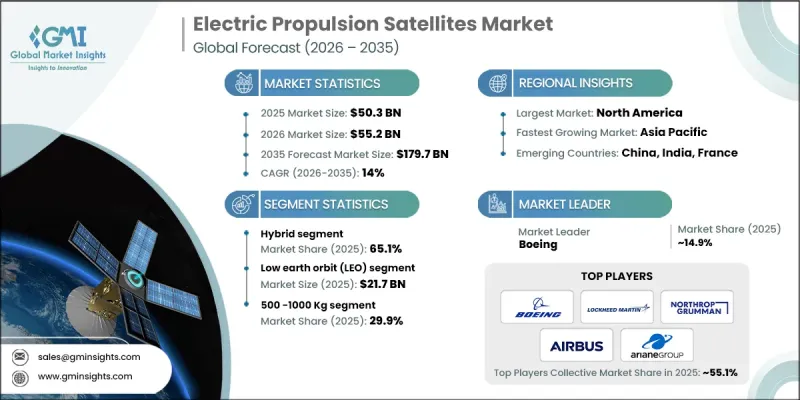
시장 성장세는 대규모 위성 콘스텔레이션에 대한 수요 증가, 전기 추진 효율의 지속적인 개선, 비용 최적화된 발사 및 궤도 운영 솔루션에 대한 선호도 증가로 뒷받침되고 있습니다. 통신, 관측, 보안 목적의 위성 배치가 증가함에 따라 임무 수명 연장과 운영 비용 절감을 실현하는 추진 시스템의 필요성이 증대되고 있습니다. 전기 추진 기술의 발전으로 추력 효율과 운영 유연성이 향상되어 위성이 더 적은 연료 질량으로 복잡한 임무를 수행할 수 있게 되었습니다. 환경 친화적인 우주 운영에 대한 관심이 높아짐에 따라 보다 깨끗한 추진시스템의 채택을 촉진하고 있습니다. 상업용 우주 생태계의 확대와 민관 이해관계자들의 참여 증가가 맞물려 수요를 더욱 자극하고 있습니다. 위성 프로그램 전반에 걸쳐 비용 효율성은 여전히 중요한 우선순위이며, 성능, 확장성, 장기 임무 경제성의 균형을 맞추는 추진 아키텍처에 대한 관심이 높아지면서 지속적인 시장 확대를 뒷받침하고 있습니다.
| 시장 범위 | |
|---|---|
| 시작 연도 | 2025년 |
| 예측 연도 | 2026-2035 |
| 개시시 가치 | 503억 달러 |
| 예측 금액 | 1,797억 달러 |
| CAGR | 14% |
하이브리드 추진 부문은 2025년 65.1%의 점유율을 차지했습니다. 이 부문은 다양한 임무 요건을 충족하기 위해 전기 추진 시스템과 화학 추진 시스템을 결합하여 이점을 얻습니다. 위성 운영업체들이 기동성과 내구성을 모두 지원하면서 비용 효율성을 유지하면서 신뢰할 수 있는 추진 솔루션을 찾는 가운데, 하이브리드 구성에 대한 수요는 지속적으로 증가하고 있습니다.
저궤도(LEO) 부문은 2025년 217억 달러의 시장 규모를 창출했습니다. LEO 위성에 대한 수요는 빈번한 배치가 필요한 대규모 별자리로의 적합성, 효율적인 추진 성능, 광범위한 애플리케이션에서 신뢰할 수 있는 운영 커버리지로 인해 높은 수요를 창출하고 있습니다.
북미 전기 추진 위성 시장은 2025년 36.7%의 점유율을 차지했습니다. 이 지역의 시장 리더십은 위성 기술에 대한 지속적인 투자, 첨단 통신 인프라에 대한 강력한 수요, 공공 및 민간 자금으로 추진되는 기술 혁신의 지속적인 개발로 뒷받침되고 있습니다.
자주 묻는 질문
목차
제1장 조사 방법과 범위
제2장 주요 요약
제3장 업계 인사이트
- 생태계 분석
- 공급업체 상황
- 이익률
- 비용 구조
- 각 단계의 부가가치
- 밸류체인에 영향을 미치는 요인
- 디스럽션
- 업계에 대한 영향요인
- 성장 촉진요인
- 세계 위성 컨스텔레이션에 대한 수요 증가
- 전기 추진 기술 효율성의 진전
- 적정 가격의 발사 솔루션에 대한 수요 증가
- 방위·상업 분야의 우주 발사 급증
- 우주 인프라 개발에 대한 투자 증가
- 업계의 잠재적 리스크와 과제
- 초기 개발 및 높은 도입 비용
- 기술적 제약과 성능상 우려
- 시장 기회
- 지속가능한 우주 기술에 대한 수요 증가
- 위성 부품 소형화의 진전
- 성장 촉진요인
- 성장 가능성 분석
- 규제 상황
- 북미
- 유럽
- 아시아태평양
- 라틴아메리카
- 중동 및 아프리카
- Porters 분석
- PESTEL 분석
- 기술과 혁신 동향
- 현재 기술 동향
- 신기술
- 신흥 비즈니스 모델
- 컴플라이언스 요건
- 방위 예산 분석
- 세계의 방위 지출 동향
- 지역별 방위 예산 배분
- 북미
- 유럽
- 아시아태평양
- 중동 및 아프리카
- 라틴아메리카
- 공급망 회복탄력성
- 지정학적 분석
- 노동력 분석
- 디지털 전환
- 합병, 인수 및 전략적 제휴 동향
- 리스크 평가와 관리
제4장 경쟁 구도
- 소개
- 기업의 시장 점유율 분석
- 지역별
- 북미
- 유럽
- 아시아태평양
- 라틴아메리카
- 중동 및 아프리카
- 시장 집중도 분석
- 지역별
- 주요 기업의 경쟁 벤치마킹
- 재무 실적 비교
- 매출
- 이익률
- 연구개발
- 제품 포트폴리오 비교
- 제품 라인 폭
- 기술
- 혁신
- 지역적 입지 비교
- 세계 전개 분석
- 서비스 네트워크 커버율
- 지역별 시장 침투율
- 경쟁 포지셔닝 매트릭스
- 리더 기업
- 과제자
- 팔로어
- 틈새 플레이어
- 전략적 전망 매트릭스
- 재무 실적 비교
- 주요 발전
- 인수합병
- 제휴 및 협업
- 기술적 진보
- 확대와 투자전략
- 지속가능성에 대한 대처
- 디지털 전환의 대처
- 신흥/스타트업 경쟁 동향
제5장 시장 추정 및 예측 : 궤도별, 2022-2035
- 저궤도(LEO)
- 중궤도(MEO)
- 정지궤도(GEO)
제6장 시장 추정 및 예측 : 위성 유형별, 2022-2035
- 완전 전기식
- 하이브리드
제7장 시장 추정 및 예측 : 위성 질량별, 2022-2035
- 100kg 미만
- 100-500kg
- 500-1000kg
- 1000kg 이상
제8장 시장 추정 및 예측 : 추진력별, 2022-2035
- 전기열식
- 정전식
- 전자식
- 기타
제9장 시장 추정 및 예측 : 용도별, 2022-2035
- 지구 관측
- 항법
- 통신
- 기상 모니터링
- 기타
제10장 시장 추정 및 예측 : 최종 용도별, 2022-2035
- 정부
- 군사
- 기타
- 상업용
제11장 시장 추정 및 예측 : 지역별, 2022-2035
- 북미
- 미국
- 캐나다
- 유럽
- 독일
- 영국
- 프랑스
- 스페인
- 이탈리아
- 네덜란드
- 아시아태평양
- 중국
- 인도
- 일본
- 호주
- 한국
- 라틴아메리카
- 브라질
- 멕시코
- 아르헨티나
- 중동 및 아프리카
- 남아프리카공화국
- 사우디아라비아
- 아랍에미리트
제12장 기업 개요
- 세계의 주요 기업
- Boeing
- Lockheed Martin
- Northrop Grumman
- Airbus
- ArianeGroup
- 지역별 주요 기업
- 북미
- Aerojet Rocketdyne
- Busek Co. Inc.
- L3Harris Technologies
- 아시아태평양
- Bellatrix Aerospace
- 유럽
- OHB System
- Safran Group
- Sitael Spa
- Thales Alenia Space
- ThrustMe
- 북미
- 틈새 기업/디스럽터
- Accion Systems Inc.
- Ad Astra Rocket
The Global Electric Propulsion Satellites Market was valued at USD 50.3 billion in 2025 and is estimated to grow at a CAGR of 14% to reach USD 179.7 billion by 2035.
Market growth is supported by accelerating demand for large-scale satellite constellations, continuous improvements in electric propulsion efficiency, and rising preference for cost-optimized launch and in-orbit operation solutions. Increased deployment of satellites for communication, observation, and security purposes is reinforcing the need for propulsion systems that offer extended mission life and reduced operational costs. Advancements in electric propulsion technologies are enhancing thrust efficiency and operational flexibility, enabling satellites to perform complex missions with lower fuel mass. Growing emphasis on environmentally responsible space operations is also encouraging the adoption of cleaner propulsion alternatives. Expansion of the commercial space ecosystem, combined with rising participation from both public and private stakeholders, is further stimulating demand. Cost efficiency remains a key priority across satellite programs, driving interest in propulsion architectures that balance performance, scalability, and long-term mission economics, thereby supporting sustained market expansion.
| Market Scope | |
|---|---|
| Start Year | 2025 |
| Forecast Year | 2026-2035 |
| Start Value | $50.3 Billion |
| Forecast Value | $179.7 Billion |
| CAGR | 14% |
The hybrid propulsion segment accounted for 65.1% share in 2025. This segment benefits from combining electric and chemical propulsion systems to meet diverse mission requirements. Demand for hybrid configurations continues to grow as satellite operators seek reliable propulsion solutions that support both maneuverability and endurance while maintaining cost efficiency.
The low Earth orbit segment generated USD 21.7 billion in 2025. Strong demand for LEO satellites is being driven by their suitability for large constellations requiring frequent deployment, efficient propulsion performance, and reliable operational coverage across a wide range of applications.
North America Electric Propulsion Satellites Market held 36.7% share in 2025. Market leadership in the region is supported by sustained investment in satellite technology, strong demand for advanced communication infrastructure, and continued development of propulsion innovations backed by public and private funding.
Key companies operating in the Global Electric Propulsion Satellites Market include Airbus, Boeing, Lockheed Martin, Northrop Grumman, Thales Alenia Space, Safran Group, Aerojet Rocketdyne, L3Harris Technologies, ArianeGroup, OHB System, Accion Systems, Bellatrix Aerospace, Busek, ThrustMe, Sitael, and Ad Astra Rocket. Companies in the Electric Propulsion Satellites Market are strengthening their competitive position through technology innovation, strategic partnerships, and capacity expansion. Many players are investing in advanced propulsion systems that improve efficiency, reduce mass, and extend satellite operational life. Expanding hybrid propulsion portfolios is a key strategy to address diverse mission profiles and customer requirements. Firms are also collaborating with satellite manufacturers and launch providers to integrate propulsion solutions early in spacecraft design.
Table of Contents
Chapter 1 Methodology and Scope
- 1.1 Market scope and definition
- 1.2 Research design
- 1.2.1 Research approach
- 1.2.2 Data collection methods
- 1.3 Data mining sources
- 1.3.1 Global
- 1.3.2 Regional/Country
- 1.4 Base estimates and calculations
- 1.4.1 Base year calculation
- 1.4.2 Key trends for market estimation
- 1.5 Primary research and validation
- 1.5.1 Primary sources
- 1.6 Forecast model
- 1.7 Research assumptions and limitations
Chapter 2 Executive Summary
- 2.1 Industry 3600 synopsis, 2022 - 2035
- 2.2 Key market trends
- 2.2.1 Orbit trends
- 2.2.2 Satellite type trends
- 2.2.3 Satellite mass trends
- 2.2.4 Propulsion trends
- 2.2.5 Application trends
- 2.2.6 End use trends
- 2.2.7 Regional
- 2.3 TAM Analysis, 2026-2035
- 2.4 CXO perspectives: Strategic imperatives
- 2.4.1 Executive decision points
- 2.4.2 critical success factors
- 2.5 Future outlook and strategic recommendations
Chapter 3 Industry Insights
- 3.1 Industry ecosystem analysis
- 3.1.1 Supplier Landscape
- 3.1.2 Profit Margin
- 3.1.3 Cost structure
- 3.1.4 Value addition at each stage
- 3.1.5 Factor affecting the value chain
- 3.1.6 Disruptions
- 3.2 Industry impact forces
- 3.2.1 Growth drivers
- 3.2.1.1 Rising demand for global satellite constellations
- 3.2.1.2 Progress in electric propulsion technology efficiency
- 3.2.1.3 Increasing demand for affordable launch solutions
- 3.2.1.4 Surge in space launches for defense, commercial
- 3.2.1.5 Increased investment in space infrastructure development
- 3.2.2 Industry pitfalls and challenges
- 3.2.2.1 High initial development and implementation costs
- 3.2.2.2 Technical limitations and performance concerns
- 3.2.3 Market opportunities
- 3.2.3.1 Growing demand for sustainable space technologies
- 3.2.3.2 Advancements in miniaturization of satellite components
- 3.2.1 Growth drivers
- 3.3 Growth potential analysis
- 3.4 Regulatory landscape
- 3.4.1 North America
- 3.4.2 Europe
- 3.4.3 Asia Pacific
- 3.4.4 Latin America
- 3.4.5 Middle East & Africa
- 3.5 Porter';s analysis
- 3.6 PESTEL analysis
- 3.7 Technology and innovation landscape
- 3.7.1 Current technological trends
- 3.7.2 Emerging technologies
- 3.8 Emerging business models
- 3.9 Compliance requirements
- 3.10 Defense Budget Analysis
- 3.11 Global Defense Spending Trends
- 3.12 Regional Defense Budget Allocation
- 3.12.1 North America
- 3.12.2 Europe
- 3.12.3 Asia Pacific
- 3.12.4 Middle East and Africa
- 3.12.5 Latin America
- 3.13 Supply Chain Resilience
- 3.14 Geopolitical Analysis
- 3.15 Workforce Analysis
- 3.16 Digital Transformation
- 3.17 Mergers, Acquisitions, and Strategic Partnerships Landscape
- 3.18 Risk Assessment and Management
Chapter 4 Competitive Landscape, 2025
- 4.1 Introduction
- 4.2 Company market share analysis
- 4.2.1 By region
- 4.2.1.1 North America
- 4.2.1.2 Europe
- 4.2.1.3 Asia Pacific
- 4.2.1.4 Latin America
- 4.2.1.5 Middle East & Africa
- 4.2.2 Market Concentration Analysis
- 4.2.1 By region
- 4.3 Competitive benchmarking of key players
- 4.3.1 Financial performance comparison
- 4.3.1.1 Revenue
- 4.3.1.2 Profit margin
- 4.3.1.3 R&D
- 4.3.2 Product portfolio comparison
- 4.3.2.1 Product range breadth
- 4.3.2.2 Technology
- 4.3.2.3 Innovation
- 4.3.3 Geographic presence comparison
- 4.3.3.1 Global footprint analysis
- 4.3.3.2 Service network coverage
- 4.3.3.3 Market penetration by region
- 4.3.4 Competitive positioning matrix
- 4.3.4.1 Leaders
- 4.3.4.2 Challengers
- 4.3.4.3 Followers
- 4.3.4.4 Niche players
- 4.3.5 Strategic outlook matrix
- 4.3.1 Financial performance comparison
- 4.4 Key developments
- 4.4.1 Mergers and acquisitions
- 4.4.2 Partnerships and collaborations
- 4.4.3 Technological advancements
- 4.4.4 Expansion and investment strategies
- 4.4.5 Sustainability initiatives
- 4.4.6 Digital transformation initiatives
- 4.5 Emerging/ startup competitors landscape
Chapter 5 Market Estimates and Forecast, By Orbit, 2022 - 2035 (USD Million)
- 5.1 Key trends
- 5.2 Low earth orbit (LEO)
- 5.3 Medium earth orbit (MEO)
- 5.4 Geostationary orbit (GEO)
Chapter 6 Market Estimates and Forecast, By Satellite Type, 2022 - 2035 (USD Million)
- 6.1 Key trends
- 6.2 Full electric
- 6.3 Hybrid
Chapter 7 Market Estimates and Forecast, By Satellite Mass, 2022 - 2035 (USD Million)
- 7.1 Key trends
- 7.2 Less than 100 kg
- 7.3 100 -500 KG
- 7.4 500 -1000 Kg
- 7.5 Above 1000 Kg
Chapter 8 Market Estimates and Forecast, By Propulsion, 2022 - 2035 (USD Million)
- 8.1 Key trends
- 8.2 Electrothermal
- 8.3 Electrostatic
- 8.4 Electromagnetic
- 8.5 Others
Chapter 9 Market Estimates and Forecast, By Application, 2022 - 2035 (USD Million)
- 9.1 Key trends
- 9.2 Earth observation
- 9.3 Navigation
- 9.4 Communication
- 9.5 Weather monitoring
- 9.6 Others
Chapter 10 Market Estimates and Forecast, By End Use, 2022 - 2035 (USD Million)
- 10.1 Key trends
- 10.2 Government
- 10.2.1 Military
- 10.2.2 Others
- 10.3 Commercial
Chapter 11 Market Estimates and Forecast, By Region, 2022 - 2035 (USD Million)
- 11.1 Key trends
- 11.2 North America
- 11.2.1 U.S.
- 11.2.2 Canada
- 11.3 Europe
- 11.3.1 Germany
- 11.3.2 UK
- 11.3.3 France
- 11.3.4 Spain
- 11.3.5 Italy
- 11.3.6 Netherlands
- 11.4 Asia Pacific
- 11.4.1 China
- 11.4.2 India
- 11.4.3 Japan
- 11.4.4 Australia
- 11.4.5 South Korea
- 11.5 Latin America
- 11.5.1 Brazil
- 11.5.2 Mexico
- 11.5.3 Argentina
- 11.6 Middle East and Africa
- 11.6.1 South Africa
- 11.6.2 Saudi Arabia
- 11.6.3 UAE
Chapter 12 Company Profiles
- 12.1 Global Key Players
- 12.1.1 Boeing
- 12.1.2 Lockheed Martin
- 12.1.3 Northrop Grumman
- 12.1.4 Airbus
- 12.1.5 ArianeGroup
- 12.2 Regional key players
- 12.2.1 North America
- 12.2.1.1 Aerojet Rocketdyne
- 12.2.1.2 Busek Co. Inc.
- 12.2.1.3 L3Harris Technologies
- 12.2.2 Asia Pacific
- 12.2.2.1 Bellatrix Aerospace
- 12.2.3 Europe
- 12.2.3.1 OHB System
- 12.2.3.2 Safran Group
- 12.2.3.3 Sitael Spa
- 12.2.3.4 Thales Alenia Space
- 12.2.3.5 ThrustMe
- 12.2.1 North America
- 12.3 Niche Players/Disruptors
- 12.3.1 Accion Systems Inc.
- 12.3.2 Ad Astra Rocket


