
|
시장보고서
상품코드
1928999
이벤트 물류 시장 기회, 성장 촉진요인, 업계 동향 분석 및 예측(2026-2035년)Event Logistics Market Opportunity, Growth Drivers, Industry Trend Analysis, and Forecast 2026 - 2035 |
||||||

세계의 이벤트 물류 시장은 2025년에 775억 달러로 평가되었으며, 2035년까지 CAGR 5.9%로 성장하여 1,349억 달러에 달할 것으로 예측됩니다.
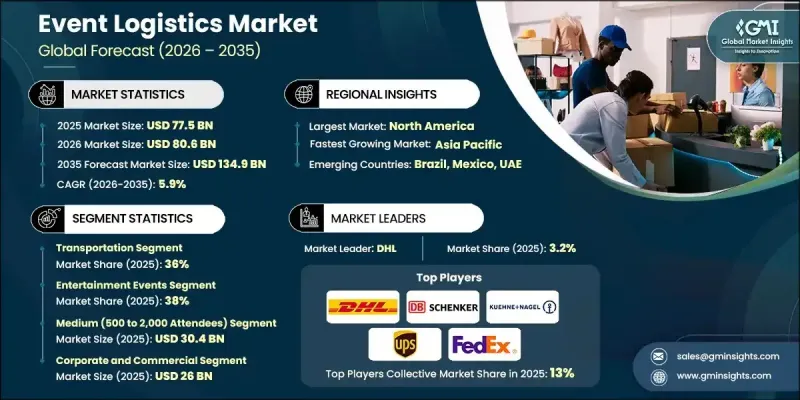
시장 확대는 전 세계적으로 대규모 이벤트의 빈도 증가와 고도로 조정된 정시성 물류 서비스에 대한 수요 증가에 의해 뒷받침되고 있습니다. 행사 주최자는 복잡한 공급망 전반의 정확성, 신뢰성, 비용 관리를 점점 더 우선시하여 원활한 운영과 참가자의 좋은 경험을 보장하고 있습니다. 이벤트가 더욱 정교해지고 지리적으로 분산됨에 따라 엄격한 일정 관리, 운영 리스크 최소화, 계획부터 행사 후 운영까지 원활하게 조정할 수 있는 물류 솔루션에 대한 수요가 증가하고 있습니다. 또한, 물류 사업자들이 투명성, 정확성, 대응력을 높이는 첨단 기술을 도입하는 가운데, 디지털 전환의 확산도 시장을 견인하고 있습니다. 실시간 가시성과 데이터 기반 의사결정은 진화하는 고객의 기대에 부응하기 위해 필수적인 요소가 되고 있습니다. 통합된 엔드-투-엔드 물류 모델로의 전환을 통해 여러 행사장에서의 자원 활용, 확장성 및 일관성을 향상시킬 수 있습니다. 이러한 발전으로 전문 이벤트 물류 사업자는 단순한 벤더가 아닌 전략적 파트너로서의 역할을 강화하고 있습니다.
| 시장 범위 | |
|---|---|
| 시작 연도 | 2025년 |
| 예측 연도 | 2026-2035 |
| 개시시 가치 | 775억 달러 |
| 예측 금액 | 1,349억 달러 |
| CAGR | 5.9% |
운송 부문은 2025년 36%의 점유율을 차지했으며, 2026년부터 2035년까지 CAGR 4.6%로 성장할 것으로 전망됩니다. 이 부문은 이벤트 관련 자산의 적시 이동을 보장하는 역할을 담당하고 있기 때문에 중심적인 위치를 차지하고 있습니다. 디지털 추적, 커넥티드 모니터링 시스템, 지능형 경로 계획 플랫폼의 사용 증가로 배송 정확도와 일정 준수율이 향상되고 있습니다.
엔터테인먼트 이벤트 분야는 2025년 38%의 점유율을 차지했으며, 2026년부터 2035년까지 연평균 7.1%의 성장률을 기록할 것으로 전망됩니다. 높은 업무 강도와 복잡한 조정 요구사항은 이 분야에서 기술을 활용한 물류 솔루션에 대한 강한 의존도를 촉진하고 있으며, 이는 선도적 지위를 뒷받침하고 있습니다.
미국 이벤트 물류 시장은 2025년 83%의 점유율을 차지하며 230억 달러 규모를 달성했습니다. 선진화된 인프라와 효율성, 모니터링, 조정을 강화하는 디지털 물류 플랫폼의 조기 도입이 지역적 선도적 위치를 뒷받침하고 있습니다.
자주 묻는 질문
목차
제1장 조사 방법과 범위
제2장 주요 요약
제3장 업계 인사이트
- 생태계 분석
- 공급업체 상황
- 이익률
- 비용 구조
- 각 단계의 부가가치
- 밸류체인에 영향을 미치는 요인
- 디스럽션
- 업계에 대한 영향요인
- 성장 촉진요인
- 증가하는 세계의 이벤트 수
- 시간 엄수 및 신뢰성 높은 배송의 필요성
- 디지털·스마트 물류 기술 채용
- 기업 브랜딩과 경험 형태 마케팅 성장
- 업계의 잠재적 리스크와 과제
- 높은 운영상 복잡성과 리스크
- 한정된 마진과 높은 비용 감응도
- 시장 기회
- 하이브리드, 가상, 세계의 이벤트 확대
- 지속가능하고 친환경적인 이벤트 물류 솔루션
- 클라우드 기반 및 통합 플랫폼 확대
- AI 및 머신러닝을 활용한 물류 솔루션의 도입
- 성장 촉진요인
- 성장 가능성 분석
- 규제 상황
- 북미
- 미국 : OSHA 및 연방 이벤트 안전 가이드라인
- 캐나다 : 운송 성 및 산업안전보건 가이드라인
- 유럽
- 독일 : BMVI 및 DGUV 규제
- 프랑스 : DGME 및 CNES 가이드라인
- 영국 : 해사 해병성(MCA) 및 건강 안전 집행청(HSE) 규제
- 이탈리아 : ENAC 및 INAIL 가이드라인
- 아시아태평양
- 중국 : 교통 운송 성 및 이벤트 안전 규제
- 일본 : JCAB 및 국토 교통성 가이드라인
- 한국 : 국토 교통성 및 안전 가이드라인
- 인도 : 해운성 및 부두 안전 규칙
- 라틴아메리카
- 브라질 : ANTAQ 및 인프라 성 가이드라인
- 멕시코 : SEMAR 및 DGPM 규제
- 중동 및 아프리카
- 아랍에미리트 : 에너지·인프라 성 규제
- 사우디아라비아 : 사우디 항만청 가이드라인
- 북미
- Porters 분석
- PESTEL 분석
- 기술과 혁신 동향
- 현재 기술 동향
- 신기술
- 가격 동향
- 지역별
- 제품별
- 비용 내역 분석
- 특허 분석
- 지속가능성과 환경적 측면
- 지속가능한 대처
- 폐기물 절감 전략
- 생산의 에너지 효율
- 친환경적인 대처
- 탄소발자국에 관한 고려사항
- 사용 사례 시나리오
- 가격 책정, 상업 및 수익 모델 분석
- 수요측 구매 행동과 의사 의사결정 프레임워크
제4장 경쟁 구도
- 소개
- 기업의 시장 점유율 분석
- 북미
- 유럽
- 아시아태평양
- 라틴아메리카
- 중동 및 아프리카
- 주요 시장 기업 경쟁 분석
- 경쟁 포지셔닝 매트릭스
- 전략적 전망 매트릭스
- 주요 발전
- 인수합병
- 제휴·협업
- 신제품 발매
- 사업 확대 계획과 자금 조달
제5장 시장 추정 및 예측 : 서비스별, 2022-2035
- 교통기관
- 창고 보관 서비스
- 재고 관리
- 현지에서의 설치 및 철거
- 물류 계획과 조정
- 기타
제6장 시장 추정 및 예측 : 이벤트 규모별, 2022-2035
- 소규모(500명까지)
- 중규모(500명-2,000명)
- 대규모(2,000명-10,000명 규모)
- 메가 규모(10,000명 이상)
제7장 시장 추정 및 예측 : 용도별, 2022-2035
- 기업 이벤트
- 스포츠 이벤트
- 엔터테인먼트 이벤트
- 공개 이벤트
- 프라이빗 이벤트
제8장 시장 추정 및 예측 : 최종 용도별, 2022-2035
- 법인용 및 상업용
- 엔터테인먼트·미디어
- 스포츠
- 정부·공공 부문
- 교육기관
제9장 시장 추정 및 예측 : 지역별, 2022-2035
- 북미
- 미국
- 캐나다
- 유럽
- 영국
- 독일
- 프랑스
- 이탈리아
- 스페인
- 벨기에
- 네덜란드
- 스웨덴
- 아시아태평양
- 중국
- 인도
- 일본
- 호주
- 싱가포르
- 한국
- 베트남
- 인도네시아
- 라틴아메리카
- 브라질
- 멕시코
- 아르헨티나
- 중동 및 아프리카
- 아랍에미리트
- 남아프리카공화국
- 사우디아라비아
제10장 기업 개요
- Global Player
- C.H. Robinson
- CEVA Logistics
- DB Schenker
- DHL
- DSV Panalpina
- FedEx
- Kuehne+Nagel
- Nippon Express
- UPS
- XPO Logistics
- Regional Player
- Agility Logistics
- Bollore Logistics
- DB Cargo Logistics
- GEFCO
- Geodis
- Hellmann Worldwide Logistics
- Kerry Logistics
- Mainfreight
- Rhenus Logistics
- TVS Supply Chain Solutions
- 신흥 기업
- Flexport
- Locus Logistics
- OnTime Logistics
- Senpex
- ShipMonk
The Global Event Logistics Market was valued at USD 77.5 billion in 2025 and is estimated to grow at a CAGR of 5.9% to reach USD 134.9 billion by 2035.
Market expansion is supported by the rising frequency of large-scale events worldwide and the growing need for highly coordinated, time-sensitive logistics services. Event organizers are increasingly prioritizing precision, reliability, and cost control across complex supply chains to ensure smooth execution and positive participant experiences. As events become more sophisticated and geographically dispersed, demand is increasing for logistics solutions that can manage tight schedules, minimize operational risks, and deliver seamless coordination from planning through post-event operations. The market is also benefiting from widespread digital transformation, as logistics providers adopt advanced technologies to enhance transparency, accuracy, and responsiveness. Real-time visibility and data-driven decision-making are becoming essential to meet evolving client expectations. The shift toward integrated, end-to-end logistics models is enabling better resource utilization, scalability, and consistency across multiple event locations. These developments are reinforcing the role of specialized event logistics providers as strategic partners rather than basic service vendors.
| Market Scope | |
|---|---|
| Start Year | 2025 |
| Forecast Year | 2026-2035 |
| Start Value | $77.5 Billion |
| Forecast Value | $134.9 Billion |
| CAGR | 5.9% |
The transportation segment held 36% share in 2025 and is expected to grow at a CAGR of 4.6% from 2026 to 2035. This segment holds a central position due to its responsibility for ensuring the timely movement of event-related assets. Increased use of digital tracking, connected monitoring systems, and intelligent routing platforms is improving delivery accuracy and schedule adherence.
The entertainment events segment accounted for 38% share in 2025 and is projected to grow at a CAGR of 7.1% from 2026 to 2035. High operational intensity and complex coordination requirements are driving strong reliance on technology-enabled logistics solutions within this segment, supporting its leading position.
United States Event Logistics Market held 83% share and generated USD 23 billion in 2025. Regional leadership is supported by advanced infrastructure and early adoption of digital logistics platforms that enhance efficiency, monitoring, and coordination.
Key companies operating in the Global Event Logistics Market include DHL, UPS, FedEx, Kuehne + Nagel, DB Schenker, C.H. Robinson, XPO Logistics, CEVA Logistics, Nippon Express, and DSV Panalpina. Companies in the Global Event Logistics Market are strengthening their competitive position through technology integration, service diversification, and global network expansion. Many providers are investing in digital platforms that enable real-time visibility, predictive planning, and centralized coordination across event supply chains. Expanding end-to-end service offerings allows companies to manage transportation, storage, on-site handling, and reverse logistics more efficiently. Strategic partnerships with event organizers and venue operators help secure long-term contracts. Firms are also enhancing sustainability initiatives by optimizing routes and reducing emissions.
Table of Contents
Chapter 1 Methodology & Scope
- 1.1 Market scope and definition
- 1.2 Research design
- 1.2.1 Research approach
- 1.2.2 Data collection methods
- 1.3 Data mining sources
- 1.3.1 Global
- 1.3.2 Regional/Country
- 1.4 Base estimates and calculations
- 1.4.1 Base year calculation
- 1.4.2 Key trends for market estimation
- 1.5 Primary research and validation
- 1.5.1 Primary sources
- 1.6 Forecast
- 1.7 Research assumptions and limitations
Chapter 2 Executive Summary
- 2.1 Industry 360° synopsis, 2022 - 2035
- 2.2 Key market trends
- 2.2.1 Regional
- 2.2.2 Service
- 2.2.3 Event Size
- 2.2.4 Application
- 2.2.5 End Use
- 2.3 TAM Analysis, 2026-2035
- 2.4 CXO perspectives: Strategic imperatives
- 2.4.1 Executive decision points
- 2.4.2 Critical success factors
- 2.5 Future outlook and strategic recommendations
Chapter 3 Industry Insights
- 3.1 Industry ecosystem analysis
- 3.1.1 Supplier Landscape
- 3.1.2 Profit Margin
- 3.1.3 Cost structure
- 3.1.4 Value addition at each stage
- 3.1.5 Factor affecting the value chain
- 3.1.6 Disruptions
- 3.2 Industry impact forces
- 3.2.1 Growth drivers
- 3.2.1.1 Rising Number of Global Events
- 3.2.1.2 Need for Time-Critical & Reliable Delivery
- 3.2.1.3 Adoption of Digital & Smart Logistics Technologies
- 3.2.1.4 Growth of Corporate Branding & Experiential Marketing
- 3.2.2 Industry pitfalls and challenges
- 3.2.2.1 High Operational Complexity & Risk
- 3.2.2.2 Limited Margins & High-Cost Sensitivity
- 3.2.3 Market opportunities
- 3.2.3.1 Expansion of hybrid, virtual & global events
- 3.2.3.2 Sustainable & green event logistics solutions
- 3.2.3.3 Expansion of cloud-based and integrated platforms
- 3.2.3.4 Adoption of AI- and ML-driven logistics solutions
- 3.2.1 Growth drivers
- 3.3 Growth potential analysis
- 3.4 Regulatory landscape
- 3.4.1 North America
- 3.4.1.1 U.S.: OSHA & Federal Event Safety Guidelines
- 3.4.1.2 Canada: Transport Canada & WorkSafe Guidelines
- 3.4.2 Europe
- 3.4.2.1 Germany: BMVI & DGUV Regulations
- 3.4.2.2 France: DGME & CNES Guidelines
- 3.4.2.3 UK: MCA & HSE Regulations
- 3.4.2.4 Italy: ENAC & INAIL Guidelines
- 3.4.3 Asia Pacific
- 3.4.3.1 China: Ministry of Transport & Event Safety Regulations
- 3.4.3.2 Japan: JCAB & MLIT Guidelines
- 3.4.3.3 South Korea: MOLIT & Safety Guidelines
- 3.4.3.4 India: Ministry of Shipping & Dock Safety Rules
- 3.4.4 Latin America
- 3.4.4.1 Brazil: ANTAQ & Ministry of Infrastructure Guidelines
- 3.4.4.2 Mexico: SEMAR & DGPM Regulations
- 3.4.5 Middle East and Africa
- 3.4.5.1 UAE: Ministry of Energy & Infrastructure Regulations
- 3.4.5.2 Saudi Arabia: Saudi Ports Authority Guidelines
- 3.4.1 North America
- 3.5 Porter';s analysis
- 3.6 PESTEL analysis
- 3.7 Technology and Innovation Landscape
- 3.7.1 Current technological trends
- 3.7.2 Emerging technologies
- 3.8 Price trends
- 3.8.1 By region
- 3.8.2 By product
- 3.9 Cost breakdown analysis
- 3.10 Patent analysis
- 3.11 Sustainability and Environmental Aspects
- 3.11.1 Sustainable practices
- 3.11.2 Waste reduction strategies
- 3.11.3 Energy efficiency in production
- 3.11.4 Eco-friendly initiatives
- 3.11.5 Carbon footprint considerations
- 3.12 Use case scenarios
- 3.13 Pricing, Commercial & Revenue Model Analysis
- 3.14 Demand-Side Buying Behavior & Decision Framework
Chapter 4 Competitive Landscape, 2025
- 4.1 Introduction
- 4.2 Company market share analysis
- 4.2.1 North America
- 4.2.2 Europe
- 4.2.3 Asia Pacific
- 4.2.4 Latin America
- 4.2.5 Middle East & Africa
- 4.3 Competitive analysis of major market players
- 4.4 Competitive positioning matrix
- 4.5 Strategic outlook matrix
- 4.6 Key developments
- 4.6.1 Mergers & acquisitions
- 4.6.2 Partnerships & collaborations
- 4.6.3 New product launches
- 4.6.4 Expansion plans and funding
Chapter 5 Market Estimates & Forecast, By Service, 2022 - 2035 ($ Bn)
- 5.1 Key trends
- 5.2 Transportation
- 5.3 Warehousing and storage
- 5.4 Inventory management
- 5.5 On-site setup and dismantling
- 5.6 Logistics planning and Coordination
- 5.7 Others
Chapter 6 Market Estimates & Forecast, By Event Size, 2022 - 2035 ($ Bn)
- 6.1 Key trends
- 6.2 Small (up to 500 attendees)
- 6.3 Medium (500 to 2,000 attendees)
- 6.4 Large (2,000 to 10,000 attendees)
- 6.5 Mega (over 10,000 attendees)
Chapter 7 Market Estimates & Forecast, By Application, 2022 - 2035 ($ Bn)
- 7.1 Key trends
- 7.2 Corporate Events
- 7.3 Sports Events
- 7.4 Entertainment Events
- 7.5 Public Events
- 7.6 Private Events
Chapter 8 Market Estimates & Forecast, By End Use, 2022 - 2035 ($ Bn)
- 8.1 Key trends
- 8.2 Corporate and commercial
- 8.3 Entertainment & media
- 8.4 Sports
- 8.5 Government & public sector
- 8.6 Educational institutions
Chapter 9 Market Estimates & Forecast, By Region, 2022 - 2035 ($ Bn)
- 9.1 Key trends
- 9.2 North America
- 9.2.1 US
- 9.2.2 Canada
- 9.3 Europe
- 9.3.1 UK
- 9.3.2 Germany
- 9.3.3 France
- 9.3.4 Italy
- 9.3.5 Spain
- 9.3.6 Belgium
- 9.3.7 Netherlands
- 9.3.8 Sweden
- 9.4 Asia Pacific
- 9.4.1 China
- 9.4.2 India
- 9.4.3 Japan
- 9.4.4 Australia
- 9.4.5 Singapore
- 9.4.6 South Korea
- 9.4.7 Vietnam
- 9.4.8 Indonesia
- 9.5 Latin America
- 9.5.1 Brazil
- 9.5.2 Mexico
- 9.5.3 Argentina
- 9.6 MEA
- 9.6.1 UAE
- 9.6.2 South Africa
- 9.6.3 Saudi Arabia
Chapter 10 Company Profiles
- 10.1 Global Player
- 10.1.1 C.H. Robinson
- 10.1.2 CEVA Logistics
- 10.1.3 DB Schenker
- 10.1.4 DHL
- 10.1.5 DSV Panalpina
- 10.1.6 FedEx
- 10.1.7 Kuehne + Nagel
- 10.1.8 Nippon Express
- 10.1.9 UPS
- 10.1.10 XPO Logistics
- 10.2 Regional Player
- 10.2.1 Agility Logistics
- 10.2.2 Bollore Logistics
- 10.2.3 DB Cargo Logistics
- 10.2.4 GEFCO
- 10.2.5 Geodis
- 10.2.6 Hellmann Worldwide Logistics
- 10.2.7 Kerry Logistics
- 10.2.8 Mainfreight
- 10.2.9 Rhenus Logistics
- 10.2.10 TVS Supply Chain Solutions
- 10.3 Emerging Players
- 10.3.1 Flexport
- 10.3.2 Locus Logistics
- 10.3.3 OnTime Logistics
- 10.3.4 Senpex
- 10.3.5 ShipMonk