|
시장보고서
상품코드
1929005
자동차 타이어 E-Retailing 시장 기회, 성장 촉진요인, 업계 동향 분석 및 예측(2026-2035년)Automotive Tires E-Retailing Market Opportunity, Growth Drivers, Industry Trend Analysis, and Forecast 2026 - 2035 |
||||||

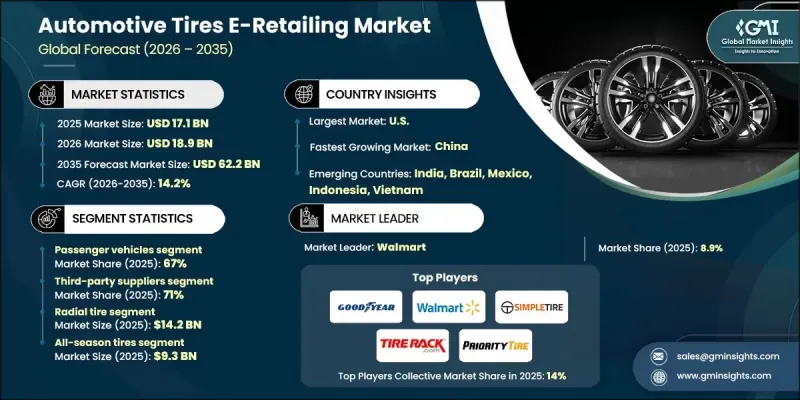
세계의 자동차 타이어 E-Retailing 시장은 2025년에 171억 달러로 평가되었고, 2035년까지 연평균 복합 성장률(CAGR) 14.2%로 성장하여 622억 달러에 이를 것으로 예측됩니다.
시장 성장은 온라인 타이어 소매 플랫폼 전반에 걸쳐 시각적 및 양방향 디지털 상거래 도구의 급속한 통합에 의해 형성되고 있습니다. 디지털 리테일 경험은 더욱 몰입도가 높아졌고, 고객은 구매 전에 제품을 더 잘 평가하고 더 높은 확신을 가지고 정보에 입각한 의사결정을 내릴 수 있게 되었습니다. 이러한 변화는 온라인 판매자에게는 고객 참여도 향상, 제품 반품률 감소, 전환율 강화로 이어지고 있습니다. 첨단 디지털 쇼룸과 구성 도구의 사용 확대로 타이어 판매업체들은 경쟁에서 차별화를 꾀하는 동시에 고객 만족도를 향상시킬 수 있습니다. 타이어 교체 주기, 유지보수 계획, 계절별 사용 패턴에 초점을 맞춘 구독형 서비스도 구매 행동을 변화시키고 있습니다. 이러한 모델을 통해 고객은 일회성 구매에서 벗어나 유연하고 비용 효율적인 서비스 플랜을 선택할 수 있습니다. 편리함과 예측 가능한 지출을 원하는 사용자들 사이에서 이 모델은 점점 더 많은 지지를 얻고 있습니다. 예측 분석 기술은 사용 데이터를 기반으로 적절한 교체 시기를 제안하고, 고객 생애 가치 향상을 지원함으로써 이러한 진화를 더욱 촉진하고 있습니다. 인공지능을 활용한 추천 엔진은 구매 결정에 지속적으로 영향을 미치고 있으며, 소비자의 온라인 타이어 구매에 대한 태도를 재정의하고 있습니다.
| 시장 범위 | |
|---|---|
| 개시 연도 | 2025년 |
| 예측 연도 | 2026-2035년 |
| 개시 연도 가치 | 171억 달러 |
| 예측 금액 | 622억 달러 |
| CAGR | 14.2% |
승용차 부문은 2025년 67%의 점유율을 차지할 것으로 예상되며, 2026년부터 2035년까지 연평균 복합 성장률(CAGR) 14%로 성장할 것으로 전망됩니다. 시장 수요는 차량 소유율 증가와 차량 사용 주기의 장기화에 의해 뒷받침되고 있으며, 이는 지속적인 교체 수요를 촉진하고 있습니다. 온라인 플랫폼은 가격 비교의 용이성, 사용자 피드백에 대한 접근성, 간소화된 구매 워크플로우로 인해 점점 더 선호되는 추세입니다. 더 많은 차량이 장기간 운행하는 가운데, 디지털 채널을 통한 교체용 타이어에 대한 수요는 계속 증가하고 있습니다. 소비자들은 편리함과 속도를 우선시하며, e-리테일 플랫폼은 간소화된 접근성과 구매 효율성을 통해 이러한 기대에 부응하고 있습니다.
타사 공급업체 부문은 2025년 71%의 점유율을 차지할 것으로 예상되며, 2026년부터 2035년까지 연평균 복합 성장률(CAGR) 13.5%를 보일 것으로 예측됩니다. 이 부문의 선도적 지위는 다양한 브랜드, 사양, 가격대를 아우르는 폭넓은 제품 라인업을 통해 뒷받침되고 있습니다. 강력한 조달 네트워크와 수량 기준 조달 전략을 통해 성능과 안전 기준을 유지하면서 경쟁력 있는 가격 책정을 실현하고 있습니다. 이러한 가치 중심의 제안은 온라인 구매자의 기대에 부응하여 시장에서의 입지를 더욱 강화해 나가고 있습니다.
미국 자동차 타이어 E-Retailing 시장은 2025년 82%의 점유율을 차지하며 40억 달러의 매출을 기록할 것으로 예측됩니다. 높은 자동차 보유율과 안정적인 교체 수요가 국내 온라인 타이어 판매를 뒷받침하고 있습니다. 소비자들은 다양한 제품 구색, 경쟁력 있는 가격, 택배 서비스를 제공하는 디지털 채널을 점점 더 많이 이용하고 있습니다. 소매업체들은 합리적인 가격과 편의성을 높이는 로열티 인센티브와 유연한 디지털 결제 솔루션을 통해 판매 모멘텀을 더욱 촉진하고 있습니다.
자주 묻는 질문
목차
제1장 조사 방법
제2장 주요 요약
제3장 업계 인사이트
- 생태계 분석
- 공급업체 상황
- 이익률 분석
- 비용 구조
- 각 단계 부가가치
- 밸류체인에 영향을 미치는 요인
- 파괴적 변화
- 업계에 대한 영향요인
- 성장 촉진요인
- 업계의 잠재적 리스크&과제
- 시장 기회
- 성장 가능성 분석
- 규제 상황
- 북미
- FMVSS-연방 자동차 안전기준(타이어)
- 캐나다 차량 안전기준(CVSS)
- 유럽
- UNECE R117/E마크 인증
- EUDR-EU삼림 파괴 방지 규칙
- 타이어 표시 규제(EU 2020/740)
- 아시아태평양
- 타이어용 중국 강제성 제품 인증(CCC)
- 확대 생산자 책임(EPR)
- 타이어에 관한 일본공업규격(JIS)
- 라틴아메리카
- INMETRO 타이어 인증 및 표시 제도
- IRAM/지역별 타이어 규격
- 차량 및 타이어 유럽 규격에의 적합성
- 중동 및 아프리카
- RFID 탑재 타이어 식별 라벨
- SASO 타이어 성능 및 내열성 기준
- EPR 타이어 재활용/폐기물 관리 기준
- 북미
- Porter의 Five Forces 분석
- PESTEL 분석
- 특허 분석
- 기술과 혁신 동향
- 현재 기술 동향
- 신기술
- 가격 동향
- 지역별
- 제품별
- 비용 내역 분석
- 생산 통계
- 생산 거점
- 수입과 수출
- 주요 수입국
- 지속가능성과 환경면
- 지속가능한 대처
- 폐기물 감축 전략
- 생산 에너지 효율
- 친환경 이니셔티브
- 탄소발자국에 관한 고려사항
- 소비자 구매 프로세스와 의사결정 요인
- 주요 온라인 의사결정 파라미터(가격, 리뷰, 적합성 툴)
- AI 기반 타이어 추천 엔진 역할
- 비교 툴, 사용자 리뷰, 평가 영향
- 지불 방법 희망
- 향후 시장 전망과 구조적 변화
- 옴니채널 형 타이어 소매에의 이동
- 구독 형 타이어 서비스 성장
- 제조업체로부터 소비자에게의 직접 판매 가속
- E-Retailing 플랫폼간 통합 전망
제4장 경쟁 구도
- 서론
- 기업의 시장 점유율 분석
- 주요 시장 기업의 경쟁 분석
- 경쟁 포지셔닝 매트릭스
- 전략적 전망 매트릭스
- 주요 발전
- 인수합병(M&A)
- 제휴 및 협업
- 신제품 발매
- 사업 확대 계획과 자금조달
제5장 시장 추산·예측 : 타이어별, 2022-2035
- 올 시즌 타이어
- 서머 타이어
- 윈터 타이어
- 기타
제6장 시장 추산·예측 : 제조별, 2022-2035
- 레이디얼 타이어
- 바이어스 타이어
제7장 시장 추산·예측 : 차량별, 2022-2035
- 승용차
- 해치백
- 세단
- SUV
- 상용차
- 소형 상용차(LCV)
- 중형 상용차(MCV)
- 대형 상용차(HCV)
제8장 시장 추산·예측 : 유통 채널별, 2022-2035
- OEM
- 제삼자 공급업체
제9장 시장 추산·예측 : 판매 모델별, 2022-2035
- 소비자용 직접 판매(D2C)
- 온라인으로부터 오프라인(O2O)
- 설치 서비스 마켓플레이스
제10장 시장 추산·예측 : 지역별, 2022-2034
- 북미
- 미국
- 캐나다
- 유럽
- 영국
- 독일
- 프랑스
- 이탈리아
- 스페인
- 러시아
- 덴마크
- 핀란드
- 노르웨이
- 스웨덴
- 아시아태평양
- 중국
- 인도
- 일본
- 한국
- ANZ
- 싱가포르
- 태국
- 인도네시아
- 베트남
- 라틴아메리카
- 브라질
- 멕시코
- 아르헨티나
- 중동 및 아프리카
- 남아프리카공화국
- 사우디아라비아
- 아랍에미리트
제11장 기업 개요
- 세계 기업
- Amazon Tires
- Costco Tires
- Discount Tire Direct
- Goodyear
- Pep Boys
- Sam's Club Tires
- SimpleTire
- Tire Rack
- TireBuyer
- Walmart Tires
- 지역 주요 기업
- 4 Wheel Parts
- BJ's Tire Center
- BJ's Wholesale Club Tires
- Discounted Wheel Warehouse
- Fountain Tire
- Les Schwab Tires
- NTB(National Tire &Battery)
- Priority Tire
- Tire Kingdom
- Tires-easy.com
- 신규 기업
- 123 Tire
- AlloTire
- BestOne Tire &Auto
- Blackcircles
- CarParts.com Tires
- Falken Tires Online
- Just Tires
- Oponeo
- Tyremarket
- WheelMax
The Global Automotive Tires E-Retailing Market was valued at USD 17.1 billion in 2025 and is estimated to grow at a CAGR of 14.2% to reach USD 62.2 billion by 2035.
Market growth is shaped by the rapid integration of visual and interactive digital commerce tools across online tire retail platforms. Digital retail experiences are becoming more immersive, allowing customers to better evaluate products before purchase and make informed decisions with higher confidence. This shift is improving engagement levels, lowering product return rates, and strengthening conversion performance for online sellers. The growing use of advanced digital showrooms and configuration tools is enabling tire sellers to differentiate themselves while improving overall customer satisfaction in a competitive landscape. Subscription-based offerings focused on tire replacement cycles, maintenance scheduling, and seasonal usage patterns are also reshaping purchasing behavior. These models allow customers to move away from one-time purchases in favor of flexible, cost-efficient service plans. The model is gaining traction among users seeking convenience and predictable expenses. Predictive analytics are further supporting this evolution by enabling retailers to recommend timely replacements based on usage data, supporting higher lifetime customer value. Artificial intelligence-driven recommendation engines continue to influence purchasing decisions and redefine how consumers approach online tire buying.
| Market Scope | |
|---|---|
| Start Year | 2025 |
| Forecast Year | 2026-2035 |
| Start Value | $17.1 Billion |
| Forecast Value | $62.2 Billion |
| CAGR | 14.2% |
The passenger vehicle segment held 67% share in 2025 and is forecast to grow at a CAGR of 14% from 2026 to 2035. Market demand is supported by rising vehicle ownership and longer vehicle usage cycles, which are driving consistent replacement needs. Online platforms are increasingly preferred due to ease of price comparison, access to user feedback, and simplified purchasing workflows. As more vehicles remain in operation for extended periods, demand for replacement tires through digital channels continues to rise. Consumers are prioritizing convenience and speed, and e-retailing platforms are meeting these expectations through streamlined access and purchasing efficiency.
The third-party suppliers segment held a 71% share in 2025 and is expected to grow at a CAGR of 13.5% from 2026 to 2035. Their leadership position is supported by broad product assortments covering multiple brands, specifications, and pricing tiers. These suppliers can offer competitive pricing while maintaining performance and safety standards due to strong procurement networks and volume-based sourcing strategies. This value-driven proposition aligns well with online buyer expectations and continues to reinforce their market presence.
United States Automotive Tires E-Retailing Market held 82% share in 2025, generating USD 4 billion. Strong vehicle ownership levels and consistent replacement demand are sustaining online tire sales across the country. Consumers are increasingly turning to digital channels that offer wide product availability, competitive pricing, and home delivery services. Retailers are further supporting sales momentum through loyalty incentives and flexible digital payment solutions that enhance affordability and convenience.
Key companies operating in the Global Automotive Tires E-Retailing Market include Tire Rack, Amazon, Walmart Tires, Discount Tire Direct, Goodyear, SimpleTire, Priority Tire, Pep Boys, Tires-easy, and NTB. These companies are actively shaping the competitive environment through platform innovation and service expansion. Companies in the automotive tires e-retailing market are reinforcing their competitive position through digital optimization, customer-centric services, and supply chain efficiency. Many players are investing in advanced data analytics to personalize recommendations and improve demand forecasting. Expanding private-label offerings and exclusive partnerships is helping improve margins and brand loyalty. Retailers are also enhancing fulfillment capabilities through faster delivery options and expanded installation networks. Subscription services and flexible payment plans are being used to encourage repeat purchases and long-term engagement.
Table of Contents
Chapter 1 Methodology
- 1.1 Research approach
- 1.2 Quality Commitments
- 1.2.1 GMI AI policy & data integrity commitment
- 1.2.1.1 Source consistency protocol
- 1.2.1 GMI AI policy & data integrity commitment
- 1.3 Research Trail & Confidence Scoring
- 1.3.1 Research Trail Components
- 1.3.2 Scoring Components
- 1.4 Data Collection
- 1.4.1 Partial list of primary sources
- 1.5 Data mining sources
- 1.5.1 Paid sources
- 1.5.1.1 Sources, by region
- 1.5.1 Paid sources
- 1.6 Base estimates and calculations
- 1.6.1 Base year calculation for any one approach
- 1.7 Forecast model
- 1.7.1 Quantified market impact analysis
- 1.7.1.1 Mathematical impact of growth parameters on forecast
- 1.7.1 Quantified market impact analysis
- 1.8 Research transparency addendum
- 1.8.1 Source attribution framework
- 1.8.2 Quality assurance metrics
- 1.8.3 Our commitment to trust
Chapter 2 Executive Summary
- 2.1 Industry 360° synopsis, 2022 - 2035
- 2.2 Key market trends
- 2.2.1 Regional
- 2.2.2 Tire
- 2.2.3 Manufacturing
- 2.2.4 Vehicle
- 2.2.5 Distribution channel
- 2.2.6 Sales model
- 2.3 TAM Analysis, 2026-2035
- 2.4 CXO perspectives: Strategic imperatives
- 2.4.1 Executive decision points
- 2.4.2 Critical success factors
- 2.5 Future outlook and strategic recommendations
- 2.6 Strategic recommendations
Chapter 3 Industry Insights
- 3.1 Industry ecosystem analysis
- 3.1.1 Supplier landscape
- 3.1.2 Profit margin analysis
- 3.1.3 Cost structure
- 3.1.4 Value addition at each stage
- 3.1.5 Factor affecting the value chain
- 3.1.6 Disruptions
- 3.2 Industry impact forces
- 3.2.1 Growth drivers
- 3.2.1.1 Expansion of online tire marketplaces
- 3.2.1.2 Rising preference for direct-to-consumer sales
- 3.2.1.3 Growing digitalization in automotive retail
- 3.2.1.4 Increased consumer preference for convenience
- 3.2.2 Industry pitfalls and challenges
- 3.2.2.1 High return rates due to incorrect size selection
- 3.2.2.2 Limited physical inspection before purchase
- 3.2.2.3 Dependence on last-mile logistics & installers
- 3.2.2.4 Price competition among online sellers
- 3.2.3 Market opportunities
- 3.2.3.1 AI-based tire recommendation engines
- 3.2.3.2 Subscription & tire-as-a-service models
- 3.2.3.3 Growth of EV-specific tire demand
- 3.2.3.4 Expansion in emerging markets
- 3.2.3.5 Partnerships with installers & service networks
- 3.2.1 Growth drivers
- 3.3 Growth potential analysis
- 3.4 Regulatory landscape
- 3.4.1 North America
- 3.4.1.1 FMVSS - Federal Motor Vehicle Safety Standards (Tires)
- 3.4.1.2 Canada Vehicle Safety Standards (CVSS)
- 3.4.2 Europe
- 3.4.2.1 UNECE R117 / E-Mark Certification
- 3.4.2.2 EUDR - EU Deforestation Regulation
- 3.4.2.3 Tyre Labelling Regulation (EU 2020/740)
- 3.4.3 Asia Pacific
- 3.4.3.1 China Compulsory Certification (CCC) for Tires
- 3.4.3.2 Extended Producer Responsibility (EPR)
- 3.4.3.3 Japan Industrial Standards (JIS) for Tires
- 3.4.4 Latin America
- 3.4.4.1 INMETRO Tire Certification & Labeling
- 3.4.4.2 IRAM / Local Tire Standards
- 3.4.4.3 Vehicle & Tire Relevance to Euro Standards
- 3.4.5 MEA
- 3.4.5.1 Tire Identification Labels with RFID
- 3.4.5.2 SASO Tire Performance & Heat Resistance Standards
- 3.4.5.3 EPR Tire Recycling / Waste Management Standards
- 3.4.1 North America
- 3.5 Porter';s analysis
- 3.6 PESTEL analysis
- 3.7 Patent analysis
- 3.8 Technology and innovation landscape
- 3.8.1 Current technological trends
- 3.8.2 Emerging technologies
- 3.9 Price trends
- 3.9.1 By region
- 3.9.2 By product
- 3.10 Cost breakdown analysis
- 3.11 Production statistics
- 3.11.1 Production hubs
- 3.11.2 Import and export
- 3.11.3 Major import countries
- 3.12 Sustainability and environmental aspects
- 3.12.1 Sustainable practices
- 3.12.2 Waste reduction strategies
- 3.12.3 Energy efficiency in production
- 3.12.4 Eco-friendly initiatives
- 3.12.5 Carbon footprint considerations
- 3.13 Consumer buying journey & decision factors
- 3.13.1 Key online decision parameters (price, reviews, fitment tools)
- 3.13.2 Role of AI-based tire recommendation engines
- 3.13.3 Comparison tools, user reviews, and ratings impact
- 3.13.4 Payment preferences
- 3.14 Future market outlook & structural shifts
- 3.14.1 Shift toward omnichannel tire retailing
- 3.14.2 Growth of subscription-based tire services
- 3.14.3 Direct OEM-to-consumer acceleration
- 3.14.4 Consolidation outlook among e-retail platforms
Chapter 4 Competitive Landscape, 2025
- 4.1 Introduction
- 4.2 Company market share analysis
- 4.2.1 North America
- 4.2.2 Europe
- 4.2.3 Asia Pacific
- 4.2.4 Latin America
- 4.2.5 MEA
- 4.3 Competitive analysis of major market players
- 4.4 Competitive positioning matrix
- 4.5 Strategic outlook matrix
- 4.6 Key developments
- 4.6.1 Mergers & acquisitions
- 4.6.2 Partnerships & collaborations
- 4.6.3 New product launches
- 4.6.4 Expansion plans and funding
Chapter 5 Market Estimates & Forecast, By Tire, 2022 - 2035 ($Mn & Units)
- 5.1 Key trends
- 5.2 All-season tires
- 5.3 Summer tires
- 5.4 Winter tires
- 5.5 Others
Chapter 6 Market Estimates & Forecast, By Manufacturing, 2022 - 2035 ($Mn & Units)
- 6.1 Key trends
- 6.2 Radial tire
- 6.3 Bias tire
Chapter 7 Market Estimates & Forecast, By Vehicle, 2022 - 2035 ($Mn & Units)
- 7.1 Key trends
- 7.2 Passenger car
- 7.2.1 Hatchback
- 7.2.2 Sedan
- 7.2.3 SUV
- 7.3 Commercial vehicle
- 7.3.1 Light commercial vehicle (LCV)
- 7.3.2 Medium commercial vehicle (MCV)
- 7.3.3 Heavy commercial vehicle (HCV)
Chapter 8 Market Estimates & Forecast, By Distribution Channel, 2022 - 2035 ($Mn & Units)
- 8.1 Key trends
- 8.2 OEM
- 8.3 Third-party suppliers
Chapter 9 Market Estimates & Forecast, By Sales Model, 2022 - 2035 ($Mn & Units)
- 9.1 Key trends
- 9.2 Direct-to-Consumer (D2C)
- 9.3 Online-to-Offline (O2O)
- 9.4 Marketplace with Installed Services
Chapter 10 Market Estimates & Forecast, By Region, 2022-2034 ($Mn, Units)
- 10.1 Key trends
- 10.2 North America
- 10.2.1 U.S.
- 10.2.2 Canada
- 10.3 Europe
- 10.3.1 UK
- 10.3.2 Germany
- 10.3.3 France
- 10.3.4 Italy
- 10.3.5 Spain
- 10.3.6 Russia
- 10.3.7 Denmark
- 10.3.8 Finland
- 10.3.9 Norway
- 10.3.10 Sweden
- 10.4 Asia Pacific
- 10.4.1 China
- 10.4.2 India
- 10.4.3 Japan
- 10.4.4 South Korea
- 10.4.5 ANZ
- 10.4.6 Singapore
- 10.4.7 Thailand
- 10.4.8 Indonesia
- 10.4.9 Vietnam
- 10.5 Latin America
- 10.5.1 Brazil
- 10.5.2 Mexico
- 10.5.3 Argentina
- 10.6 MEA
- 10.6.1 South Africa
- 10.6.2 Saudi Arabia
- 10.6.3 UAE
Chapter 11 Company Profiles
- 11.1 Global Players
- 11.1.1 Amazon Tires
- 11.1.2 Costco Tires
- 11.1.3 Discount Tire Direct
- 11.1.4 Goodyear
- 11.1.5 Pep Boys
- 11.1.6 Sam’s Club Tires
- 11.1.7 SimpleTire
- 11.1.8 Tire Rack
- 11.1.9 TireBuyer
- 11.1.10 Walmart Tires
- 11.2 Regional Champions
- 11.2.1. 4 Wheel Parts
- 11.2.2 BJ’s Tire Center
- 11.2.3 BJ’s Wholesale Club Tires
- 11.2.4 Discounted Wheel Warehouse
- 11.2.5 Fountain Tire
- 11.2.6 Les Schwab Tires
- 11.2.7 NTB (National Tire & Battery)
- 11.2.8 Priority Tire
- 11.2.9 Tire Kingdom
- 11.2.10 Tires-easy.com
- 11.3 Emerging Players
- 11.3.1. 123 Tire
- 11.3.2 AlloTire
- 11.3.3 BestOne Tire & Auto
- 11.3.4 Blackcircles
- 11.3.5 CarParts.com Tires
- 11.3.6 Falken Tires Online
- 11.3.7 Just Tires
- 11.3.8 Oponeo
- 11.3.9 Tyremarket
- 11.3.10 WheelMax