

|
시장보고서
상품코드
1936491
산업용 배출 모니터링 및 제어 시스템 시장 : 시장 기회, 성장 요인, 산업 동향 분석 및 예측(2026-2035년)Industrial Emission Monitoring and Control System Market Opportunity, Growth Drivers, Industry Trend Analysis, and Forecast 2026 - 2035 |
||||||

세계의 산업용 배출 모니터링 및 제어 시스템 시장은 2025년에 78억 달러로 평가되었고, 2035년까지 연평균 복합 성장률(CAGR) 7.1%로 성장할 전망이며, 155억 달러에 이를 것으로 예측됩니다.
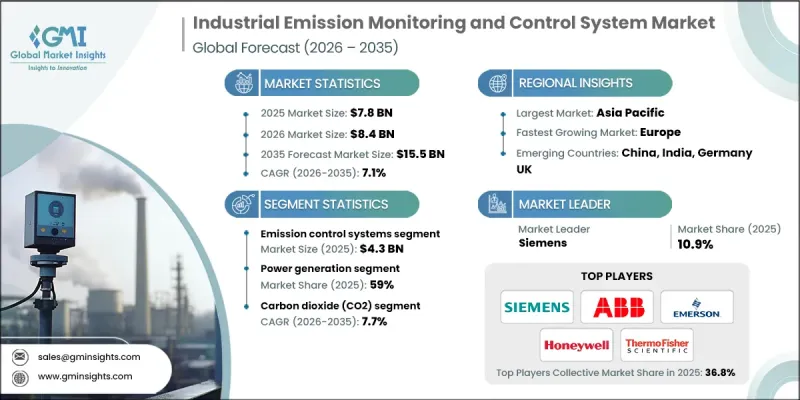
시장 확대의 배경에는 산업용 배출을 제한하고 환경 오염을 줄이기 위해 점점 더 엄격한 환경 규제가 있습니다. 각 지역의 정부는 산업에 선진적인 배출 모니터링 및 제어 기술의 채용을 촉진하는 컴플라이언스 요건을 시행하고 있습니다. 결과적으로 제조업체는 정확하고 실시간 배출 데이터를 제공할 수 있는 고급 시스템에 대한 투자를 추진하고 있습니다. 인공지능(AI)과 연결형 모니터링 플랫폼의 통합을 포함한 기술적 진보가 시스템 성능을 향상시키고 도입을 촉진하고 있습니다. 에너지 및 전력 부문은 여전히 산업 배출량의 주요 출처이며 모니터링 및 제어 솔루션에 대한 수요의 중요한 원천입니다. 청정에너지 발전으로 이행의 진전과 발전 시설에서 배출 삭감 기술의 도입은 강력한 성장 기회를 창출하고 있습니다. 시장은 레거시 시스템의 갱신과 관련된 높은 자본 투자 요건 및 기술적 복잡성과 같은 과제에 직면하고 있지만, 정부의 지원책과 재정 지원 프로그램이 이러한 장벽을 상쇄해, 보다 광범위한 도입을 촉진하고 있습니다.
| 시장 범위 | |
|---|---|
| 시작 연도 | 2025년 |
| 예측 연도 | 2026-2035년 |
| 시작 시 가치 | 78억 달러 |
| 예측 금액 | 155억 달러 |
| CAGR | 7.1% |
배출 모니터링 시스템 분야는 2026-2035년 연평균 복합 성장률(CAGR) 7.3%로 성장할 전망입니다. 연결 센서와 고급 데이터 분석 기술의 통합으로 지속적인 모니터링, 실시간 보고 및 컴플라이언스 정확도가 향상되었습니다. 산업계에서는 온실가스 배출량 및 대기 오염물질의 삭감에 더욱 중점을 두고 있어 이것이 모니터링 및 제어 솔루션 수요를 직접적으로 증가시키고 있습니다. 규제 당국은 환경 틀의 강화 및 클린 생산 수법의 추진을 진행하고 있어, 이것에 의해 산업 시설 전체에서의 최신 배출 제어 기술의 도입이 더욱 가속하고 있습니다.
이산화탄소 부문은 2026-2035년 연평균 복합 성장률(CAGR) 7.7%로 성장할 것으로 예측됩니다. 기후 변화와 지구온난화에 대한 인식이 높아짐에 따라 이산화탄소 배출량의 측정 및 관리에 대한 주목이 더욱 강화되고 있습니다. 세계 각국의 정부는 탄소 가격 설정 기구와 배출량 책임 정책을 실시하고 있으며, 산업에 대해 CO2 배출량의 보다 엄격한 추적과 관리를 의무화하고 있습니다. 이 규제 압력으로 CO2 모니터링은 산업용 배출 관리 전략의 핵심 요소가 되었습니다.
미국의 산업용 배출 모니터링 및 제어 시스템 시장은 2025년 77%의 점유율을 차지했으며, 18억 달러 규모에 달했습니다. 이 나라 시장 성장은 연방 당국이 확립한 엄격한 환경 규제와 집행 틀에 의해 지원됩니다. 법적 의무에 따라 산업 시설은 배출량을 일관되게 측정, 보고 및 감소해야 합니다. 게다가 기업의 지속가능성 이니셔티브와 환경책임에 대한 관심이 높아지면서 여러 산업에 걸친 배출 모니터링 솔루션에 대한 투자가 가속화되고 있습니다.
자주 묻는 질문
목차
제1장 조사 방법 및 범위
제2장 주요 요약
제3장 업계 인사이트
- 생태계 분석
- 공급자의 상황
- 이익률
- 각 단계에서의 부가가치
- 밸류체인에 영향을 주는 요인
- 업계에 미치는 영향요인
- 성장 촉진요인
- 업계의 잠재적 위험 및 과제
- 기회
- 성장 가능성 분석
- 장래 시장 동향
- 기술 및 혁신 동향
- 현재 기술 동향
- 신흥 기술
- 가격 동향
- 지역별
- 시스템 유형별
- 규제 상황
- 규격 및 컴플라이언스 요건
- 지역별 규제 프레임워크
- 인증기준
- Porter's Five Forces 분석
- PESTEL 분석
제4장 경쟁 구도
- 서문
- 기업의 시장 점유율 분석
- 지역별
- 기업 매트릭스 분석
- 주요 시장 기업의 경쟁 분석
- 경쟁 포지셔닝 매트릭스
- 주요 발전
- 합병 및 인수
- 제휴 및 협업
- 신제품 발매
- 확대 계획
제5장 시장 추계 및 예측 : 시스템 유형별(2022-2035년)
- 배출 모니터링 시스템
- 연속 배출 모니터링 시스템(CEMS)
- 예측 배출량 모니터링 시스템(PEMS)
- 배출가스 제어 시스템
- 전기 집진 장치(ESP)
- 스크러버(배연 탈황 장치)
- 촉매 시스템
- 패브릭 필터 및 버그하우스
- 흡착제 주입 시스템
- 기타(열산화 장치, 사이클론 등)
제6장 시장 추계 및 예측 : 오염물질 유형별(2022-2035년)
- 질소 산화물(NOx)
- 황산화물(SOx/SO2)
- 이산화탄소(CO2)
- 메탄
- 미립자 물질
- 기타(THC, 수은 등)
제7장 시장 추계 및 예측 : 최종 이용 산업별(2022-2035년)
- 발전
- 석유 및 가스
- 화학제품 및 석유화학제품
- 금속 및 광업
- 펄프 및 제지
- 의약품
- 기타(선박 등)
제8장 시장 추계 및 예측 : 유통 채널별(2022-2035년)
- 직접 판매
- 간접 판매
제9장 시장 추계 및 예측 : 지역별(2022-2035년)
- 북미
- 미국
- 캐나다
- 유럽
- 독일
- 영국
- 프랑스
- 스페인
- 이탈리아
- 네덜란드
- 아시아태평양
- 중국
- 일본
- 인도
- 호주
- 한국
- 라틴아메리카
- 브라질
- 멕시코
- 아르헨티나
- 중동 및 아프리카
- 남아프리카
- 사우디아라비아
- 아랍에미리트(UAE)
제10장 기업 프로파일
- ABB
- AMETEK
- Durag Group
- Emerson Electric
- Endress Hauser
- Forbes Marshall
- Honeywell International
- Horiba
- Kawasaki Heavy Industries
- Kongsberg
- Mitsubishi Heavy Industries
- Siemens
- Teledyne Technologies
- Thermo Fisher Scientific
- Yokogawa Electric
The Global Industrial Emission Monitoring and Control System Market was valued at USD 7.8 billion in 2025 and is estimated to grow at a CAGR of 7.1% to reach USD 15.5 billion by 2035.
Market expansion is driven by increasingly strict environmental regulations aimed at limiting industrial emissions and reducing environmental pollution. Governments across regions are enforcing compliance requirements that encourage industries to adopt advanced emission monitoring and control technologies. As a result, manufacturers are investing in sophisticated systems capable of delivering accurate, real-time emission data. Technological advancements, including the integration of artificial intelligence and connected monitoring platforms, are enhancing system performance and driving adoption. The energy and power sector remains one of the largest contributors to industrial emissions, making it a key demand generator for monitoring and control solutions. Ongoing transitions toward cleaner energy generation and the implementation of emission reduction technologies in power facilities are creating strong growth opportunities. While the market faces challenges such as high capital investment requirements and technical complexity in upgrading legacy systems, supportive government incentives and financial assistance programs are helping offset these barriers and encouraging broader adoption.
| Market Scope | |
|---|---|
| Start Year | 2025 |
| Forecast Year | 2026-2035 |
| Start Value | $7.8 Billion |
| Forecast Value | $15.5 Billion |
| CAGR | 7.1% |
The emission monitoring systems segment will grow at a CAGR of 7.3% during 2026 to 2035. The incorporation of connected sensors and advanced data analytics is improving continuous monitoring, real-time reporting, and compliance accuracy. Industries are placing greater emphasis on reducing greenhouse gas emissions and airborne pollutants, which is directly increasing demand for monitoring and control solutions. Regulatory authorities are strengthening environmental frameworks and promoting cleaner production practices, further accelerating the deployment of modern emission control technologies across industrial facilities.
The carbon dioxide segment is projected to grow at a CAGR of 7.7% from 2026 to 2035. Heightened awareness around climate change and global temperature rise has intensified the focus on carbon dioxide emission measurement and management. Governments worldwide are implementing carbon pricing mechanisms and emission accountability policies, compelling industries to track and control CO2 output more rigorously. This regulatory pressure is making CO2 monitoring a critical component of industrial emission management strategies.
United States Industrial Emission Monitoring and Control System Market accounted for 77% share and generated USD 1.8 billion in 2025. Market growth in the country is supported by stringent environmental regulations and enforcement frameworks established by federal authorities. Legislative mandates require industrial facilities to measure, report, and reduce emissions consistently. Additionally, rising corporate focus on sustainability initiatives and environmental responsibility is accelerating investment in emission monitoring solutions across multiple industries.
Key companies operating in the Global Industrial Emission Monitoring and Control System Market include Siemens, ABB, Emerson Electric, Honeywell International, Yokogawa Electric, Thermo Fisher Scientific, Endress+Hauser, Mitsubishi Heavy Industries, Horiba, Teledyne Technologies, AMETEK, Kongsberg, Kawasaki Heavy Industries, Durag Group, and Forbes Marshall. Companies in the Industrial Emission Monitoring and Control System Market are strengthening their market position through technology innovation, strategic partnerships, and geographic expansion. Leading players are investing heavily in research and development to enhance system accuracy, automation, and digital integration. Many are expanding their product portfolios to offer customized solutions tailored to specific industrial applications.
Table of Contents
Chapter 1 Methodology and scope
- 1.1 Market scope and definition
- 1.2 Research design
- 1.2.1 Research approach
- 1.2.2 Data collection methods
- 1.3 Data mining sources
- 1.3.1 Global
- 1.3.2 Regional/country
- 1.4 Base estimates and calculations
- 1.4.1 Base year calculation
- 1.4.2 Key trends for market estimation
- 1.5 Primary research and validation
- 1.5.1 Primary sources
- 1.6 Forecast model
- 1.7 Research assumptions and limitations
Chapter 2 Executive summary
- 2.1 Industry 360° synopsis
- 2.2 Key market trends
- 2.2.1 Regional
- 2.2.2 System Type
- 2.2.3 Pollutant Type
- 2.2.4 End Use Industry
- 2.2.5 Distribution Channel
- 2.3 CXO perspectives: strategic imperatives
- 2.3.1 Key decision points for industry executives
- 2.3.2 Critical success factors for market players
- 2.4 Future outlook and strategic recommendations
Chapter 3 Industry insights
- 3.1 Industry ecosystem analysis
- 3.1.1 Supplier landscape
- 3.1.2 Profit margin
- 3.1.3 Value addition at each stage
- 3.1.4 Factor affecting the value chain
- 3.2 Industry impact forces
- 3.2.1 Growth drivers
- 3.2.2 Industry pitfalls & challenges
- 3.2.3 Opportunities
- 3.3 Growth potential analysis
- 3.4 Future market trends
- 3.5 Technology and innovation landscape
- 3.5.1 Current technological trends
- 3.5.2 Emerging technologies
- 3.6 Price trends
- 3.6.1 By region
- 3.6.2 By system type
- 3.7 Regulatory landscape
- 3.7.1 Standards and compliance requirements
- 3.7.2 Regional regulatory frameworks
- 3.7.3 Certification standards
- 3.8 Porter's analysis
- 3.9 PESTEL analysis
Chapter 4 Competitive landscape, 2025
- 4.1 Introduction
- 4.2 Company market share analysis
- 4.2.1 By region
- 4.2.1.1 North America
- 4.2.1.2 Europe
- 4.2.1.3 Asia Pacific
- 4.2.1.4 Latin America
- 4.2.1.5 MEA
- 4.2.1 By region
- 4.3 Company matrix analysis
- 4.4 Competitive analysis of major market players
- 4.5 Competitive positioning matrix
- 4.6 Key developments
- 4.6.1 Mergers & acquisitions
- 4.6.2 Partnerships & collaborations
- 4.6.3 New product launches
- 4.6.4 Expansion plans
Chapter 5 Market Estimates & Forecast, By System Type, 2022 - 2035 ($Billion, Thousand Units)
- 5.1 Key trends
- 5.2 Emission monitoring systems
- 5.2.1 Continuous emission monitoring system (CEMS)
- 5.2.2 Predictive emission monitoring system (PEMS)
- 5.3 Emission control systems
- 5.3.1 Electrostatic precipitators (ESP)
- 5.3.2 Scrubbers (FGD systems)
- 5.3.3 Catalytic systems
- 5.3.4 Fabric filters/baghouses
- 5.3.5 Sorbent injection systems
- 5.3.6 Others (thermal oxidizers, cyclones etc.)
Chapter 6 Market Estimates & Forecast, By Pollutant Type, 2022 - 2035 ($Billion, Thousand Units)
- 6.1 Key trends
- 6.2 Nitrogen Oxides (NOx)
- 6.3 Sulfur Oxides (SOx/SO2)
- 6.4 Carbon Dioxide (CO2)
- 6.5 Methane
- 6.6 Particulate Matter
- 6.7 Others (THC, mercury etc.)
Chapter 7 Market Estimates & Forecast, By End Use Industry, 2022 - 2035 ($Billion, Thousand Units)
- 7.1 Key trends
- 7.2 Power Generation
- 7.3 Oil & Gas
- 7.4 Chemical & Petrochemical
- 7.5 Metals & Mining
- 7.6 Pulp & Paper
- 7.7 Pharmaceuticals
- 7.8 Others (marine etc.)
Chapter 8 Market Estimates & Forecast, By Distribution Channel, 2022 - 2035 ($Billion, Thousand Units)
- 8.1 Key trends
- 8.2 Direct sales
- 8.3 Indirect sales
Chapter 9 Market Estimates & Forecast, By Region, 2022 - 2035 ($Billion, Thousand Units)
- 9.1 Key trends
- 9.2 North America
- 9.2.1 U.S.
- 9.2.2 Canada
- 9.3 Europe
- 9.3.1 Germany
- 9.3.2 UK
- 9.3.3 France
- 9.3.4 Spain
- 9.3.5 Italy
- 9.3.6 Netherlands
- 9.4 Asia Pacific
- 9.4.1 China
- 9.4.2 Japan
- 9.4.3 India
- 9.4.4 Australia
- 9.4.5 South Korea
- 9.5 Latin America
- 9.5.1 Brazil
- 9.5.2 Mexico
- 9.5.3 Argentina
- 9.6 MEA
- 9.6.1 South Africa
- 9.6.2 Saudi Arabia
- 9.6.3 UAE
Chapter 10 Company Profiles
- 10.1 ABB
- 10.2 AMETEK
- 10.3 Durag Group
- 10.4 Emerson Electric
- 10.5 Endress+Hauser
- 10.6 Forbes Marshall
- 10.7 Honeywell International
- 10.8 Horiba
- 10.9 Kawasaki Heavy Industries
- 10.10 Kongsberg
- 10.11 Mitsubishi Heavy Industries
- 10.12 Siemens
- 10.13 Teledyne Technologies
- 10.14 Thermo Fisher Scientific
- 10.15 Yokogawa Electric


