|
시장보고서
상품코드
1936495
기계용 진동 모니터링 시스템 시장 : 시장 기회, 성장 요인, 산업 동향 분석 및 예측(2026-2035년)Vibrational Monitoring System for Machinery Market Opportunity, Growth Drivers, Industry Trend Analysis, and Forecast 2026 - 2035 |
||||||

세계의 기계 진동 모니터링 시스템 시장은 2025년에 9억 2,220만 달러로 평가되었고, 2035년까지 연평균 복합 성장률(CAGR) 6.5%로 성장할 전망이며, 17억 2,000만 달러에 이를 것으로 예측됩니다.

이러한 성장은 설비 수명 연장, 자본 집약 자산 보호, 산업 환경 전반의 가동 시간 극대화에 대한 의식이 높아짐에 따라 형성되고 있습니다. 제조업체 및 자산 소유자는 상태 기반 유지보수를 핵심 운영 전략으로 선호하고 있으며, 이는 첨단 진동 모니터링 솔루션에 대한 수요를 지속적으로 이끌고 있습니다. 시장 기세는 기술력 강화 및 업계 전반에 걸친 솔루션 포트폴리오의 확대를 초래하는 제휴 및 인수를 포함한 지속적인 통합 활동에 의해 지원됩니다. 한편, 종래의 검사 방법은 그 효과의 한계와 확장성의 부족으로 인해 높은 생산성의 산업 환경에서 중요성을 잃고 있습니다. 기술의 지속적인 발전으로 진동 모니터링은 무선 감지, 지능형 진단 및 연결 분석 플랫폼에 지원되는 데이터 구동 분야로 발전했습니다. 이러한 혁신을 통해 조직은 예기치 않은 가동 중지 시간을 대폭 줄이고 에너지 효율을 높이고 재료 손실을 최소화할 수 있습니다. 산업 운영의 자동화와 가동 시간에 대한 의존도가 증가함에 따라 진동 모니터링 시스템은 세계의 현대적인 유지 보수 프레임 워크에서 필수적인 요소가 되고 있습니다.
| 시장 범위 | |
|---|---|
| 시작 연도 | 2025년 |
| 예측 연도 | 2026-2035년 |
| 시작 시 가치 | 9억 2,220만 달러 |
| 예측 금액 | 17억 2,000만 달러 |
| CAGR | 6.5% |
휴대용 모니터링 시스템 부문은 54.9%의 점유율을 차지했으며 2025년에는 5억 670만 달러의 수익을 창출했습니다. 이 부문은 합리적인 가격, 도입의 용이성 및 영구적인 설치가 경제적으로 정당화되지 않는 광범위한 2차 및 비중요 기계에 대한 적응성을 통해 계속 주목을 받고 있습니다.
하드웨어 부문은 58.5%의 점유율을 차지했으며, 2025년에는 5억 3,950만 달러에 달했습니다. 물리적 감지 컴포넌트는 정확한 기계 상태 데이터를 얻기 위해 필수적이며, 소형화 및 무선 통신 기술의 발전으로 성능, 내구성 및 실시간 응답성이 향상되었습니다. 신뢰성 있는 센싱 인프라에 대한 강한 수요는 커넥티드 팩토리와 지속적인 장비 진단으로의 광범위한 전환을 반영합니다.
미국의 기계적 진동 모니터링 시스템 시장은 2025년 75.6%의 점유율을 차지했습니다. 이 주도적 지위는 디지털 제조, 예지보전 프로그램, 확대하는 산업 및 에너지 자산에 대한 다액의 투자에 의해 지원되고 있습니다. 국내 기업들은 적극적인 모니터링 기법을 통해 기계의 수명 연장 및 가동 중단 감소에 주력하는 경향이 커지고 있습니다.
자주 묻는 질문
목차
제1장 조사 방법 및 범위
제2장 주요 요약
제3장 업계 인사이트
- 생태계 분석
- 공급자의 상황
- 이익률
- 각 단계에서의 부가가치
- 밸류체인에 영향을 주는 요인
- 업계에 미치는 영향요인
- 성장 촉진요인
- 예방 보전에서 예지보전으로의 이행
- IIoT(산업용 IoT) 및 무선 센싱의 보급
- 에너지 및 전력 분야에 있어서 중요한 자산 보호
- 업계의 잠재적 위험 및 과제
- 높은 초기 도입 및 하드웨어 비용
- 숙련된 진동 해석 기술자의 부족
- 기회
- AI를 활용한 자동 진단
- 구독형 서비스로서의 모니터링
- 성장 촉진요인
- 성장 가능성 분석
- 장래 시장 동향
- 기술 및 혁신 동향
- 현재 기술 동향
- 신흥 기술
- 가격 동향
- 지역별
- 모니터링 프로세스별
- 규제 상황
- 규격 및 컴플라이언스 요건
- 지역별 규제 프레임워크
- 인증 기준
- Porter's Five Forces 분석
- PESTEL 분석
제4장 경쟁 구도
- 서문
- 기업의 시장 점유율 분석
- 지역별
- 기업 매트릭스 분석
- 주요 시장 기업의 경쟁 분석
- 경쟁 포지셔닝 매트릭스
- 주요 발전
- 합병 및 인수
- 제휴 및 협업
- 신제품 발매
- 확대 계획
제5장 시장 추계 및 예측 : 컴포넌트별(2022-2035년)
- 하드웨어
- 소프트웨어
- 서비스
제6장 시장 추계 및 예측 : 모니터링 프로세스별(2022-2035년)
- 온라인
- 휴대용
제7장 시장 추계 및 예측 : 시스템별(2022-2035년)
- 내장형
- 진동 분석기
- 진동계
제8장 시장 추계 및 예측 : 용도별(2022-2035년)
- 석유 및 가스
- 에너지 및 전력
- 금속 및 광업
- 화학
- 자동차
- 식품 및 음료
- 기타
제9장 시장 추계 및 예측 : 지역별(2022-2035년)
- 북미
- 미국
- 캐나다
- 유럽
- 독일
- 영국
- 프랑스
- 이탈리아
- 스페인
- 아시아태평양
- 중국
- 일본
- 인도
- 호주
- 한국
- 라틴아메리카
- 브라질
- 멕시코
- 아르헨티나
- 중동 및 아프리카
- 남아프리카
- 사우디아라비아
- 아랍에미리트(UAE)
제10장 기업 프로파일
- ABB Ltd.
- Analog Devices, Inc.
- Baker Hughes
- Bruel & Kjaer(HBK)
- Emerson Electric Co.
- Fluke Corporation
- Honeywell International Inc.
- National Instruments Corp.
- PCB Piezotronics
- Pruftechnik
- Rockwell Automation, Inc.
- Schaeffler AG
- SKF AB
- SPM Instrument AB
- Waites Wireless Sensor Technologies
The Global Vibrational Monitoring System for Machinery Market was valued at USD 922.2 million in 2025 and is estimated to grow at a CAGR of 6.5% to reach USD 1.72 billion by 2035.
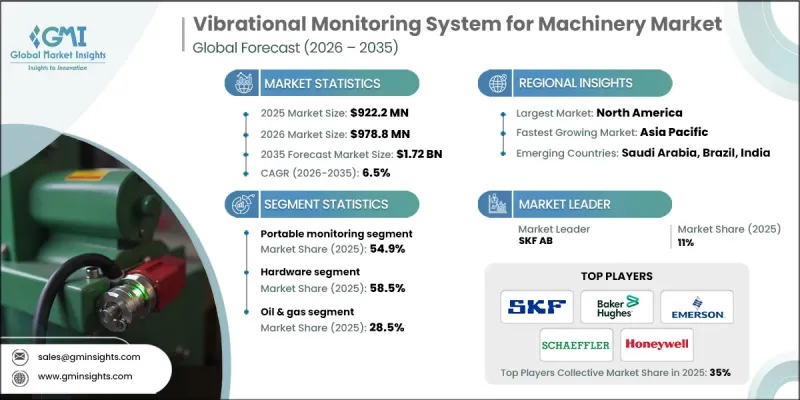
The growth is shaped by rising awareness around extending equipment life, protecting capital-intensive assets, and maximizing operational uptime across industrial environments. Manufacturers and asset owners are prioritizing condition-based maintenance as a core operational strategy, which continues to drive demand for advanced vibration monitoring solutions. Market momentum is also supported by ongoing consolidation activities, including collaborations and acquisitions, which are strengthening technological capabilities and expanding solution portfolios across the industry. At the same time, legacy inspection approaches are losing relevance in high-output industrial settings due to their limited effectiveness and lack of scalability. Continuous technological progress has elevated vibration monitoring into a data-driven discipline supported by wireless sensing, intelligent diagnostics, and connected analytics platforms. These innovations allow organizations to significantly reduce unexpected downtime, improve energy efficiency, and minimize material losses. As industrial operations become increasingly automated and uptime-sensitive, vibration monitoring systems are becoming an essential component of modern maintenance frameworks worldwide.
| Market Scope | |
|---|---|
| Start Year | 2025 |
| Forecast Year | 2026-2035 |
| Start Value | $922.2 Million |
| Forecast Value | $1.72 Billion |
| CAGR | 6.5% |
The portable monitoring systems segment held 54.9% share, generating USD 506.7 million in 2025. This segment continues to gain traction due to its affordability, ease of deployment, and adaptability across a wide range of secondary and non-critical machinery where permanent installations are not economically justified.
The hardware segment held 58.5% share, reaching USD 539.5 million in 2025. Physical sensing components remain essential for capturing accurate machine condition data, while advances in miniaturization and wireless communication are enhancing performance, durability, and real-time responsiveness. Strong demand for reliable sensing infrastructure reflects the broader shift toward connected factories and continuous equipment diagnostics.
U.S. Vibrational Monitoring System for Machinery Market held 75.6% share in 2025. This leadership is driven by substantial investments in digital manufacturing, predictive maintenance programs, and expanding industrial and energy assets. Companies across the country are increasingly focused on extending machinery lifespan and reducing operational disruptions through proactive monitoring practices.
Key companies operating in the Global Vibrational Monitoring System for Machinery Market include SKF AB, Emerson Electric Co., ABB Ltd., Schaeffler AG, Rockwell Automation, Inc., Baker Hughes Company (Bently Nevada), Honeywell International Inc., Analog Devices, Inc., Bruel & Kjaer (HBK), SPM Instrument AB, National Instruments Corp., PCB Piezotronics, Fluke Corporation, Pruftechnik, and Waites Wireless Sensor Technologies. Companies in the vibrational monitoring system for machinery market are reinforcing their competitive position through continuous technology innovation, portfolio expansion, and strategic alliances. Many players are investing heavily in smart sensors, advanced analytics, and AI-driven diagnostics to deliver more accurate and actionable insights. Emphasis is also placed on integrating monitoring solutions with broader industrial IoT ecosystems to support predictive and prescriptive maintenance models. Firms are expanding service offerings, including remote monitoring, system integration, and lifecycle support, to deepen customer relationships. Geographic expansion and targeted acquisitions are being used to access new industrial sectors and regional markets.
Table of Contents
Chapter 1 Methodology and Scope
- 1.1 Market scope and definition
- 1.2 Research design
- 1.2.1 Research approach
- 1.2.2 Data collection methods
- 1.3 Data mining sources
- 1.3.1 Global
- 1.3.2 Regional/Country
- 1.4 Base estimates and calculations
- 1.4.1 Base year calculation
- 1.4.2 Key trends for market estimation
- 1.5 Primary research and validation
- 1.5.1 Primary sources
- 1.6 Forecast model
- 1.7 Research assumptions and limitations
Chapter 2 Executive Summary
- 2.1 Industry 360° synopsis
- 2.2 Key market trends
- 2.2.1 Regional
- 2.2.2 Component
- 2.2.3 Monitoring Process
- 2.2.4 Application
- 2.2.5 System
- 2.3 CXO perspectives: Strategic imperatives
- 2.3.1 Key decision points for industry executives
- 2.3.2 Critical success factors for market players
- 2.4 Future outlook and strategic recommendations
Chapter 3 Industry Insights
- 3.1 Industry ecosystem analysis
- 3.1.1 Supplier landscape
- 3.1.2 Profit margin
- 3.1.3 Value addition at each stage
- 3.1.4 Factor affecting the value chain
- 3.2 Industry impact forces
- 3.2.1 Growth drivers
- 3.2.1.1 Shift from preventive to predictive maintenance
- 3.2.1.2 Proliferation of IIoT & wireless sensing
- 3.2.1.3 Critical asset protection in energy & power
- 3.2.2 Industry pitfalls & challenges
- 3.2.2.1 High initial installation & hardware costs
- 3.2.2.2 Shortage of skilled vibration analysts
- 3.2.3 Opportunities
- 3.2.3.1 Ai-Powered automated diagnostics
- 3.2.3.2 Subscription-based "Monitoring-as-a-Service"
- 3.2.1 Growth drivers
- 3.3 Growth potential analysis
- 3.4 Future market trends
- 3.5 Technology and innovation landscape
- 3.5.1 Current technological trends
- 3.5.2 Emerging technologies
- 3.6 Price trends
- 3.6.1 By region
- 3.6.2 By Monitoring process
- 3.7 Regulatory landscape
- 3.7.1 Standards and compliance requirements
- 3.7.2 Regional regulatory frameworks
- 3.7.3 Certification standards
- 3.8 Porter's analysis
- 3.9 PESTEL analysis
Chapter 4 Competitive Landscape, 2025
- 4.1 Introduction
- 4.2 Company market share analysis
- 4.2.1 By region
- 4.2.1.1 North America
- 4.2.1.2 Europe
- 4.2.1.3 Asia Pacific
- 4.2.1.4 Latin America
- 4.2.1.5 Middle East and Africa
- 4.2.1 By region
- 4.3 Company matrix analysis
- 4.4 Competitive analysis of major market players
- 4.5 Competitive positioning matrix
- 4.6 Key developments
- 4.6.1 Mergers & acquisitions
- 4.6.2 Partnerships & collaborations
- 4.6.3 New product launches
- 4.6.4 Expansion plans
Chapter 5 Market Estimates and Forecast, By Component, 2022 - 2035 (USD Million) (Thousand Units)
- 5.1 Key trends
- 5.2 Hardware
- 5.3 Software
- 5.4 Services
Chapter 6 Market Estimates and Forecast, By Monitoring Process, 2022 - 2035 (USD Million) (Thousand Units)
- 6.1 Key trends
- 6.2 Online
- 6.3 Portable
Chapter 7 Market Estimates and Forecast, By System, 2022 - 2035 (USD Million) (Thousand Units)
- 7.1 Key trends
- 7.2 Embedded
- 7.3 Vibration Analyzers
- 7.4 Vibration Meter
Chapter 8 Market Estimates and Forecast, By Application, 2022 - 2035 (USD Million) (Thousand Units)
- 8.1 Key trends
- 8.2 Oil & Gas
- 8.3 Energy & Power
- 8.4 Metal & Mining
- 8.5 Chemical
- 8.6 Automotive
- 8.7 Food & Beverages
- 8.8 Others
Chapter 9 Market Estimates and Forecast, By Region, 2022 - 2035 (USD Million) (Thousand Units)
- 9.1 Key trends
- 9.2 North America
- 9.2.1 U.S.
- 9.2.2 Canada
- 9.3 Europe
- 9.3.1 Germany
- 9.3.2 UK
- 9.3.3 France
- 9.3.4 Italy
- 9.3.5 Spain
- 9.4 Asia Pacific
- 9.4.1 China
- 9.4.2 Japan
- 9.4.3 India
- 9.4.4 Australia
- 9.4.5 South Korea
- 9.5 Latin America
- 9.5.1 Brazil
- 9.5.2 Mexico
- 9.5.3 Argentina
- 9.6 Middle East and Africa
- 9.6.1 South Africa
- 9.6.2 Saudi Arabia
- 9.6.3 UAE
Chapter 10 Company Profiles
- 10.1 ABB Ltd.
- 10.2 Analog Devices, Inc.
- 10.3 Baker Hughes
- 10.4 Bruel & Kjaer (HBK)
- 10.5 Emerson Electric Co.
- 10.6 Fluke Corporation
- 10.7 Honeywell International Inc.
- 10.8 National Instruments Corp.
- 10.9 PCB Piezotronics
- 10.10 Pruftechnik
- 10.11 Rockwell Automation, Inc.
- 10.12 Schaeffler AG
- 10.13 SKF AB
- 10.14 SPM Instrument AB
- 10.15 Waites Wireless Sensor Technologies