

|
시장보고서
상품코드
1936536
포름알데히드 시장 : 시장 기회, 성장 요인, 산업 동향 분석 및 예측(2026-2035년)Formaldehyde Market Opportunity, Growth Drivers, Industry Trend Analysis, and Forecast 2026 - 2035 |
||||||

세계의 포름알데히드 시장은 2025년에 69억 달러로 평가되었고, 2035년까지 연평균 복합 성장률(CAGR) 5.1%로 성장할 전망이며, 114억 달러에 이를 것으로 예측됩니다.
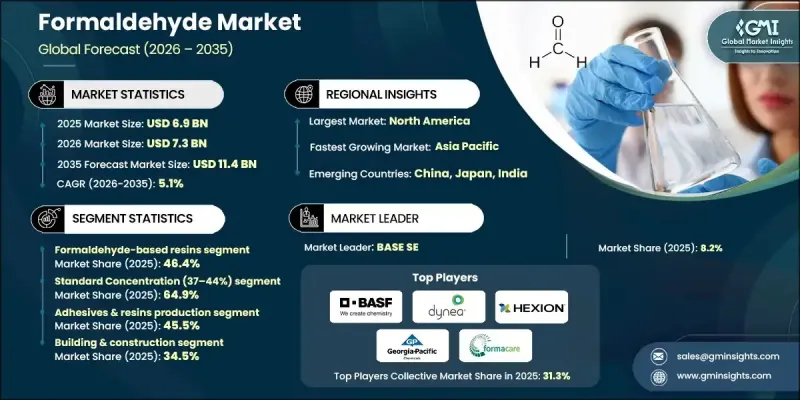
이 산업의 성장은 건설, 자동차, 의료, 농업 및 산업 제조 분야의 다양한 용도로 견인되고 있습니다. 규제 압력 및 환경 문제가 시장 형성에 점차 영향을 미치고 있으며, 제조업체는 저 배출형 및 초저포름알데히드(ULEF) 제품의 개발을 촉진하고 있습니다. 건축 및 건설, 자동차, 의료 용도는 여전히 포름알데히드의 최대 소비 분야입니다. 북미는 성숙한 제조거점과 확립된 규제 체제의 혜택을 받아 시장을 선도하고 있습니다. 한편, 유럽에서는 지속가능성과 저배출 제품의 개발이 중시되고 있습니다. 제조업체 각사는 E0 규격, CARB 기준, 유럽 기준을 충족하기 위해 혁신적인 수지 배합과 독자적인 배출 제어 기술에 주력하고 있습니다. 건설, 가구, 내장 용도에 대한 수요 증가가 시장 성장을 계속 유지하고 있는 한편, 도시화와 인프라 개발은 세계적으로 포름알데히드계 솔루션의 채용을 더욱 촉진하고 있습니다.
| 시장 범위 | |
|---|---|
| 시작 연도 | 2025년 |
| 예측 연도 | 2026-2035년 |
| 시작 시 가치 | 69억 달러 |
| 예측 금액 | 114억 달러 |
| CAGR | 5.1% |
포름알데히드계 수지 부문은 2025년에 46.4%의 점유율을 차지하였고, 2035년까지 연평균 복합 성장률(CAGR) 5%를 나타낼 것으로 예측되고 있습니다. 이러한 수지는 접착제, 라미네이트, 엔지니어드 우드 제품 등 다양한 용도로 소비를 지배합니다. 포름알데히드 용액(포르말린)도 섬유, 가죽, 수처리 등 산업에서 소독제, 방부제, 화학 중간체로서 시장에 크게 공헌하고 있습니다. 수지 기술의 지속적인 개선으로 제조업체는 제품의 성능과 품질을 유지하면서 배출량을 줄일 수 있습니다.
건설 및 건축 분야는 2025년에 24억 달러에 이르렀고, 2035년까지 연평균 복합 성장률(CAGR) 4.6%를 나타낼 것으로 예측됩니다. 급속한 도시화, 대규모 인프라 프로젝트, 주택 및 상업 시설에 대한 수요 증가가 접착제, 적층재, 단열재, 엔지니어드 우드 제품 전체의 성장을 견인하고 있습니다. 선진국 및 신흥국 양쪽에 있어서 건설 활동의 확대는 보다 엄격한 환경 규제나 지속가능성 목표에 따른 저배출 및 초저 포름알데히드 수지의 채용을 제조업체에 촉구하고 있습니다.
북미의 포름알데히드 시장은 2025년 9억 5,040만 달러 규모에 이르렀습니다. 안정적인 건설 활동, 자동차 용도, 첨단 수지 기술이 이 지역 수요를 견인하고 있습니다. 저배출 제품에 관한 규제 요건에 따라 적합 수지의 도입이 가속되는 한편, 주택 및 가구, 산업 분야에 있어서의 지속적인 수요가 더욱 성장을 지지하고 있습니다.
자주 묻는 질문
목차
제1장 조사 방법 및 범위
제2장 주요 요약
제3장 업계 인사이트
- 생태계 분석
- 공급자의 상황
- 이익률
- 각 단계에서의 부가가치
- 밸류체인에 영향을 주는 요인
- 혁신
- 업계에 미치는 영향요인
- 성장 촉진요인
- 세계의 건설 및 주택 시장에 있어서 엔지니어드 우드 제품에 수요 증가
- 자동차 및 수송 기기 제조의 확대에 수반해, 경량으로 내구성이 뛰어난 포름알데히드계 재료의 사용이 증가하고 있습니다
- 하류의 플라스틱, 페인트, 특수 화학제품 산업용의 화학 중간체 생산 확대
- 업계의 잠재적 위험 및 과제
- 포름알데히드 배출량 및 노출 한계치와 관련된 엄격한 환경 규제 및 건강상의 우려
- 메탄올 원료 가격의 변동이 포름알데히드의 생산 비용 및 수익성에 미치는 영향
- 대체가 되는 바이오베이스 및 저독성 대체품의 이용 가능성이 포름알데히드 채용률 저하
- 시장 기회
- 엄격한 세계의 규제를 충족하는 저배출 및 초저 포름알데히드 수지 개발
- 아시아태평양에서의 급속한 인프라 정비의 진전이, 건설용 화학제품 및 수지 수요를 밀어 올리고 있습니다
- 전자 기기, 의료기기, 특수 용도에 있어서 포름알데히드 유도체의 사용 증가
- 성장 촉진요인
- 성장 가능성 분석
- 규제 상황
- 북미
- 유럽
- 아시아태평양
- 라틴아메리카
- 중동 및 아프리카
- Porter's Five Forces 분석
- PESTEL 분석
- 가격 동향
- 지역별
- 제품 유형별
- 장래 시장 동향
- 기술 및 혁신 동향
- 현재 기술 동향
- 신흥 기술
- 특허 상황
- 무역 통계(HS코드)(참고 : 무역 통계는 주요 국가에서만 제공됨)
- 주요 수입국
- 주요 수출국
- 지속가능성 및 환경면
- 지속가능한 대처
- 폐기물 감축 전략
- 생산에 있어서 에너지 효율
- 환경에 배려한 대처
- 탄소발자국 고려
제4장 경쟁 구도
- 서문
- 기업의 시장 점유율 분석
- 지역별
- 북미
- 유럽
- 아시아태평양
- 라틴아메리카
- 중동 및 아프리카
- 지역별
- 기업 매트릭스 분석
- 주요 시장 기업의 경쟁 분석
- 경쟁 포지셔닝 매트릭스
- 주요 발전
- 합병 및 인수
- 제휴 및 협업
- 신제품 발매
- 사업 확대 계획
제5장 시장 추계 및 예측 : 제품 유형별(2022-2035년)
- 포름알데히드 용액(포르말린)
- 파라포름알데히드
- 포름알데히드계 수지
- 포름알데히드 유도체
제6장 시장 추계 및 예측 : 등급별(2022-2035년)
- 고농도(45-50%)
- 표준농도(37-44%)
- 고농도 형태(85% 이상-파라포름알데히드)
제7장 시장 추계 및 예측 : 용도별(2022-2035년)
- 접착제 및 수지 제조
- 화학 중간체
- 코팅 및 페인트
- 소독제 및 방부제
- 섬유 및 피혁 처리
- 공업용 공정 보조제
- 기타
제8장 시장 추계 및 예측 : 최종 용도별(2022-2035년)
- 건축 및 건설
- 자동차
- 의료 및 헬스케어
- 농업
- 석유 및 가스
- 섬유, 의류 및 피혁
- 항공우주 및 방위
- 반도체 및 전자 기기
- 퍼스널케어 및 위생 용품
- 기타
제9장 시장 추계 및 예측 : 지역별(2022-2035년)
- 북미
- 미국
- 캐나다
- 유럽
- 독일
- 영국
- 프랑스
- 스페인
- 이탈리아
- 기타 유럽
- 아시아태평양
- 중국
- 인도
- 일본
- 호주
- 한국
- 기타 아시아태평양
- 라틴아메리카
- 브라질
- 멕시코
- 아르헨티나
- 기타 라틴아메리카
- 중동 및 아프리카
- 사우디아라비아
- 남아프리카
- 아랍에미리트(UAE)
- 기타 중동 및 아프리카
제10장 기업 프로파일
- Acron Group(PJSC Akron)
- Bakelite Synthetics
- Balaji Formalin Private Limited
- BASF SE
- Celanese Corporation
- Chemanol(National Methanol Company)
- Dynea AS
- Ercros SA
- Foremark Performance Chemicals
- Gulf Formaldehyde Company QSC
- Hexion Inc.
- Huntsman Corporation
- LCY Chemical Corp.
- Metafrax Chemicals PJSC(Metafrax Group)
- Yuntianhua Group Co., Ltd.
The Global Formaldehyde Market was valued at USD 6.9 billion in 2025 and is estimated to grow at a CAGR of 5.1% to reach USD 11.4 billion by 2035.
The industry's growth is driven by its widespread use across construction, automotive, healthcare, agriculture, and industrial manufacturing sectors. Regulatory pressures and environmental concerns are increasingly shaping the market, prompting manufacturers to develop lower-emission and ultra-low-formaldehyde (ULEF) products. Building and construction, automotive, and healthcare applications remain the largest consumers of formaldehyde. North America leads the market, benefiting from a mature manufacturing base and well-established regulatory frameworks, while Europe emphasizes sustainability and low-emission product development. Manufacturers are focusing on innovative resin formulations and proprietary emission-control technologies to meet E0, CARB, and European standards. Growing demand in construction, furniture, and interior applications continues to support market expansion, while urbanization and infrastructure development further strengthen the adoption of formaldehyde-based solutions globally.
| Market Scope | |
|---|---|
| Start Year | 2025 |
| Forecast Year | 2026-2035 |
| Start Value | $6.9 Billion |
| Forecast Value | $11.4 Billion |
| CAGR | 5.1% |
The formaldehyde-based resins segment accounted for 46.4% share in 2025 and is expected to grow at a CAGR of 5% through 2035. These resins dominate consumption due to their extensive application in adhesives, laminates, and engineered wood products. Formaldehyde solutions (formalin) also contribute significantly to the market, serving as disinfectants, preservatives, and chemical intermediates in industries such as textiles, leather, and water treatment. Continuous improvements in resin technology have enabled manufacturers to reduce emissions while maintaining product performance and quality.
The construction and building segment reached USD 2.4 billion in 2025 and is projected to grow at a CAGR of 4.6% through 2035. Rapid urbanization, large-scale infrastructure projects, and increasing demand for residential and commercial housing are driving growth across adhesives, laminates, insulations, and engineered wood products. Expanding construction activities in both developed and emerging markets are encouraging manufacturers to adopt low-emission and ultra-low-formaldehyde resins, aligning with stricter environmental regulations and sustainability goals.
North America Formaldehyde Market generated USD 950.4 million in 2025. Steady construction activity, automotive applications, and advanced resin technologies are driving demand in the region. Regulatory mandates on low-emission products have accelerated the adoption of compliant resins, while ongoing demand in housing, furniture, and industrial sectors further supports growth.
Key players in the Global Formaldehyde Market include BASF SE, Huntsman Corporation, Dynea AS, Metafrax Chemicals PJSC (Metafrax Group), Acron Group (PJSC Akron), Celanese Corporation, Hexion Inc., Bakelite Synthetics, Balaji Formalin Private Limited, Chemanol (National Methanol Company), Ercros S.A., Foremark Performance Chemicals, Gulf Formaldehyde Company Q.S.C., LCY Chemical Corp., and Yuntianhua Group Co., Ltd. To strengthen market presence and expand their foothold, companies in the formaldehyde industry are adopting multiple strategic approaches. They are investing heavily in R&D to develop low-emission and ultra-low-formaldehyde resins that comply with international environmental standards. Partnerships, joint ventures, and collaborations are being pursued to expand production capacities and enter emerging regional markets. Firms are modernizing production facilities to enhance operational efficiency and reduce carbon footprints.
Table of Contents
Chapter 1 Methodology & Scope
- 1.1 Market scope and definition
- 1.2 Research design
- 1.2.1 Research approach
- 1.2.2 Data collection methods
- 1.3 Data mining sources
- 1.3.1 Global
- 1.3.2 Regional/Country
- 1.4 Base estimates and calculations
- 1.4.1 Base year calculation
- 1.4.2 Key trends for market estimation
- 1.5 Primary research and validation
- 1.5.1 Primary sources
- 1.6 Forecast model
- 1.7 Research assumptions and limitations
Chapter 2 Executive Summary
- 2.1 Industry 360° synopsis
- 2.2 Key market trends
- 2.2.1 Regional
- 2.2.2 Product Type
- 2.2.3 Grade
- 2.2.4 Application
- 2.2.5 End Use
- 2.3 TAM Analysis, 2025-2034
- 2.4 CXO perspectives: Strategic imperatives
- 2.4.1 Executive decision points
- 2.4.2 Critical success factors
- 2.5 Future Outlook and Strategic Recommendations
Chapter 3 Industry Insights
- 3.1 Industry ecosystem analysis
- 3.1.1 Supplier landscape
- 3.1.2 Profit margin
- 3.1.3 Value addition at each stage
- 3.1.4 Factor affecting the value chain
- 3.1.5 Disruptions
- 3.2 Industry impact forces
- 3.2.1 Growth drivers
- 3.2.1.1 Rising demand for engineered wood products in global construction and housing markets
- 3.2.1.2 Expanding automotive and transportation manufacturing increasing use of lightweight durable formaldehyde-based materials
- 3.2.1.3 Growing chemical intermediates production for downstream plastics, coatings, and specialty chemical industries
- 3.2.2 Industry pitfalls and challenges
- 3.2.2.1 Stringent environmental regulations and health concerns related to formaldehyde emissions and exposure limits
- 3.2.2.2 Volatility in methanol feedstock prices impacting formaldehyde production costs and profitability
- 3.2.2.3 Availability of alternative bio-based and low-toxicity substitutes reducing formaldehyde adoption rates
- 3.2.3 Market opportunities
- 3.2.3.1 Development of low-emission and ultra-low formaldehyde resins meeting stringent global regulations
- 3.2.3.2 Rapid infrastructure growth in Asia Pacific boosting demand for construction chemicals and resins
- 3.2.3.3 Rising use of formaldehyde derivatives in electronics, medical devices, and specialty applications
- 3.2.1 Growth drivers
- 3.3 Growth potential analysis
- 3.4 Regulatory landscape
- 3.4.1 North America
- 3.4.2 Europe
- 3.4.3 Asia Pacific
- 3.4.4 Latin America
- 3.4.5 Middle East & Africa
- 3.5 Porter's analysis
- 3.6 PESTEL analysis
- 3.7 Price trends
- 3.7.1 By region
- 3.7.2 By product type
- 3.8 Future market trends
- 3.9 Technology and Innovation landscape
- 3.9.1 Current technological trends
- 3.9.2 Emerging technologies
- 3.10 Patent Landscape
- 3.11 Trade statistics (HS code) ( Note: the trade statistics will be provided for key countries only)
- 3.11.1 Major importing countries
- 3.11.2 Major exporting countries
- 3.12 Sustainability and environmental aspects
- 3.12.1 Sustainable practices
- 3.12.2 Waste reduction strategies
- 3.12.3 Energy efficiency in production
- 3.12.4 Eco-friendly initiatives
- 3.13 Carbon footprint consideration
Chapter 4 Competitive Landscape, 2025
- 4.1 Introduction
- 4.2 Company market share analysis
- 4.2.1 By region
- 4.2.1.1 North America
- 4.2.1.2 Europe
- 4.2.1.3 Asia Pacific
- 4.2.1.4 LATAM
- 4.2.1.5 MEA
- 4.2.1 By region
- 4.3 Company matrix analysis
- 4.4 Competitive analysis of major market players
- 4.5 Competitive positioning matrix
- 4.6 Key developments
- 4.6.1 Mergers & acquisitions
- 4.6.2 Partnerships & collaborations
- 4.6.3 New Product Launches
- 4.6.4 Expansion Plans
Chapter 5 Market Estimates and Forecast, By Product Type, 2022-2035 (USD Billion) (Kilo Tons)
- 5.1 Key trends
- 5.2 Formaldehyde Solutions (Formalin)
- 5.3 Paraformaldehyde
- 5.4 Formaldehyde-Based Resins
- 5.5 Formaldehyde Derivatives
Chapter 6 Market Estimates and Forecast, By Grade, 2022-2035 (USD Billion) (Kilo Tons)
- 6.1 Key trends
- 6.2 High Concentration (45-50%)
- 6.3 Standard Concentration (37-44%)
- 6.4 Concentrated Forms (>85% - Paraformaldehyde)
Chapter 7 Market Estimates and Forecast, By Application, 2022-2035 (USD Billion) (Kilo Tons)
- 7.1 Key trends
- 7.2 Adhesives & Resins Production
- 7.3 Chemical Intermediates
- 7.4 Coatings & Paints
- 7.5 Disinfectants & Preservatives
- 7.6 Textiles & Leather Treatment
- 7.7 Industrial Process Aids
- 7.8 Others
Chapter 8 Market Estimates and Forecast, By End Use, 2022-2035 (USD Billion) (Kilo Tons)
- 8.1 Key trends
- 8.2 Building & Construction
- 8.3 Automotive
- 8.4 Medical & Healthcare
- 8.5 Agriculture
- 8.6 Oil & Gas
- 8.7 Textiles, Apparel & Leather
- 8.8 Aerospace & Defense
- 8.9 Semiconductors & Electronics
- 8.10 Personal Care & Hygiene
- 8.11 Others
Chapter 9 Market Estimates and Forecast, By Region, 2022-2035 (USD Billion) (Kilo Tons)
- 9.1 Key trends
- 9.2 North America
- 9.2.1 U.S.
- 9.2.2 Canada
- 9.3 Europe
- 9.3.1 Germany
- 9.3.2 UK
- 9.3.3 France
- 9.3.4 Spain
- 9.3.5 Italy
- 9.3.6 Rest of Europe
- 9.4 Asia Pacific
- 9.4.1 China
- 9.4.2 India
- 9.4.3 Japan
- 9.4.4 Australia
- 9.4.5 South Korea
- 9.4.6 Rest of Asia Pacific
- 9.5 Latin America
- 9.5.1 Brazil
- 9.5.2 Mexico
- 9.5.3 Argentina
- 9.5.4 Rest of Latin America
- 9.6 Middle East and Africa
- 9.6.1 Saudi Arabia
- 9.6.2 South Africa
- 9.6.3 UAE
- 9.6.4 Rest of Middle East and Africa
Chapter 10 Company Profiles
- 10.1 Acron Group (PJSC Akron)
- 10.2 Bakelite Synthetics
- 10.3 Balaji Formalin Private Limited
- 10.4 BASF SE
- 10.5 Celanese Corporation
- 10.6 Chemanol (National Methanol Company)
- 10.7 Dynea AS
- 10.8 Ercros S.A.
- 10.9 Foremark Performance Chemicals
- 10.10 Gulf Formaldehyde Company Q.S.C.
- 10.11 Hexion Inc.
- 10.12 Huntsman Corporation
- 10.13 LCY Chemical Corp.
- 10.14 Metafrax Chemicals PJSC (Metafrax Group)
- 10.15 Yuntianhua Group Co., Ltd.


