
|
시장보고서
상품코드
1936539
자재관리 장비 시장 : 시장 기회, 성장 요인, 산업 동향 분석 및 예측(2026-2035년)Material Handling Equipment Market Opportunity, Growth Drivers, Industry Trend Analysis, and Forecast 2026 - 2035 |
||||||

세계의 자재관리 장비 시장은 2025년에 1,896억 달러로 평가되었고, 2035년까지 연평균 복합 성장률(CAGR) 7%로 성장할 전망이며, 3,726억 달러에 이를 것으로 예측됩니다.
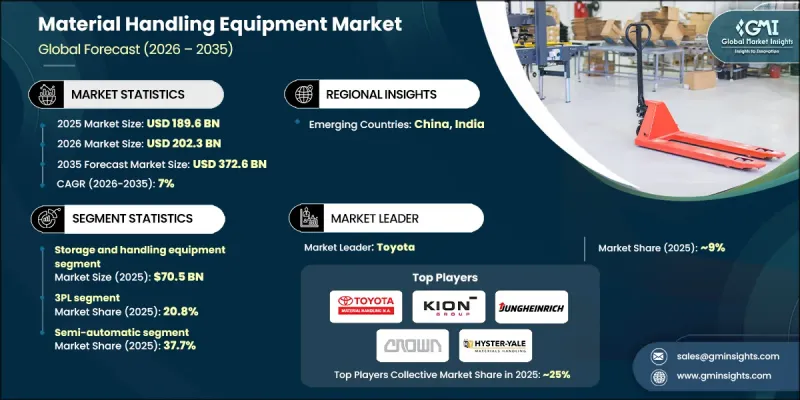
시장 확대는 디지털 상거래의 급속한 진화와 더 빠르고 안정적인 주문 이행 시스템에 대한 수요 증가가 영향을 미칩니다. 기업은 속도, 정확성, 제품 재고에 대한 높은 기대에 부응하기 위해 창고 및 유통 업무의 현대화를 강요하고 있습니다. 온라인 구매량이 증가함에 따라 기업은 높은 처리량 업무를 지원하기 때문에 자동화된 자재 이동, 보관 효율성 및 통합 물류 워크플로우를 선호합니다. 첨단 제조 기술과 연결된 공급망의 융합은 시설 간의 자재 보관, 운송 및 추적 방법을 재구성합니다. 스마트 기술을 채택함으로써 조직은 업무 동기화, 취급 실수 감소, 노동력 활용 최적화, 전반적인 비용 효율성 향상을 실현할 수 있습니다. 이러한 진보는 서비스 품질을 유지하면서 더 높은 주문량을 관리할 수 있는 확장 가능한 인프라를 제공합니다. 공급망이 더욱 복잡해지고 고객의 기대가 지속적으로 높아짐에 따라 자재관리 솔루션은 운영 경비가 아닌 전략적 투자로 파악되는 경향이 커지고 있습니다.
| 시장 범위 | |
|---|---|
| 시작 연도 | 2025년 |
| 예측 연도 | 2026-2035년 |
| 시작 시 가치 | 1,896억 달러 |
| 예측 금액 | 3,726억 달러 |
| CAGR | 7% |
보관 및 반송 기기 부문은 2025년에 705억 달러 시장 규모를 기록했으며, 2026-2035년 CAGR 7.6%를 나타낼 것으로 예측됩니다. 이 부문은 물류 시설, 제조 공장, 유통 거점 등 폭넓은 분야에서 활용되고 있기 때문에 자재관리 업무에 있어서 여전히 기초적인 역할을 담당하고 있습니다. 효율적인 보관 시스템은 공간 최적화, 재고 관리, 워크플로우 연속성을 지원하고, 증가하는 제품량 및 처리 능력 요구 사항을 충족하면서 기업이 업무 안정성을 유지할 수 있도록 합니다.
제3자 물류 분야는 2025년에 20.8%의 점유율을 차지했으며, 2035년까지 연평균 복합 성장률(CAGR) 7.2%로 추이할 것으로 전망됩니다. 이 분야의 성장은 복잡한 공급망 관리를 위한 유연하고 확장 가능한 솔루션을 추구하는 조직이 증가함에 따라 외부 위탁 물류 서비스에 대한 의존도가 높아지고 있음을 뒷받침합니다. 물류 서비스 제공업체의 역할 확대는 여러 고객을 가로지르는 업무에서 첨단 자재관리 장비에 대한 지속적인 수요를 이끌고 있습니다.
미국의 자재관리 장비 시장은 2025년 350억 달러 규모에 이르렀으며, 2026-2035년 연평균 복합 성장률(CAGR) 6.4%를 나타낼 것으로 예측됩니다. 시장의 주도적 지위는 첨단 유통 인프라, 자동화에 대한 강력한 투자, 창고 업무의 지속적인 현대화에 의해 지원됩니다. 스마트 시스템의 지속적인 통합과 디지털 제조 이니셔티브는 이 나라의 우위를 더욱 강화하고 있습니다.
자주 묻는 질문
목차
제1장 조사 방법 및 범위
제2장 주요 요약
제3장 업계 인사이트
- 생태계 분석
- 공급자의 상황
- 이익률
- 각 단계에서의 부가가치
- 밸류체인에 영향을 주는 요인
- 업계에 미치는 영향요인
- 성장 촉진요인
- 전자상거래 확대
- 인더스트리 4.0과 자동화
- 세계 공급망의 복잡성
- 과제 및 어려움
- 높은 초기 투자액
- 노동력의 스킬 갭
- 기회
- 친환경 에너지 절약 솔루션
- 신흥 시장의 성장
- 성장 촉진요인
- 성장 가능성 분석
- 장래 시장 동향
- 기술 및 혁신 동향
- 현재 기술 동향
- 신흥 기술
- 가격 동향
- 지역별
- 제품별
- 규제 상황
- 북미
- 미국-소비자제품안전위원회(CPSC) 연방규칙집(CFR) 제16편 제1512부
- 캐나다-국제표준화기구(ISO) 4210
- 유럽
- 독일-독일 표준 협회(DIN) 유럽 표준(EN) ISO 4210
- 영국-유럽 규격(EN) ISO 4210/영국 적합성 평가(UKCA)
- 프랑스-유럽 표준(EN) ISO 4210
- 아시아태평양
- 중국-국표(GB) 3565
- 인도-인도 규격(IS) 10613
- 일본-일본 공업 규격(JIS) D 9110
- 라틴아메리카
- 브라질-브라질 기술 규격 협회(ABNT) 브라질 규격(NBR) ISO 4210
- 멕시코-국제 표준화 기구(ISO) 4210
- 중동 및 아프리카
- 남아프리카-남아프리카 국가규격(SANS) 311
- 사우디아라비아-사우디아라비아 규격, 계량 및 품질 기구(SASO) 걸프 표준화 기구(GSO) ISO 4210
- 북미
- 무역 통계(HS코드-8428)
- 주요 수입국
- 주요 수출국
- Porter's Five Forces 분석
- PESTEL 분석
제4장 경쟁 구도
- 서문
- 기업의 시장 점유율 분석
- 지역별
- 북미
- 유럽
- 아시아태평양
- 라틴아메리카
- 중동 및 아프리카
- 지역별
- 기업 매트릭스 분석
- 주요 시장 기업의 경쟁 분석
- 경쟁 포지셔닝 매트릭스
- 주요 발전
- 합병 및 인수
- 제휴 및 협업
- 신제품 발매
- 확대 계획
제5장 시장 추계 및 예측 : 제품 유형별(2022-2035년)
- 보관 및 운반 설비
- 랙
- 스태킹 프레임
- 선반, 상자 및 서랍
- 메자닌
- 산업용 트럭
- 자동 유도 차량(AGV)
- 핸드 트럭, 플랫폼 트럭, 팔레트 트럭
- 주문 피커
- 팔레트 잭
- 사이드 로더
- 보행식 스태커
- 벌크 자재관리 장비
- 컨베이어 벨트
- 케이스 컨베이어
- 팔레트 컨베이어
- 스태커
- 재생 장치
- 엘리베이터
- 기타
- 로보틱스
- 자율 이동 로봇
- 협동 로봇(코봇)
- 스칼라 로봇
- 산업용 로봇
- 기타
- 자동 창고 시스템(AS/RS)
- 유닛 로드식 자동 창고 시스템(AS/RS)
- 미니로드 자동 창고 시스템(AS/RS)
제6장 시장 추계 및 예측 : 자동화별(2022-2035년)
- 수동
- 반자동
- 완전 자동화
제7장 시장 추계 및 예측 : 용도별(2022-2035년)
- 제3자 물류(3PL)
- 전자상거래
- 일반 상품
- 식품 소매업
- 식품 및 음료
- 제조업
- 내구성
- 비내구재
- 의약품 및 헬스케어
제8장 시장 추계 및 예측 : 유통 채널별(2022-2035년)
- 직접 판매
- 간접 판매
제9장 시장 추계 및 예측 : 지역별(2022-2035년)
- 북미
- 미국
- 캐나다
- 유럽
- 독일
- 영국
- 프랑스
- 이탈리아
- 스페인
- 아시아태평양
- 중국
- 인도
- 일본
- 한국
- 호주
- 라틴아메리카
- 브라질
- 멕시코
- 아르헨티나
- 중동 및 아프리카
- 사우디아라비아
- 아랍에미리트(UAE)
- 남아프리카
제10장 기업 프로파일
- BEUMER Group
- Columbus McKinnon Corporation
- Crown Equipment Corporation
- Daifuku Co., Ltd.
- Dematic(KION Group)
- Fives Group
- Honeywell Intelligrated
- Hyster-Yale Materials Handling
- Jungheinrich AG
- KION Group
- Komatsu Ltd.
- Mitsubishi Logisnext
- Murata Machinery
- SSI SCHAEFER
- Toyota Material Handling
The Global Material Handling Equipment Market was valued at USD 189.6 billion in 2025 and is estimated to grow at CAGR of 7% to reach USD 372.6 billion by 2035.
Market expansion is influenced by the rapid evolution of digital commerce and the growing need for faster, more reliable order fulfillment systems. Businesses are under increasing pressure to modernize warehouse and distribution operations to meet rising expectations for speed, accuracy, and product availability. As online purchasing volumes continue to grow, companies are prioritizing automated material movement, storage efficiency, and integrated logistics workflows to support high-throughput operations. The convergence of advanced manufacturing practices and connected supply chains is reshaping how materials are stored, transported, and tracked across facilities. The adoption of smart technologies allows organizations to synchronize operations, reduce handling errors, optimize labor utilization, and improve overall cost efficiency. These advancements are enabling scalable infrastructure capable of managing higher order volumes while maintaining service quality. As supply chains become more complex and customer expectations continue to rise, material handling solutions are increasingly viewed as strategic investments rather than operational expenses.
| Market Scope | |
|---|---|
| Start Year | 2025 |
| Forecast Year | 2026-2035 |
| Start Value | $189.6 Billion |
| Forecast Value | $372.6 Billion |
| CAGR | 7% |
The storage and handling equipment segment generated USD 70.5 billion in 2025 and is forecast to grow at a CAGR of 7.6% between 2026 and 2035. This segment remains fundamental to material handling operations due to its widespread use across logistics facilities, manufacturing plants, and distribution hubs. Efficient storage systems support space optimization, inventory control, and workflow continuity, allowing businesses to maintain operational stability while accommodating growing product volumes and throughput requirements.
The third-party logistics segment accounted for 20.8% share in 2025 and is expected to register a CAGR of 7.2% through 2035. Growth within this segment is supported by the increasing reliance on outsourced logistics services, as organizations seek flexible, scalable solutions to manage complex supply chains. The expanding role of logistics service providers is driving sustained demand for advanced material handling equipment across multi-client operations.
United States Material Handling Equipment Market USD 35 billion in 2025 and is projected to grow at a CAGR of 6.4% from 2026 to 2035. Market leadership is supported by advanced distribution infrastructure, strong investment in automation, and continuous modernization of warehousing operations. Ongoing integration of smart systems and digital manufacturing initiatives further reinforces the country's dominant position.
Key companies operating in the Global Material Handling Equipment Market include Toyota Material Handling, Daifuku Co., Ltd., KION Group, Jungheinrich AG, SSI SCHAEFER, BEUMER Group, Dematic (KION Group), Crown Equipment Corporation, Mitsubishi Logisnext, Columbus McKinnon Corporation, Murata Machinery, Komatsu Ltd., Fives Group, Honeywell Intelligrated, and Hyster-Yale Materials Handling. Companies in the material handling equipment market are strengthening their competitive position through continuous innovation, strategic partnerships, and expansion of automation-focused product portfolios. Manufacturers are investing heavily in smart, connected equipment that integrates seamlessly with digital warehouse management systems. Many firms are prioritizing modular and scalable solutions to address evolving customer requirements across diverse industries. Geographic expansion into high-growth logistics and industrial hubs is supporting revenue diversification, while service-based offerings such as lifecycle maintenance and system optimization are improving customer retention.
Table of Contents
Chapter 1 Methodology & Scope
- 1.1 Market scope & definitions
- 1.2 Research design
- 1.2.1 Research approach
- 1.2.2 Data collection methods
- 1.3 Base estimates and calculations
- 1.3.1 Base year calculation
- 1.3.2 Market estimates & forecasts parameters
- 1.4 Forecast Model
- 1.4.1 Key trends for market estimates
- 1.4.2 Quantified market impact analysis
- 1.4.2.1 Mathematical impact of growth parameters on forecast
- 1.4.3 Scenario analysis framework
- 1.5 Primary research and validation
- 1.5.1 Some of the primary sources (but not limited to)
- 1.6 Data mining sources
- 1.6.1 Paid Sources
- 1.7 Primary research and validation
- 1.7.1 Primary sources
- 1.8 Research Trail & confidence scoring
- 1.8.1 Research trail components
- 1.8.2 Scoring components
- 1.9 Research transparency addendum
- 1.9.1 Source attribution framework
- 1.9.2 Quality assurance metrics
- 1.9.3 Our commitment to trust
- 1.10 Market Definitions
Chapter 2 Executive Summary
- 2.1 Industry 360° synopsis
- 2.2 Key market trends
- 2.2.1 Regional
- 2.2.2 Product Type
- 2.2.3 Automation
- 2.2.4 Application
- 2.2.5 Distribution channel
- 2.3 CXO perspectives: Strategic imperatives
- 2.3.1 Key decision points for industry executives
- 2.3.2 Critical success factors for market players
- 2.4 Future outlook and strategic recommendations
Chapter 3 Industry Insights
- 3.1 Industry ecosystem analysis
- 3.1.1 Supplier landscape
- 3.1.2 Profit margin
- 3.1.3 Value addition at each stage
- 3.1.4 Factor affecting the value chain
- 3.2 Industry impact forces
- 3.2.1 Growth drivers
- 3.2.1.1 E-commerce expansion
- 3.2.1.2 Industry 4.0 & automation
- 3.2.1.3 Global supply chain complexity
- 3.2.2 Pitfalls & Challenges
- 3.2.2.1 High initial investment
- 3.2.2.2 Workforce skill gap
- 3.2.3 Opportunities
- 3.2.3.1 Green & energy-efficient solutions
- 3.2.3.2 Emerging markets growth
- 3.2.1 Growth drivers
- 3.3 Growth potential analysis
- 3.4 Future market trends
- 3.5 Technology and innovation landscape
- 3.5.1 Current technological trends
- 3.5.2 Emerging technologies
- 3.6 Price trends
- 3.6.1 By region
- 3.6.2 By product
- 3.7 Regulatory landscape
- 3.7.1 North America
- 3.7.1.1 US: Consumer Product Safety Commission (CPSC) 16 Code of Federal Regulations (CFR) part 1512
- 3.7.1.2 Canada: International Organization for Standardization (ISO) 4210
- 3.7.2 Europe
- 3.7.2.1 Germany: Deutsches Institut fur Normung (DIN) European Norm (EN) ISO 4210
- 3.7.2.2 UK: European Norm (EN) ISO 4210 / United Kingdom Conformity Assessed (UKCA)
- 3.7.2.3 France: European Norm (EN) ISO 4210
- 3.7.3 Asia Pacific
- 3.7.3.1 China: Guobiao (GB) 3565
- 3.7.3.2 India: Indian Standard (IS) 10613
- 3.7.3.3 Japan: Japanese Industrial Standard (JIS) D 9110
- 3.7.4 Latin America
- 3.7.4.1 Brazil: Associacao Brasileira de Normas Tecnicas (ABNT) Norma Brasileira (NBR) ISO 4210
- 3.7.4.2 Mexico: International Organization for Standardization (ISO) 4210
- 3.7.5 Middle East & Africa
- 3.7.5.1 South Africa: South African National Standard (SANS) 311
- 3.7.5.2 Saudi Arabia: Saudi Standards, Metrology and Quality Organization (SASO) Gulf Standardization Organization (GSO) ISO 4210
- 3.7.1 North America
- 3.8 Trade statistics (HS Code -8428)
- 3.8.1 Major importing countries
- 3.8.2 Major exporting countries
- 3.9 Porter's analysis
- 3.10 PESTEL analysis
Chapter 4 Competitive Landscape, 2025
- 4.1 Introduction
- 4.2 Company market share analysis
- 4.2.1 By Region
- 4.2.1.1 North America
- 4.2.1.2 Europe
- 4.2.1.3 Asia Pacific
- 4.2.1.4 Latin America
- 4.2.1.5 Middle East & Africa
- 4.2.1 By Region
- 4.3 Company matrix analysis
- 4.4 Competitive analysis of major market players
- 4.5 Competitive positioning matrix
- 4.6 Key developments
- 4.6.1 Mergers & acquisitions
- 4.6.2 Partnerships & collaborations
- 4.6.3 New product launches
- 4.6.4 Expansion plans
Chapter 5 Market Estimates & Forecast, By Product Type, 2022 - 2035, (USD Billion) (Thousand Units)
- 5.1 Key trends
- 5.2 Storage and handling equipment
- 5.2.1 Racks
- 5.2.2 Stacking frames
- 5.2.3 Shelves, bins, and drawers
- 5.2.4 Mezzanines
- 5.3 Industrial trucks
- 5.3.1 Automated Guided Vehicles (AGVs)
- 5.3.2 Hand, platform & pallet trucks
- 5.3.3 Order pickers
- 5.3.4 Pallet jacks
- 5.3.5 Side-loaders
- 5.3.6 Walkie stackers
- 5.4 Bulk material handling equipment
- 5.4.1 Conveyor belts
- 5.4.2 Case conveyors
- 5.4.3 Pallet conveyors
- 5.4.4 Stackers
- 5.4.5 Reclaimers
- 5.4.6 Elevators
- 5.4.7 Others
- 5.5 Robotics
- 5.5.1 Autonomous Mobile Robots
- 5.5.2 Cobots
- 5.5.3 Scara robots
- 5.5.4 Industrial robots
- 5.5.5 Others
- 5.5.6 AS/RS
- 5.5.6.1 Unit-load AS/RS
- 5.5.6.2 Mini-load AS/RS
Chapter 6 Market Estimates & Forecast, By Automation, 2022 - 2035, (USD Billion) (Thousand Units)
- 6.1 Key trends
- 6.2 Manual
- 6.3 Semi-automatic
- 6.4 Fully automatic
Chapter 7 Market Estimates & Forecast, By Application, 2022 - 2035, (USD Billion) (Thousand Units)
- 7.1 Key trends
- 7.2 3PL
- 7.3 E-commerce
- 7.4 General merchandise
- 7.5 Food retail
- 7.6 Food & beverage
- 7.7 Manufacturing
- 7.8 Durable
- 7.9 Non-durable
- 7.10 Pharmaceutical/healthcare
Chapter 8 Market Estimates & Forecast, By Distribution Channel, 2022 - 2035, (USD Billion) (Thousand Units)
- 8.1 Key trends
- 8.2 Direct
- 8.3 Indirect
Chapter 9 Market Estimates & Forecast, By Region, 2022 - 2035, (USD Billion) (Thousand Units)
- 9.1 Key trends
- 9.2 North America
- 9.2.1 U.S.
- 9.2.2 Canada
- 9.3 Europe
- 9.3.1 Germany
- 9.3.2 UK
- 9.3.3 France
- 9.3.4 Italy
- 9.3.5 Spain
- 9.4 Asia Pacific
- 9.4.1 China
- 9.4.2 India
- 9.4.3 Japan
- 9.4.4 South Korea
- 9.4.5 Australia
- 9.5 Latin America
- 9.5.1 Brazil
- 9.5.2 Mexico
- 9.5.3 Argentina
- 9.6 MEA
- 9.6.1 Saudi Arabia
- 9.6.2 UAE
- 9.6.3 South Africa
Chapter 10 Company Profiles
- 10.1 BEUMER Group
- 10.2 Columbus McKinnon Corporation
- 10.3 Crown Equipment Corporation
- 10.4 Daifuku Co., Ltd.
- 10.5 Dematic (KION Group)
- 10.6 Fives Group
- 10.7 Honeywell Intelligrated
- 10.8 Hyster-Yale Materials Handling
- 10.9 Jungheinrich AG
- 10.10 KION Group
- 10.11 Komatsu Ltd.
- 10.12 Mitsubishi Logisnext
- 10.13 Murata Machinery
- 10.14 SSI SCHAEFER
- 10.15 Toyota Material Handling