|
시장보고서
상품코드
1936557
외과용 내비게이션 시스템 시장 기회, 성장 촉진요인, 업계 동향 분석 및 예측(2026-2035년)Surgical Navigation Systems Market Opportunity, Growth Drivers, Industry Trend Analysis, and Forecast 2026 - 2035 |
||||||

세계의 외과용 내비게이션 시스템 시장은 2025년에 14억 달러로 평가되었으며, 2035년까지 CAGR 6.5%로 성장하여 26억 달러에 달할 것으로 예측됩니다.
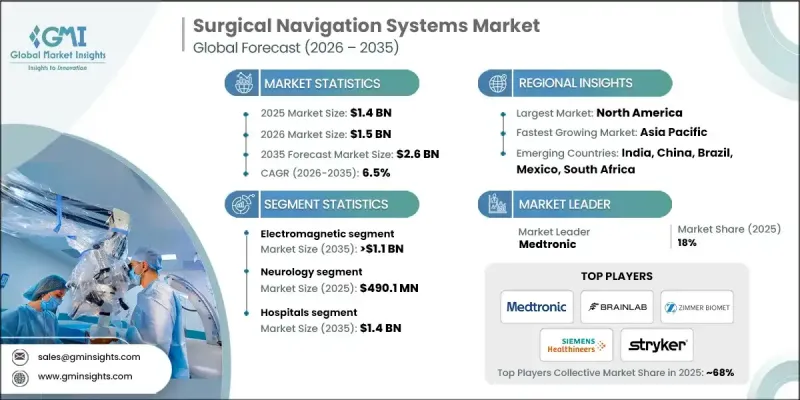
시장 성장은 복잡한 수술 건수의 증가, 최소침습 수술의 보급 확대, 영상 진단 및 내비게이션 기술의 지속적인 발전에 힘입어 성장하고 있습니다. 수술 내비게이션 시스템은 컴퓨터 지원을 통한 실시간 시각화를 제공하여 외과 의사가 보다 높은 정확성, 안전성, 효율성을 가지고 수술 계획을 수립하고 실행할 수 있도록 도와줍니다. 수술 전 또는 수술 중 영상과 첨단 추적 장치를 결합하여 정형외과, 신경외과, 이비인후과, 척추 수술의 치료 결과를 향상시킬 수 있습니다. 3D 이미징, AI 탑재 소프트웨어, 실시간 추적, CT/MRI와의 통합 등 혁신 기술을 통해 조작성과 정확성을 향상시켰습니다. 증강현실(AR)과 가상현실(VR)이 수술 영역에 디지털 가이드를 중첩하여 외과 의사의 인지적 부담 경감, 수술 중 의사결정의 최적화, 수술 계획의 고도화를 실현하는 사례가 증가하고 있습니다. 정밀하고 최소침습적인 수술의 장점에 대한 인식이 높아지면서 병원들은 첨단 내비게이션 기술에 대한 투자를 늘리고 있으며, 이는 전 세계적으로 지속적인 시장 성장을 견인하고 있습니다.
| 시장 범위 | |
|---|---|
| 시작 연도 | 2025년 |
| 예측 연도 | 2026-2035 |
| 개시 금액 | 14억 달러 |
| 예측 금액 | 26억 달러 |
| CAGR | 6.5% |
전자기 유도 내비게이션 분야는 2025년 44.5%의 점유율을 차지했습니다. 그 인기의 배경에는 시선 제한이 없는 높은 추적 정확도, 복잡한 해부학적 부위에서의 조작 용이성, 그리고 이비인후과, 신경외과, 최소침습 수술에서의 높은 채택률이 있습니다. 전자기 유도 시스템을 통해 외과의사는 직접 시야 확보가 어려운 상황에서도 기구의 위치를 실시간으로 정확하게 시각화할 수 있습니다. 이 정밀한 위치 파악 기능은 안전성을 높이고, 깊고 좁은 수술 부위에서 정확한 탐색을 보장하기 때문에 복잡한 수술에서 필수적인 기술로 자리 잡고 있습니다.
신경학 분야는 2025년 4억 9,010만 달러의 시장 규모를 기록했으며, 2026년부터 2035년까지 연평균 5.9%의 성장률을 보일 것으로 전망됩니다. 뇌종양, 간질, 뇌졸중, 신경퇴행성 질환의 증가가 정밀 뇌수술에 대한 수요를 견인하고 있습니다. 내비게이션 시스템은 중요한 뇌 구조를 피하면서 병변을 정확하게 표적화할 수 있어 합병증을 줄이고 수술 후 회복을 개선하는 데 기여합니다. 실시간 가이드를 통해 섬세한 수술이 중요한 조직에 대한 위험을 최소화하면서 시행되어 임상 결과와 환자 안전이 직접적으로 향상됩니다.
미국의 수술용 내비게이션 시스템 시장은 2025년 4억 9,710만 달러로 평가되며, 이는 북미 의료 시설에서 내비게이션 시스템 도입이 활발하게 이루어지고 있음을 반영합니다. 이 지역 병원들은 환자의 치료 결과를 개선하기 위해 최소침습 수술과 정확한 개입을 우선시하고 있으며, 이는 수술 내비게이션 시스템에 대한 의존도를 높이고 있습니다. 또한, 북미는 첨단 수술 기술에 대한 임상 연구 및 시험에서 선도적인 위치를 차지하고 있습니다. 이러한 조사에서 얻은 증거는 내비게이션 시스템의 유효성을 뒷받침하며, 임상의들 사이에서 광범위한 채택을 촉진하고 있습니다. 정부의 지원, 선진화된 병원 인프라, 높은 의료비 지출은 이 지역의 시장 우위를 더욱 강화하고 있습니다.
자주 묻는 질문
목차
제1장 조사 방법
제2장 주요 요약
제3장 업계 인사이트
제4장 경쟁 구도
제5장 시장 추정 및 예측 : 기술별, 2022-2035
제6장 시장 추정 및 예측 : 용도별, 2022-2035
제7장 시장 추정 및 예측 : 최종 용도별, 2022-2035
제8장 시장 추정 및 예측 : 지역별, 2022-2035
제9장 기업 개요
KSM 26.03.05The Global Surgical Navigation Systems Market was valued at USD 1.4 billion in 2025 and is estimated to grow at a CAGR of 6.5% to reach USD 2.6 billion by 2035.
Market growth is driven by the rising number of complex surgical procedures, increasing adoption of minimally invasive surgeries, and continuous technological advancements in imaging and navigation. Surgical navigation systems provide computer-assisted, real-time visualization, helping surgeons plan and execute procedures with higher accuracy, safety, and efficiency. By combining pre-operative or intraoperative imaging with advanced tracking devices, these systems improve outcomes in orthopedic, neurosurgical, ENT, and spinal interventions. Innovations such as 3D imaging, AI-enabled software, real-time tracking, and integration with CT/MRI have enhanced usability and precision. Augmented reality and virtual reality are increasingly incorporated to overlay digital guides onto the surgical field, enabling surgeons to reduce cognitive load, optimize intraoperative decision-making, and enhance surgical planning. Rising awareness of the benefits of accurate, minimally invasive procedures is prompting hospitals to invest in advanced navigation technologies, fueling sustained market growth globally.
| Market Scope | |
|---|---|
| Start Year | 2025 |
| Forecast Year | 2026-2035 |
| Start Value | $1.4 Billion |
| Forecast Value | $2.6 Billion |
| CAGR | 6.5% |
The electromagnetic navigation segment held 44.5% share in 2025. Its popularity stems from high tracking accuracy without line-of-sight limitations, ease of use in complex anatomical regions, and strong adoption in ENT, neurosurgery, and minimally invasive procedures. Electromagnetic systems allow surgeons to visualize the exact position of instruments in real-time, even when direct visual access is blocked. This precise localization enhances safety and ensures accurate navigation through deep or restricted surgical sites, making it indispensable for complex interventions.
The neurology segment generated USD 490.1 million in 2025 and is expected to grow at a CAGR of 5.9% from 2026 to 2035. The increasing prevalence of brain tumors, epilepsy, stroke, and degenerative neurological disorders is driving demand for precise neurosurgical procedures. Navigation systems enable surgeons to accurately target lesions while avoiding critical brain structures, reducing complications, and improving postoperative recovery. Real-time guidance ensures delicate operations are performed with minimal risk to vital tissues, directly enhancing clinical outcomes and patient safety.
U.S. Surgical Navigation Systems Market was valued at USD 497.1 million in 2025, reflecting strong adoption of navigation systems in North American healthcare facilities. Hospitals in the region prioritize minimally invasive procedures and accurate interventions to improve patient outcomes, which has increased the reliance on surgical navigation systems. Additionally, North America leads in clinical research and trials involving advanced surgical technologies. Evidence generated from these studies validates the effectiveness of navigation systems, encouraging widespread adoption among clinicians. Government support, advanced hospital infrastructure, and high healthcare expenditure further strengthen the region's market dominance.
Key players operating in the Global Surgical Navigation Systems Market include Philips, Medtronic, Stryker, Zimmer Biomet, Johnson & Johnson, KARL STORZ, Amplitude Surgical, B. BRAUN, Corin, Fiagon, BRAINLAB, Siemens Healthineers, and Smith+Nephew. Companies in the surgical navigation systems market are expanding their presence by focusing on technological innovation, developing AI-enabled and AR/VR-integrated platforms, and enhancing product accuracy and usability. Strategic collaborations with hospitals, research institutes, and clinical trial organizations allow companies to validate solutions and increase adoption. Expanding geographic reach, establishing regional distribution networks, and providing comprehensive after-sales and training services strengthen market foothold. Manufacturers are also investing in modular, customizable systems for diverse surgical specialties to address niche requirements.
Table of Contents
Chapter 1 Research Methodology
- 1.1 Research approach
- 1.2 Quality commitments
- 1.2.1 GMI AI policy & data integrity commitment
- 1.2.1.1 Source consistency protocol
- 1.2.1 GMI AI policy & data integrity commitment
- 1.3 Research trail & confidence scoring
- 1.3.1 Research trail components
- 1.3.2 Scoring components
- 1.4 Data collection
- 1.4.1 Partial list of primary sources
- 1.5 Data mining sources
- 1.5.1 Paid sources
- 1.5.1.1 Sources, by region
- 1.5.1 Paid sources
- 1.6 Base estimates and calculations
- 1.6.1 Base year calculation for any one approach
- 1.7 Forecast model
- 1.7.1 Quantified market impact analysis
- 1.7.1.1 Mathematical impact of growth parameters on forecast
- 1.7.1 Quantified market impact analysis
- 1.8 Research transparency addendum
- 1.8.1 Source attribution framework
- 1.8.2 Quality assurance metrics
- 1.8.3 Our commitment to trust
Chapter 2 Executive Summary
- 2.1 Industry 3600 synopsis
- 2.2 Key market trends
- 2.2.1 Regional trends
- 2.2.2 Technology trends
- 2.2.3 Application trends
- 2.2.4 End use trends
- 2.3 CXO perspectives: Strategic imperatives
- 2.3.1 Key decision points for industry executives
- 2.3.2 Critical success factors for market players
- 2.4 Future outlook and strategic recommendations
Chapter 3 Industry Insights
- 3.1 Industry ecosystem analysis
- 3.2 Industry impact forces
- 3.2.1 Growth drivers
- 3.2.1.1 Increasing demand for minimally invasive surgical procedures
- 3.2.1.2 Technological advancements in surgical navigation systems
- 3.2.1.3 Rise in orthopedic and neurology disorders
- 3.2.1.4 Surging target patient pool of ENT disorders
- 3.2.2 Industry pitfalls and challenges
- 3.2.2.1 High instrument and procedural costs
- 3.2.2.2 Stringent government regulations
- 3.2.3 Market opportunities
- 3.2.3.1 Expansion in emerging markets
- 3.2.3.2 Increasing use in non-traditional specialties
- 3.2.1 Growth drivers
- 3.3 Growth potential analysis
- 3.4 Regulatory landscape
- 3.4.1 North America
- 3.4.2 Europe
- 3.4.3 Asia Pacific
- 3.5 Technology landscape
- 3.5.1 Current technological trends
- 3.5.2 Emerging technologies
- 3.6 Start-up scenarios
- 3.7 Future market trends
- 3.8 Value chain analysis
- 3.9 Porter's analysis
- 3.10 PESTEL analysis
- 3.11 Gap analysis
Chapter 4 Competitive Landscape, 2025
- 4.1 Introduction
- 4.2 Company matrix analysis
- 4.3 Company market share analysis
- 4.3.1 Global
- 4.3.2 North America
- 4.3.3 Europe
- 4.3.4 Asia Pacific
- 4.4 Competitive positioning matrix
- 4.5 Competitive analysis of major market players
- 4.6 Key developments
- 4.6.1 Mergers & acquisitions
- 4.6.2 Partnerships & collaborations
- 4.6.3 New product launches
- 4.6.4 Expansion plans
Chapter 5 Market Estimates and Forecast, By Technology, 2022 - 2035 ($ Mn)
- 5.1 Key trends
- 5.2 Electromagnetic
- 5.3 Optical
- 5.4 Hybrid
Chapter 6 Market Estimates and Forecast, By Application, 2022 - 2035 ($ Mn)
- 6.1 Key trends
- 6.2 Neurology
- 6.3 Orthopedic
- 6.3.1 Knee
- 6.3.2 Hip
- 6.3.3 Shoulder
- 6.4 ENT
- 6.5 Dental
- 6.6 Other applications
Chapter 7 Market Estimates and Forecast, By End Use, 2022 - 2035 ($ Mn)
- 7.1 Key trends
- 7.2 Hospitals
- 7.3 Ambulatory surgical centers
- 7.4 Other end use
Chapter 8 Market Estimates and Forecast, By Region, 2022 - 2035 ($ Mn)
- 8.1 Key trends
- 8.2 North America
- 8.2.1 U.S.
- 8.2.2 Canada
- 8.3 Europe
- 8.3.1 Germany
- 8.3.2 UK
- 8.3.3 France
- 8.3.4 Spain
- 8.3.5 Italy
- 8.3.6 Netherlands
- 8.4 Asia Pacific
- 8.4.1 China
- 8.4.2 Japan
- 8.4.3 India
- 8.4.4 Australia
- 8.4.5 South Korea
- 8.5 Latin America
- 8.5.1 Brazil
- 8.5.2 Mexico
- 8.5.3 Argentina
- 8.6 Middle East and Africa
- 8.6.1 South Africa
- 8.6.2 Saudi Arabia
- 8.6.3 UAE
Chapter 9 Company Profiles
- 9.1 Amplitude Surgical
- 9.2 B. BRAUN
- 9.3 BRAINLAB
- 9.4 Corin
- 9.5 Fiagon
- 9.6 Johnson & Johnson
- 9.7 KARL STORZ
- 9.8 Medtronic
- 9.9 Philips
- 9.10 Siemens Healthineers
- 9.11 Smith+Nephew
- 9.12 Stryker
- 9.13 Zimmer Biomet