

|
시장보고서
상품코드
1936568
지역 냉방 시장 기회, 성장 촉진요인, 업계 동향 분석 및 예측(2026-2035년)District Cooling Market Opportunity, Growth Drivers, Industry Trend Analysis, and Forecast 2026 - 2035 |
||||||

세계의 지역 냉방 시장은 2025년에 1,336억 달러로 평가되었으며, 2035년까지 CAGR 4%로 성장하여 2,002억 달러에 달할 것으로 예측됩니다.
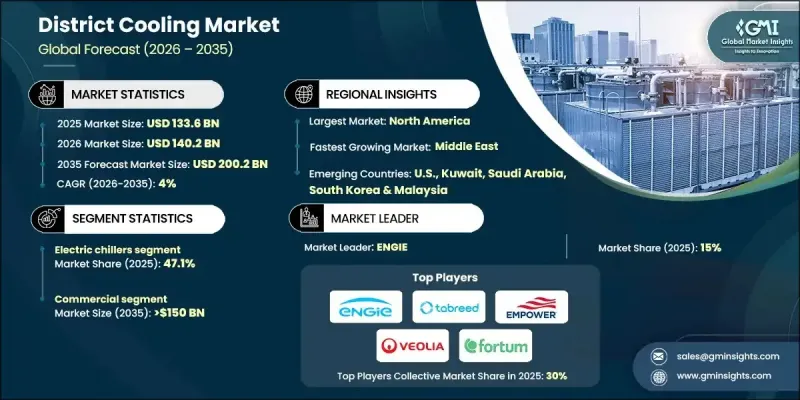
시장 성장은 가속화되는 도시 개발과 인구 밀집 환경에서의 효율적인 공간 냉각에 대한 수요 증가에 의해 뒷받침되고 있습니다. 세계 지속가능성 목표에 따라 에너지 소비와 탄소 배출량 감소에 대한 관심이 높아지면서 업계의 모멘텀이 더욱 강화되고 있습니다. 지역 냉방 시스템은 중앙 집중식 냉수 생산을 통해 가동되며, 단열 네트워크를 통해 여러 건물에 분배됩니다. 이를 통해 독립형 냉각 시스템에 대한 고효율 대안을 제공합니다. 이러한 솔루션은 전력 수요 감소, 부하 관리 개선, 환경 부하 감소를 지원합니다. 에너지 비용 상승과 열효율 최적화에 대한 요구가 높아지면서 중앙집중식 냉각 인프라에 대한 선호도가 높아지고 있습니다. 대체 에너지원과 열회수 기술의 통합은 시스템의 성능과 지속가능성을 더욱 향상시킵니다. 정부 주도의 에너지 효율화 프로그램과 친환경 건축 기준은 보다 광범위한 도입을 지원하고 있습니다. 시스템 업그레이드, 배관망 확장, 첨단 축열 기술에 대한 지속적인 투자를 통해 운영 탄력성과 장기적인 비용 효율성을 개선하고 세계 시장의 꾸준한 확장을 강화하고 있습니다.
| 시장 범위 | |
|---|---|
| 시작 연도 | 2025년 |
| 예측 연도 | 2026-2035 |
| 개시 금액 | 1,336억 달러 |
| 예측 금액 | 2,002억 달러 |
| CAGR | 4% |
전기식 냉각기 기반 지역 냉방 시스템 부문은 2025년 47.1%의 점유율을 차지했습니다. 이 부문의 성장은 중앙 집중식 인프라를 지원하기 위해 설계된 대용량 냉각 장비의 도입 증가에 의해 주도되고 있습니다. 냉각기의 효율성 향상, 성능 최적화, 지능형 제어의 통합과 같은 발전은 대규모 냉각 네트워크 전반에 걸쳐 지속적으로 채택을 강화하고 있습니다.
상업용 부문은 2025년 76.7%의 점유율을 차지했으며, 2035년까지 1,500억 달러에 달할 것으로 예측됩니다. 대규모 빌딩을 지원하고, 진화하는 효율 표준을 준수하며, 신뢰할 수 있고 에너지 효율적인 냉각 솔루션에 대한 수요가 증가하고 있습니다. 자동화 및 시스템 최적화의 발전은 전체 상업 개발의 성장을 지속적으로 뒷받침하고 있습니다.
미국 지역 냉난방 공급 시장은 2025년 90.5%의 점유율을 차지하며 1,090억 달러 규모를 형성할 것으로 예상됩니다. 강력한 규제 시행, 에너지 절약형 냉각 기술 채택, 고밀도 도시 개발은 시장의 선도적 지위와 장기적인 확장을 지속적으로 뒷받침하고 있습니다.
자주 묻는 질문
목차
제1장 조사 방법과 범위
제2장 주요 요약
제3장 업계 인사이트
제4장 경쟁 구도
제5장 시장 규모 및 예측 : 제조 기술별, 2022-2035
제6장 시장 규모 및 예측 : 용도별, 2022-2035
제7장 시장 규모 및 예측 : 지역별, 2022-2035
제8장 기업 개요
KSM 26.03.05The Global District Cooling Market was valued at USD 133.6 billion in 2025 and is estimated to grow at a CAGR of 4% to reach USD 200.2 billion by 2035.
Market growth is supported by accelerating urban development and rising demand for efficient space cooling across densely populated environments. Increasing focus on lowering energy consumption and carbon emissions in line with global sustainability objectives continues to strengthen industry momentum. District cooling systems operate through centralized production of chilled water that is distributed to multiple buildings via insulated networks, offering a highly efficient alternative to standalone cooling systems. These solutions support reduced electricity demand, improved load management, and lower environmental impact. Rising energy costs and the need for optimized thermal efficiency are driving preference for centralized cooling infrastructure. Integration of alternative energy sources and recovery technologies further enhances system performance and sustainability. Government-backed energy efficiency programs and green construction standards are supporting broader adoption. Continued investment in system upgrades, distribution expansion, and advanced thermal storage technologies is improving operational resilience and long-term cost efficiency, reinforcing steady market expansion worldwide.
| Market Scope | |
|---|---|
| Start Year | 2025 |
| Forecast Year | 2026-2035 |
| Start Value | $133.6 Billion |
| Forecast Value | $200.2 Billion |
| CAGR | 4% |
The electric chiller-based district cooling systems segment accounted for 47.1% share in 2025. Growth in this segment is driven by the rising deployment of high-capacity cooling equipment designed to support centralized infrastructure. Advancements in chiller efficiency, performance optimization, and intelligent control integration continue to strengthen adoption across large-scale cooling networks.
The commercial applications segment held 76.7% share in 2025 and is projected to reach USD 150 billion by 2035. Demand is driven by the need for reliable, energy-efficient cooling solutions that support large building clusters and comply with evolving efficiency standards. Increased automation and system optimization continue to support growth across commercial developments.
United States District Cooling Market held 90.5% share in 2025, generating USD 109 billion. Strong regulatory enforcement, adoption of energy-efficient cooling technologies, and high-density urban development continue to support market leadership and long-term expansion.
Key companies operating in the Global District Cooling Market include ENGIE, Tabreed, Danfoss, Siemens, Veolia, Keppel, Fortum, Vattenfall, Emirates Central Cooling Systems Corporation PJSC, LOGSTOR Denmark Holding, Ramboll Group, ADC Energy Systems, Cetetherm, Marafeq Qatar, Qatar District Cooling Company, Shinryo Corporation, SP Group, Helen, Goteborg Energi, Stellar Energy, Pal Group, Wien Energie, DC Pro Engineering, and AtkinsRealis. These players maintain strong market positions through integrated service capabilities and large-scale infrastructure expertise. To strengthen their presence in pharmaceutical and healthcare applications, district cooling providers focus on delivering highly reliable and uninterrupted cooling solutions that meet stringent operational and regulatory requirements. Companies invest in redundant system design, advanced monitoring, and predictive maintenance to ensure continuous temperature control, which is critical for healthcare environments. Strategic collaborations with healthcare infrastructure developers support early system integration.
Table of Contents
Chapter 1 Methodology & Scope
- 1.1 Research approach
- 1.2 Quality commitments
- 1.2.1 GMI AI policy & data integrity commitment
- 1.2.1.1 Source consistency protocol
- 1.2.1 GMI AI policy & data integrity commitment
- 1.3 Research trail & confidence scoring
- 1.3.1 Research trail components
- 1.3.2 Scoring components
- 1.4 Data collection
- 1.4.1 Partial list of primary sources
- 1.5 Data mining sources
- 1.5.1 Paid sources
- 1.5.1.1 Sources, by region
- 1.5.1 Paid sources
- 1.6 Base estimates and calculations
- 1.6.1 Base year calculation for any one approach
- 1.7 Market estimates & forecasts parameters
- 1.8 Forecast model
- 1.8.1 Quantified market impact analysis
- 1.8.1.1 Mathematical impact of growth parameters on forecast
- 1.8.1 Quantified market impact analysis
- 1.9 Research transparency addendum
- 1.9.1 Source attribution framework
- 1.9.2 Quality assurance metrics
- 1.9.3 Our commitment to trust
- 1.10 Market definitions
Chapter 2 Executive Summary
- 2.1 Industry synopsis, 2022 - 2035
- 2.2 Business trends
- 2.3 Production technique trends
- 2.4 Application trends
- 2.5 Regional trends
Chapter 3 Industry Insights
- 3.1 Industry ecosystem analysis
- 3.1.1 Key suppliers and technology providers
- 3.1.2 Logistics, distribution, and services
- 3.2 Regulatory landscape
- 3.3 Industry impact forces
- 3.3.1 Growth drivers
- 3.3.2 Industry pitfalls & challenges
- 3.4 Growth potential analysis
- 3.5 Porter's analysis
- 3.5.1 Bargaining power of suppliers
- 3.5.2 Bargaining power of buyers
- 3.5.3 Threat of new entrants
- 3.5.4 Threat of substitutes
- 3.6 PESTEL analysis
- 3.6.1 Political factors
- 3.6.2 Economic factors
- 3.6.3 Social factors
- 3.6.4 Technological factors
- 3.6.5 Legal factors
- 3.6.6 Environmental factors
- 3.7 Cost structure analysis of district cooling system
- 3.8 Price trend analysis, by region
- 3.9 Emerging opportunities & trends
- 3.10 Digitalization and IoT integration
- 3.11 Case study analysis - Integrated DHC system in Stockholm
- 3.11.1 Project overview
- 3.11.2 Key facts & figures
- 3.11.3 Customer segmentation
- 3.11.4 Policies & incentives supporting the DHC
Chapter 4 Competitive Landscape, 2026
- 4.1 Introduction
- 4.2 Company market share analysis, by region, 2025
- 4.2.1 North America
- 4.2.2 Europe
- 4.2.3 Asia Pacific
- 4.2.4 Middle East
- 4.2.5 Rest of World
- 4.3 Strategic dashboard
- 4.3.1 Key partnerships & collaborations
- 4.3.2 Major M&A activities
- 4.3.3 Product innovations & launches
- 4.3.4 Market expansion strategies
- 4.4 Strategic initiatives
- 4.5 Competitive benchmarking
- 4.6 Innovation & technology landscape
Chapter 5 Market Size and Forecast, By Production Technique, 2022 - 2035 (USD Million & TJ)
- 5.1 Key trends
- 5.2 Free cooling
- 5.3 Absorption cooling
- 5.4 Heat pumps
- 5.5 Electric chillers
- 5.6 Others
Chapter 6 Market Size and Forecast, By Application, 2022 - 2035 (USD Million & TJ)
- 6.1 Key trends
- 6.2 Residential
- 6.3 Commercial
- 6.3.1 College/university
- 6.3.2 Office building
- 6.3.3 Government building
- 6.3.4 Others
- 6.4 Industrial
Chapter 7 Market Size and Forecast, By Region, 2022 - 2035 (USD Million & TJ)
- 7.1 Key trends
- 7.2 North America
- 7.2.1 U.S.
- 7.2.2 Canada
- 7.3 Europe
- 7.3.1 Germany
- 7.3.2 Poland
- 7.3.3 Sweden
- 7.3.4 Italy
- 7.3.5 France
- 7.3.6 Finland
- 7.3.7 Austria
- 7.3.8 Norway
- 7.4 Asia Pacific
- 7.4.1 China
- 7.4.2 Japan
- 7.4.3 South Korea
- 7.4.4 Singapore
- 7.4.5 Malaysia
- 7.5 Middle East
- 7.5.1 Saudi Arabia
- 7.5.2 UAE
- 7.5.3 Qatar
- 7.5.4 Oman
- 7.5.5 Kuwait
- 7.5.6 Bahrain
- 7.6 Rest of World
Chapter 8 Company Profiles
- 8.1 ADC Energy Systems
- 8.2 AtkinsRealis
- 8.3 Cetetherm
- 8.4 Danfoss
- 8.5 DC Pro Engineering
- 8.6 Emicool
- 8.7 Emirates Central Cooling Systems Corporation PJSC
- 8.8 ENGIE
- 8.9 Fortum
- 8.10 Goteborg Energi
- 8.11 Helen
- 8.12 Keppel
- 8.13 LOGSTOR Denmark Holding
- 8.14 Marafeq Qatar
- 8.15 Pal Group
- 8.16 Qatar District Cooling Company
- 8.17 Ramboll Group
- 8.18 Shinryo Corporation
- 8.19 Siemens
- 8.20 SP Group
- 8.21 Stellar Energy
- 8.22 Tabreed
- 8.23 Vattenfall
- 8.24 Veolia
- 8.25 Wien Energie


