|
시장보고서
상품코드
1936572
업사이클 식품 시장 기회, 성장 촉진요인, 업계 동향 분석, 예측(2026-2035년)Upcycled Food Products Market Opportunity, Growth Drivers, Industry Trend Analysis, and Forecast 2026 - 2035 |
||||||

세계의 업사이클 식품 시장은 2025년에 608억 달러로 평가되었으며, 2035년까지 CAGR 5.7%로 성장하여 1,060억 달러에 달할 것으로 예측됩니다.
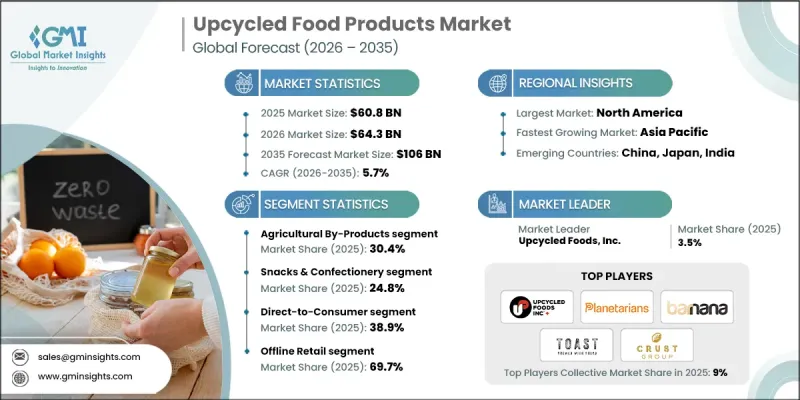
지속가능성에 대한 노력, 높아지는 환경 인식, 지속적인 혁신이 세계 식품 산업을 변화시키는 가운데, 시장은 강한 추진력을 보이고 있습니다. 제조업체들은 잉여 식품원료, 농업잔재물, 가공제품을 영양가 향상, 유통기한 연장, 다양한 제품 용도를 제공하는 부가가치 식품원료로 전환하려는 움직임이 가속화되고 있습니다. 지속가능한 방식으로 생산된 식품에 대한 소비자의 수용도가 높아짐에 따라 브랜드는 생산 규모를 확대하고 업사이클 원료를 주류 제품에 통합하도록 장려하고 있습니다. 첨단 가공 기술을 통해 기존에는 가치가 낮았던 음식물 쓰레기를 영양학적 프로파일과 안정성이 개선된 기능성 원료로 전환할 수 있게 되었습니다. 경쟁이 치열해지면서 기술 차별화가 성공의 핵심 요소로 떠오르면서 혁신, 전략적 제휴, 지적재산권 개발에 대한 투자를 촉진하고 있습니다. 이러한 변화는 업사이클 식품이 폐기물을 줄이기 위한 상업적으로 실현 가능한 솔루션으로 자리매김하는 동시에 지속가능하고 기능적인 영양을 원하는 소비자의 진화하는 수요에 부응하고 있습니다.
| 시장 범위 | |
|---|---|
| 시작 연도 | 2025년 |
| 예측 연도 | 2026-2035년 |
| 개시 금액 | 608억 달러 |
| 예측 금액 | 1,060억 달러 |
| CAGR | 5.7% |
농업 부산물 부문은 2025년 30.4%의 점유율을 차지했으며, 2035년까지 연평균 6%의 성장률을 기록할 것으로 전망됩니다. 이 부문은 안정적인 원재료 공급, 안정적인 조달 경로, 효율적인 생산 확대 능력으로 인해 선도적인 위치를 유지하고 있습니다. 예측 가능한 공급망과 확립된 산업적 가공 프레임워크는 지속가능한 성장을 뒷받침하며, 농업 유래 원료가 여러 제품 카테고리에 걸쳐 업사이클 식품 제조의 기반이 될 수 있도록 합니다.
스낵 및 과자 부문은 2025년 24.8%의 점유율을 차지했으며, 2034년까지 연평균 5.5%의 성장률을 기록할 것으로 전망됩니다. 높은 소비자 인지도, 빈번한 충동구매 행동, 효과적인 지속가능성 중심의 브랜딩이 이 부문의 우위를 뒷받침하고 있습니다. 지속적인 혁신과 클린 라벨 및 친환경 트렌드에 부합하는 지속적인 혁신이 전체 시장 성장과 함께 꾸준한 성장을 견인할 것으로 예상됩니다.
북미 업사이클 식품 시장은 2025년 243억 달러에 달했으며, 예측 기간 동안 강력한 성장세를 보일 것으로 예상됩니다. 이 지역은 지속가능성에 대한 소비자의 높은 인식, 음식물 쓰레기를 줄이기 위한 지원적인 규제 프레임워크, 그리고 높은 수준의 식품 가공 능력의 혜택을 누리고 있습니다. 잘 구축된 공급망과 혁신 중심의 식품 제조 생태계는 다양한 카테고리에서 업사이클 원료 및 완제품의 확장을 지속적으로 지원하고 있습니다.
자주 묻는 질문
목차
제1장 조사 방법과 범위
제2장 주요 요약
제3장 업계 인사이트
제4장 경쟁 구도
제5장 시장 추정 및 예측 : 원료별, 2022-2035년
제6장 시장 추정 및 예측 : 제품 유형별, 2022-2035년
제7장 시장 추정 및 예측 : 최종사용자별, 2022-2035년
제8장 시장 추정 및 예측 : 유통 채널별, 2022-2035년
제9장 시장 추정 및 예측 : 지역별, 2022-2035년
제10장 기업 개요
KSM 26.03.12The Global Upcycled Food Products Market was valued at USD 60.8 billion in 2025 and is estimated to grow at a CAGR of 5.7% to reach USD 106 billion by 2035.
The market is witnessing strong momentum as sustainability initiatives, rising environmental awareness, and ongoing innovation reshape the global food industry. Manufacturers are increasingly converting surplus food materials, agricultural residues, and processing outputs into value-added food ingredients that offer improved nutrition, extended shelf life, and broader product applications. Growing consumer acceptance of sustainably produced foods has encouraged brands to scale production and incorporate upcycled inputs into mainstream offerings. Advanced processing technologies are enabling companies to convert previously low-value food waste into functional ingredients with enhanced nutritional profiles and stability. As competition intensifies, technological differentiation has become a critical success factor, driving investments in innovation, strategic partnerships, and intellectual property development. These shifts are positioning upcycled foods as a commercially viable solution for waste reduction while meeting evolving consumer demand for sustainable and functional nutrition.
| Market Scope | |
|---|---|
| Start Year | 2025 |
| Forecast Year | 2026-2035 |
| Start Value | $60.8 Billion |
| Forecast Value | $106 Billion |
| CAGR | 5.7% |
The agricultural by-products segment accounted for 30.4% share in 2025 and is expected to grow at a CAGR of 6% through 2035. This segment continues to lead due to consistent raw material availability, reliable sourcing channels, and the ability to scale production efficiently. Predictable supply chains and established industrial processing frameworks support sustained growth, allowing agriculture-derived inputs to remain a cornerstone of upcycled food manufacturing across multiple product categories.
The snacks and confectionery segment held 24.8% share in 2025 and is projected to grow at a CAGR of 5.5% through 2034. Strong consumer familiarity, frequent impulse purchasing behavior, and effective sustainability-focused branding have supported segment dominance. Continued innovation and alignment with clean-label and eco-conscious trends are expected to drive steady expansion in line with overall market growth.
North America Upcycled Food Products Market reached USD 24.3 billion in 2025 and is expected to experience strong growth over the forecast period. The region benefits from high consumer awareness of sustainability, supportive regulatory frameworks aimed at reducing food waste, and advanced food processing capabilities. Well-developed supply chains and innovation-driven food manufacturing ecosystems continue to support the expansion of upcycled ingredients and finished products across diverse categories.
Key companies operating in the Global Upcycled Food Products Market include Upcycled Foods, Inc., Barnana, Planetarians, Toast Ale Ltd., Rubies in the Rubble Ltd., Rootly ApS, Matriark Foods, CRUST Group Pte. Ltd., Green Bowl Foods, and I Am Grounded. Companies in the upcycled food products market are adopting a range of strategies to strengthen their competitive position and expand market presence. Significant investment is being directed toward research and development to enhance ingredient functionality, nutritional value, and shelf stability. Strategic partnerships with food processors, retailers, and agricultural suppliers help secure consistent raw material streams and expand distribution networks. Firms are also focusing on product diversification to address multiple food categories and consumer segments. Branding strategies centered on sustainability, transparency, and waste reduction are being leveraged to build consumer trust and loyalty.
Table of Contents
Chapter 1 Methodology & Scope
- 1.1 Research approach
- 1.2 Quality Commitments
- 1.2.1 GMI AI policy & data integrity commitment
- 1.2.1.1 Source consistency protocol
- 1.2.1 GMI AI policy & data integrity commitment
- 1.3 Research Trail & Confidence Scoring
- 1.3.1 Research Trail Components
- 1.3.2 Scoring Components
- 1.4 Data Collection
- 1.4.1 Partial list of primary sources
- 1.5 Data mining sources
- 1.5.1 Paid sources
- 1.5.1.1 Sources, by region
- 1.5.1 Paid sources
- 1.6 Base estimates and calculations
- 1.6.1 Base year calculation for any one approach
- 1.7 Forecast model
- 1.7.1 Quantified market impact analysis
- 1.7.1.1 Mathematical impact of growth parameters on forecast
- 1.7.1 Quantified market impact analysis
- 1.8 Research transparency addendum
- 1.8.1 Source attribution framework
- 1.8.2 Quality assurance metrics
- 1.8.3 Our commitment to trust
Chapter 2 Executive Summary
- 2.1 Industry 360° synopsis
- 2.2 Key market trends
- 2.2.1 Regional
- 2.2.2 Source Type
- 2.2.3 Product Type
- 2.2.4 End User
- 2.2.5 Distribution Channel
- 2.3 TAM Analysis, 2025-2034
- 2.4 CXO perspectives: Strategic imperatives
- 2.4.1 Executive decision points
- 2.4.2 Critical success factors
- 2.5 Future Outlook and Strategic Recommendations
Chapter 3 Industry Insights
- 3.1 Industry ecosystem analysis
- 3.1.1 Supplier landscape
- 3.1.2 Profit margin
- 3.1.3 Value addition at each stage
- 3.1.4 Factor affecting the value chain
- 3.1.5 Disruptions
- 3.2 Industry impact forces
- 3.2.1 Growth drivers
- 3.2.1.1 Rapid Growth in Consumer Demand for Sustainable and Ethical Food Consumption
- 3.2.1.2 Global Food Waste Reduction Mandates Supporting Circular Economy Business Models
- 3.2.1.3 Corporate ESG Commitments Increasing Use of Sustainable Ingredients in Product Formulations
- 3.2.2 Industry pitfalls and challenges
- 3.2.2.1 Consumer Skepticism Around Safety, Quality, and Taste of Upcycled Products
- 3.2.2.2 Inconsistent Availability and Quality of Food Processing By-Product Feedstocks
- 3.2.2.3 Fragmented Regulatory Frameworks for Upcycled Foods Across Global Markets
- 3.2.3 Market opportunities
- 3.2.3.1 Expansion of High-Margin B2B Ingredients for Food and Beverage Manufacturers
- 3.2.3.2 Development of Functional Foods and Nutraceuticals from Bioactive Waste Compounds
- 3.2.3.3 Strategic Partnerships with Large Food Processors to Monetize Waste Streams
- 3.2.1 Growth drivers
- 3.3 Growth potential analysis
- 3.4 Regulatory landscape
- 3.4.1 North America
- 3.4.2 Europe
- 3.4.3 Asia Pacific
- 3.4.4 Latin America
- 3.4.5 Middle East & Africa
- 3.5 Porter's analysis
- 3.6 PESTEL analysis
- 3.7 Price trends
- 3.7.1 By region
- 3.7.2 By source type
- 3.8 Future market trends
- 3.9 Technology and Innovation landscape
- 3.9.1 Current technological trends
- 3.9.2 Emerging technologies
- 3.10 Patent Landscape
- 3.11 Trade statistics (HS code)
- 3.11.1 Major importing countries
- 3.11.2 Major exporting countries
- 3.12 Sustainability and environmental aspects
- 3.12.1 Sustainable practices
- 3.12.2 Waste reduction strategies
- 3.12.3 Energy efficiency in production
- 3.12.4 Eco-friendly initiatives
- 3.13 Carbon footprint consideration
Chapter 4 Competitive Landscape, 2025
- 4.1 Introduction
- 4.2 Company market share analysis
- 4.2.1 By region
- 4.2.1.1 North America
- 4.2.1.2 Europe
- 4.2.1.3 Asia Pacific
- 4.2.1.4 LATAM
- 4.2.1.5 MEA
- 4.2.1 By region
- 4.3 Company matrix analysis
- 4.4 Competitive analysis of major market players
- 4.5 Competitive positioning matrix
- 4.6 Key developments
- 4.6.1 Mergers & acquisitions
- 4.6.2 Partnerships & collaborations
- 4.6.3 New Product Launches
- 4.6.4 Expansion Plans
Chapter 5 Market Estimates and Forecast, By Source Type, 2022-2035 (USD Billion) (Kilo Tons)
- 5.1 Key trends
- 5.2 Food Waste
- 5.3 Agricultural By-Products
- 5.4 Brewery & Distillery Waste
- 5.5 Food Processing By-Products
- 5.6 Others
Chapter 6 Market Estimates and Forecast, By Product Type, 2022-2035 (USD Billion) (Kilo Tons)
- 6.1 Key trends
- 6.2 Snacks & Confectionery
- 6.3 Bakery & Cereal Products
- 6.4 Dairy Alternatives & Frozen
- 6.5 Ingredients & Supplements
- 6.6 Prepared Foods & Meals
- 6.7 Personal Care Products
- 6.8 Pet Food
- 6.9 Household Products
Chapter 7 Market Estimates and Forecast, By End User, 2022-2035 (USD Billion) (Kilo Tons)
- 7.1 Key trends
- 7.2 Direct-to-Consumer
- 7.3 Food Service & Hospitality
- 7.4 Ingredient Manufacturers (B2B)
- 7.5 Institutional & Government
- 7.6 Pet Care Industry
- 7.7 Beauty & Personal Care
Chapter 8 Market Estimates and Forecast, By Distribution Channel, 2022-2035 (USD Billion) (Kilo Tons)
- 8.1 Key trends
- 8.2 Online / E-Commerce
- 8.3 Offline Retail
Chapter 9 Market Estimates and Forecast, By Region, 2022-2035 (USD Billion) (Kilo Tons)
- 9.1 Key trends
- 9.2 North America
- 9.2.1 U.S.
- 9.2.2 Canada
- 9.3 Europe
- 9.3.1 Germany
- 9.3.2 UK
- 9.3.3 France
- 9.3.4 Spain
- 9.3.5 Italy
- 9.3.6 Rest of Europe
- 9.4 Asia Pacific
- 9.4.1 China
- 9.4.2 India
- 9.4.3 Japan
- 9.4.4 Australia
- 9.4.5 South Korea
- 9.4.6 Rest of Asia Pacific
- 9.5 Latin America
- 9.5.1 Brazil
- 9.5.2 Mexico
- 9.5.3 Argentina
- 9.5.4 Rest of Latin America
- 9.6 Middle East and Africa
- 9.6.1 Saudi Arabia
- 9.6.2 South Africa
- 9.6.3 UAE
- 9.6.4 Rest of Middle East and Africa
Chapter 10 Company Profiles
- 10.1 Barnana
- 10.2 CRUST Group Pte. Ltd.
- 10.3 Green Bowl Foods
- 10.4 I Am Grounded
- 10.5 Matriark Foods
- 10.6 Planetarians
- 10.7 Rootly ApS
- 10.8 Rubies in the Rubble Ltd.
- 10.9 Toast Ale Ltd.
- 10.10 Upcycled Foods, Inc.