

|
시장보고서
상품코드
1936600
태양광 패널 세척 시장 기회, 성장 촉진요인, 업계 동향 분석 및 예측(2026-2035년)Solar Panel Cleaning Market Opportunity, Growth Drivers, Industry Trend Analysis, and Forecast 2026 - 2035 |
||||||

세계의 태양광 패널 세척 시장은 2025년에 12억 2,000만 달러로 평가되었으며, 2035년까지 CAGR 3.5%로 성장하여 17억 2,000만 달러에 달할 것으로 예측됩니다.
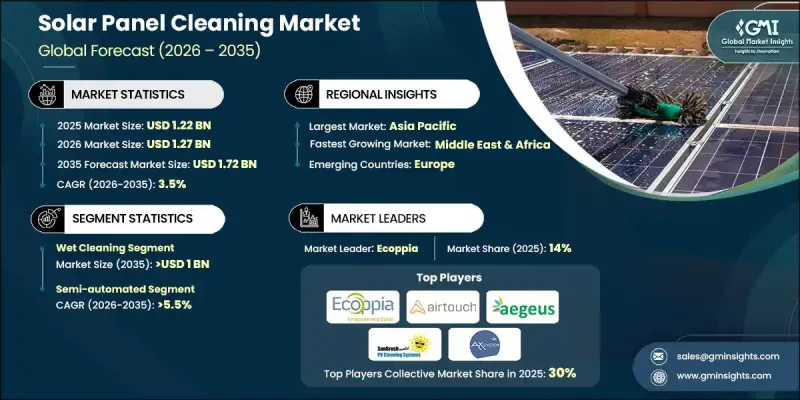
시장 성장은 태양광 패널의 최적 성능 유지의 필요성, 세정 기술의 발전, 그리고 전 세계 대규모 태양광 도입에 의해 촉진되고 있습니다. 태양광 패널에는 먼지, 꽃가루, 산업 오염물질, 이물질이 쌓여 방치하면 효율이 크게 떨어질 수 있습니다. 세척 솔루션은 수동 세척에서 자율 로봇 시스템, 드라이 브러시 방식, 정전기 제진 기술로 진화하고 있습니다. 정부 지원 연구 이니셔티브는 방오 코팅 및 로봇 세척 기술 혁신을 촉진하고 환경에 미치는 영향을 최소화하면서 효율성을 높이고 있습니다. 중동, 북아프리카 일부, 인도, 미국 남서부 등 물 부족에 직면한 지역에서는 물을 사용하지 않는 건식 로봇 세척 솔루션으로의 전환이 진행되고 있습니다. 지속가능한 세정 방법은 물 절약 효과뿐만 아니라 건조 지역의 대규모 태양광발전소 운영에도 도움이 될 수 있습니다. 수백 에이커에 달하는 유틸리티 규모의 태양광발전소 설치가 증가함에 따라 자동화되고 효율적이며 친환경적인 세척 솔루션에 대한 수요가 더욱 강화되고 있습니다.
| 시장 범위 | |
|---|---|
| 시작 연도 | 2025년 |
| 예측 연도 | 2026-2035 |
| 개시 금액 | 12억 2,000만 달러 |
| 예측 금액 | 17억 2,000만 달러 |
| CAGR | 3.5% |
습식 세정 분야는 2035년까지 10억 달러 규모에 달할 것으로 예상됩니다. 물과 중성 세제를 사용하는 습식 청소는 꽃가루, 산업 먼지 등 잘 지워지지 않는 먼지 및 기타 오염 물질을 효과적으로 제거합니다. 연구에 따르면, 오염이 심한 상태에서 습식 세정은 건식 세정에 비해 패널 효율을 2-5% 향상시킬 수 있으며, 이는 피크 시간대 에너지 출력을 유지하는 데 매우 중요한 역할을 합니다. 현대의 습식 세정 방법은 자율 시스템 및 스마트 물 관리와 통합되어 탈염수를 정밀하게 적용하고 기존 수동 세정에 비해 최대 90%의 소비를 줄일 수 있습니다. 이러한 기술은 환경적 지속가능성과 비용 효율성이라는 목표에 부합하는 동시에 효과적인 유지보수를 보장합니다.
반자동화 부문은 2035년까지 CAGR 5.5%로 성장할 것으로 예상됩니다. 반자동 시스템은 인간 모니터링과 기계화 도구를 결합하여 완전 자동화 세척 솔루션에 비해 효율적이고 비용 효율적인 대안을 제공합니다. 전동 브러시와 휴대용 세척기를 포함한 이 시스템은 지붕 설치형, 지상 설치형 어레이, 경사형 태양광 모듈 등 다양한 패널 배치에 적응할 수 있는 다재다능한 시스템입니다. 효율성과 유연성을 겸비한 반자동 툴은 보다 신속하고 균일한 청소 결과를 제공하며, 대규모 설비 투자 없이도 운영 안정성을 원하는 중규모 태양광발전소에 적합합니다.
미국의 태양광 패널 세척 시장은 2035년까지 1억 3,800만 달러에 달할 것으로 예상됩니다. 이 나라에서는 대규모 발전소용 설치가 견인차 역할을 하면서 태양광발전 용량이 견조한 증가세를 보이고 있습니다. 강우량이 적고 먼지가 많은 주와 지역에서는 먼지로 인한 효율 손실이 30%를 초과하는 경우도 있어 자동화 및 물 절약형 세척 솔루션에 대한 수요가 증가하고 있습니다. 인플레이션 억제법 등 정책적 우대 조치는 대규모 태양광발전 개발 및 예방적 유지보수 프로그램을 촉진하고, 간접적으로 태양광 패널 세척 시장을 지원하고 있습니다. 미국 시장에서는 확대되는 태양광 자산의 발전량을 최적화하기 위해 물 절약 기술, 로봇 세척 시스템, 확장 가능한 유지보수 솔루션에 중점을 두고 있습니다.
자주 묻는 질문
목차
제1장 조사 방법과 범위
제2장 주요 요약
제3장 업계 인사이트
제4장 경쟁 구도
제5장 시장 규모 및 예측 : 기술별, 2022-2035
제6장 시장 규모 및 예측 : 프로세스별, 2022-2035
제7장 시장 규모 및 예측 : 운영 형태별, 2022-2035
제8장 시장 규모 및 예측 : 용도별, 2022-2035
제9장 시장 규모 및 예측 : 지역별, 2022-2035
제10장 기업 개요
KSM 26.03.05The Global Solar Panel Cleaning Market was valued at USD 1.22 billion in 2025 and is estimated to grow at a CAGR of 3.5% to reach USD 1.72 billion by 2035.
Market growth is fueled by the need to maintain optimal solar panel performance, advances in cleaning technologies, and large-scale solar adoption worldwide. Solar panels accumulate dust, pollen, industrial pollutants, and debris, which can significantly reduce efficiency if left unaddressed. Cleaning solutions have evolved from manual washing to autonomous robotic systems, dry-brush methods, and electrostatic dust removal technologies. Government-supported research initiatives promote anti-soiling coatings and robotic cleaning innovations, enhancing efficiency while minimizing environmental impact. Regions facing water scarcity, including the Middle East, parts of North Africa, India, and the southwestern U.S., are increasingly turning to waterless and dry-robotic cleaning solutions. Sustainable cleaning approaches not only conserve water but also support large-scale solar farm operations in arid zones. Rising adoption of utility-scale solar farms, often covering hundreds of acres, further strengthens demand for automated, efficient, and eco-friendly cleaning solutions.
| Market Scope | |
|---|---|
| Start Year | 2025 |
| Forecast Year | 2026-2035 |
| Start Value | $1.22 Billion |
| Forecast Value | $1.72 Billion |
| CAGR | 3.5% |
The wet cleaning segment is forecasted to reach USD 1 billion by 2035. Wet cleaning, using water and mild detergents, effectively removes stubborn debris such as pollen, industrial dust, and other contaminants. Studies indicate that wet cleaning can restore 2-5% more panel efficiency compared to dry methods under heavily soiled conditions, which is critical for maintaining peak energy output. Modern wet cleaning approaches are increasingly integrated with autonomous systems and smart water management, allowing precise application of demineralized water and reducing consumption by up to 90% compared to traditional manual washing. These technologies ensure effective maintenance while aligning with environmental sustainability and cost-efficiency goals.
The semi-automated segment is expected to grow at a CAGR of 5.5% by 2035. Semi-automated systems blend human oversight with mechanized tools, offering an efficient yet cost-effective alternative to fully robotic cleaning solutions. These systems, including motorized brushes and portable cleaning machines, are versatile and adaptable to varied panel layouts such as rooftop installations, ground-mounted arrays, and tilted solar modules. By combining efficiency with flexibility, semi-automated tools deliver faster, more uniform cleaning results, making them ideal for mid-sized solar farms that need operational reliability without large capital investments.
U.S. Solar Panel Cleaning Market is anticipated to reach USD 138 million by 2035. The country experienced robust solar capacity expansion, with utility-scale installations leading the growth. Dust-prone states and regions with low rainfall face efficiency losses exceeding 30% due to soiling, which drives demand for automated and water-efficient cleaning solutions. Incentives from policies such as the Inflation Reduction Act promote large-scale solar development and preventive maintenance programs, indirectly supporting the solar panel cleaning market. The U.S. market emphasizes water-saving technologies, robotic cleaning systems, and scalable maintenance solutions to optimize energy generation from expanding solar assets.
Key players in the Global Solar Panel Cleaning Market include Aegeus Technologies, Airtouch Solar, AX Solar Robot, Ecoppia, Greenleap Robotics, HekaBot, hyCLEANER GmbH, IFBOT, Karcher, Leopard Dust, Premier Solar Cleaning, LLC, Saint Gobain, Sharp Clean Limited, Solabot, SolarCleano, Sun pure Technology, SunBrush mobil GmbH, Taypro, Vayu Solar, and Washpanel. Companies are strengthening their presence by investing in R&D for autonomous robotic cleaners, waterless technologies, and smart sensor integration to optimize cleaning efficiency. Many are expanding service networks for utility-scale solar farms while developing hybrid wet-dry systems for water-sensitive regions. Strategic partnerships with solar developers and EPC contractors enable broader market penetration, while technology licensing agreements accelerate the deployment of innovative cleaning solutions. Additionally, players focus on modular, scalable offerings, enabling mid-sized and large-scale solar projects to adopt sustainable, cost-efficient maintenance systems, solidifying their foothold in a competitive and growing market.
Table of Contents
Chapter 1 Methodology & Scope
- 1.1 Research design
- 1.2 Market estimates & forecast parameters
- 1.3 Forecast calculation
- 1.4 Data sources
- 1.4.1 Primary
- 1.4.2 Secondary
- 1.4.2.1 Paid
- 1.4.2.2 Public
Chapter 2 Executive Summary
- 2.1 Industry synopsis, 2022 - 2035
Chapter 3 Industry Insights
- 3.1 Industry ecosystem analysis
- 3.1.1 Raw material availability landscape
- 3.1.2 Factors affecting the value chain
- 3.1.3 Disruptions
- 3.2 Regulatory landscape
- 3.3 Industry impact forces
- 3.3.1 Growth drivers
- 3.3.2 Industry pitfalls & challenges
- 3.4 Growth potential analysis
- 3.5 Porter's analysis
- 3.5.1 Bargaining power of suppliers
- 3.5.2 Bargaining power of buyers
- 3.5.3 Threat of new entrants
- 3.5.4 Threat of substitutes
- 3.6 PESTEL analysis
- 3.6.1 Political factors
- 3.6.2 Economic factors
- 3.6.3 Social factors
- 3.6.4 Technological factors
- 3.6.5 Legal factors
- 3.6.6 Environmental factors
- 3.7 Emerging opportunities & trends
- 3.8 Investment analysis & future outlook
Chapter 4 Competitive Landscape, 2025
- 4.1 Introduction
- 4.2 Company market share, by region, 2025
- 4.2.1 North America
- 4.2.2 Europe
- 4.2.3 Asia Pacific
- 4.2.4 Middle East & Africa
- 4.2.5 Latin America
- 4.3 Strategic initiatives
- 4.4 Competitive benchmarking depictions
- 4.5 Strategy dashboard
- 4.6 Innovation & technology landscape
Chapter 5 Market Size and Forecast, By Technology, 2022 - 2035 (USD Million)
- 5.1 Key trends
- 5.2 Wet Cleaning
- 5.2.1 Semi-Automated
- 5.2.2 Automated
- 5.2.3 Water Brushes
- 5.2.4 Others
- 5.3 Dry Cleaning
- 5.3.1 Electrostatic
- 5.3.2 Automated Robotic
- 5.3.3 Others
Chapter 6 Market Size and Forecast, By Process, 2022 - 2035 (USD Million)
- 6.1 Key trends
- 6.2 Semi-Automated
- 6.3 Automated
- 6.4 Water Brushes
- 6.5 Electrostatic
- 6.6 Automated Robotic
- 6.7 Others
Chapter 7 Market Size and Forecast, By Mode of Operation, 2022 - 2035 (USD Million)
- 7.1 Key trends
- 7.2 Manual
- 7.3 Autonomous
Chapter 8 Market Size and Forecast, By Application, 2022 - 2035 (USD Million)
- 8.1 Key trends
- 8.2 Residential
- 8.3 Commercial
- 8.4 Industrial & Utility
Chapter 9 Market Size and Forecast, By Region, 2022 - 2035 (USD Million)
- 9.1 Key trends
- 9.2 North America
- 9.2.1 U.S.
- 9.2.2 Canada
- 9.2.3 Mexico
- 9.3 Europe
- 9.3.1 UK
- 9.3.2 France
- 9.3.3 Germany
- 9.3.4 Italy
- 9.3.5 Russia
- 9.3.6 Spain
- 9.4 Asia Pacific
- 9.4.1 China
- 9.4.2 Australia
- 9.4.3 India
- 9.4.4 Japan
- 9.4.5 South Korea
- 9.5 Middle East & Africa
- 9.5.1 Saudi Arabia
- 9.5.2 UAE
- 9.5.3 Turkey
- 9.5.4 South Africa
- 9.5.5 Egypt
- 9.6 Latin America
- 9.6.1 Brazil
- 9.6.2 Argentina
Chapter 10 Company Profiles
- 10.1 Aegeus Technologies
- 10.2 Airtouch Solar
- 10.3 AX Solar Robot
- 10.4 Ecoppia
- 10.5 Greenleap Robotics
- 10.6 HekaBot
- 10.7 hyCLEANER GmbH
- 10.8 IFBOT
- 10.9 Karcher
- 10.10 Leopard Dust
- 10.11 Premier Solar Cleaning, LLC
- 10.12 Saint Gobain
- 10.13 Sharp Clean Limited
- 10.14 Solabot
- 10.15 SolarCleano
- 10.16 Sun pure Technology
- 10.17 SunBrush mobil Gmbh
- 10.18 Taypro
- 10.19 Vayu Solar
- 10.20 Washpanel


