

|
시장보고서
상품코드
1936619
군용 드론 시장 기회, 성장 촉진요인, 업계 동향 분석 및 예측(2026-2035년)Military Drones Market Opportunity, Growth Drivers, Industry Trend Analysis, and Forecast 2026 - 2035 |
||||||

세계의 군용 드론 시장은 2025년에 182억 달러로 평가되었으며, 2035년까지 CAGR 13.8%로 성장하여 665억 달러에 달할 것으로 예측됩니다.
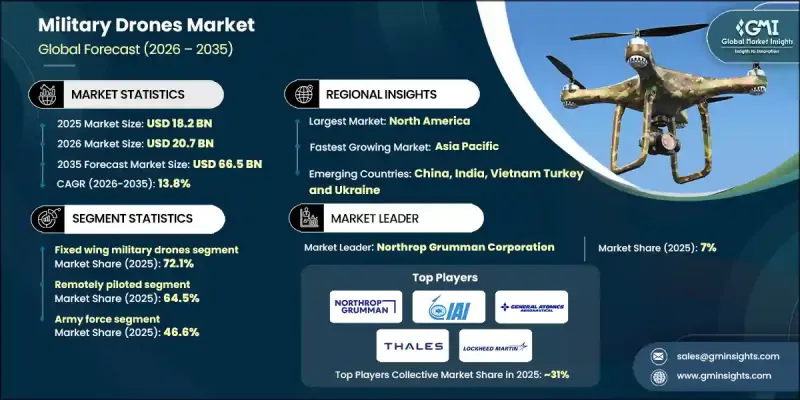
군대는 작전 효율성 향상, 인력 위험 감소, 정보 수집 범위 확대를 위해 무인항공 시스템에 대한 의존도를 높이고 있습니다. 인공지능과 머신러닝의 고도의 통합을 통해 자율 항법, 즉각적인 위협 평가, 적응형 임무 수행, 의사결정 속도 향상 등 드론의 능력을 재구축하고 있습니다. 지속적인 지역적 긴장과 대테러 활동은 정밀 교전, 장시간 체공, 지속적인 감시를 지원하는 드론에 대한 수요를 더욱 강화하고 있습니다. 이러한 플랫폼은 전투 작전, 정찰 임무, 전장 통신 지원에서 중요한 역할을 하고 있습니다. 전 세계 각국의 국방기관은 상황인식 능력과 부대 연계성을 향상시키기 위해 차세대 무인기술에 대한 투자를 지속하고 있습니다. 군집형 드론 작전에 대한 관심이 높아짐에 따라 네트워크화된 배치에 대한 수요가 증가하고 있으며, 여러 무인 시스템이 감시, 전투 조정 및 전자 작전에서 공유된 지휘 구조 하에서 협력적으로 운영될 수 있도록 하고 있습니다.
| 시장 범위 | |
|---|---|
| 시작 연도 | 2025년 |
| 예측 연도 | 2026-2035 |
| 개시 금액 | 182억 달러 |
| 예측 금액 | 665억 달러 |
| CAGR | 13.8% |
고정익 군용 드론 부문은 2025년 72.1%의 점유율을 차지했습니다. 이러한 우위는 다른 항공 플랫폼에 비해 더 긴 항속 시간, 더 긴 비행 거리, 더 높은 순항 속도, 더 큰 페이로드 용량을 제공할 수 있는 능력에 기인합니다. 국방 기관은 장시간 임무와 넓은 범위의 커버리지에서 고정익 시스템을 계속 선호하고 있습니다. 해상 감시 및 탐사 임무를 위한 중-고고도 장시간 항해 플랫폼의 조달 증가는 이 부문의 지속적인 성장을 더욱 뒷받침하고 있습니다.
원격 조종 부문은 2025년 64.5%의 점유율을 차지했습니다. 이 부문의 성장은 항공 플랫폼과 지상 관제 유닛 간의 상시 통신 링크의 필요성에 의해 지속적으로 뒷받침되고 있습니다. 운영자는 항법, 센서 사용, 교전 판단을 실시간으로 제어하여 임무의 신뢰성과 작전 정확도를 보장합니다. 복잡하고 복잡한 환경에서도 성능을 유지할 수 있는 내결함성 지휘통제시스템에 대한 수요는 계속 증가하고 있습니다.
미국 군용 드론 시장은 2025년 65억 달러에 달했습니다. 시장 성장은 중-고고도 및 고고도 장거리 항행 플랫폼의 배치 확대와 무인 시스템을 다중 도메인 작전 및 유인-무인 혼합 작전에 심층적으로 통합함으로써 촉진되고 있습니다. 안전한 위성통신, 고내구성 설계, C4ISR 프레임워크와의 원활한 호환성에 대한 강한 강조는 조달 우선순위를 계속 형성하고 있습니다.
자주 묻는 질문
목차
제1장 조사 방법과 범위
제2장 주요 요약
제3장 업계 인사이트
제4장 경쟁 구도
제5장 시장 추정 및 예측 : 플랫폼 유형별, 2022-2035
제6장 시장 추정 및 예측 : 중량 클래스별, 2022-2035
제7장 시장 추정 및 예측 : 추진 방식별, 2022-2035
제8장 시장 추정 및 예측 : 운용 방식별, 2022-2035
제9장 시장 추정 및 예측 : 운영 거리별, 2022-2035
제10장 시장 추정 및 예측 : 이륙 방식별, 2022-2035
제11장 시장 추정 및 예측 : 용도별, 2022-2035
제12장 시장 추정 및 예측 : 최종사용자별, 2022-2035
제13장 시장 추정 및 예측 : 지역별, 2022-2035
제14장 기업 개요
KSM 26.03.05The Global Military Drones Market was valued at USD 18.2 billion in 2025 and is estimated to grow at a CAGR of 13.8% to reach USD 66.5 billion by 2035.
Military forces are increasingly relying on unmanned aerial systems to enhance operational efficiency, reduce personnel risk, and expand their intelligence reach. Advanced integration of artificial intelligence and machine learning reshapes drone capabilities by enabling autonomous navigation, instant threat evaluation, adaptive mission execution, and improved decision-making speed. Ongoing regional tensions and counterterrorism activities further reinforce demand for drones that support precision engagement, extended loitering, and continuous surveillance. These platforms play a critical role in combat operations, reconnaissance missions, and battlefield communication support. Defense agencies worldwide continue to invest in next-generation unmanned technologies to improve situational awareness and force coordination. The growing emphasis on swarm-based drone operations strengthens demand for networked deployments, allowing multiple unmanned systems to operate cohesively under shared command structures for surveillance, combat coordination, and electronic operations.
| Market Scope | |
|---|---|
| Start Year | 2025 |
| Forecast Year | 2026-2035 |
| Start Value | $18.2 Billion |
| Forecast Value | $66.5 Billion |
| CAGR | 13.8% |
The fixed-wing military drones segment held 72.1% share in 2025. This dominance results from their ability to deliver extended endurance, longer flight ranges, higher cruising speeds, and greater payload capacity compared to other aerial platforms. Defense organizations continue to favor fixed-wing systems for long-duration missions and wide-area coverage. Rising procurement of medium-altitude long-endurance platforms for maritime monitoring and expeditionary missions further supports sustained growth within this segment.
The remotely piloted segment held 64.5% share in 2025. Growth in this segment remains supported by the requirement for constant communication links between airborne platforms and ground control units. Operators maintain real-time control over navigation, sensor usage, and engagement decisions, ensuring mission reliability and operational precision. Demand continues to rise for resilient command-and-control systems capable of maintaining performance in complex and contested environments.
United States Military Drones Market reached USD 6.5 billion in 2025. Market growth benefits from expanded deployment of medium- and high-altitude long-endurance platforms and deeper integration of unmanned systems into multi-domain and manned-unmanned operations. Strong emphasis on secure satellite communications, high-endurance designs, and seamless compatibility with C4ISR frameworks continues to shape procurement priorities.
Key companies active in the Global Military Drones Market include Lockheed Martin, Northrop Grumman Corporation, General Atomics Aeronautical Systems, Boeing, Airbus, Israel Aerospace Industries, BAE Systems Inc., Leonardo S.p.A., Thales Group, Dassault Aviation, Baykar Tech, Elbit Systems, Textron Inc., AeroVironment Inc., and Teledyne FLIR LLC. Companies operating in the Global Military Drones Market strengthen their position through sustained investment in advanced autonomy, AI-enabled mission systems, and secure communication technologies. Strategic focus remains on developing scalable platforms capable of supporting long-endurance operations and multi-role missions. Firms emphasize interoperability with existing defense networks and prioritize resilient command-and-control architectures. Collaboration with defense agencies supports tailored system development aligned with evolving mission needs. Continuous innovation in payload integration, sensor fusion, and electronic warfare capabilities enhances product differentiation.
Table of Contents
Chapter 1 Methodology and Scope
- 1.1 Market scope and definition
- 1.2 Research design
- 1.2.1 Research approach
- 1.2.2 Data collection methods
- 1.3 Data mining sources
- 1.3.1 Global
- 1.3.2 Regional/Country
- 1.4 Base estimates and calculations
- 1.4.1 Base year calculation
- 1.4.2 Key trends for market estimation
- 1.5 Primary research and validation
- 1.5.1 Primary sources
- 1.6 Forecast model
- 1.7 Research assumptions and limitations
Chapter 2 Executive summary
- 2.1 Industry 360° synopsis
- 2.2 Key market trends
- 2.2.1 Platform type trends
- 2.2.2 Weight class trends
- 2.2.3 Propulsion type trends
- 2.2.4 Mode of operation trends
- 2.2.5 Operational range trends
- 2.2.6 Take-off trends
- 2.2.7 Application trends
- 2.2.8 End-user trends
- 2.2.9 Regional trends
- 2.3 TAM Analysis, 2026-2035 (USD Million)
- 2.4 CXO perspectives: Strategic imperatives
- 2.4.1 Executive decision points
- 2.4.2 critical success factors
- 2.5 Future outlook and strategic recommendations
Chapter 3 Industry insights
- 3.1 Industry ecosystem analysis
- 3.1.1 Supplier landscape
- 3.1.2 Profit margin
- 3.1.3 Cost structure
- 3.1.4 Value addition at each stage
- 3.1.5 Factor affecting the value chain
- 3.1.6 Disruptions
- 3.2 Industry ecosystem analysis
- 3.3 Industry impact forces
- 3.3.1 Growth drivers
- 3.3.1.1 Escalating defense expenditure across the world
- 3.3.1.2 Geopolitical tensions & regional conflicts
- 3.3.1.3 Technological advancement in autonomous systems
- 3.3.1.4 Growing requirements for ISR capability
- 3.3.2 Pitfalls and challenges
- 3.3.2.1 Increasing cybersecurity vulnerabilities in electronic warfare
- 3.3.2.2 Regulatory restrictions and export control frameworks
- 3.3.3 Market opportunities
- 3.3.3.1 Advancements in autonomous flight control, AI, and secure communications
- 3.3.3.2 Increasing adoption of unmanned and remotely operated combat and ISR platforms
- 3.3.1 Growth drivers
- 3.4 Growth potential analysis
- 3.5 Regulatory landscape
- 3.5.1 North America
- 3.5.2 Europe
- 3.5.3 Asia Pacific
- 3.5.4 Latin America
- 3.5.5 Middle East & Africa
- 3.6 Porter's analysis
- 3.7 PESTEL analysis
- 3.8 Technology and Innovation landscape
- 3.8.1 Current technological trends
- 3.8.2 Emerging technologies
- 3.9 Emerging Business Models
- 3.10 Compliance Requirements
- 3.11 Patent and IP analysis
- 3.12 Geopolitical and trade dynamics
Chapter 4 Competitive landscape, 2025
- 4.1 Introduction
- 4.2 Company market share analysis
- 4.2.1 By region
- 4.2.1.1 North America
- 4.2.1.2 Europe
- 4.2.1.3 Asia Pacific
- 4.2.1.4 Latin America
- 4.2.1.5 Middle East & Africa
- 4.2.2 Market concentration analysis
- 4.2.1 By region
- 4.3 Competitive benchmarking of key players
- 4.3.1 Financial performance comparison
- 4.3.1.1 Revenue
- 4.3.1.2 Profit margin
- 4.3.1.3 R&D
- 4.3.2 Product portfolio comparison
- 4.3.2.1 Product range breadth
- 4.3.2.2 Technology
- 4.3.2.3 Innovation
- 4.3.3 Geographic presence comparison
- 4.3.3.1 Global footprint analysis
- 4.3.3.2 Service network coverage
- 4.3.3.3 Market penetration by region
- 4.3.4 Competitive positioning matrix
- 4.3.4.1 Leaders
- 4.3.4.2 Challengers
- 4.3.4.3 Followers
- 4.3.4.4 Niche players
- 4.3.5 Strategic outlook matrix
- 4.3.1 Financial performance comparison
- 4.4 Key developments, 2021-2024
- 4.4.1 Mergers and acquisitions
- 4.4.2 Partnerships and collaborations
- 4.4.3 Technological advancements
- 4.4.4 Expansion and investment strategies
- 4.4.5 Sustainability initiatives
- 4.4.6 Digital transformation initiatives
- 4.5 Emerging/ startup competitors landscape
Chapter 5 Market Estimates and Forecast, By Platform Type, 2022 - 2035 (USD Million)
- 5.1 Key trends
- 5.2 Fixed-wing military drones
- 5.3 Rotary-wing military drones
- 5.3.1 Single rotor
- 5.3.2 Multi rotor
- 5.4 Hybrid military drones
Chapter 6 Market Estimates and Forecast, By Weight Class, 2022 - 2035 (USD Million)
- 6.1 Key trends
- 6.2 Small UAVs (<25 kg)
- 6.3 Tactical UAVs (25-600 kg)
- 6.4 Medium-Altitude Long-Endurance (MALE) (600-5,670 kg)
- 6.5 High-Altitude Long-Endurance (HALE) (>5,670 kg)
Chapter 7 Market Estimates and Forecast, By Propulsion Type, 2022 - 2035 (USD Million)
- 7.1 Key trends
- 7.2 Electric
- 7.3 Battery
- 7.4 Solar
Chapter 8 Market Estimates and Forecast, By Mode of Operation, 2022 - 2035 (USD Million)
- 8.1 Key trends
- 8.2 Remotely Piloted
- 8.3 Semi-Autonomous
- 8.4 Fully Autonomous
Chapter 9 Market Estimates and Forecast, By Operational Range, 2022 - 2035 (USD Million)
- 9.1 Key trends
- 9.2 Visual Line of Sight (VLOS) (<5 km)
- 9.3 Extended Visual Line of Sight (EVLOS) (5-25 km)
- 9.4 Beyond Line of Sight (BLOS) (>25 km)
Chapter 10 Market Estimates and Forecast, By Take-Off, 2022 - 2035 (USD Million)
- 10.1 Key trends
- 10.2 Runway Launch & Recovery
- 10.3 Catapult Launch & Net Recovery
- 10.4 Vertical Take-off & Landing (VTOL)
- 10.5 Hand Launched
- 10.6 Others
Chapter 11 Market Estimates and Forecast, By Application, 2022 - 2035 (USD Million)
- 11.1 Key trends
- 11.2 Intelligence, Surveillance & Reconnaissance (ISR)
- 11.3 Combat & Strike Missions
- 11.4 Battlefield Communication Relay
- 11.5 Electronic Warfare & Signal Intelligence
- 11.6 Logistics & Resupply Missions
- 11.7 Target Acquisition & Damage Assessment
Chapter 12 Market Estimates and Forecast, By End-User, 2022 - 2035 (USD Million)
- 12.1 Key trends
- 12.2 Army force
- 12.3 Navy force
- 12.4 Air force
Chapter 13 Market Estimates and Forecast, By Region, 2022 - 2035 (USD Million)
- 13.1 Key trends
- 13.2 North America
- 13.2.1 U.S.
- 13.2.2 Canada
- 13.3 Europe
- 13.3.1 Germany
- 13.3.2 UK
- 13.3.3 France
- 13.3.4 Spain
- 13.3.5 Italy
- 13.3.6 Netherlands
- 13.4 Asia Pacific
- 13.4.1 China
- 13.4.2 India
- 13.4.3 Japan
- 13.4.4 Australia
- 13.4.5 South Korea
- 13.5 Latin America
- 13.5.1 Brazil
- 13.5.2 Mexico
- 13.5.3 Argentina
- 13.6 Middle East and Africa
- 13.6.1 South Africa
- 13.6.2 Saudi Arabia
- 13.6.3 UAE
Chapter 14 Company Profiles
- 14.1 AeroVironment Inc.
- 14.2 Airbus
- 14.3 BAE Systems Inc.
- 14.4 Baykar Tech
- 14.5 Boeing
- 14.6 Dassault Aviation
- 14.7 Elbit Systems
- 14.8 General Atomics Aeronautical Systems
- 14.9 Israel Aerospace Industries (IAI)
- 14.10 Leonardo S.p.A.
- 14.11 Lockheed Martin
- 14.12 Northrop Grumman Corporation
- 14.13 Teledyne FLIR LLC
- 14.14 Textron Inc.
- 14.15 Thales Group


