



|
시장보고서
상품코드
1936625
맥아 원료 시장 기회, 성장 촉진요인, 업계 동향 분석 및 예측(2026-2035년)Malt Ingredients Market Opportunity, Growth Drivers, Industry Trend Analysis, and Forecast 2026 - 2035 |
||||||

세계의 맥아 원료 시장은 2025년에 260억 달러로 평가되었으며, 2035년까지 CAGR 5.4%로 성장하여 434억 달러에 달할 것으로 예측됩니다.
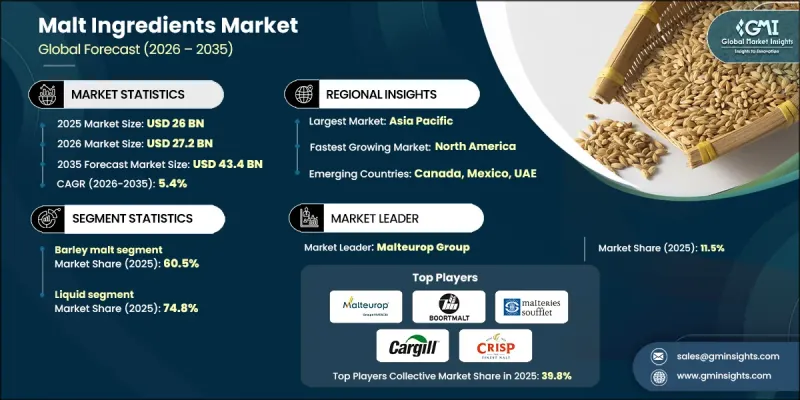
양조, 증류, 식품 산업의 수요 증가로 인해 시장은 계속 성장하고 있습니다. 보리 및 기타 곡물을 발아, 건조하여 제조되는 맥아는 맥주, 증류주, 기능성 식품에 필수적인 발효성 당류, 풍미, 영양소를 제공합니다. 프리미엄 증류주 및 위스키 분야에서는 숙성주 및 특수 주류를 선호하는 소비자가 증가함에 따라 고품질 맥아에 대한 수요가 증가하고 있습니다. 주류 이외의 용도로는 맥아 추출물이 비타민, 미네랄, 항산화 물질이 풍부하게 함유되어 있어 영양보충제 및 기능성 식품 분야에서 주목받고 있습니다. 자동 발아 및 정밀 제어 건조와 같은 맥아 제조 기술의 발전으로 생산자는 특정 풍미 특성 및 기능성을 가진 특수 맥아를 생산할 수 있게 되어 효율성과 제품 품질이 향상되고 있습니다. 이러한 발전으로 시장은 지속가능성과 생산의 일관성을 유지하면서 전통적인 양조 분야와 새로운 건강 지향적 응용 분야 모두에서 증가하는 수요를 충족시킬 수 있게 되었습니다.
| 시장 범위 | |
|---|---|
| 시작 연도 | 2025년 |
| 예측 연도 | 2026-2035 |
| 개시 금액 | 260억 달러 |
| 예측 금액 | 434억 달러 |
| CAGR | 5.4% |
보리 맥아 부문은 2025년 60.5%의 점유율을 차지했으며, 2035년까지 5.3%의 CAGR로 성장할 것으로 예상되며, 양조 분야에서 다양한 용도(필수 향미, 색소, 발효성 당 공급)로 인해 2035년까지 5.3%의 CAGR을 기록할 것으로 예상됩니다. 보리 맥아의 천연 효소 특성, 영양 성분, 양조 및 식품 가공 분야에서의 오랜 인기로 인해 보리 맥아는 시장에서 선도적인 지위를 유지하며 전 세계 맥아 생산자들이 선호하는 선택이 되었습니다.
액체 맥아 성분 부문은 2025년 74.8%의 점유율을 차지했으며, 앞으로도 강력한 성장세를 유지할 것으로 전망됩니다. 액체 맥아는 다재다능하고 사용하기 쉬워 양조, 증류, 식품 용도로 높은 인기를 누리고 있습니다. 주요 장비 조정 없이 생산 라인에 원활하게 통합할 수 있는 능력은 효율성을 높이고, 운영의 복잡성을 줄이며, 산업 프로세스 전반에 걸쳐 채택을 확대하는 데 기여하고 있습니다.
북미 맥아 원료 시장은 2026년부터 2035년까지 CAGR 5.3%로 성장할 것으로 예상됩니다. 지속가능성과 순환 경제의 원칙이 점점 더 많은 영향을 미치고 있으며, 폐수 재활용 및 제품별 가치화 기술의 발전으로 환경 부하와 운영 효율성이 모두 개선되고 있습니다. 친환경 클린 라벨과 기능성 원료에 대한 소비자의 관심이 높아지면서 식음료 및 건강 분야에서 맥아 기반 솔루션을 채택하는 브랜드가 증가하고 있습니다. 이러한 추세는 영양과 환경 기준을 모두 충족시키면서 변화하는 소비자 기호에 부응하는 맥아 원료의 중요성을 더욱 확고히 하고 있습니다.
자주 묻는 질문
목차
제1장 조사 방법과 범위
제2장 주요 요약
제3장 업계 인사이트
제4장 경쟁 구도
제5장 시장 추정 및 예측 : 제품별, 2022-2035
제6장 시장 추정 및 예측 : 형태별, 2022-2035
제7장 시장 추정 및 예측 : 등급별, 2022-2035
제8장 시장 추정 및 예측 : 용도별, 2022-2035
제9장 시장 추정 및 예측 : 지역별, 2022-2035
제10장 기업 개요
KSM 26.03.05The Global Malt Ingredients Market was valued at USD 26 billion in 2025 and is estimated to grow at a CAGR of 5.4% to reach USD 43.4 billion by 2035.
The market is expanding due to the growing demand across the brewing, distilling, and food industries. Malt, derived from barley or other grains through germination and drying, contributes essential fermentable sugars, flavor, and nutrition to beer, spirits, and functional foods. Premium spirits and whiskey segments are driving demand for high-quality malt, as consumers increasingly prefer aged and specialty alcoholic beverages. Beyond alcoholic applications, malt extracts are gaining traction in dietary supplements and functional foods for their vitamins, minerals, and antioxidants. Technological advancements in malting, including automated germination and precision-controlled drying, have allowed producers to create specialty malts with specific flavor profiles and functional properties, improving efficiency and product quality. These developments are enabling the market to meet the rising requirements of both traditional brewing and emerging health-focused applications while maintaining sustainability and consistency in production.
| Market Scope | |
|---|---|
| Start Year | 2025 |
| Forecast Year | 2026-2035 |
| Start Value | $26 Billion |
| Forecast Value | $43.4 Billion |
| CAGR | 5.4% |
The barley malt segment held 60.5% share in 2025 and is expected to grow at a CAGR of 5.3% through 2035 due to extensive applications in brewing, where it provides essential flavors, colors, and fermentable sugars. Barley malt's natural enzymatic properties, nutritional content, and long-standing popularity in both brewing and food processing sustain its leadership in the market, making it the preferred choice for malt producers worldwide.
The liquid malt ingredients segment captured 74.8% share in 2025 and is expected to maintain strong growth. The versatility and ease of use of liquid malt make it highly favored for brewing, distilling, and food applications. Its ability to integrate seamlessly into production lines without major equipment adjustments enhances efficiency and reduces operational complexity, driving higher adoption across industrial processes.
North America Malt Ingredients Market is projected to grow at a CAGR of 5.3% between 2026 and 2035. Sustainability and circular economy principles are increasingly influencing the industry, with advancements in recycling wastewater and valorizing by-products improving both environmental impact and operational efficiency. Growing consumer focus on eco-friendly, clean-label, and functional ingredients is pushing brands to adopt malt-based solutions across food, beverages, and health applications. This trend reinforces the importance of malt ingredients in meeting both nutritional and environmental standards while catering to evolving consumer preferences.
Key players operating in the Global Malt Ingredients Market include Briess Malt, Boortmalt, Bairds Malt, Malteurop Group, Malt Products Corporation, Cargill, Rahr Corporation, Malteries Soufflet, Simpsons Malt, Weyermann Malz, Crisp Malt, and The Malt Company. Companies in the malt ingredients industry are implementing multiple strategies to strengthen market presence and secure long-term growth. They are investing in R&D to develop specialty malts with unique flavor profiles, higher nutritional value, and consistent fermentability. Sustainable production practices, including recycling, by-product valorization, and energy-efficient malting processes, are being adopted to meet growing environmental regulations and consumer demand. Strategic partnerships with breweries, distilleries, and functional food manufacturers help expand market reach and ensure reliable supply chains. Product diversification, including liquid and dry malt variants, allows companies to cater to multiple industry segments.
Table of Contents
Chapter 1 Methodology & Scope
- 1.1 Market scope and definition
- 1.2 Research design
- 1.2.1 Research approach
- 1.2.2 Data collection methods
- 1.3 Data mining sources
- 1.3.1 Global
- 1.3.2 Regional/Country
- 1.4 Base estimates and calculations
- 1.4.1 Base year calculation
- 1.4.2 Key trends for market estimation
- 1.5 Primary research and validation
- 1.5.1 Primary sources
- 1.6 Forecast model
- 1.7 Research assumptions and limitations
Chapter 2 Executive Summary
- 2.1 Industry 360° synopsis
- 2.2 Key market trends
- 2.2.1 Regional
- 2.2.2 Product
- 2.2.3 Form
- 2.2.4 Grade
- 2.2.5 Application
- 2.3 TAM Analysis, 2026-2035
- 2.4 CXO perspectives: Strategic imperatives
- 2.4.1 Executive decision points
- 2.4.2 Critical success factors
- 2.5 Future Outlook and Strategic Recommendations
Chapter 3 Industry Insights
- 3.1 Industry ecosystem analysis
- 3.1.1 Supplier landscape
- 3.1.2 Profit margin
- 3.1.3 Value addition at each stage
- 3.1.4 Factor affecting the value chain
- 3.1.5 Disruptions
- 3.2 Industry impact forces
- 3.2.1 Growth drivers
- 3.2.1.1 Craft brewing revolution & specialty malt demand
- 3.2.1.2 Premium spirits & whiskey market growth
- 3.2.1.3 Rising demand for malt-based nutritional supplements
- 3.2.2 Industry pitfalls and challenges
- 3.2.2.1 Volatility in barley prices & supply
- 3.2.2.2 Climate change impact on malting barley quality
- 3.2.3 Market opportunities
- 3.2.3.1 Emerging markets in Asia Pacific (China, India, Southeast Asia)
- 3.2.3.2 Non-alcoholic beer & low-alcohol beverage trends
- 3.2.1 Growth drivers
- 3.3 Growth potential analysis
- 3.4 Regulatory landscape
- 3.4.1 North America
- 3.4.2 Europe
- 3.4.3 Asia Pacific
- 3.4.4 Latin America
- 3.4.5 Middle East & Africa
- 3.5 Porter's analysis
- 3.6 PESTEL analysis
- 3.7 Price trends
- 3.7.1 By region
- 3.7.2 By product
- 3.8 Future market trends
- 3.9 Technology and innovation landscape
- 3.9.1 Current technological trends
- 3.9.2 Emerging technologies
- 3.10 Patent Landscape
- 3.11 Trade statistics (HS code)
- 3.11.1 Major importing countries
- 3.11.2 Major exporting countries
- 3.12 Sustainability and environmental aspects
- 3.12.1 Sustainable practices
- 3.12.2 Waste reduction strategies
- 3.12.3 Energy efficiency in production
- 3.12.4 Eco-friendly initiatives
- 3.13 Carbon footprint consideration
Chapter 4 Competitive Landscape, 2025
- 4.1 Introduction
- 4.2 Company market share analysis
- 4.2.1 By region
- 4.2.1.1 North America
- 4.2.1.2 Europe
- 4.2.1.3 Asia Pacific
- 4.2.1.4 LATAM
- 4.2.1.5 MEA
- 4.2.1 By region
- 4.3 Company matrix analysis
- 4.4 Competitive analysis of major market players
- 4.5 Competitive positioning matrix
- 4.6 Key developments
- 4.6.1 Mergers & acquisitions
- 4.6.2 Partnerships & collaborations
- 4.6.3 New Product Launches
- 4.6.4 Expansion Plans
Chapter 5 Market Estimates and Forecast, By Product, 2022-2035 (USD Billion) (Kilo Tons)
- 5.1 Key trends
- 5.2 Barley Malt
- 5.3 Wheat Malt
- 5.4 Corn Malt
- 5.5 Rye Malt
- 5.6 Others
Chapter 6 Market Estimates and Forecast, By Form, 2022-2035 (USD Billion) (Kilo Tons)
- 6.1 Key trends
- 6.2 Dry
- 6.3 Liquid
Chapter 7 Market Estimates and Forecast, By Grade, 2022-2035 (USD Billion) (Kilo Tons)
- 7.1 Key trends
- 7.2 Standard/commercial grade
- 7.3 Specialty/premium grade
Chapter 8 Market Estimates and Forecast, By Application, 2022-2035 (USD Billion) (Kilo Tons)
- 8.1 Key trends
- 8.2 Alcoholic beverage production
- 8.2.1 Brewing
- 8.2.2 Distilling
- 8.3 Food products (non-alcoholic)
- 8.3.1 Baking
- 8.3.2 Confectionery
- 8.3.3 Malted beverages (non-alcoholic)
- 8.3.4 Breakfast cereals
- 8.3.5 Nutritional supplements
- 8.3.6 Others
- 8.4 Animal feed & nutrition
- 8.4.1 Ruminant feed
- 8.4.2 Poultry feed
- 8.4.3 Swine feed
- 8.4.4 Aquaculture feed
- 8.4.5 Pet food
- 8.5 Pharmaceuticals
- 8.5.1 Tablet excipients
- 8.5.2 Nutritional formulations
- 8.5.3 Probiotic carriers
- 8.5.4 Others
- 8.6 Cosmetics & personal care
- 8.6.1 Skincare products
- 8.6.2 Haircare products
- 8.6.3 Others
- 8.7 Others
Chapter 9 Market Estimates and Forecast, By Region, 2022-2035 (USD Billion) (Kilo Tons)
- 9.1 Key trends
- 9.2 North America
- 9.2.1 U.S.
- 9.2.2 Canada
- 9.3 Europe
- 9.3.1 Germany
- 9.3.2 UK
- 9.3.3 France
- 9.3.4 Spain
- 9.3.5 Italy
- 9.3.6 Rest of Europe
- 9.4 Asia Pacific
- 9.4.1 China
- 9.4.2 India
- 9.4.3 Japan
- 9.4.4 Australia
- 9.4.5 South Korea
- 9.4.6 Rest of Asia Pacific
- 9.5 Latin America
- 9.5.1 Brazil
- 9.5.2 Mexico
- 9.5.3 Argentina
- 9.5.4 Rest of Latin America
- 9.6 Middle East and Africa
- 9.6.1 Saudi Arabia
- 9.6.2 South Africa
- 9.6.3 UAE
- 9.6.4 Rest of Middle East and Africa
Chapter 10 Company Profiles
- 10.1 Bairds Malt
- 10.2 Boortmalt
- 10.3 Briess Malt
- 10.4 Cargill
- 10.5 Crisp Malt
- 10.6 Malt Products Corporation
- 10.7 Malteries Soufflet
- 10.8 Malteurop Group
- 10.9 Rahr Corporation
- 10.10 Simpsons Malt
- 10.11 The Malt Company
- 10.12 Weyermann Malz


