
|
시장보고서
상품코드
1936639
체인 컨베이어 시장 기회, 성장 촉진요인, 업계 동향 분석 및 예측(2026-2035년)Chain Conveyors Market Opportunity, Growth Drivers, Industry Trend Analysis, and Forecast 2026 - 2035 |
||||||

세계의 체인 컨베이어 시장은 2025년에 6억 1,650만 달러로 평가되었으며, 2035년까지 CAGR 5.6%로 성장하여 10억 5,000만 달러에 달할 것으로 예측됩니다.
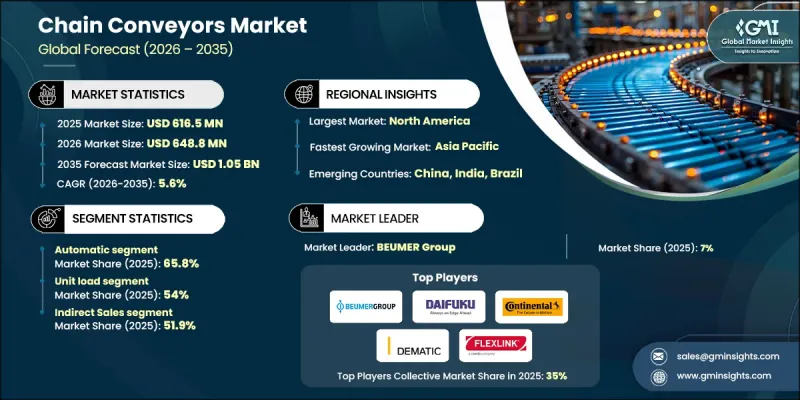
지속가능한 공급망 운영에 대한 관심의 증가와 업무 효율화에 대한 필요성이 결합되어 첨단 컨베이어 체인 시스템에 대한 수요가 증가하고 있습니다. 각 산업 분야의 기업들은 지게차, 기본 팔레트 분류, 중력식 시스템 등 효율성이 낮고 노동 집약적이며 환경적으로 지속가능하지 않은 기존의 수동 자재 취급 방식에서 벗어나고 있습니다. 현대의 체인 컨베이어에는 고토크 에너지 효율 모터, 회생제동시스템, 스마트 제어 메커니즘이 장착되는 경우가 증가하고 있으며, 이를 통해 전력 소비를 최대 30-39%까지 절감하여 환경 부하를 크게 줄일 수 있습니다. 기계화 추세는 높은 처리 능력, 빠른 배송, 안정적인 자재 흐름이 중요한 식음료, 자동차, E-Commerce 물류 등의 산업에서 특히 두드러지게 나타나고 있습니다. 주요 기업 간 인수합병은 혁신과 확장을 촉진하고 세계 공급망의 효율성, 신뢰성, 지속가능성을 더욱 향상시킬 수 있는 통합 솔루션을 창출하고 있습니다.
| 시장 범위 | |
|---|---|
| 시작 연도 | 2025년 |
| 예측 연도 | 2026-2035 |
| 개시 금액 | 6억 1,650만 달러 |
| 예측 금액 | 10억 5,000만 달러 |
| CAGR | 5.6% |
2025년 자동 체인 컨베이어 부문은 65.8%의 점유율을 차지하며 4억 5,500만 달러의 매출을 기록할 것으로 예상됩니다. 자동 체인 시스템은 인건비 의존도를 낮추는 동시에 안전성을 높이고 자재 취급의 오류를 최소화하여 생산성을 향상시킵니다. 로봇공학, 센서, AI와의 통합을 통해 실시간 모니터링, 예지보전, 적응형 제어가 가능하여 고수요 환경에서의 처리량 최적화를 실현합니다. 이러한 변화는 스마트 팩토리와 완전 연결된 창고가 자동화를 우선시하고 업무의 우수성, 에너지 절약, 사이클 타임 단축을 달성하는 '인더스트리 4.0'을 광범위하게 채택하고 있음을 반영하고 있습니다. 자동화 컨베이어는 현재 자재 운송에 있어 속도와 정확성을 동시에 충족시켜야 하는 현대식 물류센터, 대량 생산 공장, 가공 시설에서 필수적인 인프라로 여겨지고 있습니다.
간접 판매 부문은 2025년 51.9%의 점유율을 차지했으며, 전문 솔루션 제공에 있어 유통업체, 시스템 통합업체, 제3자 파트너에 대한 의존도가 높다는 점이 부각되고 있습니다. 최종사용자는 이러한 채널을 통해 현지 지원, 애프터마켓 서비스, 유지보수 계약을 통해 대규모 운영에서 다운타임을 최소화하는 데 필수적인 현지 지원, 애프터마켓 서비스, 유지보수 계약을 선호합니다. 간접 채널은 또한 신속한 부품 교체, 맞춤형 솔루션, 특정 운영 환경에 맞는 설치 서비스를 가능하게 합니다. 컨베이어 시스템이 기술적으로 고도화됨에 따라 타사 통합 업체는 원활한 도입, 적절한 시스템 조정, 지속적인 기술 지원을 보장하는 데 중요한 역할을하고 있으며 간접 판매는 시장 성장의 기반이되었습니다.
미국 체인 컨베이어 시장은 창고 자동화, 물류 최적화, E-Commerce 네트워크 확장에 대한 대규모 투자에 힘입어 2025년 84.5%의 점유율을 차지할 것으로 예상됩니다. 인체공학적 핸들링 솔루션과 작업장 안전 표준에 대한 높은 수요로 인해 수작업 공정을 자동화 체인 컨베이어 시스템으로 대체하는 기업이 증가하고 있습니다. 대규모 유통 허브, 풀필먼트 센터, 산업 플랜트에 대한 투자는 에너지 절약 및 대용량 컨베이어 도입을 더욱 촉진하고 있습니다. 또한, 기업들은 재고 관리 개선, 업무 병목 현상 감소, 적시 주문 이행 보장을 위해 커넥티드 솔루션을 활용하고 있으며, 이는 미국을 체인 컨베이어 도입의 세계 리더로 확고히 자리매김하고 있습니다.
자주 묻는 질문
목차
제1장 조사 방법과 범위
제2장 주요 요약
제3장 업계 인사이트
제4장 경쟁 구도
제5장 시장 추정 및 예측 : 조작별, 2022-2035
제6장 시장 추정 및 예측 : 부하별, 2022-2035
제7장 시장 추정 및 예측 : 설치 장소별, 2022-2035
제8장 시장 추정 및 예측 : 최종 이용 업계별, 2022-2035
제9장 시장 추정 및 예측 : 유통 채널별, 2022-2035
제10장 시장 추정 및 예측 : 지역별, 2022-2035
제11장 기업 개요
KSM 26.03.05The Global Chain Conveyors Market was valued at USD 616.5 million in 2025 and is estimated to grow at a CAGR of 5.6% to reach USD 1.05 billion by 2035.
The rising emphasis on sustainable supply chain operations, coupled with the need for operational efficiency, is fueling demand for advanced conveyor chain systems. Companies across industries are moving away from traditional, manual material handling methods, such as forklifts, basic pallet sorting, and gravity-fed systems, which are less efficient, labor-intensive, and environmentally unsustainable. Modern chain conveyors are increasingly being equipped with high-torque, energy-efficient motors, regenerative braking systems, and smart control mechanisms, capable of reducing power consumption by up to 30-39%, significantly lowering environmental impact. The trend toward mechanization is especially strong in industries such as food & beverage, automotive, and e-commerce logistics, where high throughput, faster delivery, and consistent material flow are critical. Mergers and acquisitions among key players are also driving innovation and expansion, creating integrated solutions that further improve efficiency, reliability, and sustainability of supply chains globally.
| Market Scope | |
|---|---|
| Start Year | 2025 |
| Forecast Year | 2026-2035 |
| Start Value | $616.5 Million |
| Forecast Value | $1.05 Billion |
| CAGR | 5.6% |
In 2025, the automatic chain conveyors segment held 65.8% share, generating USD 405.5 million. Automated chain systems enhance productivity by reducing reliance on manual labor while improving safety and minimizing errors in material handling. Integration with robotics, sensors, and AI enables real-time monitoring, predictive maintenance, and adaptive control, optimizing throughput in high-demand environments. This shift reflects the broader Industry 4.0 adoption, where smart factories and fully connected warehouses prioritize automation to achieve operational excellence, energy savings, and faster cycle times. Automated conveyors are now seen as essential infrastructure in modern distribution centers, high-volume manufacturing plants, and processing facilities that require both speed and precision in material transport.
The indirect sales segment accounted for 51.9% share in 2025, highlighting the reliance on distributors, system integrators, and third-party partners to deliver specialized solutions. End users prefer these channels for localized support, aftermarket services, and maintenance contracts, which are critical for minimizing downtime in high-volume operations. Indirect channels also facilitate rapid part replacements, customized solutions, and installation services tailored to specific operational environments. As conveyor systems become more technologically advanced, third-party integrators play a key role in ensuring seamless deployment, proper system calibration, and ongoing technical assistance, making indirect sales a cornerstone of market growth.
U.S. Chain Conveyors Market held an 84.5% share in 2025, driven by extensive investment in warehouse automation, logistics optimization, and e-commerce network expansion. High demand for ergonomic handling solutions and workplace safety standards encourages companies to replace manual processes with automated chain conveyor systems. Investments in large-scale distribution hubs, fulfillment centers, and industrial plants further support the adoption of energy-efficient and high-capacity conveyors. Additionally, companies are leveraging connected solutions to improve inventory management, reduce operational bottlenecks, and ensure timely order fulfillment, cementing the U.S. as a global leader in chain conveyor deployment.
Key players operating in the Global Chain Conveyors Market include Daifuku Co., Ltd., Siemens, BEUMER Group, Hytrol Conveyor Company, Inc., Interroll Group, Shuttleworth, Honeywell International Inc., FlexLink, Ultimation Industries, LLC., WAMGROUP S.p.A., Kardex, Regal Rexnord Corporation, Taikisha Ltd., Continental AG, and Dematic. Companies in the chain conveyors market are strengthening their position through strategies such as continuous R&D to develop energy-efficient, modular, and high-throughput systems suitable for automated warehouses and production lines. Strategic partnerships with distributors and integrators expand geographic reach while ensuring localized technical support. Firms are investing in AI, IoT, and predictive maintenance technologies to enhance system reliability and reduce operational downtime. Mergers and acquisitions allow them to consolidate expertise, enter new industrial verticals, and offer integrated solutions.
Table of Contents
Chapter 1 Methodology and Scope
- 1.1 Market scope and definition
- 1.2 Research design
- 1.2.1 Research approach
- 1.2.2 Data collection methods
- 1.3 Data mining sources
- 1.3.1 Global
- 1.3.2 Regional/Country
- 1.4 Base estimates and calculations
- 1.4.1 Base year calculation
- 1.4.2 Key trends for market estimation
- 1.5 Primary research and validation
- 1.5.1 Primary sources
- 1.6 Forecast model
- 1.7 Research assumptions and limitations
Chapter 2 Executive Summary
- 2.1 Industry 360° synopsis
- 2.2 Key market trends
- 2.2.1 Regional
- 2.2.2 Operation
- 2.2.3 Load
- 2.2.4 Location
- 2.2.5 End-Use
- 2.2.6 Distribution Channel
- 2.3 CXO perspectives: Strategic imperatives
- 2.3.1 Key decision points for industry executives
- 2.3.2 Critical success factors for market players
- 2.4 Future outlook and strategic recommendations
Chapter 3 Industry Insights
- 3.1 Industry ecosystem analysis
- 3.1.1 Supplier landscape
- 3.1.2 Profit margin
- 3.1.3 Value addition at each stage
- 3.1.4 Factor affecting the value chain
- 3.2 Industry impact forces
- 3.2.1 Growth drivers
- 3.2.1.1 Rapid E-commerce & Fulfillment Growth
- 3.2.1.2 Industry 4.0 & Smart Manufacturing
- 3.2.1.3 Sustainability & Energy Efficiency
- 3.2.2 Industry pitfalls & challenges
- 3.2.2.1 High Initial CAPEX & Long ROI
- 3.2.2.2 Complexity of Retrofitting Legacy Sites
- 3.2.3 Opportunities
- 3.2.3.1 IoT & Predictive Maintenance Integration
- 3.2.3.2 Modular & Flexible Conveyor Design
- 3.2.1 Growth drivers
- 3.3 Growth potential analysis
- 3.4 Future market trends
- 3.5 Technology and innovation landscape
- 3.5.1 Current technological trends
- 3.5.2 Emerging technologies
- 3.6 Price trends
- 3.6.1 By region
- 3.6.2 By Operation
- 3.7 Regulatory landscape
- 3.7.1 Standards and compliance requirements
- 3.7.2 Regional regulatory frameworks
- 3.7.3 Certification standards
- 3.8 Porter's analysis
- 3.9 PESTEL analysis
Chapter 4 Competitive Landscape, 2025
- 4.1 Introduction
- 4.2 Company market share analysis
- 4.2.1 By region
- 4.2.1.1 North America
- 4.2.1.2 Europe
- 4.2.1.3 Asia Pacific
- 4.2.1.4 Latin America
- 4.2.1.5 Middle East and Africa
- 4.2.1 By region
- 4.3 Company matrix analysis
- 4.4 Competitive analysis of major market players
- 4.5 Competitive positioning matrix
- 4.6 Key developments
- 4.6.1 Mergers & acquisitions
- 4.6.2 Partnerships & collaborations
- 4.6.3 New product launches
- 4.6.4 Expansion plans
Chapter 5 Market Estimates and Forecast, By Operation, 2022 - 2035 (USD Million) (Thousand Units)
- 5.1 Key trends
- 5.2 Manual
- 5.3 Automatic
- 5.4 Semi-automatic
Chapter 6 Market Estimates and Forecast, By Load, 2022 - 2035 (USD Million) (Thousand Units)
- 6.1 Key trends
- 6.2 Bulk load
- 6.3 Unit load
Chapter 7 Market Estimates and Forecast, By Location, 2022 - 2035 (USD Million) (Thousand Units)
- 7.1 Key trends
- 7.2 In-floor
- 7.3 On-floor
- 7.4 Overhead
Chapter 8 Market Estimates and Forecast, By End-User Vertical, 2022 - 2035 (USD Million) (Thousand Units)
- 8.1 Key trends
- 8.2 Food & beverages
- 8.3 Pharmaceuticals
- 8.4 Automotive & transport
- 8.5 Mining
- 8.6 Manufacturing
- 8.7 Airport
- 8.8 Warehouses & Logistic Centers
- 8.9 Others (Marine, oil & gas, etc.)
Chapter 9 Market Estimates and Forecast, By Distribution Channel, 2022 - 2035 (USD Million) (Thousand Units)
- 9.1 Key trends
- 9.2 Direct
- 9.3 Indirect
Chapter 10 Market Estimates and Forecast, By Region, 2022 - 2035 (USD Million) (Thousand Units)
- 10.1 Key trends
- 10.2 North America
- 10.2.1 U.S.
- 10.2.2 Canada
- 10.3 Europe
- 10.3.1 Germany
- 10.3.2 UK
- 10.3.3 France
- 10.3.4 Italy
- 10.3.5 Spain
- 10.4 Asia Pacific
- 10.4.1 China
- 10.4.2 Japan
- 10.4.3 India
- 10.4.4 Australia
- 10.4.5 South Korea
- 10.5 Latin America
- 10.5.1 Brazil
- 10.5.2 Mexico
- 10.5.3 Argentina
- 10.6 Middle East and Africa
- 10.6.1 South Africa
- 10.6.2 Saudi Arabia
- 10.6.3 UAE
Chapter 11 Company Profiles
- 11.1 BEUMER Group
- 11.2 Daifuku Co., Ltd.
- 11.3 Dematic
- 11.4 Fives
- 11.5 FlexLink
- 11.6 Honeywell International Inc
- 11.7 Hytrol Conveyor Company, Inc.
- 11.8 Interroll Group
- 11.9 Kardex
- 11.10 Regal Rexnord Corporation
- 11.11 Shuttleworth
- 11.12 Siemens
- 11.13 Taikisha Ltd.
- 11.14 Ultimation Industries, LLC.
- 11.15 WAMGROUP S.p.A.