|
시장보고서
상품코드
1936676
자동차 필터 시장 기회, 성장 촉진요인, 업계 동향 분석 및 예측(2026-2035년)Automotive Filters Market Opportunity, Growth Drivers, Industry Trend Analysis, and Forecast 2026 - 2035 |
||||||

세계의 자동차 필터 시장은 2025년에 188억 달러로 평가되었으며, 2035년까지 CAGR 3%로 성장하여 253억 달러에 달할 것으로 예측됩니다.
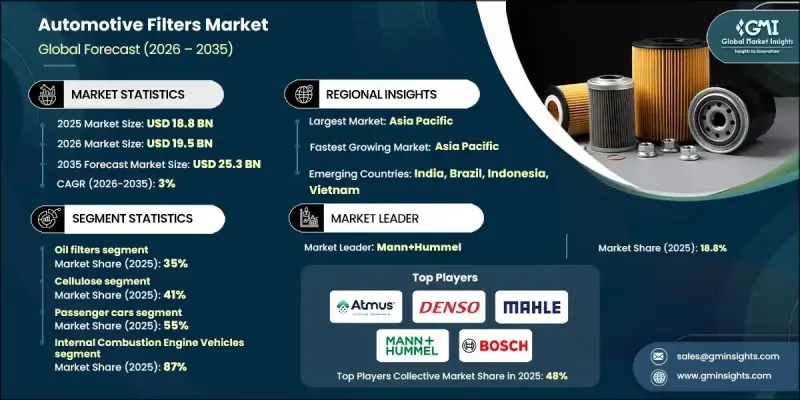
시장 성장의 배경에는 승용차 및 상용차에서 공기, 연료, 오일의 오염물질을 제어하여 차량 성능을 유지하는 자동차 필터의 중요한 역할이 있습니다. 전 세계 자동차 생산량 증가와 차량 평균 수명 연장으로 인해 OEM 및 애프터마켓 채널을 통한 교체 수요가 꾸준히 증가하고 있습니다. 전 세계적으로 배출가스 규제가 강화됨에 따라 미립자 물질과 질소계 오염물질을 줄이는 첨단 여과 솔루션의 도입이 더욱 가속화되고 있습니다. 정기적인 교체 수요와 독립적인 서비스 네트워크의 확장으로 애프터마켓은 계속해서 가장 큰 매출 점유율을 차지하고 있습니다. 주행거리의 연장과 차량 이용률의 증가는 성숙 지역과 개발도상국 모두에서 교체량을 증가시키고 있습니다. 합성 여과재의 지속적인 개선을 통해 오염물질 포집 능력 향상과 수명 연장을 실현하여 다양한 차량 카테고리의 수요를 뒷받침하고 있습니다.
| 시장 범위 | |
|---|---|
| 시작 연도 | 2025년 |
| 예측 연도 | 2026-2035 |
| 개시 금액 | 188억 달러 |
| 예측 금액 | 253억 달러 |
| CAGR | 3% |
오일 필터 부문은 2025년 35% 점유율을 차지했으며, 2035년까지 연평균 1.8%의 성장률을 보일 것으로 예측됩니다. 승용차와 상용차 모두 정기적인 엔진 유지보수에 대한 지속적인 의존도가 안정적인 수요를 뒷받침하고 있습니다. 오일 필터는 엔진 부품 보호, 윤활 효율 향상, 엔진 수명 연장에 필수적이며, 이는 높은 교체 빈도를 뒷받침하고 있습니다. 특히 애프터마켓의 성장이 두드러지는데, 차량의 노후화와 소유기간의 장기화로 인해 도시 및 장거리 운전 환경에서 정기적인 서비스 간격과 반복 구매가 증가하고 있습니다.
셀룰로오스 부문은 2025년 41%의 시장 점유율을 차지했으며, 2026년부터 2035년까지 CAGR 1.3%로 성장할 것으로 전망됩니다. 기존 내연기관과의 높은 호환성과 비용 효율적인 성능 특성으로 인해 셀룰로오스 필터는 계속해서 우선적으로 선택되는 선택이 되고 있습니다. 잦은 교체 수요와 여러 차종 카테고리에서 광범위하게 사용되면서 출하량은 높은 수준을 유지하고 있으며, 2024년 세계 출하량은 5억 대를 돌파할 것으로 예상됩니다.
미국 자동차 필터 시장은 2025년 88%의 점유율을 차지하며 41억 달러의 수익을 창출할 것으로 예상됩니다. 이 시장의 강점은 방대하고 다양한 차량 보유량, 일관된 정비 관행, 승용차 및 상용차 부문의 높은 서비스 빈도 등이 뒷받침하고 있습니다. 정기적인 정비로 인한 안정적인 수요는 장기적인 시장 회복력과 수익 전망을 지속적으로 강화하고 있습니다.
자주 묻는 질문
목차
제1장 조사 방법
제2장 주요 요약
제3장 업계 인사이트
제4장 경쟁 구도
제5장 시장 추정 및 예측 : 필터별, 2022-2035
제6장 시장 추정 및 예측 : 재료별, 2022-2035
제7장 시장 추정 및 예측 : 차량별, 2022-2035
제8장 시장 추정 및 예측 : 추진력별, 2022-2035
제9장 시장 추정 및 예측 : 판매 채널별, 2022-2035
제10장 시장 추정 및 예측 : 지역별, 2022-2035
제11장 기업 개요
KSM 26.03.05The Global Automotive Filters Market was valued at USD 18.8 billion in 2025 and is estimated to grow at a CAGR of 3% to reach USD 25.3 billion by 2035.
Market growth is driven by the essential role automotive filters play in maintaining vehicle performance by controlling contaminants in air, fuel, and oil across passenger and commercial vehicles. Rising global vehicle production, combined with the growing average age of vehicles on the road, is steadily increasing replacement demand through both OEM and aftermarket channels. Tightening emission norms worldwide are further accelerating the adoption of advanced filtration solutions designed to reduce particulate matter and nitrogen-based pollutants. The aftermarket continues to account for the largest revenue share due to recurring replacement requirements and the expanding presence of independent service networks. Longer driving distances and higher vehicle utilization levels are reinforcing replacement volumes across mature and developing regions. Continuous improvements in synthetic filtration media are enabling higher contaminant retention and extended service life, supporting demand across multiple vehicle categories.
| Market Scope | |
|---|---|
| Start Year | 2025 |
| Forecast Year | 2026-2035 |
| Start Value | $18.8 Billion |
| Forecast Value | $25.3 Billion |
| CAGR | 3% |
The oil filters segment held a 35% share in 2025 and is projected to grow at a CAGR of 1.8% through 2035. Ongoing reliance on routine engine maintenance across both passenger and commercial vehicle fleets continues to underpin steady demand. Oil filters remain essential for protecting engine components, improving lubrication efficiency, and extending engine life, which supports their high replacement frequency. Growth is particularly pronounced in the aftermarket, where aging vehicle populations and extended ownership cycles are driving regular service intervals and repeat purchases across urban and long-distance driving environments.
The cellulose segment accounted for a 41% market share in 2025 and is anticipated to grow at a CAGR of 1.3% from 2026 to 2035. Strong compatibility with traditional internal combustion engines and cost-effective performance characteristics continue to make cellulose filters a preferred choice. Frequent replacement needs, combined with widespread usage across multiple vehicle categories, are sustaining high shipment volumes, with global deliveries surpassing 500 million units in 2024.
U.S. Automotive Filters Market held an 88% share and generated USD 4.1 billion in 2025. Market strength is supported by a vast and diverse vehicle population, consistent maintenance practices, and high service frequency across passenger and commercial segments. Stable demand from routine servicing continues to reinforce long-term market resilience and revenue visibility.
Key players in the Global Automotive Filters Market include Robert Bosch, Donaldson Company, Mann+Hummel, Mahle, Denso, Freudenberg, Parker Hannifin, Purflux, Hengst Filtration, and Atmus Filtration Technologies. Key strategies adopted by companies in the automotive filters market focus on expanding aftermarket penetration, enhancing product durability, and investing in advanced filtration media. Leading players prioritize the development of high-efficiency filters that meet evolving emission regulations while extending service intervals. Strategic partnerships with OEMs and service networks help strengthen distribution reach and brand visibility. Companies are also investing in lightweight, eco-friendly materials and digital tools for predictive maintenance to align with sustainability trends. Capacity expansion in high-growth regions and localized manufacturing are being used to reduce costs and improve supply chain resilience. Continuous R&D efforts aimed at improving filtration performance and compatibility across vehicle platforms remain central to maintaining competitive positioning.
Table of Contents
Chapter 1 Methodology
- 1.1 Research approach
- 1.2 Quality Commitments
- 1.2.1 GMI AI policy & data integrity commitment
- 1.2.1.1 Source consistency protocol
- 1.2.1 GMI AI policy & data integrity commitment
- 1.3 Research Trail & Confidence Scoring
- 1.3.1 Research Trail Components
- 1.3.2 Scoring Components
- 1.4 Data Collection
- 1.4.1 Partial list of primary sources
- 1.5 Data mining sources
- 1.5.1 Paid sources
- 1.5.1.1 Sources, by region
- 1.5.1 Paid sources
- 1.6 Base estimates and calculations
- 1.6.1 Base year calculation for any one approach
- 1.7 Forecast model
- 1.7.1 Quantified market impact analysis
- 1.7.1.1 Mathematical impact of growth parameters on forecast
- 1.7.1 Quantified market impact analysis
- 1.8 Research transparency addendum
- 1.8.1 Source attribution framework
- 1.8.2 Quality assurance metrics
- 1.8.3 Our commitment to trust
Chapter 2 Executive Summary
- 2.1 Industry 3600 synopsis, 2022 - 2035
- 2.2 Key market trends
- 2.2.1 Regional
- 2.2.2 Filter
- 2.2.3 Material
- 2.2.4 Vehicle
- 2.2.5 Propulsion
- 2.2.6 Sales Channel
- 2.3 TAM Analysis, 2026-2035
- 2.4 CXO perspectives: Strategic imperatives
- 2.4.1 Executive decision points
- 2.4.2 Critical success factors
- 2.5 Future outlook and strategic recommendations
Chapter 3 Industry Insights
- 3.1 Industry ecosystem analysis
- 3.1.1 Supplier landscape
- 3.1.2 Profit margin analysis
- 3.1.3 Cost structure
- 3.1.4 Value addition at each stage
- 3.1.5 Factor affecting the value chain
- 3.1.6 Disruptions
- 3.2 Industry impact forces
- 3.2.1.1 Growth drivers
- 3.2.1.2 Rising global vehicle parc
- 3.2.1.3 Stringent emission regulations
- 3.2.1.4 Growth of aftermarket services
- 3.2.1.5 Increase in urban air pollution
- 3.2.2 Industry pitfalls and challenges
- 3.2.2.1 Price sensitivity in emerging markets
- 3.2.2.2 Counterfeit and low-quality products
- 3.2.3 Market opportunities
- 3.2.3.1 Growth in electric and hybrid vehicles
- 3.2.3.2 Advancements in synthetic filter media
- 3.2.3.3 Expansion of vehicle production in Asia
- 3.3 Growth potential analysis
- 3.4 Regulatory landscape
- 3.4.1 North America
- 3.4.1.1 United States EPA Emission and Filter Standards
- 3.4.1.2 DOT Vehicle Maintenance Guidelines
- 3.4.1.3 California CARB Filter Compliance
- 3.4.1.4 Canada Transport Canada Filtration Requirements
- 3.4.2 Europe
- 3.4.2.1 EU Vehicle Emission Standards
- 3.4.2.2 Euro NCAP Filtration Guidelines
- 3.4.2.3 National Compliance Inspections
- 3.4.2.4 EN Standards for Filters
- 3.4.3 Asia Pacific
- 3.4.3.1 China vehicle filtration regulations
- 3.4.3.2 India arai filter compliance
- 3.4.3.3 Japan vehicle filtration guidelines
- 3.4.3.4 South korea filter standards
- 3.4.3.5 Asean regional filtration guidelines
- 3.4.4 Latin America
- 3.4.4.1 Brazil Vehicle Filter Standards
- 3.4.4.2 Argentina Filter Compliance
- 3.4.4.3 Mexico Filter Regulations
- 3.4.4.4 Regional Emission Compliance
- 3.4.5 Middle East & Africa
- 3.4.5.1 UAE Vehicle Filter Standards
- 3.4.5.2 Saudi Arabia Filtration Requirements
- 3.4.5.3 South Africa Filter Regulations
- 3.4.5.4 Regional Automotive Standards
- 3.4.1 North America
- 3.5 Porter's analysis
- 3.6 PESTEL analysis
- 3.7 Technology and innovation landscape
- 3.7.1 Current technological trends
- 3.7.2 Emerging technologies
- 3.8 Price trends
- 3.8.1 By region
- 3.8.2 By product
- 3.9 Production statistics
- 3.9.1 Production hubs
- 3.9.2 Consumption hubs
- 3.9.3 Export and import
- 3.10 Cost breakdown analysis
- 3.10.1 Filter manufacturing and material costs
- 3.10.2 Installation and integration costs
- 3.10.3 Operational and maintenance costs
- 3.10.4 Testing and certification costs
- 3.10.5 Regulatory compliance costs
- 3.10.6 Training and service costs
- 3.11 Patent analysis
- 3.12 Sustainability and environmental aspects
- 3.12.1 Sustainable practices
- 3.12.2 Waste reduction strategies
- 3.12.3 Energy efficiency in production
- 3.12.4 Eco-friendly Initiatives
- 3.12.5 Carbon footprint considerations
- 3.13 OEM vs Aftermarket Dynamics
- 3.14 Replacement Cycle & Service Interval Analysis
- 3.15 Impact of Electrification on Filter Demand
- 3.16 Filter Performance & Efficiency Benchmarks
Chapter 4 Competitive Landscape, 2025
- 4.1 Introduction
- 4.2 Company market share analysis
- 4.2.1 North America
- 4.2.2 Europe
- 4.2.3 Asia Pacific
- 4.2.4 LATAM
- 4.2.5 MEA
- 4.3 Competitive analysis of major market players
- 4.4 Competitive positioning matrix
- 4.5 Strategic outlook matrix
- 4.6 Key developments
- 4.6.1 Mergers & acquisitions
- 4.6.2 Partnerships & collaborations
- 4.6.3 New Product Launches
- 4.6.4 Expansion Plans and funding
Chapter 5 Market Estimates & Forecast, By Filter, 2022 - 2035 (USD Mn, Units)
- 5.1 Key trends
- 5.2 Air Filters
- 5.3 Oil Filters
- 5.4 Fuel Filters
- 5.5 Cabin Air Filters
- 5.6 Others
Chapter 6 Market Estimates & Forecast, By Material, 2022 - 2035 (USD Mn, Units)
- 6.1 Key trends
- 6.2 Cellulose
- 6.3 Synthetic
- 6.4 Activated Carbon
- 6.5 Electrostatic
- 6.6 Others
Chapter 7 Market Estimates & Forecast, By Vehicle, 2022 - 2035 (USD Mn, Units)
- 7.1 Key trends
- 7.2 Passenger cars
- 7.2.1 Hatchbacks
- 7.2.2 Sedans
- 7.2.3 SUVs
- 7.2.4 MPVs
- 7.3 Commercial vehicles
- 7.3.1 Light commercial vehicles (LCVs)
- 7.3.2 Medium commercial vehicles (MCVs)
- 7.3.3 Heavy commercial vehicles (HCVs)
- 7.4 Two-Wheelers
- 7.4.1 Motorcycle
- 7.4.2 Scooter
Chapter 8 Market Estimates & Forecast, By Propulsion, 2022 - 2035 (USD Mn, Units)
- 8.1 Key trends
- 8.2 Internal Combustion Engine (ICE) Vehicles
- 8.3 Electric Vehicles (EVs)
- 8.4 Hybrid Vehicles (HEVs / PHEVs)
Chapter 9 Market Estimates & Forecast, By Sales Channel, 2022 - 2035 (USD Mn, Units)
- 9.1 Key trends
- 9.2 OEM
- 9.3 Aftermarket
Chapter 10 Market Estimates & Forecast, By Region, 2022 - 2035 (USD Mn, Units)
- 10.1 Key trends
- 10.2 North America
- 10.2.1 US
- 10.2.2 Canada
- 10.3 Europe
- 10.3.1 Germany
- 10.3.2 UK
- 10.3.3 France
- 10.3.4 Italy
- 10.3.5 Spain
- 10.3.6 Russia
- 10.3.7 Nordics
- 10.3.8 Netherlands
- 10.3.9 Sweden
- 10.4 Asia Pacific
- 10.4.1 China
- 10.4.2 India
- 10.4.3 Japan
- 10.4.4 Australia
- 10.4.5 South Korea
- 10.4.6 Singapore
- 10.4.7 Thailand
- 10.4.8 Indonesia
- 10.4.9 Vietnam
- 10.5 Latin America
- 10.5.1 Brazil
- 10.5.2 Mexico
- 10.5.3 Argentina
- 10.6 MEA
- 10.6.1 South Africa
- 10.6.2 Saudi Arabia
- 10.6.3 UAE
- 10.6.4 Turkey
Chapter 11 Company Profiles
- 11.1 Global Players
- 11.1.1 Mann+Hummel
- 11.1.2 Mahle
- 11.1.3 Robert Bosch
- 11.1.4 Denso
- 11.1.5 Atmus Filtration Technologies
- 11.1.6 Donaldson Company
- 11.1.7 Freudenberg
- 11.1.8 Parker Hannifin
- 11.1.9 Hengst Filtration
- 11.1.10 Purflux
- 11.2 Regional Players
- 11.2.1 Toyota Boshoku
- 11.2.2 First Brands
- 11.2.3 UFI Filters
- 11.2.4 GUD
- 11.2.5 Elofic Industries
- 11.2.6 ALCO Filters
- 11.2.7 Bengbu Jinwei Automotive Parts
- 11.3 Emerging Players & Disruptors
- 11.3.1 Valeo
- 11.3.2 K&N Engineering
- 11.3.3 A.L.