|
시장보고서
상품코드
1936680
마이크로그리드 시장 기회, 성장 촉진요인, 업계 동향 분석 및 예측(2026-2035년)Microgrid Market Opportunity, Growth Drivers, Industry Trend Analysis, and Forecast 2026 - 2035 |
||||||

세계의 마이크로그리드 시장은 2025년에 289억 달러로 평가되었으며, 2035년까지 CAGR 18.3%로 성장하여 1,661억 달러에 달할 것으로 예측됩니다.
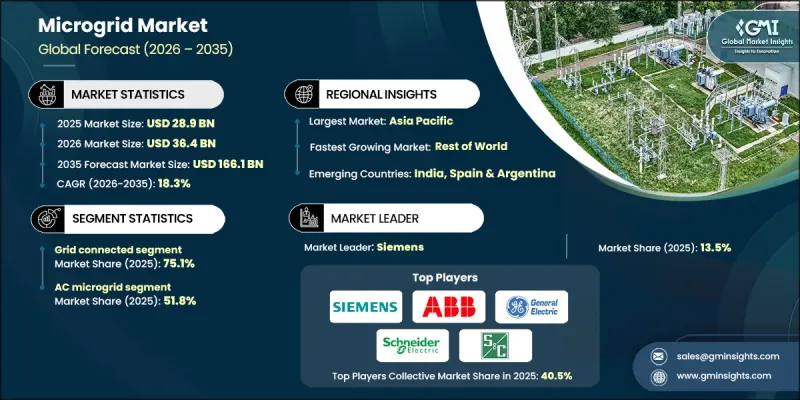
시장 성장은 에너지 신뢰성, 그리드 복원력, 분산화에 대한 필요성이 증가하고 있으며, 전 세계적으로 재생에너지 도입이 가속화되고 환경 기준이 강화되고 있는 데 힘입어 성장세를 보이고 있습니다. 기후 변화, 인프라 부담 증가, 보안 위협으로 인한 정전 위험 증가에 따라 정부, 유틸리티, 기업들은 필요할 때 독립적으로 운영할 수 있는 지역 밀착형 전력 시스템 도입을 우선시하고 있습니다. 마이크로그리드란 명확한 운영 경계를 가진 자립형 에너지 네트워크로, 연결 모드와 고립 모드 모두에서 작동할 수 있는 독립형 에너지 네트워크입니다. 이 시스템은 분산형 발전, 에너지 저장, 지능형 제어 소프트웨어를 결합하여 성능과 안정성을 최적화합니다. 신뢰성 향상, 중앙 집중식 그리드에 대한 의존도 감소, 지속가능성 목표에 부합하기 위해 산업 시설, 캠퍼스, 커뮤니티에서 도입이 확대되고 있습니다. 청정에너지 프로그램에 대한 민관투자가 확대되면서 초기 비용이 절감되고 프로젝트 실현가능성이 향상되고 있습니다. 동시에 스마트 그리드 소프트웨어, 전력전자, 축전 기술의 발전으로 시스템의 효율성, 확장성, 장기적인 운영 성능이 향상되어 지역과 용도를 초월한 보급이 촉진되고 있습니다.
| 시장 범위 | |
|---|---|
| 시작 연도 | 2025년 |
| 예측 연도 | 2026-2035 |
| 개시 금액 | 289억 달러 |
| 예측 금액 | 1,661억 달러 |
| CAGR | 18.3% |
오프그리드 마이크로그리드 분야는 기존 송전망 확장이 어려운 지역의 전력 수요 증가를 배경으로 2035년까지 CAGR 20.2%로 성장할 것으로 전망됩니다. 이러한 시스템은 에너지 제약 지역의 경제 활동과 인프라 개발을 지원하면서 신뢰할 수 있고 환경 친화적인 전력 솔루션을 제공합니다. 중앙 집중식 네트워크에 의존하지 않고 안정적인 전력을 공급할 수 있는 특성으로 인해 장기적인 에너지 접근 전략의 중요한 구성요소가 되고 있습니다.
교류 마이크로그리드 부문은 2025년 51.8%의 점유율을 차지했으며, 2026년부터 2035년까지 CAGR 18.3%로 성장할 것으로 전망됩니다. 기존 전력 인프라와의 호환성 및 신뢰성 문제에 효과적으로 대응하기 위해 교류 기반 시스템에 대한 수요가 증가하고 있습니다. 전력 저장 통합, 그리드 관리 소프트웨어, 전력 변환 기술의 지속적인 발전과 더불어 지원적인 정책 프레임워크가 이 부문에 대한 투자 모멘텀을 강화하고 있습니다.
미국 마이크로그리드 시장은 2025년 81.6%의 점유율을 차지하며 2035년까지 105억 달러 규모로 성장할 것으로 예상됩니다. 정책 중심의 인센티브, 인프라 현대화 노력, 에너지 복원력에 대한 관심 증가가 시장 확대를 뒷받침하고 있습니다. 기업과 지역사회는 무정전 전원 확보, 장기적인 에너지 비용 절감, 탈탄소화 목표 달성을 위해 마이크로그리드 도입을 가속화하고 있습니다.
자주 묻는 질문
목차
제1장 조사 방법과 범위
제2장 주요 요약
제3장 업계 인사이트
제4장 경쟁 구도
제5장 시장 규모 및 예측 : 그리드 유형별, 2022-2035
제6장 시장 규모 및 예측 : 접속 방식별, 2022-2035
제7장 시장 규모 및 예측 : 전원별, 2022-2035
제8장 시장 규모 및 예측 : 에너지 저장 디바이스별, 2022-2035
제9장 시장 규모 및 예측 : 용도별, 2022-2035
제10장 시장 규모 및 예측 : 지역별, 2022-2035
제11장 기업 개요
KSM 26.03.05The Global Microgrid Market was valued at USD 28.9 billion in 2025 and is estimated to grow at a CAGR of 18.3% to reach USD 166.1 billion by 2035.
Market growth is supported by the rising need for energy reliability, grid resilience, and decentralization, along with accelerating renewable energy adoption and stricter environmental standards worldwide. Increasing exposure to power disruptions caused by climate volatility, infrastructure strain, and security threats has pushed governments, utilities, and enterprises to prioritize localized power systems that can operate independently when required. Microgrids are defined as self-sufficient energy networks with clear operational boundaries that can function in both connected and isolated modes. These systems combine distributed generation, energy storage, and intelligent control software to optimize performance and stability. They are increasingly deployed across industrial sites, campuses, and communities to improve reliability, reduce dependence on centralized grids, and align with sustainability objectives. Growing public and private investment in clean energy programs is improving project feasibility by lowering upfront costs. At the same time, advances in smart grid software, power electronics, and storage technologies are improving system efficiency, scalability, and long-term operational performance, supporting broader adoption across regions and applications.
| Market Scope | |
|---|---|
| Start Year | 2025 |
| Forecast Year | 2026-2035 |
| Start Value | $28.9 Billion |
| Forecast Value | $166.1 Billion |
| CAGR | 18.3% |
The off-grid microgrid segment is expected to grow at a CAGR of 20.2% through 2035, driven by rising electricity demand in areas where traditional grid expansion remains challenging. These systems provide dependable and environmentally responsible power solutions while supporting economic activity and infrastructure development in energy-constrained regions. Their ability to deliver consistent electricity without reliance on centralized networks makes them a critical component of long-term energy access strategies.
The AC microgrids segment accounted for a 51.8% share in 2025 and is projected to grow at a CAGR of 18.3% from 2026 to 2035. Demand for AC-based systems is increasing due to their compatibility with existing power infrastructure and their effectiveness in addressing reliability challenges. Continued progress in storage integration, grid management software, and power conversion technologies, along with supportive policy frameworks, is strengthening investment momentum for this segment.
United States Microgrid Market held 81.6% share in 2025 and is expected to generate USD 10.5 billion by 2035. Market expansion is supported by policy-driven incentives, infrastructure modernization efforts, and heightened focus on energy resilience. Businesses and communities are increasingly adopting microgrids to secure uninterrupted power, reduce long-term energy costs, and advance decarbonization goals.
Key companies active in the Global Microgrid Market include Siemens, Schneider Electric, ABB, Eaton, General Electric, Honeywell International, Hitachi Energy, Caterpillar, Toshiba Corporation, Ameresco, Bloom Energy Corporation, Lockheed Martin Corporation, S&C Electric Company, PowerSecure, Exelon Corporation, Delta Electronics, BoxPower, Heila Technologies, Power Analytics Global Corporation, General Microgrids, and Advanced Microgrid Systems. Companies operating in the microgrid market are strengthening their market position by investing heavily in research and development to enhance system intelligence, automation, and storage integration. Strategic partnerships with utilities, technology providers, and infrastructure developers are helping expand deployment capabilities and accelerate commercialization.
Table of Contents
Chapter 1 Methodology & Scope
- 1.1 Research design
- 1.1.1 Research approach
- 1.1.2 Data collection methods
- 1.2 Base estimates and calculations
- 1.2.1 Base year calculation
- 1.2.2 Market estimates & forecast parameters
- 1.3 Forecast
- 1.3.1 Key trends for market estimates
- 1.3.1.1 Quantified market impact analysis
- 1.3.2 Mathematical impact of growth parameters on forecast
- 1.3.3 Scenario analysis framework
- 1.3.1 Key trends for market estimates
- 1.4 Primary research and validation
- 1.4.1 Some of the primary sources (but not limited to)
- 1.5 Data mining sources
- 1.5.1 Paid Sources
- 1.5.2 Sources, by region
- 1.6 Research trail & scoring components
- 1.6.1 Research trail components
- 1.6.2 Scoring components
- 1.7 Research transparency addendum
- 1.7.1 Source attribution framework
- 1.7.2 Quality assurance metrics
- 1.7.3 Our commitment to trust
- 1.8 Market definitions
Chapter 2 Executive Summary
- 2.1 Industry synopsis, 2022 - 2035
- 2.2 Business trends
- 2.3 Connectivity trends
- 2.4 Grid type trends
- 2.5 Power source trends
- 2.6 Storage device trends
- 2.7 Application trends
- 2.8 Regional trends
Chapter 3 Industry Insights
- 3.1 Industry ecosystem
- 3.1.1 Raw material availability & sourcing analysis
- 3.1.2 Manufacturing capacity assessment
- 3.1.3 Supply chain resilience & risk factors
- 3.1.4 Distribution network analysis
- 3.2 Regulatory landscape
- 3.3 Industry impact forces
- 3.3.1 Growth drivers
- 3.3.2 Industry pitfalls & challenges
- 3.4 Growth potential analysis
- 3.5 Cost structure analysis
- 3.6 Price trend analysis (USD/MW)
- 3.6.1 By grid type
- 3.6.2 By region
- 3.7 Porter's analysis
- 3.7.1 Bargaining power of suppliers
- 3.7.2 Bargaining power of buyers
- 3.7.3 Threat of new entrants
- 3.7.4 Threat of substitutes
- 3.8 PESTEL analysis
- 3.8.1 Political factors
- 3.8.2 Economic factors
- 3.8.3 Social factors
- 3.8.4 Technological factors
- 3.8.5 Legal factors
- 3.8.6 Environmental factors
- 3.9 Emerging opportunities & trends
- 3.9.1 Digitalization & IoT integration
- 3.9.2 Emerging market penetration
- 3.10 Investment analysis and future outlook
Chapter 4 Competitive landscape, 2025
- 4.1 Introduction
- 4.2 Company market share analysis, by region, 2025
- 4.2.1 North America
- 4.2.2 Europe
- 4.2.3 Asia Pacific
- 4.2.4 Latin America
- 4.2.5 Middle East & Africa
- 4.3 Strategic dashboard
- 4.4 Strategic initiatives
- 4.5 Company benchmarking
- 4.6 Innovation & technology landscape
Chapter 5 Market Size and Forecast, By Grid Type, 2022 - 2035 (USD Billion & MW)
- 5.1 Key trends
- 5.2 AC microgrid
- 5.3 DC microgrid
- 5.4 Hybrid
Chapter 6 Market Size and Forecast, By Connectivity, 2022 - 2035 (USD Billion & MW)
- 6.1 Key trends
- 6.2 Grid connected
- 6.3 Off grid
Chapter 7 Market Size and Forecast, By Power Source, 2022 - 2035 (USD Billion & MW)
- 7.1 Key trends
- 7.2 Diesel generators
- 7.3 Natural gas
- 7.4 Solar PV
- 7.5 CHP
- 7.6 Others
Chapter 8 Market Size and Forecast, By Storage Device, 2022 - 2035 (USD Billion & MW)
- 8.1 Key trends
- 8.2 Lithium-ion
- 8.3 Lead acid
- 8.4 Flow battery
- 8.5 Flywheels
- 8.6 Others
Chapter 9 Market Size and Forecast, By Application, 2022 - 2035 (USD Billion & MW)
- 9.1 Key trends
- 9.2 Healthcare
- 9.3 Educational institutes
- 9.4 Military
- 9.5 Utility
- 9.6 Industrial/ commercial
- 9.7 Remote
- 9.8 Others
Chapter 10 Market Size and Forecast, By Region, 2022 - 2035 (USD Billion & MW)
- 10.1 Key trends
- 10.2 North America
- 10.2.1 U.S.
- 10.2.2 Canada
- 10.2.3 Mexico
- 10.3 Europe
- 10.3.1 Germany
- 10.3.2 France
- 10.3.3 UK
- 10.3.4 Russia
- 10.3.5 Spain
- 10.4 Asia Pacific
- 10.4.1 China
- 10.4.2 Japan
- 10.4.3 South Korea
- 10.4.4 India
- 10.4.5 Australia
- 10.5 Middle East and Africa
- 10.5.1 Saudi Arabia
- 10.5.2 UAE
- 10.5.3 South Africa
- 10.6 Latin America
- 10.6.1 Brazil
- 10.6.2 Argentina
- 10.6.3 Chile
Chapter 11 Company Profiles
- 11.1 ABB
- 11.2 Advanced Microgrid Systems
- 11.3 Ameresco
- 11.4 Bloom Energy Corporation
- 11.5 BoxPower
- 11.6 Caterpillar
- 11.7 Delta Electronics
- 11.8 Exelon Corporation
- 11.9 Eaton
- 11.10 General Electric
- 11.11 General Microgrids
- 11.12 Heila Technologies
- 11.13 Honeywell International
- 11.14 Hitachi Energy
- 11.15 Lockheed Martin Corporation
- 11.16 PowerSecure
- 11.17 Power Analytics Global Corporation
- 11.18 Schneider Electric
- 11.19 S&C Electric Company
- 11.20 Siemens
- 11.21 Toshiba Corporation