
|
시장보고서
상품코드
1959287
할랄 원료 시장 기회, 성장요인, 업계 동향 분석 및 예측(2026-2035년)Halal Ingredients Market Opportunity, Growth Drivers, Industry Trend Analysis, and Forecast 2026 - 2035 |
||||||

세계의 할랄 원료 시장은 2025년에 4억 2,550만 달러로 평가되었고, 2035년까지 연평균 복합 성장률(CAGR) 6%로 성장하여 7억 6,200만 달러에 이를 것으로 예측됩니다.

이 시장은 식음료, 의약품, 화장품 및 관련 분야에서 사용되는 할랄 요건을 준수하는 원료를 생산 및 공급하는 세계 생태계로 정의됩니다. 할랄 원료는 엄격한 윤리적, 종교적 프레임워크 하에 개발되고, 조달, 가공, 물류가 공인된 할랄 원칙을 준수하도록 보장됩니다. 이 컴플라이언스 프레임워크는 소비자 신뢰를 구축하는 중요한 요소로 자리매김하고 있습니다. 시장 성장은 소득 수준 상승, 급속한 도시 개발, 국경 간 무역 확대에 힘입어 할랄 인증 제품에 대한 전 세계 수요 증가에 기인합니다. 동남아시아, 중동, 북아프리카에서는 소비 트렌드가 눈에 띄게 강화되고 있으며, 유럽과 북미에서도 할랄 기준에 대한 소비자의 신뢰가 높아지면서 수요가 가속화되고 있습니다. 또한, 인증 제도와 표시 관행의 조화로 인한 투명성 향상도 시장을 뒷받침하고 있으며, 이는 기존 소비자와 비전통적 소비자 모두에게 제품의 신뢰성을 강화하고 있습니다.
| 시장 범위 | |
|---|---|
| 개시 연도 | 2025년 |
| 예측 연도 | 2026-2035년 |
| 개시 연도 가치 | 4억 2,550만 달러 |
| 예측 금액 | 7억 6,200만 달러 |
| CAGR | 6% |
동물성 원료 부문은 2025년 2억 3,100만 달러에 달했습니다. 이 카테고리에는 국제 할랄 규정을 준수하기 위해 조달 관행, 추적성, 품질 보증 시스템에 대한 엄격한 모니터링이 필요한 재료가 포함됩니다. 동시에 식습관의 변화와 식물성 영양에 대한 관심이 높아지면서 식물성 원료에 대한 수요는 지속적으로 증가하고 있습니다. 미생물 및 발효 기반 방식으로 생산되는 원료도 주목받고 있으며, 제조업체는 인증된 생산 환경과 통제된 공정을 통해 규정 준수를 보장하고 있습니다.
오프라인 유통 부문은 2025년 3억 3,750만 달러의 매출을 기록할 것으로 예측됩니다. 시장 구조에는 물리적 및 디지털 판매 플랫폼이 모두 포함되지만, 산업 구매자의 장기적인 조달 습관으로 인해 대면 구매가 여전히 주류입니다. 특히 대량 조달 시에는 인증의 직접 확인을 우선시하기 때문에 오프라인 소매 및 BtoB 채널이 계속해서 중심적인 역할을 하고 있습니다.
북미 할랄 원료 시장은 2035년까지 8,010만 달러에 달할 것으로 예측됩니다. 이 지역의 성장은 문화적 다양성의 확대와 할랄 기준에 대한 대중의 이해도가 높아진 것과 관련이 있습니다. 식품 소매업체와 서비스 제공업체들은 할랄 인증 제품군을 확대하고 있으며, 소비자들은 윤리적으로 조달된 식물성 성분을 함유한 제품에 대한 관심이 높아지고 있습니다. 도시 지역은 표시 관행의 개선과 소매 환경에서의 전용 할랄 제품 배치에 힘입어 주요 수요 거점으로 남아 있습니다.
자주 묻는 질문
목차
제1장 조사 방법과 범위
제2장 주요 요약
제3장 업계 인사이트
제4장 경쟁 구도
제5장 시장 추산 및 예측 : 제품 유형별, 2022-2035
제6장 시장 추산 및 예측 : 원료 기원별, 2022-2035
제7장 시장 추산 및 예측 : 용도별, 2022-2035
제8장 시장 추산 및 예측 : 유통 채널별, 2022-2035
제9장 시장 추산 및 예측 : 지역별, 2022-2035
제10장 기업 개요
LSH 26.03.18The Global Halal Ingredients Market was valued at USD 425.5 million in 2025 and is estimated to grow at a CAGR of 6% to reach USD 762 million by 2035.
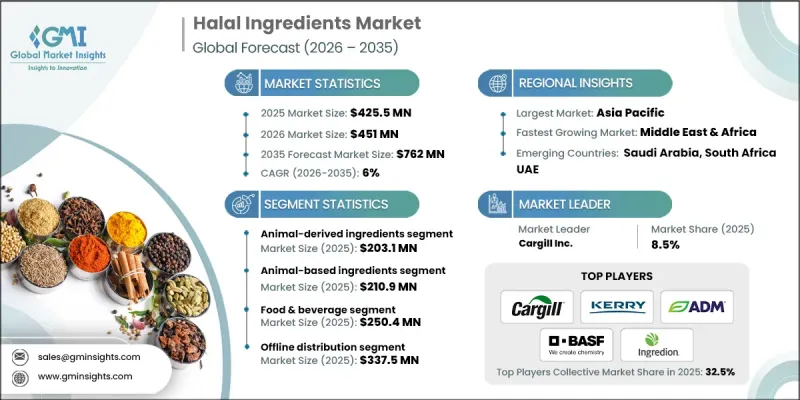
The market is defined as the worldwide ecosystem responsible for the production and supply of ingredients used across food and beverages, pharmaceuticals, cosmetics, and related sectors that comply with halal requirements. Halal ingredients are positioned as being developed under strict ethical and religious frameworks, ensuring that sourcing, processing, and logistics adhere to recognized halal principles. This compliance framework is presented as a key factor in building consumer confidence. Market growth is attributed to expanding global demand for halal-certified offerings, supported by rising income levels, rapid urban development, and growing cross-border trade. Strong consumption trends are noted across Southeast Asia as well as the Middle East and North Africa, while demand is also accelerating in Europe and North America due to broader consumer trust in halal standards. The market is further supported by increased transparency enabled through harmonized certification systems and labeling practices, which reinforce product credibility among both traditional and non-traditional consumers.
| Market Scope | |
|---|---|
| Start Year | 2025 |
| Forecast Year | 2026-2035 |
| Start Value | $425.5 Million |
| Forecast Value | $762 Million |
| CAGR | 6% |
The animal-based ingredients segment reached USD 203.1 million in 2025. This category includes materials that require strict oversight of sourcing practices, traceability, and quality assurance systems to align with international halal regulations. At the same time, demand for plant-origin ingredients continues to rise, driven by changing dietary preferences and the growing appeal of plant-forward nutrition. Ingredients produced through microbial and fermentation-based methods are also gaining attention, with manufacturers ensuring compliance through certified production environments and controlled processes.
The offline distribution segment generated USD 337.5 million in 2025. The market structure includes both physical and digital sales platforms; however, in-person purchasing remains dominant due to long-standing procurement habits among industrial buyers. Physical retail and business-to-business channels continue to play a central role, as buyers prioritize direct verification of certification, particularly when sourcing large volumes.
North America Halal Ingredients Market is expected to reach USD 80.1 million by 2035. Growth in this region is linked to increasing cultural diversity and greater public understanding of halal standards. Food retailers and service providers are expanding halal-certified portfolios, while consumers show heightened interest in ethically sourced and plant-focused formulations. Urban centers remain the primary demand hubs, supported by improved labeling practices and dedicated halal product placements in retail environments.
Key companies active in the Global Halal Ingredients Market include Cargill Inc., ADM, DSM-Firmenich, BASF SE, Ingredion, Kerry Group, Ajinomoto, Corbion, Roquette, and Givaudan. Companies operating in the halal ingredients market are strengthening their market positions through strategic investments in certification, supply chain transparency, and portfolio diversification. Many players are prioritizing compliance management by aligning production facilities with globally recognized halal standards. Product innovation focused on clean-label, plant-based, and ethically sourced ingredients is being used to attract a wider consumer base. Firms are also expanding their geographic reach through partnerships with regional distributors and food manufacturers. Branding efforts centered on trust, traceability, and quality assurance are helping companies reinforce credibility, while digital tools are increasingly used to improve documentation, audit readiness, and customer engagement across global markets.
Table of Contents
Chapter 1 Methodology & Scope
- 1.1 Market scope and definition
- 1.2 Research design
- 1.2.1 Research approach
- 1.2.2 Data collection methods
- 1.3 Data mining sources
- 1.3.1 Global
- 1.3.2 Regional/Country
- 1.4 Base estimates and calculations
- 1.4.1 Base year calculation
- 1.4.2 Key trends for market estimation
- 1.5 Primary research and validation
- 1.5.1 Primary sources
- 1.6 Forecast model
- 1.7 Research assumptions and limitations
Chapter 2 Executive Summary
- 2.1 Industry 360° synopsis
- 2.2 Key market trends
- 2.2.1 Product Type
- 2.2.2 Source Origin
- 2.2.3 Application
- 2.2.4 Distribution Channel
- 2.2.5 Regional
- 2.3 TAM Analysis, 2026-2035
- 2.4 CXO perspectives: Strategic imperatives
- 2.4.1 Executive decision points
- 2.4.2 Critical success factors
- 2.5 Future outlook and strategic recommendations
Chapter 3 Industry Insights
- 3.1 Industry ecosystem analysis
- 3.1.1 Supplier landscape
- 3.1.2 Profit margin
- 3.1.3 Value addition at each stage
- 3.1.4 Factor affecting the value chain
- 3.1.5 Disruptions
- 3.2 Industry impact forces
- 3.2.1 Growth drivers
- 3.2.1.1 Rising global demand for halal-compliant products
- 3.2.1.2 Increasing disposable incomes and urbanization in key markets
- 3.2.1.3 Growing health consciousness and preference for ethically sourced products
- 3.2.2 Industry pitfalls and challenges
- 3.2.2.1 High costs associated with Halal certification and compliance
- 3.2.2.2 Complex supply chains that increase operational challenges
- 3.2.3 Market opportunities
- 3.2.3.1 Adoption of blockchain and IoT for supply chain traceability
- 3.2.3.2 Automation in food processing and quality control for efficiency
- 3.2.3.3 Development of plant-based and lab-grown Halal-compliant alternatives
- 3.2.1 Growth drivers
- 3.3 Growth potential analysis
- 3.4 Regulatory landscape
- 3.4.1 North America
- 3.4.2 Europe
- 3.4.3 Asia Pacific
- 3.4.4 Latin America
- 3.4.5 Middle East & Africa
- 3.5 Porter’s analysis
- 3.6 PESTEL analysis
- 3.7 Technology and innovation landscape
- 3.7.1 Current technological trends
- 3.7.2 Emerging technologies
- 3.8 Price trends
- 3.8.1 By region
- 3.8.2 By Product type
- 3.9 Future market trends
- 3.10 Patent landscape
- 3.11 Trade statistics (HS code)
- 3.11.1 Major importing countries
- 3.11.2 Major exporting countries
- 3.12 Sustainability and environmental aspects
- 3.12.1 Sustainable practices
- 3.12.2 Waste reduction strategies
- 3.12.3 Energy efficiency in production
- 3.12.4 Eco-friendly initiatives
- 3.13 Carbon footprint consideration
Chapter 4 Competitive Landscape, 2025
- 4.1 Introduction
- 4.2 Company market share analysis
- 4.2.1 By region
- 4.2.1.1 North America
- 4.2.1.2 Europe
- 4.2.1.3 Asia Pacific
- 4.2.1.4 LATAM
- 4.2.1.5 MEA
- 4.2.1 By region
- 4.3 Company matrix analysis
- 4.4 Competitive analysis of major market players
- 4.5 Competitive positioning matrix
- 4.6 Key developments
- 4.6.1 Mergers & acquisitions
- 4.6.2 Partnerships & collaborations
- 4.6.3 New product launches
- 4.6.4 Expansion plans
Chapter 5 Market Estimates and Forecast, By Product Type, 2022-2035 (USD Million) (Kilo Tons)
- 5.1 Key trends
- 5.2 Animal-derived ingredients
- 5.2.1 Meat
- 5.2.2 Dairy
- 5.2.3 Gelatin
- 5.2.4 Collagen
- 5.2.5 Enzymes
- 5.3 Plant-derived ingredients
- 5.3.1 Proteins
- 5.3.2 Grains
- 5.3.3 Oils
- 5.3.4 Extracts
- 5.4 Microbial/fermentation-derived
- 5.4.1 Enzymes
- 5.4.2 Cultures
- 5.5 Precision fermentation proteins
- 5.5.1 Synthetic/chemical
- 5.5.2 Synthetic additives
- 5.5.3 Flavors
- 5.5.4 Colors
- 5.6 Others
Chapter 6 Market Estimates and Forecast, By Source Origin, 2022-2035 (USD Million) (Kilo Tons)
- 6.1 Key trends
- 6.2 Animal-based ingredients
- 6.3 Plant-based ingredients
- 6.4 Microbial/fermentation-derived ingredients
- 6.5 Synthetic/chemically synthesized ingredients
Chapter 7 Market Estimates and Forecast, By Application, 2022-2035 (USD Million) (Kilo Tons)
- 7.1 Key trends
- 7.2 Food & beverages
- 7.2.1 Meat and poultry products
- 7.2.2 Dairy and dairy alternatives
- 7.2.3 Bakery and confectionery
- 7.2.4 Beverages
- 7.2.5 Snacks and savory foods
- 7.2.6 Processed and ready meals
- 7.2.7 Condiments and sauces
- 7.2.8 Others
- 7.3 Pharmaceuticals
- 7.3.1 Gelatin capsules
- 7.3.2 Excipients
- 7.3.3 Active pharmaceutical ingredients (APIs)
- 7.3.4 Vitamins and supplements
- 7.3.5 Others
- 7.4 Cosmetics & personal care
- 7.4.1 Skincare and body care
- 7.4.2 Haircare
- 7.4.3 Oral care
- 7.4.4 Fragrances and perfumes
- 7.4.5 Color cosmetics (makeup)
- 7.4.6 Others
- 7.5 Animal feed & pet food
- 7.5.1 Livestock feed (cattle, sheep, goat)
- 7.5.2 Poultry feed (chicken, turkey)
- 7.5.3 Aquaculture feed (fish, shrimp)
- 7.5.4 Others
Chapter 8 Market Estimates and Forecast, By Distribution Channel, 2022-2035 (USD Million) (Kilo Tons)
- 8.1 Key trends
- 8.2 Offline distribution
- 8.2.1 Hypermarkets and supermarkets
- 8.2.2 Convenience stores
- 8.2.3 Specialty halal stores
- 8.2.4 Traditional markets and bazaars
- 8.2.5 Foodservice
- 8.2.6 Others
- 8.3 Online distribution
- 8.3.1 E-commerce marketplaces
- 8.3.2 Direct-to-consumer (DTC) brand websites
- 8.3.3 Online grocery delivery
- 8.3.4 Others
Chapter 9 Market Estimates and Forecast, By Region, 2022-2035 (USD Million) (Kilo Tons)
- 9.1 Key trends
- 9.2 North America
- 9.2.1 U.S.
- 9.2.2 Canada
- 9.3 Europe
- 9.3.1 Germany
- 9.3.2 UK
- 9.3.3 France
- 9.3.4 Spain
- 9.3.5 Italy
- 9.3.6 Rest of Europe
- 9.4 Asia Pacific
- 9.4.1 China
- 9.4.2 India
- 9.4.3 Japan
- 9.4.4 Australia
- 9.4.5 South Korea
- 9.4.6 Rest of Asia Pacific
- 9.5 Latin America
- 9.5.1 Brazil
- 9.5.2 Mexico
- 9.5.3 Argentina
- 9.5.4 Rest of Latin America
- 9.6 Middle East and Africa
- 9.6.1 Saudi Arabia
- 9.6.2 South Africa
- 9.6.3 UAE
- 9.6.4 Rest of Middle East and Africa
Chapter 10 Company Profiles
- 10.1 ADM
- 10.2 Ajinomoto
- 10.3 BASF SE
- 10.4 Cargill Inc.
- 10.5 Corbion
- 10.6 DSM-Firmenich
- 10.7 Givaudan
- 10.8 Ingredion
- 10.9 Kerry Group
- 10.10 Roquette