

|
시장보고서
상품코드
1959298
섬유 및 바이오메디컬용 박테리아 셀룰로오스 시장 기회, 성장요인, 업계 동향 분석 및 예측(2026-2035년)Bacterial Cellulose in Textiles and Biomedical Market Opportunity, Growth Drivers, Industry Trend Analysis, and Forecast 2026 - 2035 |
||||||

세계의 섬유 및 바이오메디컬용 박테리아 셀룰로오스 시장은 2025년에 1,040만 달러로 평가되었고, 2035년까지 연평균 복합 성장률(CAGR) 11%로 성장하여 3,090만 달러에 이를 것으로 예측되고 있습니다.
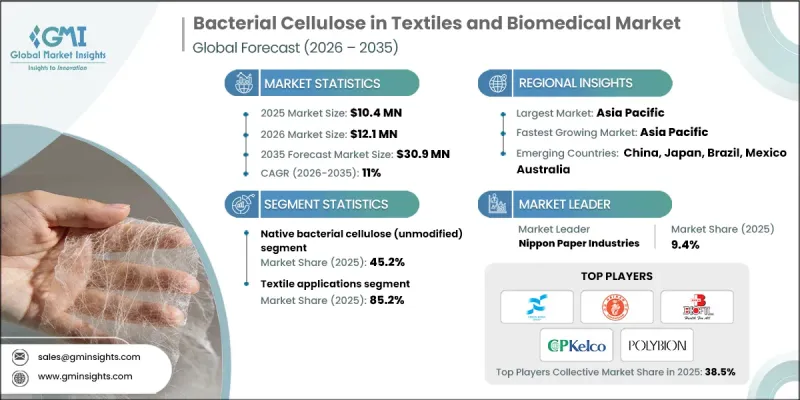
이 산업은 미개질 소재, 나노셀룰로오스 변종, 복합 및 기능화 형태, 의료용 전달 용도로 설계된 하이드로겔 시스템 등 다양한 박테리아 셀룰로오스 형태를 포괄하는 것으로 평가받고 있습니다. 생산은 배치식, 기계 강화식, 연속식, 생물학적 최적화 프로세스 등 다양한 제조 방식에 의존하는 것으로 알려져 있습니다. 시장 동향은 바이오 소재와 순환 경제 도입을 촉진하는 공공 부문의 노력에 힘입어 지속가능성과 첨단 의료 수요와의 강력한 정합성을 강조하고 있습니다. 아시아태평양은 강력한 인프라 투자와 유리한 규제 환경으로 인해 주요 지역 기여자로 자리매김하고 있습니다. 한편, 북미는 지속 가능하고 동물 실험을 하지 않는 소재에 대한 소비자 선호도 변화와 혁신에 힘입어 빠르게 발전하고 있는 시장으로 특징지어집니다. 전반적으로 본 시장은 친환경 섬유와 차세대 바이오메디컬 솔루션의 융합점으로 자리매김하고 있습니다.
| 시장 범위 | |
|---|---|
| 개시 연도 | 2025년 |
| 예측 기간 | 2026-2035년 |
| 개시 금액 | 1,040만 달러 |
| 예측 금액 | 3,090만 달러 |
| CAGR | 11% |
천연 박테리아 셀룰로오스 부문은 2025년 45.2%의 점유율을 차지할 것으로 예상되며, 2035년까지 연평균 10.8%의 성장률을 보일 것으로 전망됩니다. 이 부문은 기존 셀룰로오스 원료에 비해 순도, 구조적 무결성, 나노 단위의 섬유 배열로 인해 여러 산업 및 의료 응용 분야에서 주목을 받고 있다고 설명합니다. 이 소재는 내구성, 통기성, 생체적합성이 요구되는 응용 분야에서 우선적인 선택으로 자리매김하고 있으며, 상업적 채택이 지속적으로 확대되고 있습니다.
섬유 응용 분야는 2025년 85.2%의 점유율을 차지할 것으로 예상되며, 2035년까지 연평균 10.9%의 성장률을 보일 것으로 전망됩니다. 섬유 관련 제품에서 박테리아 셀룰로오스의 활용은 패션, 인테리어 디자인, 모빌리티 관련 분야에서 확대되고 있다는 설명입니다. 이 소재들은 기존의 섬유 및 가죽 대체품에 비해 유연성, 고급스러운 표면 외관, 환경 부하 감소를 제공하는 것으로 인정받고 있습니다.
북미 섬유 및 바이오 메디컬 분야의 박테리아 셀룰로오스 시장은 2026-2035년 동안 CAGR 11% 성장할 것으로 추정됩니다. 이 지역은 바이오 제조 기술의 발전과 지속 가능한 소재 개발에 대한 투자 증가의 혜택을 누리고 있는 것으로 특징지을 수 있습니다. 시장 전망은 환경적 책임과 소재 안전에 대한 소비자의 인식이 높아짐에 따라 제조업체와 디자이너가 의료용 제품과 라이프스타일 제품 모두에 박테리아 셀룰로오스를 통합하도록 장려하고 있습니다.
자주 묻는 질문
목차
제1장 조사 방법과 범위
제2장 주요 요약
제3장 업계 인사이트
제4장 경쟁 구도
제5장 시장 추산·예측 : 제품 유형별, 2022-2035년
제6장 시장 추산·예측 : 기술 유형별, 2022-2035년
제7장 시장 추산·예측 : 지역별, 2022-2035년
제8장 기업 개요
LSH 26.03.26The Global Bacterial Cellulose in Textiles and Biomedical Market was valued at USD 10.4 million in 2025 and is estimated to grow at a CAGR of 11% to reach USD 30.9 million by 2035.

The industry is portrayed as covering a wide range of bacterial cellulose forms, including unmodified materials, nanocellulose variants, composite and functionalized formats, and hydrogel-based systems designed for medical delivery applications. Production is stated to rely on multiple manufacturing approaches, including batch-based, mechanically enhanced, continuous, and biologically optimized processes. The market narrative highlights its strong alignment with sustainability and advanced healthcare needs, supported by public sector initiatives promoting bio-based materials and circular economy adoption. Asia Pacific is identified as the leading regional contributor due to strong infrastructure investment and favorable regulatory environments, while North America is characterized as a rapidly advancing market driven by innovation and changing consumer preferences toward sustainable and cruelty-free materials. Overall, the market is positioned as a convergence point between eco-conscious textiles and next-generation biomedical solutions.
| Market Scope | |
|---|---|
| Start Year | 2025 |
| Forecast Year | 2026-2035 |
| Start Value | $10.4 Million |
| Forecast Value | $30.9 Million |
| CAGR | 11% |
The native bacterial cellulose segment held 45.2% share in 2025 and is projected to grow at a CAGR of 10.8% through 2035. This segment is described as gaining traction across multiple industrial and medical uses due to its purity, structural integrity, and nanoscale fiber arrangement when compared with conventional cellulose sources. The material is positioned as a preferred option for applications requiring durability, breathability, and biocompatibility, supporting its continued commercial adoption.
The textiles segment held 85.2% share in 2025 and is forecast to grow at a CAGR of 10.9% through 2035. The use of bacterial cellulose in textile-related products is described as expanding across fashion, interior design, and mobility-related sectors. These materials are recognized for offering flexibility, premium surface appearance, and reduced environmental impact compared with traditional textile and leather alternatives.
North America Bacterial Cellulose in Textiles and Biomedical Market is estimated to grow at a CAGR of 11% between 2026 and 2035. The region is characterized as benefiting from advancements in biomanufacturing technologies and rising investment in sustainable material development. The market outlook emphasizes increasing consumer awareness regarding environmental responsibility and material safety, which is encouraging manufacturers and designers to incorporate bacterial cellulose into both medical-grade and lifestyle-focused products.
Key companies active in the Global Bacterial Cellulose in Textiles and Biomedical Market are described as including Polybion, Nippon Paper Industries, Nanollose, CPKelco, Modern Synthesis, Cellugy, San-Ei Gen F.F.I., Axcelon Biopolymers, Biofill, ScobyTec, Hainan Yeguo Foods, fzmb GmbH, BOWIL Biotech, Kusano Sakko, and S2Medical. Companies operating in the Bacterial Cellulose in Textiles and Biomedical Market are stated to be strengthening their positions through a combination of capacity expansion, process optimization, and strategic collaborations. Many players are focusing on improving fermentation efficiency and material consistency to support scalable production. Investments in research and development are described as targeting enhanced performance characteristics and broader application suitability. Firms are also reported to be forming partnerships with fashion brands, healthcare providers, and research institutions to accelerate commercialization.
Table of Contents
Chapter 1 Methodology & Scope
- 1.1 Market scope and definition
- 1.2 Research design
- 1.2.1 Research approach
- 1.2.2 Data collection methods
- 1.3 Data mining sources
- 1.3.1 Global
- 1.3.2 Regional/Country
- 1.4 Base estimates and calculations
- 1.4.1 Base year calculation
- 1.4.2 Key trends for market estimation
- 1.5 Primary research and validation
- 1.5.1 Primary sources
- 1.6 Forecast model
- 1.7 Research assumptions and limitations
Chapter 2 Executive Summary
- 2.1 Industry 360° synopsis
- 2.2 Key market trends
- 2.2.1 Product type
- 2.2.2 Application
- 2.2.3 Regional
- 2.3 TAM Analysis, 2026-2035
- 2.4 CXO perspectives: Strategic imperatives
- 2.4.1 Executive decision points
- 2.4.2 Critical success factors
- 2.5 Future Outlook and Strategic Recommendations
Chapter 3 Industry Insights
- 3.1 Industry ecosystem analysis
- 3.1.1 Supplier landscape
- 3.1.2 Profit margin
- 3.1.3 Value addition at each stage
- 3.1.4 Factor affecting the value chain
- 3.1.5 Disruptions
- 3.2 Industry impact forces
- 3.2.1 Growth drivers
- 3.2.2 Industry pitfalls and challenges
- 3.2.3 Market opportunities
- 3.3 Growth potential analysis
- 3.4 Regulatory landscape
- 3.4.1 North America
- 3.4.2 Europe
- 3.4.3 Asia Pacific
- 3.4.4 Latin America
- 3.4.5 Middle East & Africa
- 3.5 Porter's analysis
- 3.6 PESTEL analysis
- 3.7 Price trends
- 3.7.1 By region
- 3.7.2 By product type
- 3.8 Future market trends
- 3.9 Technology and innovation landscape
- 3.9.1 Current technological trends
- 3.9.2 Emerging technologies
- 3.10 Patent Landscape
- 3.11 Trade statistics (HS code)
- 3.11.1 Major importing countries
- 3.11.2 Major exporting countries
- 3.12 Sustainability and environmental aspects
- 3.12.1 Sustainable practices
- 3.12.2 Waste reduction strategies
- 3.12.3 Energy efficiency in production
- 3.12.4 Eco-friendly initiatives
- 3.13 Carbon footprint consideration
Chapter 4 Competitive Landscape, 2025
- 4.1 Introduction
- 4.2 Company market share analysis
- 4.2.1 By region
- 4.2.1.1 North America
- 4.2.1.2 Europe
- 4.2.1.3 Asia Pacific
- 4.2.1.4 LATAM
- 4.2.1.5 MEA
- 4.2.1 By region
- 4.3 Company matrix analysis
- 4.4 Competitive analysis of major market players
- 4.5 Competitive positioning matrix
- 4.6 Key developments
- 4.6.1 Mergers & acquisitions
- 4.6.2 Partnerships & collaborations
- 4.6.3 New Product Launches
- 4.6.4 Expansion Plans
Chapter 5 Market Estimates and Forecast, By Product Type, 2022-2035 (USD Million) (Kilo Tons)
- 5.1 Key trends
- 5.2 Native bacterial cellulose (unmodified)
- 5.3 Bacterial nanocellulose (BNC)
- 5.4 BC composites and functionalized BC
- 5.4.1 Antimicrobial BC
- 5.4.2 Polymer-BC composites
- 5.4.3 Nanoparticle-enhanced BC
- 5.4.4 Conductive BC (smart textiles)
- 5.5 BC-based hydrogels and drug delivery systems
- 5.5.1 Controlled-release systems
- 5.5.2 Transdermal delivery systems
- 5.5.3 Stimuli-responsive hydrogels
Chapter 6 Market Estimates and Forecast, By Technology Type, 2022-2035 (USD Million) (Kilo Tons)
- 6.1 Key trends
- 6.2 Textile applications
- 6.2.1 Vegan leather and fashion materials
- 6.2.2 Medical and healthcare textiles
- 6.2.3 Protective and performance textiles
- 6.2.4 Cosmetic and personal care textiles
- 6.3 Biomedical applications
- 6.3.1 Wound care
- 6.3.2 Tissue engineering and regenerative medicine
- 6.3.3 Drug delivery and transdermal systems
- 6.3.4 Implantable devices and medical adhesives
Chapter 7 Market Estimates and Forecast, By Region, 2022-2035 (USD Million) (Kilo Tons)
- 7.1 Key trends
- 7.2 North America
- 7.2.1 U.S.
- 7.2.2 Canada
- 7.3 Europe
- 7.3.1 Germany
- 7.3.2 UK
- 7.3.3 France
- 7.3.4 Spain
- 7.3.5 Italy
- 7.3.6 Rest of Europe
- 7.4 Asia Pacific
- 7.4.1 China
- 7.4.2 India
- 7.4.3 Japan
- 7.4.4 Australia
- 7.4.5 South Korea
- 7.4.6 Rest of Asia Pacific
- 7.5 Latin America
- 7.5.1 Brazil
- 7.5.2 Mexico
- 7.5.3 Argentina
- 7.5.4 Rest of Latin America
- 7.6 Middle East and Africa
- 7.6.1 Saudi Arabia
- 7.6.2 South Africa
- 7.6.3 UAE
- 7.6.4 Rest of Middle East and Africa
Chapter 8 Company Profiles
- 8.1 CPKelco
- 8.2 Hainan Yeguo Foods
- 8.3 Nippon Paper Industries
- 8.4 Polybion
- 8.5 Biofill
- 8.6 Nanollose
- 8.7 Axcelon Biopolymers
- 8.8 BOWIL Biotech
- 8.9 fzmb GmbH
- 8.10 San-Ei Gen F.F.I.
- 8.11 Kusano Sakko
- 8.12 S2Medical
- 8.13 Modern Synthesis
- 8.14 ScobyTec
- 8.15 Cellugy


