|
시장보고서
상품코드
1959304
식초 기반 보존 시스템 시장 기회, 성장요인, 업계 동향 분석 및 예측(2026-2035년)Vinegar-based Preservation Systems Market Opportunity, Growth Drivers, Industry Trend Analysis, and Forecast 2026 - 2035 |
||||||

세계의 식초 기반 보존 시스템 시장은 2025년에 41억 달러로 평가되었고, 2035년까지 연평균 복합 성장률(CAGR) 5.2%로 성장하여 69억 달러에 이를 것으로 예측됩니다.
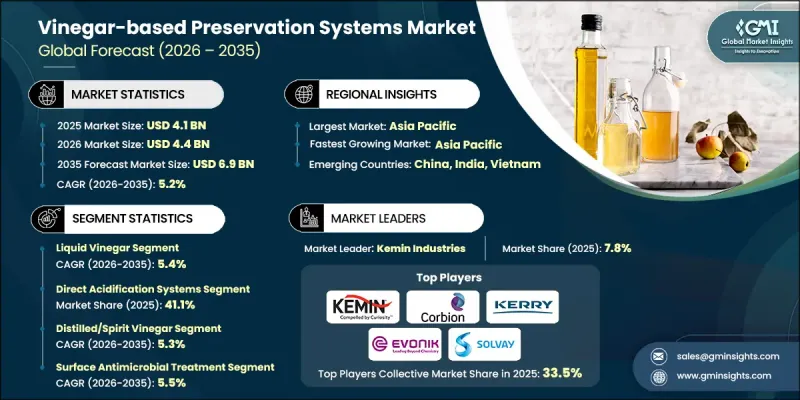
이 시장에는 액체 식초, 분말 및 건조 식초, 농축 식초, 완충 식초 블렌드, 유기농 식초 기술 등 다양한 솔루션이 포함되어 있습니다. 이러한 시스템은 복합 보존 시스템, 염화칼슘과 아세트산 조합 시스템, 과아세트산(PAA) 기반 솔루션, 완충 시스템, 직접 산성화 기술 등 첨단 제조 기법을 사용하여 개발되었습니다. 레토르트 식품, 음료, 소스 및 드레싱, 육류 및 가금류 제품, 베이커리 제품 등에 적용됩니다. 이러한 성장은 천연 유래 및 클린 라벨 보존 방법에 대한 수요 증가와 식품 안전 및 지속 가능한 가공 방법에 대한 규제적 지원 강화로 인해 촉진되고 있습니다. 세계 각국 정부는 천연 유래 항균 솔루션에 대한 연구 자금 지원 및 지원 정책 시행을 통해 친환경적이고 소비자 친화적인 보존 기술 채택을 장려하고 있습니다. 현재 아시아태평양이 식초 기반 보존 시스템 시장을 주도하고 있으며, 중국, 인도, 일본 등의 국가에서 생산 능력과 인프라에 대한 강력한 투자가 이를 주도하고 있습니다. 한편, 북미에서는 기술 혁신, 클린 라벨 원료에 대한 지출 증가, 최소 가공 및 자연 보존 식품에 대한 소비자 선호도 증가로 인해 빠르게 성장하고 있습니다.
| 시장 범위 | |
|---|---|
| 개시 연도 | 2025년 |
| 예측 연도 | 2026-2035년 |
| 개시 금액 | 41억 달러 |
| 예측 금액 | 69억 달러 |
| CAGR | 5.2% |
액체 식초 부문은 2025년 53.4%의 점유율을 차지할 것으로 예상되며, 2035년까지 연평균 5.4%의 성장률을 보일 것으로 예측됩니다. 다양한 식품 카테고리에서 채택된 것은 강력한 항균 성능과 다양한 배합에 대한 적합성을 반영합니다. 액체 식초는 클린 라벨 트렌드에 따라 투명한 성분 표시를 원하는 소비자의 니즈를 충족시킵니다. 식품 제조업체들은 합성첨가물에 의존하지 않고 보존 기간을 연장할 수 있는 효과, 신뢰성 및 특성으로 인해 다양한 보존 공정에 액체 식초를 도입하고 있습니다.
직접 산성화 시스템 부문은 2025년 41.1%의 점유율을 차지할 것으로 예상되며, 2035년까지 연평균 5.2%의 성장률을 보일 것으로 전망됩니다. 이러한 시스템은 대규모 식품 생산 환경에 원활하게 통합되어 신속하고 효율적인 미생물 제어를 실현하는 것으로 인정받고 있습니다. 식품 안전 기준의 향상과 제품 품질 유지 능력이 향상되어 상업용 가공 시설에서 채택이 강화되고 있습니다. 최소한의 가공을 거친 식품에 대한 수요 증가와 식품 안전 준수에 대한 관심이 높아지면서 식초 기반 보존 시스템 시장에서 직접 산성화 기술 도입이 가속화되고 있습니다.
북미 식초 기반 보존 시스템 시장은 2026년부터 2035년까지 연평균 복합 성장률(CAGR) 5.2%를 나타낼 것으로 예측됩니다. 시장 확대는 지속 가능한 가공 기술 혁신과 클린 라벨 보존 원료로서 완충 식초 제제의 사용 증가에 의해 뒷받침되고 있습니다. 이 지역의 기업들은 식품 안전 규제와 순환 경제 이니셔티브에 부합하는 천연 솔루션 개발에 주력하고 있습니다. 인공 방부제와 관련된 잠재적 건강 위험에 대한 소비자의 인식이 높아짐에 따라 제조업체는 GRAS 지정 식초 기반 방부제로의 전환을 촉진하고 있으며, 이는 지속적인 시장 성장을 주도하고 있습니다.
자주 묻는 질문
목차
제1장 조사 방법과 범위
제2장 주요 요약
제3장 업계 인사이트
제4장 경쟁 구도
제5장 시장 추산·예측 : 제품 유형별, 2022-2035년
제6장 시장 추산·예측 : 기술 유형별, 2022-2035년
제7장 시장 추산·예측 : 식초 원료별, 2022-2035년
제8장 시장 추산·예측 : 용도별, 2022-2035년
제9장 시장 추산·예측 : 지역별, 2022-2035년
제10장 기업 개요
LSH 26.03.26The Global Vinegar-based Preservation Systems Market was valued at USD 4.1 billion in 2025 and is estimated to grow at a CAGR of 5.2% to reach USD 6.9 billion by 2035.
The market includes a wide range of solutions such as liquid vinegar, powdered and dry vinegar formats, concentrated variants, buffered vinegar blends, and organic vinegar technologies. These systems are developed using advanced production approaches, including combination preservation systems, calcium chloride with acetic acid systems, peroxyacetic acid (PAA)-based solutions, buffered systems, and direct acidification technologies. Applications span ready-to-eat meals, beverages, sauces and dressings, meat and poultry, and bakery products. Growth is being fueled by rising demand for natural and clean-label preservation methods, along with increasing regulatory support for food safety and sustainable processing practices. Governments worldwide are encouraging the adoption of environmentally responsible and consumer-friendly preservation technologies by funding research into natural antimicrobial solutions and implementing supportive policies. Asia Pacific currently leads the vinegar-based preservation systems market, driven by strong investments in production capacity and infrastructure across countries such as China, India, and Japan. Meanwhile, North America is emerging rapidly due to technological innovation, higher spending on clean-label ingredients, and a growing consumer preference for minimally processed and naturally preserved food products.
| Market Scope | |
|---|---|
| Start Year | 2025 |
| Forecast Year | 2026-2035 |
| Start Value | $4.1 Billion |
| Forecast Value | $6.9 Billion |
| CAGR | 5.2% |
The liquid vinegar segment accounted for 53.4% share in 2025 and is anticipated to grow at a CAGR of 5.4% through 2035. Its widespread adoption across multiple food categories reflects its strong antimicrobial performance and compatibility with diverse formulations. Liquid vinegar aligns with clean label trends and meets consumer demand for transparent ingredient declarations. Food manufacturers are incorporating liquid vinegar into various preservation processes due to its effectiveness, reliability, and ability to support extended shelf life without relying on synthetic additives.
The direct acidification systems segment held 41.1% share in 2025 and is forecast to grow at a CAGR of 5.2% by 2035. These systems are recognized for delivering fast and efficient microbial control while integrating seamlessly into large-scale food production environments. Their ability to enhance food safety standards and maintain product integrity has strengthened their adoption across commercial processing facilities. Rising demand for minimally processed food options and heightened attention to food safety compliance continue to accelerate the deployment of direct acidification technologies within the vinegar-based preservation systems market.
North America Vinegar-based Preservation Systems Market is expected to grow at a CAGR of 5.2% between 2026 and 2035. Market expansion is being supported by innovation in sustainable processing techniques and increasing use of buffered vinegar formulations as clean-label preservation ingredients. Companies across the region are focusing on developing natural solutions that align with food safety regulations and circular economy initiatives. Growing consumer awareness regarding the potential health concerns associated with artificial preservatives has encouraged manufacturers to shift toward GRAS-designated, vinegar-based preservation ingredients, thereby driving sustained market growth.
Key companies operating in the Global Vinegar-based Preservation Systems Market include Kerry Group, Kemin Industries, Corbion N.V., Solvay S.A., IFF, Evonik Industries, Galactic S.A., Novonesis, Hydrite Chemical, Henan Weichuang, BioSafe Systems, YOTA BIO, Handary S.A., Sunson Biotech, and AmTech Ingredients. Companies in the Global Vinegar-based Preservation Systems Market are strengthening their competitive position through strategic product innovation, expansion of clean label portfolios, and investment in sustainable production technologies. Many players are enhancing research and development capabilities to create advanced antimicrobial blends that meet evolving regulatory and consumer standards. Strategic partnerships, capacity expansions, and regional manufacturing investments are also being used to improve supply chain resilience and global reach. Firms are focusing on certifications, GRAS compliance, and transparent sourcing practices to build brand credibility.
Table of Contents
Chapter 1 Methodology & Scope
- 1.1 Market scope and definition
- 1.2 Research design
- 1.2.1 Research approach
- 1.2.2 Data collection methods
- 1.3 Data mining sources
- 1.3.1 Global
- 1.3.2 Regional/Country
- 1.4 Base estimates and calculations
- 1.4.1 Base year calculation
- 1.4.2 Key trends for market estimation
- 1.5 Primary research and validation
- 1.5.1 Primary sources
- 1.6 Forecast model
- 1.7 Research assumptions and limitations
Chapter 2 Executive Summary
- 2.1 Industry 360° synopsis
- 2.2 Key market trends
- 2.2.1 Product type
- 2.2.2 Technology type
- 2.2.3 Application
- 2.2.4 Regional
- 2.3 TAM Analysis, 2026-2035
- 2.4 CXO perspectives: Strategic imperatives
- 2.4.1 Executive decision points
- 2.4.2 Critical success factors
- 2.5 Future Outlook and Strategic Recommendations
Chapter 3 Industry Insights
- 3.1 Industry ecosystem analysis
- 3.1.1 Supplier landscape
- 3.1.2 Profit margin
- 3.1.3 Value addition at each stage
- 3.1.4 Factor affecting the value chain
- 3.1.5 Disruptions
- 3.2 Industry impact forces
- 3.2.1 Growth drivers
- 3.2.2 Industry pitfalls and challenges
- 3.2.3 Market opportunities
- 3.3 Growth potential analysis
- 3.4 Regulatory landscape
- 3.4.1 North America
- 3.4.2 Europe
- 3.4.3 Asia Pacific
- 3.4.4 Latin America
- 3.4.5 Middle East & Africa
- 3.5 Porter’s analysis
- 3.6 PESTEL analysis
- 3.7 Price trends
- 3.7.1 By region
- 3.7.2 By product type
- 3.8 Future market trends
- 3.9 Technology and innovation landscape
- 3.9.1 Current technological trends
- 3.9.2 Emerging technologies
- 3.10 Patent Landscape
- 3.11 Trade statistics (HS code)
- 3.11.1 Major importing countries
- 3.11.2 Major exporting countries
- 3.12 Sustainability and environmental aspects
- 3.12.1 Sustainable practices
- 3.12.2 Waste reduction strategies
- 3.12.3 Energy efficiency in production
- 3.12.4 Eco-friendly initiatives
- 3.13 Carbon footprint consideration
Chapter 4 Competitive Landscape, 2025
- 4.1 Introduction
- 4.2 Company market share analysis
- 4.2.1 By region
- 4.2.1.1 North America
- 4.2.1.2 Europe
- 4.2.1.3 Asia Pacific
- 4.2.1.4 LATAM
- 4.2.1.5 MEA
- 4.2.1 By region
- 4.3 Company matrix analysis
- 4.4 Competitive analysis of major market players
- 4.5 Competitive positioning matrix
- 4.6 Key developments
- 4.6.1 Mergers & acquisitions
- 4.6.2 Partnerships & collaborations
- 4.6.3 New Product Launches
- 4.6.4 Expansion Plans
Chapter 5 Market Estimates and Forecast, By Product Type, 2022-2035 (USD Billion) (Kilo Tons)
- 5.1 Key trends
- 5.2 Liquid vinegar
- 5.3 Concentrated vinegar
- 5.4 Dry / powder vinegar
- 5.5 Buffered vinegar - liquid
- 5.6 Buffered vinegar - dry / powder
- 5.7 Organic vinegar
- 5.8 Others
Chapter 6 Market Estimates and Forecast, By Technology Type, 2022-2035 (USD Billion) (Kilo Tons)
- 6.1 Key trends
- 6.2 Direct acidification systems
- 6.3 Buffered vinegar systems
- 6.3.1 Sodium-based
- 6.3.2 Potassium-based
- 6.3.3 Calcium-based
- 6.4 Calcium chloride + acetic acid systems
- 6.5 Combination preservation systems
- 6.6 Peroxyacetic acid (PAA)-based systems
- 6.7 Others
Chapter 7 Market Estimates and Forecast, By Vinegar Source, 2022-2035 (USD Billion) (Kilo Tons)
- 7.1 Key trends
- 7.2 Distilled / spirit vinegar
- 7.3 Apple cider vinegar
- 7.3.1 Wine vinegar
- 7.3.2 Red wine vinegar
- 7.4 White wine vinegar
- 7.5 Balsamic vinegar
- 7.6 Rice vinegar
- 7.7 Others
Chapter 8 Market Estimates and Forecast, By Application, 2022-2035 (USD Billion) (Kilo Tons)
- 8.1 Key trends
- 8.2 Pickling & brining
- 8.3 Surface antimicrobial treatment
- 8.4 Marinade & injection systems
- 8.5 Dressing & condiment formulation
- 8.6 Bulk / industrial preservation systems
- 8.7 Fermentation aid & pH control
- 8.8 Others
Chapter 9 Market Estimates and Forecast, By Region, 2022-2035 (USD Billion) (Kilo Tons)
- 9.1 Key trends
- 9.2 North America
- 9.2.1 U.S.
- 9.2.2 Canada
- 9.3 Europe
- 9.3.1 Germany
- 9.3.2 UK
- 9.3.3 France
- 9.3.4 Spain
- 9.3.5 Italy
- 9.3.6 Rest of Europe
- 9.4 Asia Pacific
- 9.4.1 China
- 9.4.2 India
- 9.4.3 Japan
- 9.4.4 Australia
- 9.4.5 South Korea
- 9.4.6 Rest of Asia Pacific
- 9.5 Latin America
- 9.5.1 Brazil
- 9.5.2 Mexico
- 9.5.3 Argentina
- 9.5.4 Rest of Latin America
- 9.6 Middle East and Africa
- 9.6.1 Saudi Arabia
- 9.6.2 South Africa
- 9.6.3 UAE
- 9.6.4 Rest of Middle East and Africa
Chapter 10 Company Profiles
- 10.1 Kemin Industries
- 10.2 Corbion N.V.
- 10.3 Kerry Group
- 10.4 Evonik Industries
- 10.5 Solvay S.A.
- 10.6 IFF
- 10.7 Novonesis
- 10.8 Galactic S.A.
- 10.9 Henan Weichuang
- 10.10 YOTA BIO
- 10.11 Hydrite Chemical
- 10.12 BioSafe Systems
- 10.13 Sunson Biotech
- 10.14 Handary S.A.
- 10.15 AmTech Ingredients