
|
시장보고서
상품코드
1959320
식품용 부형제 시장 기회, 성장요인, 업계 동향 분석 및 예측(2026-2035년)Food-grade Excipients Market Opportunity, Growth Drivers, Industry Trend Analysis, and Forecast 2026 - 2035 |
||||||

세계의 식품용 부형제 시장은 2025년에 1,141억 달러로 평가되었고, 2035년까지 연평균 복합 성장률(CAGR) 4.3%로 성장하여 1,764억 달러에 이를 것으로 예측되고 있습니다.
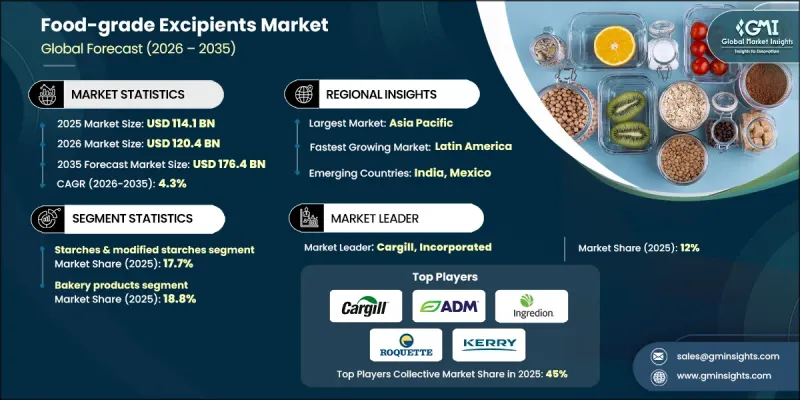
식품 제조업체, 건강기능식품 개발자, 기능성 원료 제조업체들이 제제의 안전성, 안정성, 투명성을 점점 더 중요시하는 가운데, 시장은 전략적 전환기에 있다고 평가받고 있습니다. 과거에는 부차적인 원료로 여겨졌던 성분은 이제 규제 요건 충족, 제제 성능 향상, 제품 차별화를 위한 필수 요소로 자리매김하고 있습니다. 식품 첨가물은 구조적 무결성 유지, 식감 개선, 방출 거동 제어, 가공 효율 향상 등의 능력으로 널리 인정받고 있습니다. 제형 과학의 발전으로 부형제는 기능적 성능 향상을 실현하고 복잡한 식품 시스템의 설계와 혁신을 지원하고 있습니다. 업계에서는 또한 소비자의 신뢰를 강화하기 위해 클린 라벨 포지셔닝, 원료 추적성, 완전 공개를 실천하는 데 중점을 두고 있다고 설명합니다. 지속가능성에 대한 고려가 조달 및 생산 전략에 반영되는 사례가 증가하고 있으며, 이는 세계 시장에서 경쟁적 포지셔닝을 형성하고 있습니다.
| 시장 범위 | |
|---|---|
| 개시 연도 | 2025년 |
| 예측 연도 | 2026-2035년 |
| 개시 연도 가치 | 1,141억 달러 |
| 예측 금액 | 1,764억 달러 |
| CAGR | 4.3% |
전분 및 가공 전분 부문은 2025년 17.7%의 점유율을 차지할 것으로 예상되며, 2035년까지 연평균 3.1%의 성장률을 보일 것으로 예측됩니다. 이 부문은 다양한 식품 시스템에서 구조, 점도 및 결합 성능을 향상시키는 광범위한 기능적 역할로 뒷받침됩니다. 기타 첨가제 카테고리는 수분 관리, 제형 안정화, 관능적 특성 개선, 기존 제품과 개선된 제품 모두에서 균일성을 보장하는 능력으로 인해 그 중요성이 계속 증가하고 있습니다.
베이커리 관련 응용 분야는 2025년 18.8%의 점유율을 차지할 것으로 예상되며, 2026년부터 2035년까지 연평균 4%의 성장률을 보일 것으로 예측됩니다. 식품 제조업체는 가공 및 저장 시 균일성, 구조적 안정성, 관능적 균형을 유지하기 위해 부형제에 의존하고 있습니다. 이러한 원료는 재제형 제품에서 안정성과 종합적인 성능을 유지하면서 기존 제품의 특성을 재현하기 위해 널리 사용되고 있습니다.
북미 식품 첨가물 시장은 2025년 27.7%의 점유율을 차지했습니다. 이 지역은 안전, 품질 보증, 원료 투명성을 중시하는 성숙한 규제 환경의 혜택을 누리고 있습니다. 식품 선호도가 계속 변화하는 가운데, 지역 제조업체들은 다양한 제품 포트폴리오에서 식감, 맛의 지속성, 안정성, 균일성을 유지하기 위해 고성능 첨가제에 대한 의존도를 높이고 있습니다.
자주 묻는 질문
목차
제1장 조사 방법과 범위
제2장 주요 요약
제3장 업계 인사이트
제4장 경쟁 구도
제5장 시장 추산 및 예측 : 제품 유형별, 2022-2035
제6장 시장 추산 및 예측 : 용도별, 2022-2035
제7장 시장 추산 및 예측 : 지역별, 2022-2035
제8장 기업 개요
LSH 26.03.18The Global Food-grade Excipients Market was valued at USD 114.1 billion in 2025 and is estimated to grow at a CAGR of 4.3% to reach USD 176.4 billion by 2035.
The market is described as undergoing a strategic shift as food manufacturers, nutraceutical developers, and functional ingredient producers increasingly prioritize formulation safety, stability, and transparency. Ingredients once regarded as secondary inputs are now positioned as critical to meeting regulatory expectations, improving formulation performance, and enabling product differentiation. Food-grade excipients are widely recognized for their ability to support structural integrity, improve texture, regulate release behavior, and enhance processing efficiency. Advances in formulation science are enabling excipients to deliver enhanced functional performance, supporting the design and innovation of complex food systems. The industry is also described as placing strong emphasis on clean-label positioning, ingredient traceability, and full disclosure practices to strengthen consumer confidence. Sustainability considerations are increasingly integrated into sourcing and production strategies, shaping competitive positioning across the global market.
| Market Scope | |
|---|---|
| Start Year | 2025 |
| Forecast Year | 2026-2035 |
| Start Value | $114.1 Billion |
| Forecast Value | $176.4 Billion |
| CAGR | 4.3% |
The starches and modified starches segment held a share of 17.7% in 2025 and is anticipated to grow at a CAGR of 3.1% through 2035. This segment is supported by a broad functional role in enhancing structure, consistency, and binding performance across multiple food systems. Other excipient categories continue to gain relevance due to their ability to manage moisture, stabilize formulations, improve sensory characteristics, and ensure uniformity across both legacy and reformulated products.
The bakery-related applications segment held 18.8% share in 2025 and is expected to grow at a CAGR of 4% during the 2026-2035 period. Food manufacturers rely on excipients to maintain consistency, structural stability, and sensory balance during processing and storage. These ingredients are also widely used to replicate traditional product attributes in reformulated offerings while maintaining stability and overall performance.
North America Food-grade Excipients Market held a 27.7% share in 2025. The region benefits from a mature regulatory environment that emphasizes safety, quality assurance, and ingredient transparency. As dietary preferences continue to evolve, manufacturers in the region increasingly depend on high-performance excipients to maintain texture, flavor delivery, stability, and consistency across diverse product portfolios.
Key companies active in the Global Food-grade Excipients Market include Ingredion Incorporated, Cargill, Incorporated, Roquette Freres, Kerry Group plc, DSM-Firmenich, Archer Daniels Midland Company, Corbion N.V., DuPont de Nemours, Inc., BENEO GmbH, Jungbunzlauer Suisse AG, Ashland Global Holdings Inc., J. Rettenmaier & Sohne GmbH + Co KG, CP Kelco, Palsgaard A/S, TIC Gums, and Silvateam S.p.A. Companies operating in the food-grade excipients market are reinforcing their market positions through targeted investments in research and formulation science. Many players are expanding clean-label and multifunctional excipient portfolios to address evolving regulatory and consumer expectations. Strategic partnerships with food manufacturers and ingredient developers are being used to accelerate innovation and application-specific customization. Firms are also strengthening supply chain transparency and sustainability credentials to support brand trust. Capacity expansion, geographic diversification, and process optimization remain central strategies, while digital quality control and traceability systems are increasingly adopted to improve compliance, efficiency, and customer engagement across global markets.
Table of Contents
Chapter 1 Methodology & Scope
- 1.1 Market scope and definition
- 1.2 Research design
- 1.2.1 Research approach
- 1.2.2 Data collection methods
- 1.3 Data mining sources
- 1.3.1 Global
- 1.3.2 Regional/Country
- 1.4 Base estimates and calculations
- 1.4.1 Base year calculation
- 1.4.2 Key trends for market estimation
- 1.5 Primary research and validation
- 1.5.1 Primary sources
- 1.6 Forecast model
- 1.7 Research assumptions and limitations
Chapter 2 Executive Summary
- 2.1 Industry 360° synopsis
- 2.2 Key market trends
- 2.2.1 Regional
- 2.2.2 Product Type
- 2.2.3 Application
- 2.3 TAM Analysis, 2026-2035
- 2.4 CXO perspectives: Strategic imperatives
- 2.4.1 Executive decision points
- 2.4.2 Critical success factors
- 2.5 Future Outlook and Strategic Recommendations
Chapter 3 Industry Insights
- 3.1 Industry ecosystem analysis
- 3.1.1 Supplier landscape
- 3.1.2 Profit margin
- 3.1.3 Value addition at each stage
- 3.1.4 Factor affecting the value chain
- 3.1.5 Disruptions
- 3.2 Industry impact forces
- 3.2.1 Growth drivers
- 3.2.1.1 Rising demand for processed & convenience foods
- 3.2.1.2 Growth of plant-based food industry
- 3.2.1.3 Clean label & natural ingredient trends
- 3.2.2 Industry pitfalls and challenges
- 3.2.2.1 Stringent regulatory requirements & approval delays
- 3.2.2.2 Consumer skepticism toward synthetic additives
- 3.2.3 Market opportunities
- 3.2.3.1 Microencapsulation for controlled release applications
- 3.2.3.2 Bio-based & fermentation-derived excipients
- 3.2.1 Growth drivers
- 3.3 Growth potential analysis
- 3.4 Regulatory landscape
- 3.4.1 North America
- 3.4.2 Europe
- 3.4.3 Asia Pacific
- 3.4.4 Latin America
- 3.4.5 Middle East & Africa
- 3.5 Porter's analysis
- 3.6 PESTEL analysis
- 3.7 Price trends
- 3.7.1 By region
- 3.7.2 By product type
- 3.8 Future market trends
- 3.9 Technology and Innovation landscape
- 3.9.1 Current technological trends
- 3.9.2 Emerging technologies
- 3.10 Patent Landscape
- 3.11 Trade statistics (HS code)
- 3.11.1 Major importing countries
- 3.11.2 Major exporting countries
- 3.12 Sustainability and environmental aspects
- 3.12.1 Sustainable practices
- 3.12.2 Waste reduction strategies
- 3.12.3 Energy efficiency in production
- 3.12.4 Eco-friendly initiatives
- 3.13 Carbon footprint consideration
Chapter 4 Competitive Landscape, 2025
- 4.1 Introduction
- 4.2 Company market share analysis
- 4.2.1 By region
- 4.2.1.1 North America
- 4.2.1.2 Europe
- 4.2.1.3 Asia Pacific
- 4.2.1.4 LATAM
- 4.2.1.5 MEA
- 4.2.1 By region
- 4.3 Company matrix analysis
- 4.4 Competitive analysis of major market players
- 4.5 Competitive positioning matrix
- 4.6 Key developments
- 4.6.1 Mergers & acquisitions
- 4.6.2 Partnerships & collaborations
- 4.6.3 New Product Launches
- 4.6.4 Expansion Plans
Chapter 5 Market Estimates and Forecast, By Product Type, 2022-2035 (USD Billion) (Kilo Tons)
- 5.1 Key trends
- 5.2 Starches & modified starches
- 5.3 Hydrocolloids (gums)
- 5.4 Emulsifiers
- 5.5 Sweeteners & polyols
- 5.6 Cellulose & cellulose derivatives
- 5.7 Preservatives & antimicrobials
- 5.8 Fibers & bulking agents
- 5.9 Colorants
- 5.10 Anticaking agents
- 5.11 Acidulants & ph regulators
- 5.12 Proteins & enzymes
- 5.13 Others
Chapter 6 Market Estimates and Forecast, By Application, 2022-2035 (USD Billion) (Kilo Tons)
- 6.1 Key trends
- 6.2 Bakery products
- 6.3 Beverages
- 6.4 Confectionery
- 6.5 Dairy & dairy alternatives
- 6.6 Meat & meat alternatives
- 6.7 Sauces, dressings & condiments
- 6.8 Snacks & convenience foods
- 6.9 Infant & baby food
- 6.10 Nutraceuticals & dietary supplements
- 6.11 Frozen foods
Chapter 7 Market Estimates and Forecast, By Region, 2022-2035 (USD Billion) (Kilo Tons)
- 7.1 Key trends
- 7.2 North America
- 7.2.1 U.S.
- 7.2.2 Canada
- 7.3 Europe
- 7.3.1 Germany
- 7.3.2 UK
- 7.3.3 France
- 7.3.4 Spain
- 7.3.5 Italy
- 7.3.6 Rest of Europe
- 7.4 Asia Pacific
- 7.4.1 China
- 7.4.2 India
- 7.4.3 Japan
- 7.4.4 Australia
- 7.4.5 South Korea
- 7.4.6 Rest of Asia Pacific
- 7.5 Latin America
- 7.5.1 Brazil
- 7.5.2 Mexico
- 7.5.3 Argentina
- 7.5.4 Rest of Latin America
- 7.6 Middle East and Africa
- 7.6.1 Saudi Arabia
- 7.6.2 South Africa
- 7.6.3 UAE
- 7.6.4 Rest of Middle East and Africa
Chapter 8 Company Profiles
- 8.1 Cargill, Incorporated
- 8.2 Ingredion Incorporated
- 8.3 Kerry Group plc
- 8.4 Archer Daniels Midland Company (ADM)
- 8.5 DuPont de Nemours, Inc.
- 8.6 DSM-Firmenich
- 8.7 Ashland Global Holdings Inc.
- 8.8 BENEO GmbH (Sudzucker Group)
- 8.9 Roquette Freres
- 8.10 Corbion N.V.
- 8.11 Jungbunzlauer Suisse AG
- 8.12 J. Rettenmaier & Sohne GmbH + Co KG (JRS)
- 8.13 Palsgaard A/S
- 8.14 CP Kelco (J.M. Huber Corporation)
- 8.15 TIC Gums (Ingredion)
- 8.16 Silvateam S.p.a.