
|
시장보고서
상품코드
1959334
석유 및 가스 업계용 OTS 시장 기회, 성장요인, 업계 동향 분석 및 예측(2026-2035년)Oil and Gas OTS Market Opportunity, Growth Drivers, Industry Trend Analysis, and Forecast 2026 - 2035 |
||||||

세계의 석유 및 가스 업계용 OTS 시장은 2025년에 31억 달러로 평가되었고, 2035년까지 연평균 복합 성장률(CAGR) 5.1%로 성장하여 50억 달러에 이를 것으로 예측됩니다.
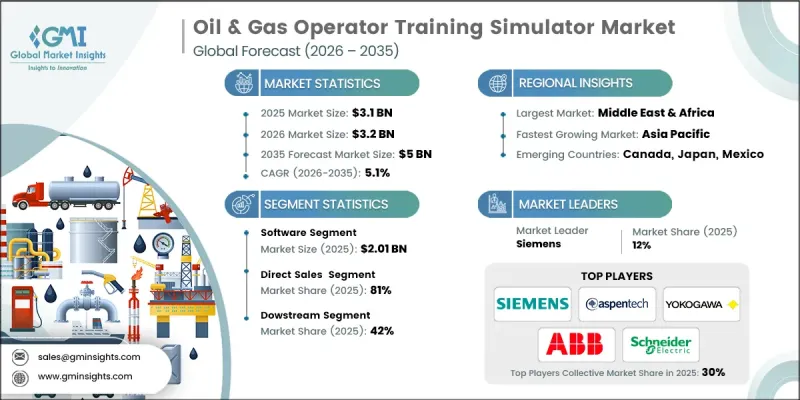
이 시장의 성장은 석유 및 가스 운영이 본질적으로 높은 위험을 수반하는 특성에서 기인합니다. 고압, 극한의 온도, 유해한 화학물질, 복잡한 공정이 오류 발생 시 치명적인 사고를 유발할 수 있기 때문입니다. 정유, 해양, 가스 처리 사업에서 발생한 중대 사고는 인적 성과 향상과 예방적 안전 조치의 필요성을 강조해 왔습니다. 운영자 훈련 시뮬레이터(OTS)는 운영자가 일상 업무, 비정상 상황, 비상 시나리오를 연습할 수 있는 현실적인 가상 환경을 제공함으로써 운영 위험 감소의 핵심이 되고 있습니다. 이 시뮬레이터를 통해 작업자는 실제 업무의 압박과 요구 사항을 안전하게 경험할 수 있습니다. 안전과 더불어 예방적 위험 관리와 손실 방지에 초점을 맞추었습니다. 기업들은 잠재적 고장 시뮬레이션, 안전 절차 검증, 높은 스트레스 상황에서의 작업자 대응 평가 등을 위해 OTS를 점점 더 많이 활용하고 있습니다. 이를 통해 실제 사고가 발생하기 전에 훈련 및 운영 절차의 미비점을 파악할 수 있어 운영의 신뢰성과 직원의 역량을 모두 향상시킬 수 있습니다.
| 시장 범위 | |
|---|---|
| 개시 연도 | 2025년 |
| 예측 연도 | 2026-2035년 |
| 개시 금액 | 31억 달러 |
| 예측 금액 | 50억 달러 |
| CAGR | 5.1% |
2025년 소프트웨어 부문은 20억 1,000만 달러의 수익을 창출했습니다. 소프트웨어는 OTS 시스템의 핵심으로 프로세스 시뮬레이션 엔진, 동적 수학 모델링, 에뮬레이트 제어 로직, 시나리오 관리 도구 등을 포함합니다. 고정밀 소프트웨어는 실제 플랜트 성능에서 도출된 제1원칙 프로세스 모델에 의존하여 작업자의 조작에 대한 현실적인 반응을 보장합니다. 가상 플랜트 환경을 재현함으로써 작업자는 실제 운영과 거의 동일한 조건에서 기술을 습득하고, 정보에 입각한 의사결정을 내릴 수 있으며, 안전 대응 능력을 향상시킬 수 있습니다. 이에 따라 효과적인 운영자 교육 및 지속적인 인재 육성에 있어 소프트웨어는 필수불가결한 존재가 되었습니다.
2025년 기준, 직접 판매 채널 부문이 81%의 점유율을 차지했습니다. OTS 솔루션의 높은 기술적 복잡성, 맞춤화, 자본 집약성으로 인해 공급업체와의 직접적 관여가 선호되는 경향이 있습니다. 벤더는 석유 및 가스 기업과 긴밀히 협력하여 플랜트별 모델 제작, 분산제어시스템(DCS)과의 통합, 실제 운영 절차를 반영한 훈련 시나리오를 구축합니다. 이러한 접근 방식을 통해 운영자는 시스템 설계, 품질, 라이프사이클 지원에 대한 관리 권한을 유지할 수 있습니다. 또한, 직접 판매는 제조업체와 고객 간의 관계 강화에 기여하며, 설치 후 지원과 장기적인 가치 향상으로 이어집니다.
미국의 석유 및 가스 산업을 위한 운영자 훈련 시뮬레이터 시장은 2025년 83%의 점유율을 차지하며 7억 달러 규모에 달할 것으로 예측됩니다. 미국 시장은 방대한 정제 능력, LNG 수출 인프라, 선진화된 업스트림 및 중류 운영으로 인해 전 세계적으로 선도적인 위치를 차지하고 있습니다. 고도로 자동화된 시설, 엄격한 안전 규제, 환경 모니터링으로 인해 고충실도 DCS 통합형 OTS 솔루션에 대한 수요가 증가하고 있습니다. 미국 기반의 OTS 공급업체 및 자동화 벤더들은 클라우드 기반 시뮬레이션 툴, 디지털 트윈 플랫폼, 성능 기반 운전자 평가 시스템 등 첨단 솔루션 도입을 적극적으로 추진하고 있습니다. 석유 및 가스 활동이 활발한 주에서는 안전, 효율성, 규제 준수에 중점을 두고 이러한 기술의 도입을 가속화하고 있습니다.
자주 묻는 질문
목차
제1장 조사 방법과 범위
제2장 주요 요약
제3장 업계 인사이트
제4장 경쟁 구도
제5장 시장 추산·예측 : 컴포넌트별, 2022-2035년
제6장 시장 추산·예측 : 도입 모델별, 2022-2035년
제7장 시장 추산·예측 : 사업별, 2022-2035년
제8장 시장 추산·예측 : 오퍼레이션별, 2022-2035년
제9장 시장 추산·예측 : 유통 채널별, 2022-2035년
제10장 시장 추산·예측 : 지역별, 2022-2035년
제11장 기업 개요
LSH 26.03.26The Global Oil & Gas Operator Training Simulator Market was valued at USD 3.1 billion in 2025 and is estimated to grow at a CAGR of 5.1% to reach USD 5 billion by 2035.
The market's growth is driven by the inherently high-risk nature of oil and gas operations, where high pressure, extreme temperatures, hazardous chemicals, and complex processes can lead to catastrophic events if errors occur. Historically, major accidents in refining, offshore, and gas processing operations have emphasized the need for enhanced human performance and preventive safety measures. Operator Training Simulators (OTS) have become central to reducing operational risks by providing realistic virtual environments where operators can practice routine, abnormal, and emergency scenarios. These simulators allow operators to experience the pressures and demands of real-world operations safely. In addition to safety, the focus has shifted to proactive risk management and loss prevention. Companies are increasingly using OTS to simulate potential failures, test safety procedures, and evaluate operator responses to high-stress situations. This enables identification of gaps in training and operational procedures before actual incidents occur, improving both operational reliability and workforce competence.
| Market Scope | |
|---|---|
| Start Year | 2025 |
| Forecast Year | 2026-2035 |
| Start Value | $3.1 Billion |
| Forecast Value | $5 Billion |
| CAGR | 5.1% |
In 2025, the software segment generated USD 2.01 billion. Software forms the core of OTS systems, encompassing process simulation engines, dynamic mathematical modeling, emulated control logic, and scenario management tools. High-fidelity software relies on first-principle process models derived from actual plant performance, ensuring realistic responses to operator actions. By recreating a virtual plant environment, the software allows operators to develop skills, make informed decisions, and improve safety readiness in conditions nearly identical to real operations. This makes software indispensable for effective operator training and continuous workforce development.
The direct sales channel segment held 81% share in 2025. The high level of technical complexity, customization, and capital intensity of OTS solutions drives the preference for direct engagement with suppliers. Vendors collaborate closely with oil and gas companies to create plant-specific models, integrate with Distributed Control Systems (DCS), and ensure training scenarios reflect actual operating procedures. This approach allows operators to maintain control over system design, quality, and lifecycle support. Direct sales also foster stronger relationships between manufacturers and clients, enhancing post-installation support and long-term value.
U.S. Oil & Gas Operator Training Simulator Market captured 83% share, generating USD 0.7 billion in 2025. The U.S. market leads globally due to its extensive refining capacity, LNG export infrastructure, and advanced upstream and midstream operations. Highly automated facilities, stringent safety regulations, and environmental oversight drive demand for DCS-integrated OTS solutions with high fidelity. U.S.-based OTS suppliers and automation vendors actively promote the adoption of advanced solutions, including cloud-based simulation tools, digital twin platforms, and performance-based operator assessment systems. States with significant oil and gas activity are accelerating the deployment of these technologies, emphasizing safety, efficiency, and regulatory compliance.
Key players operating in the Global Oil & Gas Operator Training Simulator Market include ABB, Aspen Technology, ANDRITZ, AVEVA Group Limited, Designing Digitally, DNV AS, DuPont, EON Reality, ESI Group, Hyperion Group, Schneider Electric, Siemens, Tecnatom, TRAX Energy Solutions, and Yokogawa Electric. Companies in the Oil & Gas Operator Training Simulator Market are strengthening their presence by investing in high-fidelity simulation software, cloud-enabled platforms, and scenario libraries covering routine, abnormal, and emergency operations. Strategic collaborations with oil and gas operators help ensure simulators are tailored to plant-specific processes and DCS configurations. Firms are expanding service offerings, including operator performance assessments, training analytics, and remote access to simulation environments. Adoption of digital twin technology, real-time monitoring, and AI-driven evaluation tools differentiates providers and enhances value delivery.
Table of Contents
Chapter 1 Methodology and Scope
- 1.1 Market scope and definition
- 1.2 Research design
- 1.2.1 Research approach
- 1.2.2 Data collection methods
- 1.3 Data mining sources
- 1.3.1 Global
- 1.3.2 Regional/Country
- 1.4 Base estimates and calculations
- 1.4.1 Base year calculation
- 1.4.2 Key trends for market estimation
- 1.5 Primary research and validation
- 1.5.1 Primary sources
- 1.6 Forecast model
- 1.7 Research assumptions and limitations
Chapter 2 Executive Summary
- 2.1 Industry 360° synopsis
- 2.2 Key market trends
- 2.2.1 Regional
- 2.2.2 Component
- 2.2.3 Deployment model
- 2.2.4 Operations
- 2.2.5 Environmental simulation
- 2.2.6 Distribution channel
- 2.3 CXO perspectives: Strategic imperatives
- 2.3.1 Key decision points for industry executives
- 2.3.2 Critical success factors for market players
- 2.4 Future outlook and strategic recommendations
Chapter 3 Industry Insights
- 3.1 Industry ecosystem analysis
- 3.1.1 Supplier landscape
- 3.1.2 Profit margin
- 3.1.3 Value addition at each stage
- 3.1.4 Factor affecting the value chain
- 3.2 Industry impact forces
- 3.2.1 Growth drivers
- 3.2.1.1 Increasing focus on operational safety & risk reduction
- 3.2.1.2 Regulatory & compliance requirements
- 3.2.1.3 Digital transformation & industry 4.0
- 3.2.2 Industry pitfalls & challenges
- 3.2.2.1 High upfront cost
- 3.2.2.2 Technical complexity & maintenance burden
- 3.2.3 Opportunities
- 3.2.3.1 Integration with digital twins & AI
- 3.2.3.2 Modular & cloud-enabled OTS models
- 3.2.1 Growth drivers
- 3.3 Growth potential analysis
- 3.4 Future market trends
- 3.5 Technology and innovation landscape
- 3.5.1 Current technological trends
- 3.5.2 Emerging technologies
- 3.6 Price trends
- 3.6.1 By region
- 3.6.2 By component
- 3.7 Regulatory landscape
- 3.7.1 Standards and compliance requirements
- 3.7.2 Regional regulatory frameworks
- 3.7.3 Certification standards
- 3.8 Porter’s analysis
- 3.9 PESTEL analysis
Chapter 4 Competitive Landscape, 2025
- 4.1 Introduction
- 4.2 Company market share analysis
- 4.2.1 By region
- 4.2.1.1 North America
- 4.2.1.2 Europe
- 4.2.1.3 Asia Pacific
- 4.2.1.4 Latin America
- 4.2.1.5 Middle East and Africa
- 4.2.1 By region
- 4.3 Company matrix analysis
- 4.4 Competitive analysis of major market players
- 4.5 Competitive positioning matrix
- 4.6 Key developments
- 4.6.1 Mergers & acquisitions
- 4.6.2 Partnerships & collaborations
- 4.6.3 New product launches
- 4.6.4 Expansion plans
Chapter 5 Market Estimates and Forecast, By Component, 2022 - 2035 (USD Billion) (Thousand Units)
- 5.1 Key trends
- 5.2 Hardware
- 5.3 Software
- 5.3.1 Control simulation
- 5.3.2 Process simulation
- 5.3.3 Immersive simulation
- 5.4 Services
- 5.4.1 Consulting
- 5.4.2 Installation & environmental simulation
- 5.4.3 Maintenance & support
Chapter 6 Market Estimates and Forecast, By Deployment Model, 2022 - 2035 (USD Billion) (Thousand Units)
- 6.1 Key trends
- 6.2 On-Premises
- 6.3 Cloud-based
- 6.4 Hybrid
Chapter 7 Market Estimates and Forecast, By Operations, 2022 - 2035 (USD Billion) (Thousand Units)
- 7.1 Key trends
- 7.2 Upstream operations
- 7.3 Midstream operations
- 7.4 Downstream operations
Chapter 8 Market Estimates and Forecast, By Operations, 2022 - 2035 (USD Billion) (Thousand Units)
- 8.1 Key trends
- 8.2 Console operator training
- 8.3 Field operator training
Chapter 9 Market Estimates and Forecast, By Distribution Channel, 2022 - 2035 (USD Billion) (Thousand Units)
- 9.1 Key trends
- 9.2 Direct sales
- 9.3 Indirect sales
Chapter 10 Market Estimates and Forecast, By Region, 2022 - 2035 (USD Billion) (Thousand Units)
- 10.1 Key trends
- 10.2 North America
- 10.2.1 U.S.
- 10.2.2 Canada
- 10.3 Europe
- 10.3.1 Germany
- 10.3.2 UK
- 10.3.3 France
- 10.3.4 Italy
- 10.3.5 Spain
- 10.4 Asia Pacific
- 10.4.1 China
- 10.4.2 Japan
- 10.4.3 India
- 10.4.4 Australia
- 10.4.5 South Korea
- 10.5 Latin America
- 10.5.1 Brazil
- 10.5.2 Mexico
- 10.5.3 Argentina
- 10.6 Middle East and Africa
- 10.6.1 South Africa
- 10.6.2 Saudi Arabia
- 10.6.3 UAE
Chapter 11 Company Profiles
- 11.1 ABB
- 11.2 ANDRITZ
- 11.3 Aspen Technology
- 11.4 AVEVA Group Limited
- 11.5 Designing Digitally
- 11.6 DNV AS
- 11.7 DuPont
- 11.8 EON Reality
- 11.9 ESI Group
- 11.10 Hyperion Group
- 11.11 Schneider Electric
- 11.12 Siemens
- 11.13 Tecnatom
- 11.14 TRAX Energy Solutions
- 11.15 Yokogawa Electric