

|
시장보고서
상품코드
1959554
모듈식 및 조립식 건축 시장 기회, 성장요인, 업계 동향 분석 및 예측(2026-2035년)Modular and Prefabricated Construction Market Opportunity, Growth Drivers, Industry Trend Analysis, and Forecast 2026 - 2035 |
||||||

세계의 모듈식 및 조립식 건축 시장은 2025년에 1,711억 달러로 평가되었고, 2035년까지 연평균 복합 성장률(CAGR) 6.1%로 성장하여 3,072억 달러에 이를 것으로 예측되고 있습니다.
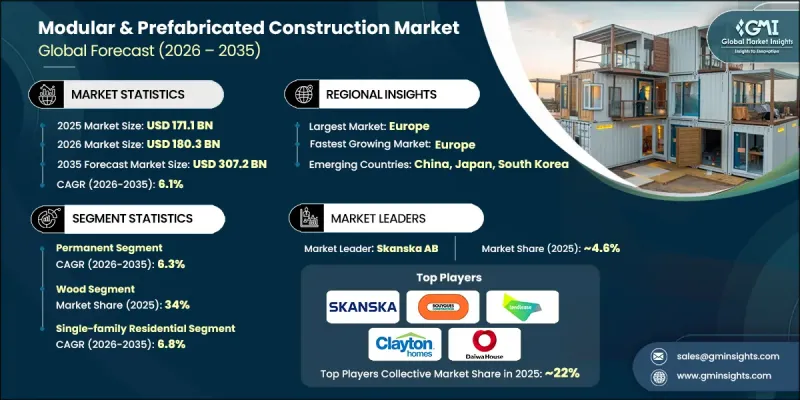
상업시설, 주택, 인프라 등 모든 분야에서 프로젝트 공기 단축이 최우선 과제로 떠오르면서 모듈형 조립식 솔루션에 대한 수요가 증가하고 있습니다. 오프사이트 제조를 통해 벽, 바닥, 지붕 시스템 등의 구조부재를 동시에 생산할 수 있어 프로젝트를 조기에 완료할 수 있습니다. 이 방법은 현장의 노동력 요구 사항을 줄이고, 날씨로 인한 지연을 줄이며, 소유주가 부동산을 더 빨리 활용할 수 있도록 하여 궁극적으로 전체 건설 비용을 절감할 수 있습니다. 표준화된 모듈은 품질의 일관성과 설치의 용이성을 보장하고, 프로젝트 소유자가 예산과 현금 흐름을 보다 예측 가능하게 관리할 수 있도록 도와줍니다. 모듈식 건축은 개보수 및 확장 프로젝트에 대응할 수 있으며, 일상 업무에 지장을 주지 않고 기존 건물을 업그레이드할 수 있습니다. 모듈식 공법의 효율성, 비용 효율성, 유연성은 지속가능성 및 컴플라이언스 기준을 충족시키면서 보다 신속하고 고품질의 시공 결과를 원하는 시장에서 선호되는 솔루션으로 자리매김하고 있습니다.
| 시장 범위 | |
|---|---|
| 개시 연도 | 2025년 |
| 예측 연도 | 2026-2035년 |
| 개시 금액 | 1,711억 달러 |
| 예측 금액 | 3,072억 달러 |
| CAGR | 6.1% |
영구 건설 부문은 2025년 918억 달러 시장 규모를 형성할 것으로 예상되며, 2026년부터 2035년까지 연평균 6.3%의 성장률을 보일 것으로 전망됩니다. 그 우위는 주택단지, 사무실, 공공시설 등 장기적인 구조물에서 광범위하게 사용되기 때문입니다. 조립식 강재, 콘크리트, 엔지니어링 목재 부품은 내구성, 구조적 무결성, 건축법규에 대한 적합성을 높이면서 노동력과 건설 기간을 줄여줍니다. 도시화의 진전, 지속 가능한 주택 수요, 상업 인프라의 확충이 채용을 촉진하고 있습니다.
목재 부문은 2025년 34%의 점유율을 차지할 것으로 예상되며, 2026년부터 2035년까지 연평균 6.4%의 성장률을 보일 것으로 전망됩니다. 목재의 다재다능함, 지속가능성, 미적 매력은 주거, 상업, 공공 프로젝트에서 선호되는 재료가 되었으며, 환경 부하를 줄이면서 빠른 조립과 유연한 설계를 가능하게 합니다.
독일의 모듈식 조립식 건축 시장은 2025년 23억 1,190만 달러에 달할 것으로 예상되며, 2035년까지 연평균 6.4%의 성장률을 보일 것으로 전망됩니다. 이 시장은 엄격한 건축 기준, 에너지 효율 규제, 숙련된 노동력 부족으로 인해 공장 생산 모듈에 대한 수요를 견인하고 있습니다. 조립식 공법은 품질 일관성, 규정 준수, 프로젝트 기간 단축을 보장하기 때문에 주거용 및 산업용 모두에서 실용적인 솔루션이 되고 있습니다.
자주 묻는 질문
목차
제1장 조사 방법과 범위
제2장 주요 요약
제3장 업계 인사이트
제4장 경쟁 구도
제5장 시장 추산·예측 : 제품 유형별, 2022-2035년
제6장 시장 추산·예측 : 재료별, 2022-2035년
제7장 시장 추산·예측 : 용도별, 2022-2035년
제8장 시장 추산·예측 : 지역별, 2022-2035년
제9장 기업 개요
LSH 26.03.26The Global Modular & Prefabricated Construction Market was valued at USD 171.1 billion in 2025 and is estimated to grow at a CAGR of 6.1% to reach USD 307.2 billion by 2035.
Accelerating project timelines has become a priority across commercial, residential, and infrastructure sectors, driving demand for modular and prefabricated solutions. Offsite fabrication allows structural components such as walls, floors, and roof systems to be produced simultaneously, enabling quicker project completion. This approach reduces onsite labor requirements, mitigates weather-related delays, and allows owners to utilize properties sooner, ultimately lowering overall construction costs. Standardized modules ensure consistent quality and ease of installation, helping project owners manage budgets and cash flows with greater predictability. Modular construction also supports renovation and expansion projects, allowing upgrades to existing buildings without disrupting daily operations. The efficiency, cost-effectiveness, and flexibility of modular methods are positioning them as a preferred solution in markets seeking faster, high-quality construction outcomes while meeting sustainability and compliance standards.
| Market Scope | |
|---|---|
| Start Year | 2025 |
| Forecast Year | 2026-2035 |
| Start Value | $171.1 Billion |
| Forecast Value | $307.2 Billion |
| CAGR | 6.1% |
The permanent construction segment generated USD 91.8 billion in 2025 and is expected to grow at a CAGR of 6.3% from 2026 to 2035. Its dominance stems from widespread use in long-term structures such as residential complexes, offices, and institutional facilities. Prefabricated steel, concrete, and engineered timber components enhance durability, structural integrity, and compliance with building regulations while reducing labor and construction time. Rising urbanization, sustainable housing demand, and expansion of commercial infrastructure are fueling adoption.
The wood segment held a 34% share in 2025 and is anticipated to grow at a CAGR of 6.4% from 2026 to 2035. Wood's versatility, sustainability, and aesthetic appeal make it a preferred material for residential, commercial, and institutional projects, supporting rapid assembly and flexible design with lower environmental impact.
Germany Modular & Prefabricated Construction Market reached USD 23.19 billion in 2025, projected to grow at a CAGR of 6.4% through 2035. The market is shaped by strict building codes, energy efficiency regulations, and a shortage of skilled labor, which drive demand for factory-built modules. Prefabrication ensures consistent quality, regulatory compliance, and accelerated project timelines, making it a practical solution for both residential and industrial applications.
Key players in the Global Modular & Prefabricated Construction Market include ACS Group, ATCO Ltd., Bouygues Construction, Boxabl Inc., Clayton Homes, Daiwa House Industry Co., Ltd., Guerdon, LLC, Hickory Group, Kiewit Corporation, Larsen & Toubro Limited, Lendlease Group, Red Sea International Co., Riko Group, Sekisui House, Ltd., and Skanska AB. Companies in the Modular & Prefabricated Construction Market are strengthening their position through strategic investments in offsite manufacturing facilities, standardization of modular components, and adoption of sustainable building materials. Firms are expanding global footprints to access high-demand regions while leveraging digital design and BIM technologies to improve planning and precision. Partnerships with contractors and developers enhance market reach, while R&D initiatives focus on advanced materials, energy-efficient solutions, and rapid assembly techniques.
Table of Contents
Chapter 1 Methodology & Scope
- 1.1 Market scope and definition
- 1.2 Research design
- 1.2.1 Research approach
- 1.2.2 Data collection methods
- 1.3 Data mining sources
- 1.3.1 Global
- 1.3.2 Regional/Country
- 1.4 Base estimates and calculations
- 1.4.1 Base year calculation
- 1.4.2 Key trends for market estimation
- 1.5 Primary research and validation
- 1.5.1 Primary sources
- 1.6 Forecast model
- 1.7 Research assumptions and limitations
Chapter 2 Executive Summary
- 2.1 Industry 360° synopsis
- 2.2 Key market trends
- 2.2.1 Regional
- 2.2.2 Burner design
- 2.2.3 Installation
- 2.2.4 Power Range
- 2.2.5 End Use Industry
- 2.3 CXO perspectives: Strategic imperatives
- 2.3.1 Key decision points for industry executives
- 2.3.2 Critical success factors for market players
- 2.4 Future outlook and strategic recommendations
Chapter 3 Industry Insights
- 3.1 Industry ecosystem analysis
- 3.1.1 Supplier landscape
- 3.1.2 Profit margin
- 3.1.3 Value addition at each stage
- 3.1.4 Factor affecting the value chain
- 3.2 Industry impact forces
- 3.2.1 Growth drivers
- 3.2.1.1 Rising demand for faster project completion and reduced construction timelines
- 3.2.1.2 Expansion of affordable housing and urban infrastructure projects
- 3.2.1.3 Improved quality control through factory-based construction processes
- 3.2.2 Pitfalls & Challenges
- 3.2.2.1 High upfront investment in manufacturing facilities and logistics
- 3.2.2.2 Design limitations and perception of reduced architectural flexibility
- 3.2.3 Opportunities
- 3.2.3.1 Integration of digital design tools such as BIM and automation
- 3.2.3.2 Growing use of sustainable and low-carbon building materials
- 3.2.1 Growth drivers
- 3.3 Growth potential analysis
- 3.4 Future market trends
- 3.5 Technology and innovation landscape
- 3.5.1 Current technological trends
- 3.5.2 Emerging technologies
- 3.6 Price trends
- 3.6.1 By region
- 3.6.2 By product
- 3.7 Regulatory landscape
- 3.7.1 Standards and compliance requirements
- 3.7.2 Regional regulatory frameworks
- 3.7.3 Certification standards
- 3.8 Porter’s analysis
- 3.9 PESTEL analysis
Chapter 4 Competitive Landscape, 2025
- 4.1 Introduction
- 4.2 Company market share analysis
- 4.2.1 By Region
- 4.2.1.1 North America
- 4.2.1.2 Europe
- 4.2.1.3 Asia Pacific
- 4.2.1.4 Latin America
- 4.2.1.5 Middle East & Africa
- 4.2.1 By Region
- 4.3 Company matrix analysis
- 4.4 Competitive analysis of major market players
- 4.5 Competitive positioning matrix
- 4.6 Key developments
- 4.6.1 Mergers & acquisitions
- 4.6.2 Partnerships & collaborations
- 4.6.3 New product launches
- 4.6.4 Expansion plans
Chapter 5 Market Estimates & Forecast, By Product Type, 2022 - 2035, (USD Billion) (Thousand Units)
- 5.1 Key trends
- 5.2 Permanent
- 5.3 Relocatable
Chapter 6 Market Estimates & Forecast, By Material, 2022 - 2035, (USD Billion) (Thousand Units)
- 6.1 Key trends
- 6.2 Steel
- 6.3 Wood
- 6.4 Concrete
- 6.5 Others
Chapter 7 Market Estimates & Forecast, By Application, 2022 - 2035, (USD Billion) (Thousand Units)
- 7.1 Key trends
- 7.2 Single family residential
- 7.3 Multi-family residential
- 7.4 Office
- 7.5 Hospitality
- 7.6 Retail
- 7.7 Healthcare
- 7.8 Others
Chapter 8 Market Estimates & Forecast, By Region, 2022 - 2035, (USD Billion) (Thousand Units)
- 8.1 Key trends
- 8.2 North America
- 8.2.1 U.S.
- 8.2.2 Canada
- 8.3 Europe
- 8.3.1 Germany
- 8.3.2 UK
- 8.3.3 France
- 8.3.4 Italy
- 8.3.5 Spain
- 8.4 Asia Pacific
- 8.4.1 China
- 8.4.2 India
- 8.4.3 Japan
- 8.4.4 South Korea
- 8.4.5 Australia
- 8.5 Latin America
- 8.5.1 Brazil
- 8.5.2 Mexico
- 8.5.3 Argentina
- 8.6 MEA
- 8.6.1 Saudi Arabia
- 8.6.2 UAE
- 8.6.3 South Africa
Chapter 9 Company Profiles
- 9.1 ACS Group
- 9.2 ATCO Ltd.
- 9.3 Bouygues Construction
- 9.4 Boxabl Inc.
- 9.5 Clayton Homes
- 9.6 Daiwa House Industry Co., Ltd.
- 9.7 Guerdon, LLC
- 9.8 Hickory Group
- 9.9 Kiewit Corporation
- 9.10 Larsen & Toubro Limited
- 9.11 Lendlease Group
- 9.12 Red Sea International Co.
- 9.13 Riko Group
- 9.14 Sekisui House, Ltd.
- 9.15 Skanska AB


