|
시장보고서
상품코드
1959559
붕소 광물 및 화학제품 시장 기회, 성장요인, 업계 동향 분석 및 예측(2026-2035년)Boron Minerals and Chemicals Market Opportunity, Growth Drivers, Industry Trend Analysis, and Forecast 2026 - 2035 |
||||||

세계의 붕소 광물 및 화학제품 시장은 2025년에 137억 달러로 평가되었고, 2035년까지 연평균 복합 성장률(CAGR)4.3%로 성장하여 201억 달러에 이를 것으로 예측되고 있습니다.

이 시장은 자연적으로 존재하는 붕소 광물 및 그로부터 파생된 모든 산업용 화학 화합물을 포괄합니다. 주요 광물로는 붕사, 콜마나이트, 카르나이트, 우렉사이트 등이 있으며, 이는 상업적 붕소 추출의 1차 정보입니다. 붕산, 산화붕소, 각종 붕산염 등 붕소 화학제품은 이들 광물을 가공하여 얻어지며, 내열성, 경도, 화학적 안정성이 높은 평가를 받고 있습니다. 전통적으로 붕소는 비용 효율성과 기능적 다양성으로 인해 유리, 세라믹, 농업 분야에서 활용되어 왔습니다. 유리-세라믹 분야에서는 열적-광학적 특성 개선, 농업 분야에서는 식물의 성장과 수확량을 지원하는 필수 미량 영양소로서의 효과가 기대되고 있습니다. 최근 기술 발전에 따라 붕소의 역할은 첨단 기술 분야로 확대되고 있으며, 리튬 이온 배터리, 영구 자석, 반도체, 항공우주용 복합재료, 지속 가능한 나노 재료 등 신흥 산업에서 환경 친화적이고 고부가가치가 높은 용도로의 전환이 두드러지고 있습니다.
| 시장 범위 | |
|---|---|
| 개시 연도 | 2025년 |
| 예측 연도 | 2026-2035년 |
| 개시 연도 가치 | 137억 달러 |
| 예측 금액 | 201억 달러 |
| CAGR | 4.3% |
붕소 화학 부문은 2025년 89억 달러에 달했습니다. 농업, 세제, 전자제품, 첨단소재 분야에서의 광범위한 채택은 고순도 및 특수 화합물에 대한 수요 증가에 기인합니다. 각 산업계는 성능, 효율성, 지속가능성 향상을 위해 이러한 화학제품을 요구하고 있으며, 화학 처리 기술의 혁신과 고부가가치 용도를 위한 차별화된 제품 개발을 촉진하고 있습니다.
유리-세라믹 분야는 2025년 88억 달러 시장 규모를 기록할 것으로 예측됩니다. 붕소는 붕규산 유리, 유리섬유, 첨단 세라믹의 내열성과 내구성을 향상시킵니다. 에너지 효율화 목표에 따라 건설 및 산업 분야 수요가 지속적으로 증가하고 있습니다. 붕소를 합금이나 금속에 첨가하여 경도, 강도, 내식성을 향상시켜 제조업과 자동차 산업에서의 응용을 지원하고 있습니다. 또한, 세제와 표백제는 붕소의 세척 효율과 화학적 안정성으로 인해 가정용 및 산업용 배합물에 필수적인 성분으로 자리 잡았습니다.
북미 붕소 광물 및 화학제품 시장은 2025년 22억 달러 규모에 달할 것으로 예측됩니다. 항공우주, 전자기기, 청정에너지 등 고성능 붕소 제품을 필요로 하는 첨단 제조업의 성장이 이를 뒷받침하고 있습니다. 인프라 투자, 재활용 촉진책, 엄격한 환경 규제가 수요를 더욱 강화하고 있습니다. 북미는 특수 붕소 화학제품에 대한 확고한 공급망과 탄탄한 R&D 생태계를 보유하고 있습니다.
자주 묻는 질문
목차
제1장 조사 방법과 범위
제2장 주요 요약
제3장 업계 인사이트
제4장 경쟁 구도
제5장 시장 추산 및 예측 : 제품 유형별, 2022-2035
제6장 시장 추산 및 예측 : 용도별, 2022-2035
제7장 시장 추산 및 예측 : 지역별, 2022-2035
제8장 기업 개요
LSH 26.03.18The Global Boron Minerals and Chemicals Market was valued at USD 13.7 billion in 2025 and is estimated to grow at a CAGR of 4.3% to reach USD 20.1 billion by 2035.
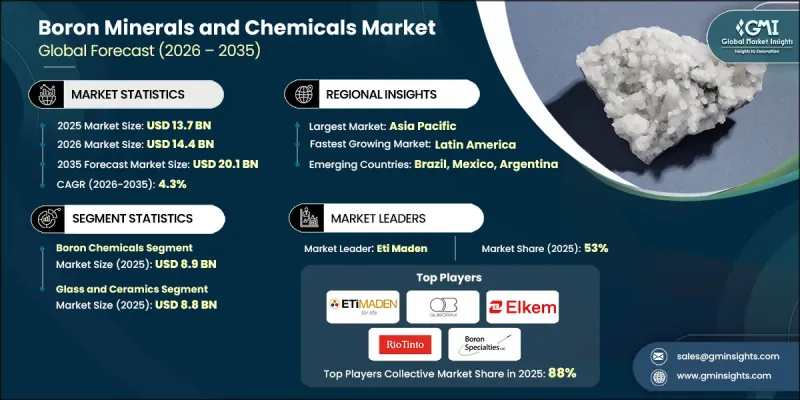
The market encompasses naturally occurring boron minerals and all industrial chemical compounds derived from them. Key minerals include borax, colemanite, kernite, and ulexite, which serve as primary sources for commercial boron extraction. Boron chemicals, such as boric acid, boron oxide, and various borates, are obtained through processing these minerals and are prized for their heat resistance, hardness, and chemical stability. Traditionally, boron has been used in glass, ceramics, and agriculture due to its cost-effectiveness and functional versatility. Glass and ceramic applications benefit from enhanced thermal and optical properties, while boron-based chemicals in agriculture act as essential micronutrients that support plant growth and crop yields. Recently, technological advancements have expanded boron's role into high-tech applications, including lithium-ion batteries, permanent magnets, semiconductors, aerospace composites, and sustainable nanomaterials, reflecting a shift toward environmentally conscious, high-value uses in emerging industries.
| Market Scope | |
|---|---|
| Start Year | 2025 |
| Forecast Year | 2026-2035 |
| Start Value | $13.7 Billion |
| Forecast Value | $20.1 Billion |
| CAGR | 4.3% |
The boron chemicals segment reached USD 8.9 billion in 2025. Their widespread adoption in agriculture, detergents, electronics, and advanced materials stems from the increasing demand for high-purity and specialty compounds. Industries are seeking these chemicals to enhance performance, efficiency, and sustainability, prompting innovations in chemical processing technologies and the development of differentiated products for high-value applications.
The glass and ceramics segment generated USD 8.8 billion in 2025. Boron improves heat resistance and durability in borosilicate glass, fiberglass, and advanced ceramics. The construction and industrial sectors continue to drive demand due to energy efficiency goals. Boron's integration into alloys and metals enhances hardness, strength, and corrosion resistance, supporting applications in manufacturing and automotive industries. Additionally, detergents and bleaches benefit from boron's cleaning efficiency and chemical stability, making it an essential component in household and industrial formulations.
North America Boron Minerals and Chemicals Market captured USD 2.2 billion in 2025. Growth is supported by advanced manufacturing sectors, including aerospace, electronics, and clean energy, which rely on high-performance boron products. Infrastructure investments, recycling initiatives, and strict environmental regulations further reinforce demand. North America benefits from well-established supply chains and robust R&D ecosystems for specialty boron chemicals.
Key players in the Global Boron Minerals and Chemicals Market industry include Rio Tinto (U.S. Borax), 3M Company, Inkabor, Searles Valley Minerals, Eti Maden, Boron Specialties, LLC, Quiborax S.A., Minera Santa Rita, Gremont Chemical Company, 5E Advanced Materials, and Elkem. Companies in the boron minerals and chemicals market are adopting diverse strategies to strengthen their market position. They are investing heavily in R&D to develop high-purity, specialty, and sustainable boron compounds for advanced applications in electronics, energy storage, and aerospace. Strategic partnerships with industrial end-users and tech firms help expand deployment in emerging sectors. Geographic expansion into high-growth regions and local production facilities ensures supply reliability. Firms are also enhancing processing technologies to improve efficiency, reduce environmental impact, and capture premium pricing. Product differentiation, intellectual property development, and targeted marketing campaigns support brand recognition and long-term market leadership while addressing evolving industrial and environmental demands.
Table of Contents
Chapter 1 Methodology & Scope
- 1.1 Market scope and definition
- 1.2 Research design
- 1.2.1 Research approach
- 1.2.2 Data collection methods
- 1.3 Data mining sources
- 1.3.1 Global
- 1.3.2 Regional/Country
- 1.4 Base estimates and calculations
- 1.4.1 Base year calculation
- 1.4.2 Key trends for market estimation
- 1.5 Primary research and validation
- 1.5.1 Primary sources
- 1.6 Forecast model
- 1.7 Research assumptions and limitations
Chapter 2 Executive Summary
- 2.1 Industry 360° synopsis
- 2.2 Key market trends
- 2.2.1 Product Type
- 2.2.2 Application
- 2.2.3 Regional
- 2.3 TAM Analysis, 2026-2035
- 2.4 CXO perspectives: Strategic imperatives
- 2.4.1 Executive decision points
- 2.4.2 Critical success factors
- 2.5 Future outlook and strategic recommendations
Chapter 3 Industry Insights
- 3.1 Industry ecosystem analysis
- 3.1.1 Supplier landscape
- 3.1.2 Profit margin
- 3.1.3 Value addition at each stage
- 3.1.4 Factor affecting the value chain
- 3.1.5 Disruptions
- 3.2 Industry impact forces
- 3.2.1 Growth drivers
- 3.2.1.1 Increasing use across multiple industrial sectors
- 3.2.1.2 Rising construction and infrastructure development
- 3.2.1.3 Ongoing improvements in material performance and efficiency
- 3.2.2 Industry pitfalls and challenges
- 3.2.2.1 Increasing environmental regulations on mining activities
- 3.2.2.2 High production costs for refined boron chemicals
- 3.2.3 Market opportunities
- 3.2.3.1 Growing demand for advanced and high-performance materials
- 3.2.3.2 Expanding focus on sustainable and efficient agriculture
- 3.2.3.3 Shift toward specialty and value-added boron products
- 3.2.1 Growth drivers
- 3.3 Growth potential analysis
- 3.4 Regulatory landscape
- 3.4.1 North America
- 3.4.2 Europe
- 3.4.3 Asia Pacific
- 3.4.4 Latin America
- 3.4.5 Middle East & Africa
- 3.5 Porter’s analysis
- 3.6 PESTEL analysis
- 3.7 Technology and innovation landscape
- 3.7.1 Current technological trends
- 3.7.2 Emerging technologies
- 3.8 Price trends
- 3.8.1 By region
- 3.8.2 By product type
- 3.9 Future market trends
- 3.10 Patent landscape
- 3.11 Trade statistics (HS code)
- 3.11.1 Major importing countries
- 3.11.2 Major exporting countries
- 3.12 Sustainability and environmental aspects
- 3.12.1 Sustainable practices
- 3.12.2 Waste reduction strategies
- 3.12.3 Energy efficiency in production
- 3.12.4 Eco-friendly initiatives
- 3.13 Carbon footprint consideration
Chapter 4 Competitive Landscape, 2025
- 4.1 Introduction
- 4.2 Company market share analysis
- 4.2.1 By region
- 4.2.1.1 North America
- 4.2.1.2 Europe
- 4.2.1.3 Asia Pacific
- 4.2.1.4 LATAM
- 4.2.1.5 MEA
- 4.2.1 By region
- 4.3 Company matrix analysis
- 4.4 Competitive analysis of major market players
- 4.5 Competitive positioning matrix
- 4.6 Key developments
- 4.6.1 Mergers & acquisitions
- 4.6.2 Partnerships & collaborations
- 4.6.3 New product launches
- 4.6.4 Expansion plans
Chapter 5 Market Estimates and Forecast, By Product Type, 2022-2035 (USD Billion) (Kilo Tons)
- 5.1 Key trends
- 5.2 Boron Minerals
- 5.2.1 Colemanite
- 5.2.2 Ulexite
- 5.2.3 Tourmaline
- 5.3 Boron Chemicals
- 5.3.1 Boric Acid
- 5.3.2 Borates
- 5.3.3 Anhydrous Borates
- 5.3.4 Borax
- 5.3.5 Anhydrous Borax
- 5.3.6 Boron Halides
- 5.3.6.1 Boron trichloride
- 5.3.6.2 Boron trifluoride
- 5.3.6.3 Boron tribromide
- 5.3.6.4 Others
- 5.3.7 Boric Acid Esters
- 5.3.8 Boron Hydrides
- 5.3.8.1 Closo borane
- 5.3.8.2 Nido borane
- 5.3.8.3 Arachno borane
- 5.3.9 Boron Carbide
- 5.3.10 Boron Nitride
- 5.3.10.1 Hexagonal Boron Nitride
- 5.3.10.2 Cubic Boron Nitride
- 5.3.10.3 Wurtzite Boron Nitride
Chapter 6 Market Estimates and Forecast, By Application, 2022-2035 (USD Billion) (Kilo Tons)
- 6.1 Key trends
- 6.2 Glass and Ceramics
- 6.2.1 Borosilicate Glass
- 6.2.2 Display Glass
- 6.2.3 Textile Fiberglass
- 6.2.4 Insulation Fiberglass
- 6.2.5 Specialty Glass
- 6.2.6 Others
- 6.3 Alloy and Metals
- 6.3.1 Steel Alloys
- 6.3.2 Metal Processing
- 6.3.3 Welding & Joining
- 6.3.4 Others
- 6.4 Detergents & Bleaches
- 6.4.1 Laundry Detergents
- 6.4.2 Household Cleaners
- 6.4.3 Industrial Cleaners
- 6.4.4 Bleaching Agents
- 6.4.5 Others
- 6.5 Agrochemicals
- 6.5.1 Micronutrient Fertilizers
- 6.5.2 Soil Correction
- 6.5.3 Others
- 6.6 Adhesives
- 6.6.1 Industrial Adhesives
- 6.6.2 Construction Adhesives
- 6.6.3 Specialty Adhesives
- 6.6.4 Others
- 6.7 Others
Chapter 7 Market Estimates and Forecast, By Region, 2022-2035 (USD Billion) (Kilo Tons)
- 7.1 Key trends
- 7.2 North America
- 7.2.1 U.S.
- 7.2.2 Canada
- 7.2.3 Mexico
- 7.3 Europe
- 7.3.1 Germany
- 7.3.2 UK
- 7.3.3 France
- 7.3.4 Spain
- 7.3.5 Italy
- 7.3.6 Rest of Europe
- 7.4 Asia Pacific
- 7.4.1 China
- 7.4.2 India
- 7.4.3 Japan
- 7.4.4 Australia
- 7.4.5 South Korea
- 7.4.6 Rest of Asia Pacific
- 7.5 Latin America
- 7.5.1 Brazil
- 7.5.2 Mexico
- 7.5.3 Argentina
- 7.5.4 Rest of Latin America
- 7.6 Middle East and Africa
- 7.6.1 Saudi Arabia
- 7.6.2 South Africa
- 7.6.3 UAE
- 7.6.4 Rest of Middle East and Africa
Chapter 8 Company Profiles
- 8.1 3M Company
- 8.2 American Borate
- 8.3 Boron Specialties, LLC
- 8.4 Eti Maden
- 8.5 Gremont Chemical Company
- 8.6 Inkabor
- 8.7 Minera Santa Rita
- 8.8 National Boraxx Corporation
- 8.9 Rio Tinto (U.S. Borax)
- 8.10 Searles Valley Minerals
- 8.11 5E Advanced Materials
- 8.12 Quiborax S.A.