
|
시장보고서
상품코드
1959598
스마트 글래스 시장 기회, 성장요인, 업계 동향 분석 및 예측(2026-2035년)Smart Glass Market Opportunity, Growth Drivers, Industry Trend Analysis, and Forecast 2026 - 2035 |
||||||

세계의 스마트 글래스 시장은 2025년에 46억 달러로 평가되었고, 2035년까지 연평균 복합 성장률(CAGR) 8.4%로 성장하여 103억 달러에 이를 것으로 예측됩니다.
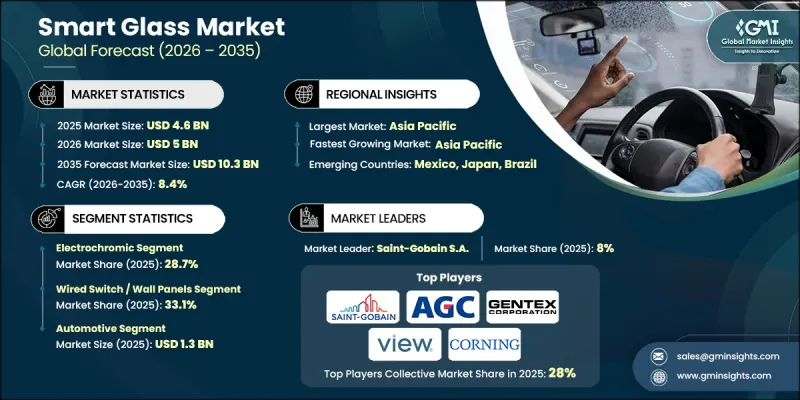
시장 성장은 전 세계적으로 환경적 책임에 대한 인식이 높아지고 건물과 차량의 에너지 소비 절감에 대한 관심이 높아짐에 따라 가속화되고 있습니다. 기존의 조명 제어 솔루션은 유연성이 부족하고 에너지 사용량 증가에 기여하는 경우가 많기 때문에 스마트 글래스는 그 역동적인 대안으로 각광받고 있습니다. 이 첨단 유리 기술은 투명도 수준을 조정하여 변화하는 환경 조건에 자동으로 적응하여 인공 조명이나 공조 시스템에 크게 의존하지 않고 열 전달과 햇빛의 투과를 제어할 수 있도록 도와줍니다. 지속가능성이 현대 설계 및 건설의 핵심 요소로 떠오르면서 스마트 유리는 넷 제로 및 에너지 효율적 개발 목표와 점점 더 일치하고 있습니다. 또한, 기술 제공업체, 건축가, 개발자 간의 강력한 협력으로 주거, 상업, 교통 분야에서의 보급이 촉진되어 시장은 더 많은 혜택을 누리고 있습니다. 재료 과학과 자동화 능력의 지속적인 혁신은 성능의 신뢰성, 비용 효율성, 확장성을 더욱 향상시키고 있으며, 스마트 글라스는 에너지 효율을 중시하는 전 세계 인프라에 장기적으로 실현 가능한 솔루션이 되고 있습니다.
| 시장 범위 | |
|---|---|
| 개시 연도 | 2025년 |
| 예측 연도 | 2026-2035년 |
| 개시 금액 | 46억 달러 |
| 예측 금액 | 103억 달러 |
| CAGR | 8.4% |
북미 전역의 지속 가능한 도시 개발에 대한 투자 증가와 유럽 및 아시아태평양의 친환경 건축 정책의 확대와 함께 스마트 유리 채택에 대한 상업적 전망은 점점 더 강해지고 있습니다. 설계자와 부동산 소유주들은 정적인 차광 대안이 아닌 반응성이 높은 성능을 제공하는 자동화된 기후 제어 솔루션으로 전환하고 있습니다. 스마트 유리는 적응력이 뛰어난 빛과 열을 관리하는 동시에 현대적인 건축 미학을 지원하고, 편안함, 효율성, 환경적 책임을 우선시하는 고급 건축 외피에 선호되는 솔루션으로 자리매김하고 있습니다.
2025년 기준 일렉트로크로믹 부문은 28.7%의 점유율을 차지하며 기술별로 가장 큰 비중을 차지했습니다. 이 부문은 대규모 설치 환경에서 정밀한 조광 및 에너지 제어를 실현할 수 있는 능력으로 인해 지속적으로 주목을 받고 있습니다. 지능형 빌딩 시스템과의 높은 호환성과 다양한 조건에서 안정적인 성능으로 상업시설 및 공공시설 프로젝트에서 도입 확대를 지원하고 있습니다.
자동차 부문은 2025년 28.3%의 점유율을 차지하며 13억 달러 시장 규모를 창출했습니다. 이 부문의 성장은 첨단 차량 설계에 스마트 글레이징 솔루션의 통합이 확대되면서 성장세를 견인하고 있습니다. 광 투과 제어는 열효율, 승객의 편안함, 종합적인 에너지 최적화를 지원합니다. 차량 전동화와 인테리어 디자인의 지속적인 혁신은 자동차 산업 전반에 걸쳐 스마트 글래스 솔루션에 대한 수요를 강화하고 있습니다.
북미 스마트 글래스 시장은 2025년 11억 달러에 달할 것으로 예상되며, 2035년까지 연평균 복합 성장률(CAGR) 8.7%를 나타낼 것으로 예측됩니다. 첨단 유리 기술의 조기 도입, 에너지 절약형 건축에 대한 강한 강조, 고급 건축물과 모빌리티 용도의 도입 확대가 지역 성장을 뒷받침하고 있습니다. 지속 가능한 건축과 에너지 절약에 대한 규제적 초점이 지역 수요를 지속적으로 강화하고 있습니다.
자주 묻는 질문
목차
제1장 조사 방법과 범위
제2장 주요 요약
제3장 업계 인사이트
제4장 경쟁 구도
제5장 시장 추산·예측 : 기술 유형별, 2022-2035년
제6장 시장 추산·예측 : 제어 방식별, 2022-2035년
제7장 시장 추산·예측 : 용도별, 2022-2035년
제8장 시장 추산·예측 : 최종사용자별, 2022-2035년
제9장 시장 추산·예측 : 지역별, 2022-2035년
제10장 기업 개요
LSH 26.03.26The Global Smart Glass Market was valued at USD 4.6 billion in 2025 and is estimated to grow at a CAGR of 8.4% to reach USD 10.3 billion by 2035.
Market growth is accelerated by rising global awareness of environmental responsibility and the increasing focus on reducing energy consumption in buildings and vehicles. Smart glass is gaining preference as a dynamic alternative to traditional light-control solutions, which often lack flexibility and contribute to higher energy usage. This advanced glazing technology adapts automatically to changing environmental conditions by modifying transparency levels, helping to control heat transfer and daylight penetration without relying heavily on artificial lighting or climate control systems. As sustainability becomes a central pillar in modern design and construction, smart glass is increasingly aligned with net-zero and energy-efficient development goals. The market is also benefiting from strong collaboration across technology providers, architects, and developers, enabling broader adoption across residential, commercial, and transportation sectors. Continuous innovation in material science and automation capabilities is further enhancing performance reliability, cost efficiency, and scalability, making smart glass a viable long-term solution for energy-conscious infrastructure worldwide.
| Market Scope | |
|---|---|
| Start Year | 2025 |
| Forecast Year | 2026-2035 |
| Start Value | $4.6 Billion |
| Forecast Value | $10.3 Billion |
| CAGR | 8.4% |
Rising investments in sustainable urban development across North America, coupled with expanding green construction policies in Europe and Asia-Pacific, are strengthening the commercial outlook for smart glass adoption. Designers and property owners are shifting toward automated climate-control solutions that offer responsive performance rather than static shading alternatives. Smart glass delivers adaptable light and heat management while supporting modern architectural aesthetics, positioning it as a preferred solution for advanced building envelopes that prioritize comfort, efficiency, and environmental accountability.
The electrochromic segment accounted for 28.7% share in 2025, maintaining the largest share among technologies. This segment continues to gain traction due to its ability to deliver precise light modulation and energy control across large installations. Strong compatibility with intelligent building systems and consistent performance under varying conditions support its growing deployment in both commercial and institutional projects.
The automotive segment held a 28.3% share in 2025, generating USD 1.3 billion. Growth in this segment is driven by the increasing integration of smart glazing solutions into advanced vehicle designs, where controlled light transmission supports thermal efficiency, passenger comfort, and overall energy optimization. Continued innovation in vehicle electrification and interior design is reinforcing demand for smart glass solutions across the automotive industry.
North America Smart Glass Market reached USD 1.1 billion in 2025 and is projected to grow at a CAGR of 8.7% through 2035. Regional growth is supported by early adoption of advanced glazing technologies, strong emphasis on energy-efficient construction, and increasing deployment in premium architectural and mobility applications. Regulatory focus on sustainable buildings and energy conservation continues to reinforce regional demand.
Key players active in the Global Smart Glass Market include Saint-Gobain S.A., AGC Inc., View, Inc., Gentex Corporation, Gauzy Ltd., Corning Incorporated, Research Frontiers Inc., Nippon Sheet Glass Co., Ltd. (NSG Group), Fuyao Glass Industry Group, Halio, Inc., Pleotint, LLC, Polytronix, Inc., ChromoGenics AB, and EControl-Glas GmbH, with competition driven by technological differentiation and global expansion strategies. Companies operating in the smart glass market are strengthening their market position through continuous investment in research, product innovation, and strategic partnerships. Manufacturers are focusing on improving switching speed, durability, and energy efficiency to meet evolving architectural and automotive requirements. Expansion into emerging construction and electric mobility markets is supporting long-term growth, while collaborations with developers and system integrators are enhancing adoption across large projects.
Table of Contents
Chapter 1 Methodology and Scope
- 1.1 Market scope and definition
- 1.2 Research design
- 1.2.1 Research approach
- 1.2.2 Data collection methods
- 1.3 Data mining sources
- 1.3.1 Global
- 1.3.2 Regional/Country
- 1.4 Base estimates and calculations
- 1.4.1 Base year calculation
- 1.4.2 Key trends for market estimation
- 1.5 Primary research and validation
- 1.5.1 Primary sources
- 1.6 Forecast model
- 1.7 Research assumptions and limitations
Chapter 2 Executive Summary
- 2.1 Industry 360° synopsis
- 2.2 Key market trends
- 2.2.1 Regional
- 2.2.2 Technology Type
- 2.2.3 Control Mode
- 2.2.4 Application
- 2.2.5 End-Use
- 2.3 CXO perspectives: Strategic imperatives
- 2.3.1 Key decision points for industry executives
- 2.3.2 Critical success factors for market players
- 2.4 Future outlook and strategic recommendations
Chapter 3 Industry Insights
- 3.1 Industry ecosystem analysis
- 3.1.1 Supplier landscape
- 3.1.2 Profit margin
- 3.1.3 Value addition at each stage
- 3.1.4 Factor affecting the value chain
- 3.2 Industry impact forces
- 3.2.1 Growth drivers
- 3.2.1.1 Rise in energy-efficient building demand
- 3.2.1.2 Advancements in automotive integration
- 3.2.1.3 IoT and smart home ecosystem integration
- 3.2.2 Industry pitfalls & challenges
- 3.2.2.1 High initial installation and material costs
- 3.2.2.2 Technical complexity and reliability issues
- 3.2.3 Opportunities
- 3.2.3.1 Electrification and AI-driven tinting
- 3.2.3.2 Expansion of the healthcare and hospitality sectors
- 3.2.1 Growth drivers
- 3.3 Growth potential analysis
- 3.4 Future market trends
- 3.5 Technology and innovation landscape
- 3.5.1 Current technological trends
- 3.5.2 Emerging technologies
- 3.6 Price trends
- 3.6.1 By region
- 3.6.2 By type
- 3.7 Regulatory landscape
- 3.7.1 Standards and compliance requirements
- 3.7.2 Regional regulatory frameworks
- 3.7.3 Certification standards
- 3.8 Porter’s analysis
- 3.9 PESTEL analysis
Chapter 4 Competitive Landscape, 2025
- 4.1 Introduction
- 4.2 Company market share analysis
- 4.2.1 By region
- 4.2.1.1 North America
- 4.2.1.2 Europe
- 4.2.1.3 Asia Pacific
- 4.2.1.4 Latin America
- 4.2.1.5 Middle East and Africa
- 4.2.1 By region
- 4.3 Company matrix analysis
- 4.4 Competitive analysis of major market players
- 4.5 Competitive positioning matrix
- 4.6 Key developments
- 4.6.1 Mergers & acquisitions
- 4.6.2 Partnerships & collaborations
- 4.6.3 New product launches
- 4.6.4 Expansion plans
Chapter 5 Market Estimates and Forecast, By Technology Type, 2022 - 2035 (USD Billion) (Thousand Units)
- 5.1 Key trends
- 5.2 Electrochromic
- 5.3 Suspended Particle Device (SPD)
- 5.4 Polymer-Dispersed Liquid Crystal (PDLC)
- 5.5 Thermochromic
- 5.6 Photochromic
- 5.7 Hybrid and Photovoltaic
Chapter 6 Market Estimates and Forecast, By Control Mode, 2022 - 2035 (USD Billion) (Thousand Units)
- 6.1 Key trends
- 6.2 Wired Switch / Wall Panel
- 6.3 Remote / RF Controller
- 6.4 Dimming Panel / Slider
- 6.5 Smartphone / Voice Assistant
- 6.6 Sensor-Based Automatic Control
Chapter 7 Market Estimates and Forecast, By Application, 2022 - 2035 (USD Billion) (Thousand Units)
- 7.1 Key trends
- 7.2 Facades and Curtain Walls
- 7.3 Interior Partitions and Privacy Panels
- 7.4 Sunroofs, Skylights and Roof Glazing
- 7.5 Mirrors and Displays
Chapter 8 Market Estimates and Forecast, By End User, 2022 - 2035 (USD Billion) (Thousand Units)
- 8.1 Key trends
- 8.2 Automotive
- 8.3 Architectural
- 8.4 Avionics
- 8.5 Marine
- 8.6 Rail
- 8.7 Consumer Electronics
- 8.8 Healthcare Facilities
- 8.9 Other
Chapter 9 Market Estimates and Forecast, By Region, 2022 - 2035 (USD Billion) (Thousand Units)
- 9.1 Key trends
- 9.2 North America
- 9.2.1 U.S.
- 9.2.2 Canada
- 9.3 Europe
- 9.3.1 Germany
- 9.3.2 UK
- 9.3.3 France
- 9.3.4 Italy
- 9.3.5 Spain
- 9.4 Asia Pacific
- 9.4.1 China
- 9.4.2 Japan
- 9.4.3 India
- 9.4.4 Australia
- 9.4.5 South Korea
- 9.5 Latin America
- 9.5.1 Brazil
- 9.5.2 Mexico
- 9.5.3 Argentina
- 9.6 Middle East and Africa
- 9.6.1 South Africa
- 9.6.2 Saudi Arabia
- 9.6.3 UAE
Chapter 10 Company Profiles
- 10.1 AGC Inc.
- 10.2 ChromoGenics AB
- 10.3 Corning Incorporated
- 10.4 EControl-Glas GmbH
- 10.5 Fuyao Glass Industry Group
- 10.6 Gauzy Ltd.
- 10.7 Gentex Corporation
- 10.8 Guardian Industries Holdings, LLC
- 10.9 Halio, Inc.
- 10.10 Nippon Sheet Glass Co., Ltd. (NSG Group)
- 10.11 Pleotint, LLC
- 10.12 Polytronix, Inc.
- 10.13 Research Frontiers Inc.
- 10.14 Saint-Gobain S.A.
- 10.15 View, Inc.