

|
시장보고서
상품코드
1959622
비타민 K 시장 기회, 성장요인, 업계 동향 분석 및 예측(2026-2035년)Vitamin K Market Opportunity, Growth Drivers, Industry Trend Analysis, and Forecast 2026 - 2035 |
||||||

세계의 비타민 K 시장은 2025년에 10억 7,000만 달러로 평가되었고, 2035년까지 연평균 복합 성장률(CAGR) 8.5%로 성장하여 24억 달러에 이를 것으로 예측됩니다.
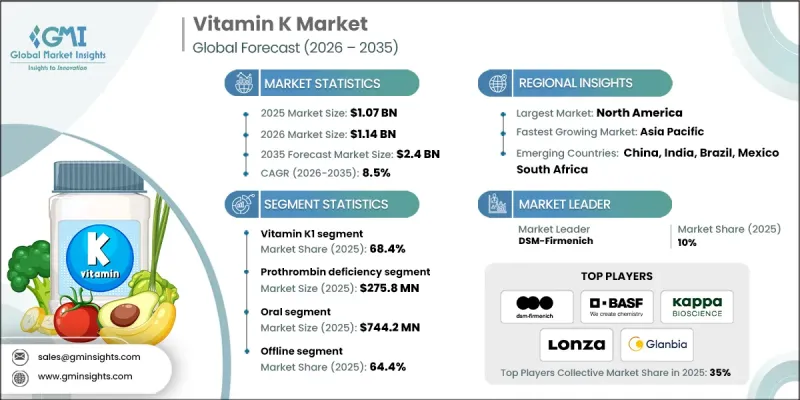
시장 성장은 혈액 응고, 뼈 강도, 심혈관 건강에서 비타민 K의 생리적 중요성에 대한 인식이 높아진 데다, 고령층에서 심혈관 질환과 영양소 결핍의 발생률이 증가함에 따라 뒷받침되고 있습니다. 예방의학 트렌드와 미량 영양소 보충에 대한 관심이 높아지면서 수요가 더욱 강화되고 있습니다. 비타민K는 칼슘 대사 조절과 혈관 건강 유지에 중요한 역할을 하기 때문에 임상영양학 및 건강증진 분야에서 큰 주목을 받고 있습니다. 소비자들이 장기적인 건강 효과를 점점 더 중요하게 생각함에 따라, 보충제는 결핍을 보완하는 것을 넘어 적극적인 질병 위험 관리로 전환하고 있습니다. 또한, 건강기능식품의 용도 확대, 제제 안정성 향상, 건강기능식품 및 의약품 전반의 생체 이용률 향상도 시장에 긍정적인 영향을 미치고 있습니다. 제조 방식과 원료 조달에 대한 지속적인 혁신을 통해 제조업체는 전 세계 수요 증가에 대응하면서 일관된 품질을 제공할 수 있습니다. 이러한 요인들이 결합되어 임상적 사용과 소비자 주도의 건강 지향적 채택에 힘입어 꾸준히 확대되는 시장 상황을 형성하고 있습니다.
| 시장 범위 | |
|---|---|
| 개시 연도 | 2025년 |
| 예측 연도 | 2026-2035년 |
| 개시 연도 가치 | 10억 7,000만 달러 |
| 예측 금액 | 24억 달러 |
| CAGR | 8.5% |
비타민 K는 지용성 영양소의 일종으로 혈액 응고, 뼈의 미네랄화, 심혈관의 균형을 담당하는 단백질 활성화에 필수적입니다. 본 시장에는 주로 치료용 및 건강보조식품에 사용되는 비타민K1과 골격 및 심장 건강 유지를 위한 보충제로의 배합이 증가하고 있는 비타민K2가 포함됩니다. 두 형태 모두 칼슘 수송을 조절하고 부적절한 미네랄 침착을 방지하는 데 핵심적인 역할을 하며, 예방 의학에서 치료 의학에 이르기까지 다양한 분야에서 중요한 역할을 하고 있습니다.
비타민 K1 부문은 2025년 68.4%의 점유율을 차지할 것으로 예상되며, 2026년부터 2035년까지 연평균 복합 성장률(CAGR) 8.3%를 나타낼 것으로 예측됩니다. 이 부문은 응고 관련 질환의 관리와 결핍 상태를 교정하는 데 있어 임상적 중요성이 입증된 가운데, 계속해서 선도적인 위치를 유지하고 있습니다. 의약품 및 의료용 영양 제품에 대한 강력한 수요가 지속적인 채택을 뒷받침하는 한편, 지속적인 제품 최적화를 통해 의료 현장 전반에서 그 중요성이 강화되고 있습니다.
프로트롬빈 결핍증 부문은 2025년 2억 7,580만 달러 시장 규모를 형성할 것으로 예측됩니다. 비타민 K는 정상적인 혈액 기능에 필요한 응고 인자의 합성과 활성화에 필수적이기 때문에 이 부문은 선도적인 위치를 유지하고 있습니다. 특히 병원 기반 치료 및 급성기 의료 프로토콜에서 응고 장애 관리에 있어 비타민 K에 대한 임상적 의존도가 안정적인 수요를 주도하고 있습니다.
북미 비타민 K 시장은 2025년 41.1%의 점유율을 차지했습니다. 선진화된 의료 시스템, 높은 예방 의료 의식, 영양 보조 식품의 광범위한 보급이 지역의 선도적 지위를 뒷받침하고 있습니다. 연구 개발, 제품 개발, 고품질 제형 기술에 대한 지속적인 투자가 시장 성장을 가속하는 한편, 과학적 근거에 기반한 영양 솔루션에 대한 소비자 선호도가 지역 수요를 더욱 강화시키고 있습니다.
자주 묻는 질문
목차
제1장 조사 방법과 범위
제2장 주요 요약
제3장 업계 인사이트
제4장 경쟁 구도
제5장 시장 추산 및 예측 : 유형별, 2022-2035
제6장 시장 추산 및 예측 : 용도별, 2022-2035
제7장 시장 추산 및 예측 : 투여 경로별, 2022-2035
제8장 시장 추산 및 예측 : 유통 채널별, 2022-2035
제9장 시장 추산 및 예측 : 지역별, 2022-2035
제10장 기업 개요
LSH 26.03.16The Global Vitamin K Market was valued at USD 1.07 billion in 2025 and is estimated to grow at a CAGR of 8.5% to reach USD 2.4 billion by 2035.
Market growth is supported by rising awareness of the physiological importance of vitamin K in blood coagulation, bone strength, and cardiovascular wellness, alongside a growing incidence of cardiovascular conditions and nutrient deficiencies among older populations. Preventive healthcare trends and increased focus on micronutrient supplementation are further strengthening demand. Vitamin K has gained significant attention in clinical nutrition and wellness applications due to its role in regulating calcium metabolism and maintaining vascular integrity. As consumers increasingly prioritize long-term health outcomes, supplementation has moved beyond deficiency correction to proactive disease risk management. The market is also benefiting from expanding nutraceutical usage, improved formulation stability, and enhanced bioavailability across supplement and pharmaceutical products. Continuous innovation in production methods and ingredient sourcing is allowing manufacturers to deliver consistent quality while addressing rising global demand. Together, these factors are shaping a steadily expanding market landscape supported by both clinical utilization and consumer-driven wellness adoption.
| Market Scope | |
|---|---|
| Start Year | 2025 |
| Forecast Year | 2026-2035 |
| Start Value | $1.07 Billion |
| Forecast Value | $2.4 Billion |
| CAGR | 8.5% |
Vitamin K represents a class of fat-soluble nutrients that are essential for activating proteins responsible for coagulation, bone mineralization, and cardiovascular balance. The market includes vitamin K1, primarily used in therapeutic and dietary formulations, and vitamin K2, which is increasingly incorporated into supplements designed to support skeletal and heart health. Both forms play a central role in regulating calcium transport and preventing improper mineral deposition, making them critical across preventive and therapeutic healthcare applications.
The vitamin K1 segment accounted for 68.4% share in 2025 and is expected to grow at a CAGR of 8.3% during 2026-2035. This segment continues to lead due to its established clinical importance in managing coagulation-related conditions and correcting deficiency states. Strong demand from pharmaceutical formulations and medical nutrition products supports its sustained adoption, while ongoing product optimization is reinforcing its relevance across healthcare settings.
The prothrombin deficiency segment generated USD 275.8 million in 2025. This segment maintained a leading position as vitamin K remains essential for the synthesis and activation of clotting factors required for normal blood function. Clinical reliance on vitamin K for managing coagulation disorders continues to drive consistent demand, particularly within hospital-based and acute care treatment protocols.
North America Vitamin K Market held 41.1% share in 2025. Regional leadership is supported by advanced healthcare systems, strong preventive health awareness, and widespread adoption of dietary supplementation. Continued investment in research, product development, and high-quality formulation technologies is reinforcing market growth, while consumer preference for scientifically backed nutritional solutions further strengthens regional demand.
Key companies operating in the Global Vitamin K Market include Pfizer, BASF SE, DSM-Firmenich, Lonza, Glanbia, Amphastar Pharmaceuticals, Gnosis by Lesaffre, Kappa Bioscience, Country Life (Kikkoman), Nature Made (Pharmavite), Nature's Bounty (Nestle Health Science), NOW Foods, Solgar, and Livealth Biopharma, with competitive positioning driven by diversified portfolios and global distribution capabilities. Companies active in the vitamin K market are strengthening their market position through continuous investment in formulation innovation, bioavailability enhancement, and product differentiation. Manufacturers are focusing on developing high-purity and stable vitamin K ingredients that meet pharmaceutical and nutraceutical quality standards. Strategic partnerships with healthcare providers and nutrition brands are expanding market reach, while geographic expansion into emerging regions is supporting long-term growth.
Table of Contents
Chapter 1 Methodology and Scope
- 1.1 Market scope and definition
- 1.2 Research approach
- 1.3 Quality commitments
- 1.3.1 GMI AI policy and data integrity commitment
- 1.3.1.1 Source consistency protocol
- 1.3.1 GMI AI policy and data integrity commitment
- 1.4 Research trail and confidence scoring
- 1.4.1 Research trail components
- 1.4.2 Scoring components
- 1.5 Data collection
- 1.5.1 Partial list of primary sources
- 1.6 Data mining sources
- 1.6.1 Paid sources
- 1.6.1.1 Sources, by region
- 1.6.1 Paid sources
- 1.7 Base estimates and calculations
- 1.7.1 Revenue share analysis
- 1.7.2 Base year calculation
- 1.8 Forecast model
- 1.9 Research transparency addendum
- 1.9.1 Source attribution framework
- 1.9.2 Quality assurance metrics
- 1.9.3 Our commitment to trust
Chapter 2 Executive Summary
- 2.1 Industry 3600 synopsis
- 2.2 Key market trends
- 2.2.1 Regional trends
- 2.2.2 Type trends
- 2.2.3 Application trends
- 2.2.4 Route of administration trends
- 2.2.5 Distribution channel trends
- 2.3 CXO perspectives: Strategic imperatives
- 2.3.1 Key decision points for industry executives
- 2.3.2 Critical success factors for market players
- 2.4 Future outlook and strategic recommendations
Chapter 3 Industry Insights
- 3.1 Industry ecosystem analysis
- 3.2 Industry impact forces
- 3.2.1 Growth drivers
- 3.2.1.1 Increasing awareness of bone and cardiovascular health
- 3.2.1.2 Growing adoption of nutraceuticals and dietary supplements
- 3.2.1.3 Advancements in formulation and bioavailability
- 3.2.1.4 Expanding pharmaceutical applications
- 3.2.2 Industry pitfalls and challenges
- 3.2.2.1 Regulatory complexity and compliance requirements
- 3.2.2.2 Risk of overdosing and side effects
- 3.2.3 Market opportunities
- 3.2.3.1 Emerging markets with rising health awareness
- 3.2.3.2 Integration with personalized nutrition and digital health
- 3.2.1 Growth drivers
- 3.3 Growth potential analysis
- 3.4 Regulatory landscape
- 3.4.1 North America
- 3.4.2 Europe
- 3.4.3 Asia Pacific
- 3.5 Future market trends
- 3.6 Porter’s analysis
- 3.7 PESTEL analysis
Chapter 4 Competitive Landscape, 2025
- 4.1 Introduction
- 4.2 Company market share analysis
- 4.3 Company matrix analysis
- 4.4 Competitive analysis of major market players
- 4.5 Competitive positioning matrix
- 4.6 Key developments
- 4.6.1 Merger and acquisition
- 4.6.2 Partnership and collaboration
- 4.6.3 New product launches
- 4.6.4 Expansion plans
Chapter 5 Market Estimates and Forecast, By Type, 2022 - 2035 ($ Mn)
- 5.1 Key trends
- 5.2 Vitamin K1
- 5.3 Vitamin K2
Chapter 6 Market Estimates and Forecast, By Application, 2022 - 2035 ($ Mn)
- 6.1 Key trends
- 6.2 Osteoporosis
- 6.3 Vitamin K-dependent clotting factors deficiency (VKCFD)
- 6.4 Prothrombin deficiency
- 6.5 Vitamin K deficiency bleeding (VKDB)
- 6.6 Dermal applications
- 6.7 Other applications
Chapter 7 Market Estimates and Forecast, By Route of Administration, 2022 - 2035 ($ Mn)
- 7.1 Key trends
- 7.2 Oral
- 7.2.1 Pills
- 7.2.2 Powders
- 7.2.3 Liquids
- 7.3 Parenteral
- 7.4 Topical
Chapter 8 Market Estimates and Forecast, By Distribution Channel, 2022 - 2035 ($ Mn)
- 8.1 Key trends
- 8.2 Offline
- 8.2.1 Hypermarkets/ supermarkets
- 8.2.2 Specialty stores
- 8.2.3 Pharmacy stores
- 8.3 Online
Chapter 9 Market Estimates and Forecast, By Region, 2022 - 2035 ($ Mn)
- 9.1 Key trends
- 9.2 North America
- 9.2.1 U.S.
- 9.2.2 Canada
- 9.3 Europe
- 9.3.1 Germany
- 9.3.2 UK
- 9.3.3 France
- 9.3.4 Spain
- 9.3.5 Italy
- 9.3.6 Netherlands
- 9.4 Asia Pacific
- 9.4.1 China
- 9.4.2 India
- 9.4.3 Japan
- 9.4.4 Australia
- 9.4.5 South Korea
- 9.5 Latin America
- 9.5.1 Brazil
- 9.5.2 Mexico
- 9.5.3 Argentina
- 9.6 Middle East and Africa
- 9.6.1 South Africa
- 9.6.2 Saudi Arabia
- 9.6.3 UAE
Chapter 10 Company Profiles
- 10.1 Amphastar Pharmaceuticals
- 10.2 BASF SE
- 10.3 Country Life (Kikkoman)
- 10.4 DSM-Firmenich
- 10.5 Glanbia
- 10.6 Gnosis by Lesaffre
- 10.7 Kappa Bioscience
- 10.8 Livealth Biopharma
- 10.9 Lonza
- 10.10 Nature's Bounty (Nestle Health Science)
- 10.11 Nature Made (Pharmavite)
- 10.12 NOW Foods
- 10.13 Pfizer
- 10.14 Solgar


