

|
시장보고서
상품코드
1959624
군용 텐트 및 쉘터 시장 기회, 성장요인, 업계 동향 분석 및 예측(2026-2035년)Military Tent and Shelter Market Opportunity, Growth Drivers, Industry Trend Analysis, and Forecast 2026 - 2035 |
||||||

세계의 군용 텐트 및 쉘터 시장은 2025년에 10억 달러로 평가되었고, 2035년에는 CAGR 4%로 성장하여 15억 달러에 이를 것으로 예측됩니다.

시장 성장의 주요 요인은 세계 국방 예산 증가로 인해 군용 대피소 조달이 증가하고 있는 것이 주요 요인으로 작용하고 있습니다. 원정 임무를 위한 신속한 배치 솔루션에 대한 수요와 모듈식 및 스마트 쉘터에 대한 기술 발전으로 인해 도입이 더욱 가속화되고 있습니다. 또한, 군사작전과 비상대응에 활용할 수 있는 대피소에 대한 관심이 높아지면서 시장의 범위가 넓어지고 있습니다. 군와 정부는 작전 준비태세와 인도적 지원 임무를 지원하기 위해 유연성, 에너지 효율성, 신속한 배치가 가능한 인프라를 점점 더 우선순위에 두고 있습니다. 이중 사용 시나리오에 대한 관심은 2020년경부터 강하게 대두되었으며, 군과 재난 대응 기관이 물류 계획을 통합하여 작전 복원력과 위기 대응 능력을 향상시키기 위해 2030년까지 조달 전략을 수립하고 있습니다.
| 시장 범위 | |
|---|---|
| 개시 연도 | 2025년 |
| 예측 연도 | 2026-2035년 |
| 개시 금액 | 10억 달러 |
| 예측 금액 | 15억 달러 |
| CAGR | 4% |
군사비 지출 증가로 인해 대피소 수요가 증가하고 있습니다. 각국 정부가 야외 작전과 재난 구호를 지원하는 이동식 인프라에 예산을 배정하고 있기 때문입니다. 모듈식 및 스마트 쉘터 설계 기술의 발전으로 군사 임무를 위한 에너지 절약 및 신속한 배치가 가능한 솔루션이 실현되고 있습니다. 한편, 긴급 대응 및 인도적 지원의 이중 용도 사용은 시장의 잠재적 잠재력을 확대하고 있습니다. 컨테이너형 대피소 및 의료용 대피소는 내구성, 적응성, 통신 시스템, 지휘 센터, 의료 인프라 등의 통합 능력으로 주목받고 있습니다. 이러한 솔루션은 오지와 분쟁 지역에서 전방 배치 작전, 반영구적 기지, 고도의 의료 지원을 가능하게 하여 임무의 효율성과 신속한 대응 능력을 향상시킵니다.
컨테이너형 쉘터 부문은 2026년부터 2035년까지 연평균 5.1%의 성장률을 보일 것으로 예측됩니다. 현대 군사 작전에서 견고하고 수명이 길며 보호성이 높은 인프라에 대한 수요가 증가함에 따라 도입이 촉진되고 있습니다. 컨테이너형 대피소는 우수한 단열성, 내구성, 그리고 지휘센터, 의료시설, 통신망 등의 시스템 통합 능력을 제공합니다. 가혹한 환경에 대한 적응성과 반영구적, 영구적 사용에 대한 적합성이 지속적인 시장 성장을 뒷받침하고 있습니다.
의료 및 야전병원 부문은 2035년까지 연평균 복합 성장률(CAGR) 5.3%를 나타낼 것으로 예측됩니다. 전선 배치 의료 부대, 재난 대응, 군 의료 체계에 대한 투자 증가가 수요를 견인하고 있습니다. 이 대피소는 외딴 지역이나 고위험 지역의 응급 치료, 격리 병동, 수술실 등을 위해 설계되었습니다. 인도적 지원 활동과 신속한 의료 대응에 대한 필요성이 증가함에 따라, 군사 및 응급 상황에 신속하게 배치할 수 있는 기술적으로 진보된 의료 인프라를 제공하는 이러한 솔루션의 도입이 가속화되고 있습니다.
북미 군용 텐트 및 대피소 시장은 2025년 39.9%의 점유율을 차지했습니다. 이 지역의 성장은 국방 예산 증가와 미국 및 캐나다 군의 원정형 인프라 구축에 대한 집중에 의해 주도되고 있습니다. 기후 제어, 전력 공급, 신속한 배치 능력을 갖춘 모듈형 및 스마트 쉘터 시스템의 채택이 증가하고 있습니다. 정부 및 방위 관련 기업들의 군사작전과 구호활동 모두를 위한 차세대 전개형 대피소에 대한 투자는 기술 발전을 지속적으로 촉진하고 있습니다. 북미는 혁신의 최전선에 머물러 있으며, 군사 현대화 프로젝트, 공동 훈련, 작전상의 필요성이 2035년까지 시장 성장을 뒷받침할 것입니다.
자주 묻는 질문
목차
제1장 조사 방법과 범위
제2장 주요 요약
제3장 업계 인사이트
제4장 경쟁 구도
제5장 시장 추산 및 예측 : 제품 유형별, 2022-2035년
제6장 시장 추산 및 예측 : 도입 유형별, 2022-2035년
제7장 시장 추산 및 예측 : 방호 레벨별, 2022-2035년
제8장 시장 추산 및 예측 : 소재 유형별, 2022-2035년
제9장 시장 추산 및 예측 : 이동 플랫폼별, 2022-2035년
제10장 시장 추산 및 예측 : 용도별, 2022-2035년
제11장 시장 추산 및 예측 : 지역별, 2022-2035년
제12장 기업 개요
LSH 26.03.26The Global Military Tent & Shelter Market was valued at USD 1 billion in 2025 and is estimated to grow at a CAGR of 4% to reach USD 1.5 billion in 2035.
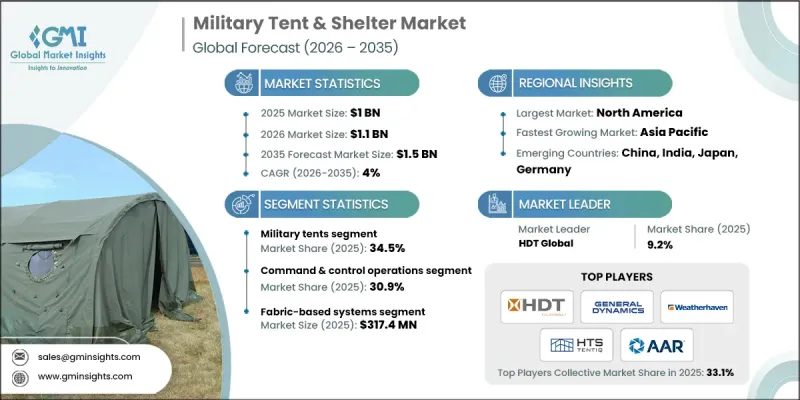
Market growth is driven by rising global defense budgets, which are increasing the procurement of military shelters. The demand for rapidly deployable solutions for expeditionary missions and technological advances in modular and smart shelters is further accelerating adoption. Additionally, there is growing interest in shelters that serve dual purposes for military operations and emergency response, broadening the market scope. Military forces and governments are increasingly prioritizing flexible, energy-efficient, and quick-deployment infrastructure to support operational readiness and humanitarian missions. The focus on dual-use scenarios emerged strongly around 2020 and continues to shape procurement strategies through 2030, as military and disaster-response agencies integrate logistics planning to improve operational resilience and crisis response capabilities.
| Market Scope | |
|---|---|
| Start Year | 2025 |
| Forecast Year | 2026-2035 |
| Start Value | $1 Billion |
| Forecast Value | $1.5 Billion |
| CAGR | 4% |
Military expenditure growth is fueling the demand for shelters, as governments allocate budgets to mobile infrastructure to support field operations and disaster relief. Advances in modular and smart shelter designs are enabling energy-efficient, rapid-deployment solutions for military missions, while dual-use applications for emergency response and humanitarian aid are expanding market potential. Containerized and medical shelters are gaining traction for their durability, adaptability, and ability to integrate systems such as communications, command centers, and healthcare infrastructure. These solutions allow for forward-deployed operations, semi-permanent bases, and advanced medical support in remote or conflict-affected areas, enhancing mission effectiveness and rapid-response capabilities.
The containerized shelters segment is expected to grow at a CAGR of 5.1% during 2026-2035. The increasing need for robust, long-lasting, and protective infrastructure for modern military operations is driving adoption. Containerized shelters offer superior insulation, durability, and the ability to integrate systems such as command centers, medical facilities, and communication networks. Their adaptability to harsh environments and suitability for semi-permanent and permanent use are supporting sustained market growth.
The medical and field hospital shelters segment is projected to grow at a CAGR of 5.3% through 2035. Rising investments in forward-deployed medical units, disaster response, and military healthcare readiness are fueling demand. These shelters are designed for emergency treatment, isolation wards, and surgical units in remote or high-risk locations. Humanitarian missions and rapid-response healthcare requirements are accelerating adoption, as these solutions provide quickly deployable and technologically advanced medical infrastructure for military and emergency use.
North America Military Tent & Shelter Market held a 39.9% share in 2025. Growth in the region is driven by rising defense budgets and the U.S. and Canadian militaries' emphasis on expeditionary infrastructure development. Modular and smart shelter systems offering climate control, power, and rapid-deployment capabilities are gaining traction. Investments by governments and defense contractors in next-generation deployable shelters for both military and relief operations continue to drive technological advancement. North America remains at the forefront of innovation, with military modernization projects, joint exercises, and operational needs sustaining market growth through 2035.
Key companies operating in the Global Military Tent & Shelter Market include HDT Global, Shelter Structures, Celina Military Shelters (Celina Tent, Inc.), Rekord Structures Company (RDS), UTS Systems LLC, AAR Mobility Systems, ADS Inc. (Advanced Deployable Systems), Losberger De Boer, Tentora / New Tents Manufacturing, ZTS TENTIQ GmbH, Weatherhaven, Outdoor Venture Corp, M. Schall, Veldeman, and other prominent players. Companies in the Military Tent & Shelter Market are strengthening their foothold through innovation, product diversification, and strategic collaborations. They are developing modular, smart, and energy-efficient shelters that cater to both military and dual-use applications. Partnerships with governments and defense contractors ensure early adoption and long-term contracts. Investments in rapid-deployment technologies, climate-controlled solutions, and integrated communication systems enhance operational relevance.
Table of Contents
Chapter 1 Methodology and Scope
- 1.1 Market scope and definition
- 1.2 Research design
- 1.2.1 Research approach
- 1.2.2 Data collection methods
- 1.3 Data mining sources
- 1.3.1 Global
- 1.3.2 Regional/Country
- 1.4 Base estimates and calculations
- 1.4.1 Base year calculation
- 1.4.2 Key trends for market estimation
- 1.5 Primary research and validation
- 1.5.1 Primary sources
- 1.6 Forecast model
- 1.7 Research assumptions and limitations
Chapter 2 Executive Summary
- 2.1 Industry 360° synopsis, 2022 - 2035
- 2.2 Key market trends
- 2.2.1 Product type trends
- 2.2.2 Deployment type trends
- 2.2.3 Protection level trends
- 2.2.4 Material type trends
- 2.2.5 Mobility platform trends
- 2.2.6 Application trends
- 2.2.7 Regional trends
- 2.3 TAM Analysis, 2026-2035
- 2.4 CXO perspectives: Strategic imperatives
- 2.4.1 Executive decision points
- 2.4.2 critical success factors
- 2.5 Future outlook and strategic recommendations
Chapter 3 Industry Insights
- 3.1 Industry ecosystem analysis
- 3.1.1 Supplier Landscape
- 3.1.2 Profit Margin
- 3.1.3 Cost structure
- 3.1.4 Value addition at each stage
- 3.1.5 Factor affecting the value chain
- 3.1.6 Disruptions
- 3.2 Industry impact forces
- 3.2.1 Growth drivers
- 3.2.1.1 Rising global defense budgets increasing shelter procurements
- 3.2.1.2 Need for rapid deployment infrastructure in expeditionary missions
- 3.2.1.3 Technological advancements in modular and smart shelters
- 3.2.1.4 Dual-use shelters for military and emergency applications
- 3.2.1.5 Interoperability demand from joint/coalition military forces
- 3.2.2 Industry pitfalls and challenges
- 3.2.2.1 High procurement, maintenance and lifecycle costs
- 3.2.2.2 Complex logistics in remote or harsh environments
- 3.2.3 Market opportunities
- 3.2.3.1 Custom modular designs for mission-specific needs
- 3.2.3.2 Integration of renewable energy systems into shelters
- 3.2.1 Growth drivers
- 3.3 Growth potential analysis
- 3.4 Regulatory landscape
- 3.4.1 North America
- 3.4.2 Europe
- 3.4.3 Asia Pacific
- 3.4.4 Latin America
- 3.4.5 Middle East & Africa
- 3.5 Porter’s analysis
- 3.6 PESTEL analysis
- 3.7 Technology and Innovation landscape
- 3.7.1 Current technological trends
- 3.7.2 Emerging technologies
- 3.8 Price trends
- 3.8.1 By region
- 3.8.2 By product
- 3.9 Pricing Strategies
- 3.10 Emerging Business Models
- 3.11 Compliance Requirements
- 3.12 Patent and IP analysis
- 3.13 Geopolitical and trade dynamics
Chapter 4 Competitive Landscape, 2025
- 4.1 Introduction
- 4.2 Company market share analysis
- 4.2.1 By region
- 4.2.1.1 North America
- 4.2.1.2 Europe
- 4.2.1.3 Asia Pacific
- 4.2.1.4 Latin America
- 4.2.1.5 Middle East & Africa
- 4.2.2 Market concentration analysis
- 4.2.1 By region
- 4.3 Competitive benchmarking of key players
- 4.3.1 Financial performance comparison
- 4.3.1.1 Revenue
- 4.3.1.2 Profit margin
- 4.3.1.3 R&D
- 4.3.2 Product portfolio comparison
- 4.3.2.1 Product range breadth
- 4.3.2.2 Technology
- 4.3.2.3 Innovation
- 4.3.3 Geographic presence comparison
- 4.3.3.1 Global footprint analysis
- 4.3.3.2 Service network coverage
- 4.3.3.3 Market penetration by region
- 4.3.4 Competitive positioning matrix
- 4.3.4.1 Leaders
- 4.3.4.2 Challengers
- 4.3.4.3 Followers
- 4.3.4.4 Niche players
- 4.3.5 Strategic outlook matrix
- 4.3.1 Financial performance comparison
- 4.4 Key developments
- 4.4.1 Mergers and acquisitions
- 4.4.2 Partnerships and collaborations
- 4.4.3 Technological advancements
- 4.4.4 Expansion and investment strategies
- 4.4.5 Digital transformation initiatives
- 4.5 Emerging/ startup competitors landscape
Chapter 5 Market Estimates and Forecast, By Product Type, 2022 - 2035 (USD Million)
- 5.1 Key trends
- 5.2 Military tents
- 5.2.1 Troop accommodation tents
- 5.2.2 Lightweight combat tents
- 5.2.3 Rapid-deployment & inflatable tents
- 5.3 Soft-wall modular shelters
- 5.3.1 Frame-supported fabric shelters
- 5.3.2 Expandable soft-wall systems
- 5.4 Hard-wall deployable shelters
- 5.4.1 Rigid panel shelters
- 5.4.2 Insulated hard-wall shelters
- 5.5 Containerized shelters
- 5.5.1 ISO container shelters (20-ft / 40-ft)
- 5.5.2 Expandable containerized shelters
- 5.6 Vehicle-mounted & trailer-mounted shelters
- 5.6.1 Mobile command shelters
- 5.6.2 Transportable mission shelters
Chapter 6 Market Estimates and Forecast, By Deployment Type, 2022 - 2035 (USD Million)
- 6.1 Key trends
- 6.2 Rapid-deployment
- 6.3 Semi-permanent
- 6.4 Relocatable / mobile
Chapter 7 Market Estimates and Forecast, By Protection Level, 2022 - 2035 (USD Million)
- 7.1 Key trends
- 7.2 Non-protected (environmental protection only)
- 7.3 Ballistic-resistant
- 7.4 Blast-resistant
- 7.5 CBRN / NBC-protected
- 7.6 EMP / EMI-shielded
- 7.7 Signature-Reduction
Chapter 8 Market Estimates and Forecast, By Material Type, 2022 - 2035 (USD Million)
- 8.1 Key trends
- 8.2 Fabric-based
- 8.3 Metal-frame
- 8.4 Composite-based
- 8.5 Hybrid construction
Chapter 9 Market Estimates and Forecast, By Mobility Platform, 2022 - 2035 (USD Million)
- 9.1 Key trends
- 9.2 Ground-deployable (man-portable / air-portable)
- 9.3 Vehicle-mounted
- 9.4 Trailer-mounted
- 9.5 Container-transportable
Chapter 10 Market Estimates and Forecast, By Application, 2022 - 2035 (USD Million)
- 10.1 Troop accommodation & base camps
- 10.2 Command & control (C2) operations
- 10.3 Medical & field hospitals
- 10.4 Maintenance, repair & logistics
- 10.5 Communication, radar & surveillance
- 10.6 Ammunition & equipment storage
- 10.7 Training & simulation support
Chapter 11 Market Estimates and Forecast, By Region, 2022 - 2035 (USD Million)
- 11.1 Key trends
- 11.2 North America
- 11.2.1 U.S.
- 11.2.2 Canada
- 11.3 Europe
- 11.3.1 Germany
- 11.3.2 UK
- 11.3.3 France
- 11.3.4 Spain
- 11.3.5 Italy
- 11.3.6 Russia
- 11.4 Asia Pacific
- 11.4.1 China
- 11.4.2 India
- 11.4.3 Japan
- 11.4.4 Australia
- 11.4.5 South Korea
- 11.5 Latin America
- 11.5.1 Brazil
- 11.5.2 Mexico
- 11.5.3 Argentina
- 11.6 Middle East and Africa
- 11.6.1 South Africa
- 11.6.2 Saudi Arabia
- 11.6.3 UAE
Chapter 12 Company Profiles
- 12.1 Global Key Players
- 12.1.1 HDT Global
- 12.1.2 General Dynamics Mission Systems
- 12.1.3 HTS TENTIQ GmbH
- 12.1.4 Losberger De Boer
- 12.1.5 AAR Mobility Systems
- 12.2 Regional key players
- 12.2.1 North America
- 12.2.1.1 UTS Systems LLC
- 12.2.1.2 ADS Inc. (Advanced Deployable Systems)
- 12.2.1.3 Celina Military Shelters (Celina Tent, Inc.)
- 12.2.1.4 Outdoor Venture Corp
- 12.2.2 Europe
- 12.2.2.1 M. Schall
- 12.2.2.2 Rekord Structures Company (RDS)
- 12.2.2.3 Veldeman
- 12.2.2.4 Tentora / New Tents Manufacturing
- 12.2.1 North America
- 12.3 Niche Players/Disruptors
- 12.3.1 Weatherhaven
- 12.3.2 Shelter Structures


