|
시장보고서
상품코드
1959642
혈액 처리 및 보존 장비 시장 기회, 성장요인, 업계 동향 분석 및 예측(2026-2035년)Blood Processing and Storage Equipment Market Opportunity, Growth Drivers, Industry Trend Analysis, and Forecast 2026 - 2035 |
||||||

세계의 혈액 처리 및 보존 장비 시장은 2025년에 539억 달러로 평가되었고, 2035년까지 연평균 복합 성장률(CAGR) 7.4%로 성장하여 1,083억 달러에 이를 것으로 예측되고 있습니다.

시장 확대는 만성 질환 증가, 혈액 관리 시스템의 지속적인 기술 발전, 수혈이 필요한 외상 관련 응급 상황 증가에 의해 뒷받침되고 있습니다. 자발적 헌혈에 대한 인식이 높아진 것도 업계 성장에 중요한 역할을 하고 있습니다. 정부 주도의 노력, 의료 캠페인, 비영리 프로그램은 전 세계 헌혈 네트워크를 강화하고 혈액 수집량을 증가시키는 데 기여하고 있습니다. 이러한 수집량의 급증은 제품의 무결성을 유지하기 위한 첨단 냉장 시스템, 혈장 저장 장치, 초저온 냉동고 및 관련 소모품 등 신뢰할 수 있는 인프라를 필요로 합니다. 현대식 설비를 통해 의료시설은 혈액의 품질 유지, 재고 관리의 효율화, 제품 손실을 최소화할 수 있습니다. 전 세계 의료 시스템이 수혈의 안전성과 업무 효율성을 우선시하는 가운데, 첨단 혈액 처리 및 보관 기술에 대한 투자가 가속화되고 있으며, 병원과 채혈 센터 전반에 걸쳐 확장성과 컴플라이언스를 갖춘 혈액 관리 프레임워크의 개발이 강화되고 있습니다.
| 시장 범위 | |
|---|---|
| 개시 연도 | 2025년 |
| 예측 연도 | 2026-2035년 |
| 개시 연도 가치 | 539억 달러 |
| 예측 금액 | 1,083억 달러 |
| CAGR | 7.4% |
혈액 처리 및 보관 장비는 엄격하게 통제된 온도 및 안전 기준 하에서 혈액과 그 성분을 채취, 분리, 분석, 보존, 관리하기 위해 설계된 전문 의료 기술로 구성되어 있습니다. 이러한 시스템에는 원심 분리 장치, 제어 냉장 시스템, 냉동고, 여과 플랫폼 및 수혈 목적의 무균성 보장, 오염 방지 및 제품 유효성 유지를 보장하는 관련 처리 기술이 포함됩니다. 정밀한 온도 제어 및 모니터링 기능은 임상 표준을 유지하고 유통기한을 연장하는 동시에 규제 준수 요건을 충족하는 데 필수적입니다.
장비 부문은 2025년 344억 달러 시장 규모를 창출하며 63.8%의 점유율을 차지할 것으로 예측됩니다. 이 카테고리에는 채혈, 분리, 보관, 모니터링을 위해 설계된 고성능 시스템이 포함됩니다. 혈장저장장치, 혈액은행용 냉장시스템, 실험실용 냉동고, 초저온시스템, 급속냉동장치, 혈액형분석기, 온열시스템, 헤마토크릿 원심분리기, 자동세포처리장치 등의 장비는 수혈서비스의 기반을 구성하고 있습니다. 이 장비는 엄격한 안전 기준을 충족하는 동시에 전체 처리 및 보관 주기 동안 혈액의 품질을 보호합니다. 병원, 진단실험실, 채혈 센터 수요 증가는 기술적으로 진보된 에너지 효율적인 장비 플랫폼에 대한 투자를 지속적으로 촉진하고 있습니다.
2025년 기준 혈액은행 부문은 36%의 점유율을 차지할 것으로 예상되며, 이는 수혈 의료의 핵심적인 역할을 반영합니다. 혈액은행은 혈액제제의 수집, 검사, 처리, 보관, 유통의 주요 거점 역할을 합니다. 안전과 규정 준수를 보장하기 위해 이들 시설은 첨단 냉장 시스템, 혈장 저장 장치, 초저온 저장 솔루션, 전문 원심분리 기술에 의존하고 있습니다. 수술 건수 증가, 응급의료 수요, 만성질환 관리 프로그램 확대로 혈액 성분에 대한 수요가 증가함에 따라 혈액은행은 인프라 확충과 엄격한 환경 관리 기준을 유지할 수 있는 차세대 보관 시스템 도입이 요구되고 있습니다.
북미 혈액 처리 및 보존 장비 시장은 선진 의료 인프라와 빠른 기술 도입에 힘입어 2025년 40.5%의 점유율을 차지할 것으로 예측됩니다. 이 지역은 탄탄한 규제 프레임워크, 잘 구축된 수혈 네트워크, 의료 혁신에 대한 지속적인 투자의 혜택을 누리고 있습니다. 수혈 요법 및 만성 질환 관리 프로그램에 대한 지속적인 수요는 신뢰할 수 있는 저장 및 처리 시스템을 필요로 합니다. 고성능 냉동 장비, 초저온 냉동고, 세포 처리 기술 및 관련 소모품은 의료기관 전반의 규정 준수를 유지하고 환자의 안전을 보장하는 데 필수적입니다.
자주 묻는 질문
목차
제1장 조사 방법과 범위
제2장 주요 요약
제3장 업계 인사이트
제4장 경쟁 구도
제5장 시장 추산 및 예측 : 유형별, 2022-2035
제6장 시장 추산 및 예측 : 최종 용도별, 2022-2035
제7장 시장 추산 및 예측 : 지역별, 2022-2035
제8장 기업 개요
LSH 26.03.16The Global Blood Processing and Storage Equipment Market was valued at USD 53.9 billion in 2025 and is estimated to grow at a CAGR of 7.4% to reach USD 108.3 billion by 2035.
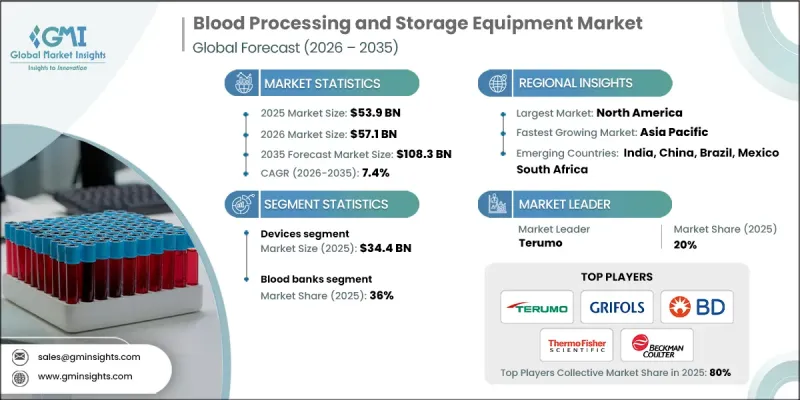
Market expansion is supported by the growing burden of chronic diseases, continuous technological progress in blood management systems, and a rising number of trauma-related emergencies requiring transfusions. Increasing awareness surrounding voluntary blood donation is also playing a critical role in shaping industry growth. Government-led initiatives, healthcare campaigns, and nonprofit programs are strengthening donation networks worldwide, resulting in higher blood collection volumes. This surge in collection requires reliable infrastructure, including advanced refrigeration systems, plasma storage units, ultralow temperature freezers, and supporting consumables to maintain product integrity. Modern equipment enables healthcare facilities to preserve blood quality, streamline inventory management, and minimize product loss. As global healthcare systems prioritize transfusion safety and operational efficiency, investments in advanced blood processing and storage technologies are accelerating, reinforcing the development of scalable and compliant blood management frameworks across hospitals and collection centers.
| Market Scope | |
|---|---|
| Start Year | 2025 |
| Forecast Year | 2026-2035 |
| Start Value | $53.9 Billion |
| Forecast Value | $108.3 Billion |
| CAGR | 7.4% |
Blood processing and storage equipment comprises specialized medical technologies designed to collect, separate, analyze, preserve, and manage blood and its components under tightly regulated temperature and safety parameters. These systems include centrifugation units, controlled refrigeration systems, deep freezers, filtration platforms, and related handling technologies that ensure sterility, prevent contamination, and maintain product viability for transfusion purposes. Precision temperature control and monitoring capabilities are essential to uphold clinical standards and extend shelf life while meeting regulatory compliance requirements.
The devices segment generated USD 34.4 billion in 2025, accounting for a 63.8% share. This category includes high-performance systems engineered for blood collection, separation, preservation, and monitoring. Equipment such as plasma storage units, blood bank refrigeration systems, laboratory-grade freezers, ultralow temperature systems, shock freezing units, blood grouping analyzers, warming systems, hematocrit centrifuges, and automated cell processors form the backbone of transfusion services. These devices safeguard blood quality throughout processing and storage cycles while meeting stringent safety benchmarks. Growing demand from hospitals, diagnostic laboratories, and blood collection centers continues to drive investments in technologically advanced and energy-efficient device platforms.
The blood banks segment held a 36% share in 2025, reflecting its central role in transfusion medicine. Blood banks function as primary hubs for the collection, testing, processing, storage, and distribution of blood products. To ensure safety and compliance, these facilities depend on advanced refrigeration systems, plasma preservation units, ultralow temperature storage solutions, and specialized centrifugation technologies. Rising surgical volumes, emergency care requirements, and chronic disease management programs are increasing demand for blood components, prompting blood banks to expand infrastructure and adopt next-generation storage systems capable of maintaining strict environmental control standards.
North America Blood Processing and Storage Equipment Market held 40.5% share in 2025, supported by its advanced healthcare infrastructure and rapid technology adoption. The region benefits from strong regulatory frameworks, well-established transfusion networks, and sustained investment in medical innovation. Continuous demand for transfusion therapies and chronic disease management programs requires dependable storage and processing systems. High-performance refrigeration units, ultralow temperature freezers, cell processing technologies, and supporting consumables are essential to maintain compliance and ensure patient safety across healthcare institutions.
Key companies operating in the Global Blood Processing and Storage Equipment Market include Thermo Fisher Scientific, Inc., Beckman Coulter, Inc., Grifols, Abbott Laboratories, Becton, Dickinson and Company, Terumo, F. Hoffmann-La Roche Ltd, Bio-Rad Laboratories, Inc., Maco Pharma International GmbH, Thermogenesis Holdings, Inc., Immucor, Inc., Sigma Laborzentrifugen, Poly Medicure Ltd, and Biomerieux. Companies in the Blood Processing and Storage Equipment Market are strengthening their competitive positioning through innovation, regulatory compliance, and global expansion strategies. Leading manufacturers are investing in energy-efficient refrigeration systems, automated processing platforms, and digital monitoring solutions that enhance traceability and quality control. Strategic partnerships with hospitals and blood collection networks help expand distribution reach and ensure recurring demand. Firms are also prioritizing research and development to introduce advanced temperature monitoring technologies and integrated data management systems.
Table of Contents
Chapter 1 Methodology and Scope
- 1.1 Market scope and definition
- 1.2 Research design
- 1.2.1 Research approach
- 1.2.2 Data collection methods
- 1.3 Data mining sources
- 1.3.1 Global
- 1.3.2 Regional/Country
- 1.4 Base estimates and calculations
- 1.4.1 Base year calculation
- 1.4.2 Key trends for market estimation
- 1.5 Primary research and validation
- 1.5.1 Primary sources
- 1.6 Forecast model
- 1.7 Research assumptions and limitations
Chapter 2 Executive Summary
- 2.1 Industry 360° synopsis
- 2.2 Key market trends
- 2.2.1 Regional trends
- 2.2.2 Product trends
- 2.2.3 End use trends
- 2.3 CXO perspectives: Strategic imperatives
- 2.3.1 Key decision points for industry executives
- 2.3.2 Critical success factors for market players
- 2.4 Future outlook and strategic recommendations
Chapter 3 Industry Insights
- 3.1 Industry ecosystem analysis
- 3.2 Industry impact forces
- 3.2.1 Growth drivers
- 3.2.1.1 Increasing prevalence of chronic diseases
- 3.2.1.2 Technological advancement in blood processing and storage equipment
- 3.2.1.3 Surge in the number of road traffic accidents
- 3.2.1.4 Growing awareness regarding blood donation
- 3.2.2 Industry pitfalls and challenges
- 3.2.2.1 High cost associated with blood processing devices
- 3.2.2.2 Stringent regulatory scenario
- 3.2.3 Market opportunities
- 3.2.3.1 Increased applications in biotherapy and regenerative medicine
- 3.2.1 Growth drivers
- 3.3 Growth potential analysis
- 3.4 Regulatory landscape
- 3.4.1 North America
- 3.4.2 Europe
- 3.4.3 Asia Pacific
- 3.4.4 Latin America
- 3.4.5 Middle East and Africa
- 3.5 Technological advancements
- 3.5.1 Current technological trends
- 3.5.2 Emerging technologies
- 3.6 Pricing analysis, 2024
- 3.7 Future market trends
- 3.8 Porter's analysis
- 3.9 PESTEL analysis
Chapter 4 Competitive Landscape, 2024
- 4.1 Introduction
- 4.2 Company market share analysis
- 4.3 Company matrix analysis
- 4.4 Competitive analysis of major market players
- 4.5 Competitive positioning matrix
- 4.6 Key developments
- 4.6.1 Mergers and acquisitions
- 4.6.2 Partnerships and collaborations
- 4.6.3 New product launches
- 4.6.4 Expansion plans
Chapter 5 Market Estimates and Forecast, By Type, 2022 - 2035 ($ Mn)
- 5.1 Key trends
- 5.2 Devices
- 5.2.1 Plasma freezers
- 5.2.2 Blood bank refrigerators
- 5.2.3 Lab refrigerators
- 5.2.4 Lab freezers
- 5.2.5 Ultralow temperature freezers
- 5.2.6 Shock freezers
- 5.2.7 Grouping analyzers
- 5.2.8 Warmers
- 5.2.9 Hematocrit centrifuges
- 5.2.10 Cell processors
- 5.3 Consumables
- 5.3.1 Blood administration sets
- 5.3.2 Blood bags
- 5.3.3 Blood collection needles
- 5.3.4 Blood collection tube
- 5.3.5 Blood filters
- 5.3.6 Blood lancets
- 5.3.7 Blood grouping reagents
- 5.3.8 Blood coagulation reagents
- 5.3.9 Hematology reagents
- 5.3.10 Other consumables
Chapter 6 Market Estimates and Forecast, By End Use, 2022 - 2035 ($ Mn)
- 6.1 Key trends
- 6.2 Blood banks
- 6.3 Diagnostic laboratories
- 6.4 Hospitals & clinics
- 6.5 Other end users
Chapter 7 Market Estimates and Forecast, By Region, 2022 - 2035 ($ Mn)
- 7.1 Key trends
- 7.2 North America
- 7.2.1 U.S.
- 7.2.2 Canada
- 7.3 Europe
- 7.3.1 Germany
- 7.3.2 UK
- 7.3.3 France
- 7.3.4 Spain
- 7.3.5 Italy
- 7.3.6 Netherlands
- 7.4 Asia Pacific
- 7.4.1 China
- 7.4.2 India
- 7.4.3 Japan
- 7.4.4 Australia
- 7.4.5 South Korea
- 7.5 Latin America
- 7.5.1 Brazil
- 7.5.2 Mexico
- 7.5.3 Argentina
- 7.6 Middle East and Africa
- 7.6.1 Saudi Arabia
- 7.6.2 South Africa
- 7.6.3 UAE
Chapter 8 Company Profiles
- 8.1 Beckman Coulter, Inc.
- 8.2 Thermogenesis Holdings, Inc.
- 8.3 Maco Pharma International GmbH
- 8.4 Immucor, Inc.
- 8.5 Becton, Dickinson and Company
- 8.6 Bio-Rad Laboratories, Inc.
- 8.7 Grifols, S.A.
- 8.8 Abbott Laboratories
- 8.9 Sigma Laborzentrifugen GmbH
- 8.10 Terumo BCT, Inc.
- 8.11 Poly Medicure Ltd
- 8.12 Thermo Fisher Scientific, Inc.
- 8.13 Biomerieux
- 8.14 F. Hoffmann-La Roche Ltd